“Seven bullets, two more at point-blank range, and she’s still breathing.”
Those were the words that froze the entire room when the radio call came through. Not because anyone thought the report was wrong, but because every man who heard it understood what it meant. Somewhere in the smoking ruins of a bombed-out compound, beneath concrete dust and twisted metal, a woman the enemy had tried to erase from the world was refusing to die.
Senior Chief Marcus Garrett did not waste time asking how.
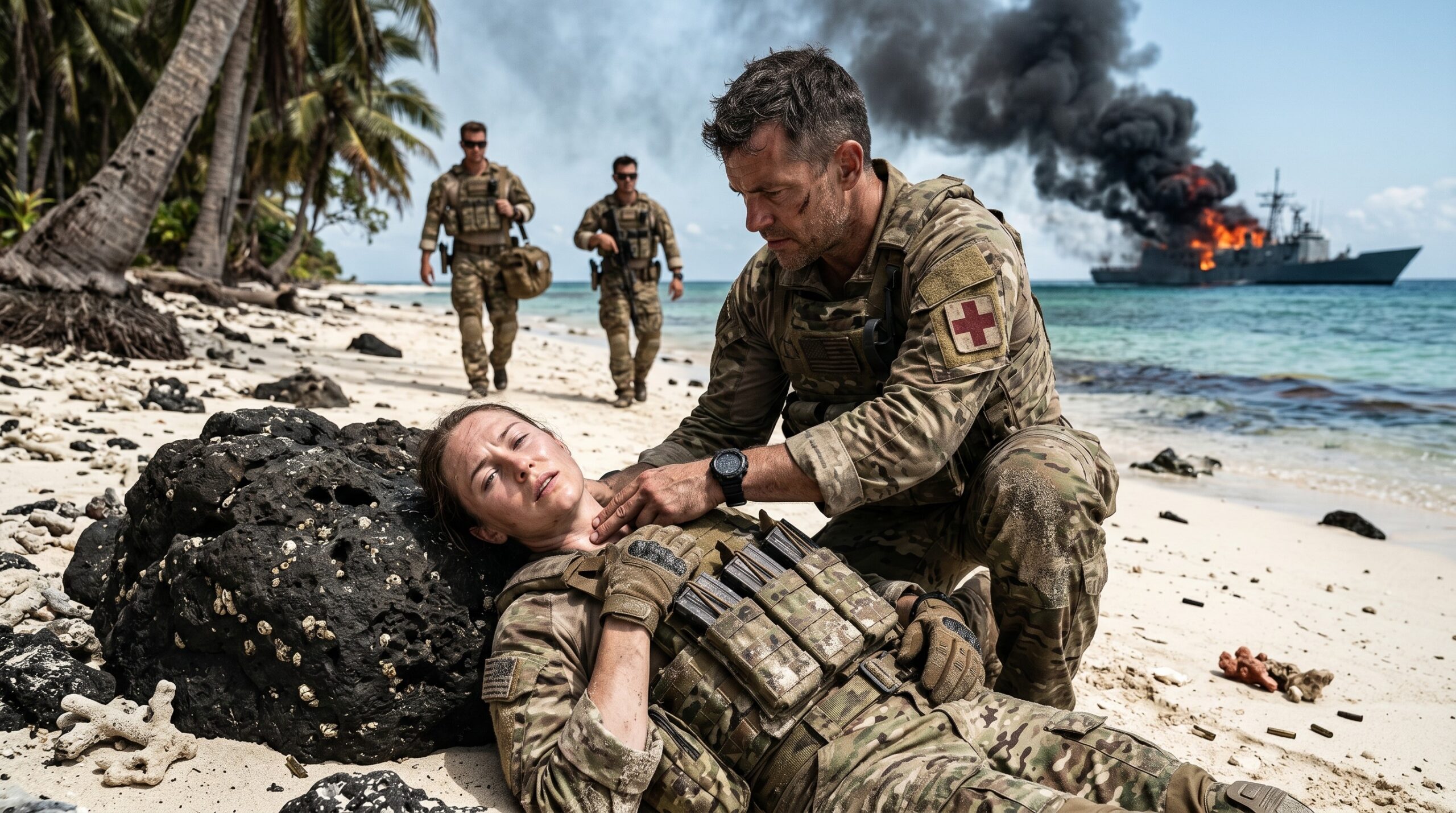
He stepped through what used to be a doorway, though doorway was too generous a word now. It was a jagged opening in a collapsed wall, with slabs of concrete hanging overhead like broken teeth. The air still shook from the strike that had ripped through the compound less than an hour earlier. Smoke crawled along the ground. Sparks hissed under broken beams. Somewhere beyond the shattered courtyard, secondary explosions popped in the dark like distant thunder.
You May Also Like
Behind him, Petty Officer Danny Kowalski cursed under his breath.
“Tell me that’s not what I think it is.”
Garrett said nothing. His boots crushed glass and stone as he moved deeper into the ruin, rifle low, eyes scanning everything. He had spent twenty-two years learning how to walk through places where death still had unfinished business. He had seen bodies hidden under rubble, men trapped inside vehicles, children pulled out of buildings that should have been empty. He did not shock easily.
Then he saw the hand.
They Slapped the Wrong Woman in a Bar — She Was the Navy SEAL Legend Nobody Knew…
A woman’s hand, pale beneath the gray dust, fingers curled slightly as if she had tried to hold on to the earth itself.
“Contact,” Garrett said, his voice flat. “Survivor. Left quadrant.”
His team moved without needing orders. Dominguez turned outward and covered the perimeter. Webb, the youngest, dropped beside Garrett as they began clearing debris. Kowalski opened his medical kit before anyone told him to.
They pulled away broken stone, rebar, a section of ceiling that had pinned her left arm. And when her face came into view, even Garrett stopped for two full seconds.
She was young. Late twenties, maybe. A Navy corpsman, or what was left of one. Her uniform was torn. Her body armor had been cracked by impacts. Her right leg was bent wrong. Blood darkened the dust around her.
Webb stared down at her and whispered, “She’s gone.”
Garrett’s head snapped toward him. “She is not gone.”
“Chief, look at her. Nobody survives this.”
“Put two fingers on her neck,” Garrett said. “Right now.”
Webb hesitated just long enough for fear to show on his face, then knelt and pressed his fingers to the side of her throat. The silence lasted too long. Kowalski stopped moving. Dominguez glanced back once, then returned his eyes to the perimeter.
Then Webb looked up.
“I’ve got a pulse.”
His voice changed when he said it. It became quiet, almost reverent.
“It’s weak, Chief, but I’ve got a pulse.”
Garrett was already on the radio. “Actual, this is Garrett. We have a survivor at grid Kilo-Seven. Female Navy medical personnel, multiple gunshot wounds, severe trauma. We need medevac on standby now.”
The reply crackled through static. “Copy, Garrett. Medevac is twenty-two minutes out. What’s her status?”
Garrett looked down at her. Her chest barely moved. Blood traced a thin red line from the corner of her mouth to her jaw. Her eyelids flickered once, as if something inside her was still fighting its way back from a place no one returned from easily.
“Critical,” he said. “We’re keeping her alive until that bird gets here.”
He clipped the radio back to his vest and pointed. “Kowalski, IV. Webb, airway. Dominguez, cover us. Nobody leaves this position until she is on that helicopter.”
Kowalski was already moving, but his voice was tight. “Chief… seven bullets.”
Garrett looked at him.
“Seven bullets and she’s still breathing,” Kowalski said.
Garrett lowered himself beside the woman and pressed gauze against the worst wound he could reach.
“That means she’s not done,” he said. “So we’re not done. Move.”
The next twenty-two minutes were not clean. They were not heroic in the way civilians imagined heroism. They were four exhausted men in a ruined compound, working in dust and darkness, hands slick with blood, trying to keep alive a woman whose body had every reason to quit.
I was supposed to fail the evaluation, but these traumatized dogs showed a room full of powerful men what loyalty looks like.
Kowalski got the IV in on the second attempt. Webb cleared her airway, jaw clenched, hands steady now because he had already made the mistake of calling her dead once and would not make it again. Garrett packed wound after wound, applying pressure, shifting, checking, commanding her in a low voice.
“Stay with me. You hear me? Stay with me. You fought too hard to leave now.”
She did not answer. She did not open her eyes. But her pulse, faint and ragged, remained.
Kowalski found the ID badge inside her torn armor.
“Reeves,” he read. “Petty Officer Sloan Reeves.”
Garrett repeated the name as if giving it back to her.
“Sloan Reeves. My name is Garrett. We are getting you home.”
Gunfire cracked somewhere north of them. Dominguez shifted silently, rifle up.
Webb glanced at Garrett. “How much longer?”
Garrett checked his watch. “Fourteen minutes.”
“She’s losing blood faster than we can replace it.”
“I know.”
“Chief—”
“I know,” Garrett said, not harshly, but with the kind of force that ended panic. “So we give her fourteen minutes. All of it. Every second.”
The helicopter came in low and hard, rotor wash blasting smoke into their faces. Garrett kept one hand on Sloan Reeves’s shoulder until the flight medics took her. He watched them lift her onto the stretcher, watched them disappear into the bird, watched the helicopter rise into the dark.
Webb stood beside him. “You think she’ll make it?”
Garrett kept his eyes on the sky long after the helicopter vanished.
“She was breathing when they took her,” he said. “That’s more than anyone expected.”
None of them knew then that Sloan Reeves’s story had begun long before those seven bullets. Long before Afghanistan. Long before the night the enemy left her in the dirt and told the darkness to finish her.
It began in western Georgia, in a small white house with three oak trees in the front yard and a long flat field behind it, where a little girl with sharp eyes fell asleep to the soft metallic sound of her father cleaning a rifle in the next room.
Her father was Dale Reeves.
Most people in Meridian County knew him as quiet, polite, a man who fixed fences, helped neighbors after storms, and never raised his voice unless a dog was about to run into the road. But in another world, the world of long-range shooters, men who spoke in yards, wind, elevation, and breath control, Dale Reeves was almost mythical.
Before Sloan was born, he had been a Marine scout sniper. He had medals in a box under the bed and memories he never opened unless they forced themselves out. He did not teach Sloan to shoot because he wanted her to become dangerous. He taught her because he believed skill was a form of safety, discipline was a form of dignity, and a person who understood a weapon was less likely to worship it.
By twelve, Sloan was hitting targets at five hundred yards. By fifteen, she was competing nationally. By sixteen, coaches were calling the house.
Her mother, Maggie Reeves, watched all of it with pride and fear in equal measure.
One night, Maggie sat on the edge of Sloan’s bed and took her daughter’s hands.
“I’m not going to tell you not to shoot,” she said. “You’re too good, and that ship has sailed. But I need you to promise me something.”
Sloan looked at her.
“I’ve watched your father live with what he did for thirty years,” Maggie said softly. “He doesn’t talk about it, but I see it. It costs, baby. It costs in ways nobody explains when they hand you the uniform and the mission.”
Sloan had seen those costs too. She had seen her father go quiet at dinner, his eyes fixed on something not in the room. She had heard the dreams he thought no one heard.
“Promise me you won’t use that gift to take a life,” Maggie said. “Use it for sport, for safety, for anything else. But not that.”
Sloan was sixteen. She had never had to choose between a promise and another person’s survival.
So she nodded.
“I promise.”
And she meant it.
At twenty-one, she joined the Navy after three years of pre-med, choosing medicine with the same focus she had once given the rifle. She became a corpsman, then a Fleet Marine Force corpsman, and quickly earned a reputation for unnatural calm under pressure. Men called her “Doc” with the kind of respect that was not handed out freely. She could start an IV in darkness, stabilize a casualty while rounds snapped overhead, and talk a terrified nineteen-year-old through shock without letting fear enter her voice.
The Arrogant Staff Sergeant Thought He Could Publicly Break the “Weak” Female Transfer—Until He Kicked Her Bag and Saw the Classified Tier-One Tattoo on Her Arm
She qualified at the top of every marksmanship course, but whenever instructors tried to talk to her about it, she redirected them.
She was there to save lives.
Not to take them.
That was what she told herself.
Then came the mission that changed everything.
Six weeks into deployment, Sloan was crouched behind a low stone wall beside a Marine named Castillo, who had taken a round through the upper thigh and was bleeding hard.
“Stay still,” she told him, pressing down with practiced hands. “It missed the femoral. You’re going to keep your leg and hate physical therapy.”
“That’s not exactly a no,” Castillo muttered.
“Castillo, I swear to God, stop moving.”
He stopped.
Gunfire was everywhere, close enough that dust jumped from the wall beside her. Sloan tuned it out the way she tuned out monitors in a field hospital. It existed. It mattered. But it was not allowed to own her attention.
Then she heard voices in the rubble to her left.
Pain. Panic. Two more men down.
“Hold pressure here,” she told Castillo, guiding his hands onto his own wound. “Do not let up.”
“Doc, where are you going?”
“Thirty seconds.”
She found Staff Sergeant Kevin Okafor pinned under a slab of concrete and Corporal James Trevino beside him with shrapnel across his face. Trevino was losing vision in one eye. Okafor could not feel his legs.
Sloan did not let the news reach her face.
“All right,” she said. “That tells me something. We’re going to work with what we know.”
For four minutes, she worked like the world had narrowed to the size of her hands. She packed Trevino’s wound. She assessed Okafor’s spine. She directed Trevino, half-blind and shaking, to push the slab just enough for her to move Okafor without destroying what remained of his chance to walk again.
She got them stable.
Then the sniper fired.
The first round hit the ground eighteen inches from her left hand. The second cracked stone from the wall behind her. The third passed through the space her head had occupied one second earlier.
Sloan dropped flat.
In the dirt, with her cheek pressed to the ground, she mapped the shot without meaning to. Elevated. Northwest. Roughly eight hundred fifty yards. Wind shifting. Darkness. Dust. Debris.
Her father’s lessons rose inside her with terrifying clarity.
She could see the consequences faster than she could feel them. Okafor and Trevino could not move. Castillo was alone and bleeding. The rest of the team was pinned. Medevac was still fourteen minutes away. The sniper had time.
All he had to do was wait.
Eight feet to Sloan’s right, partly buried in rubble, lay a bolt-action rifle that belonged to a separated teammate. She stared at it.
For eleven years, she had kept her promise.
For three seconds, she thought of her mother.
Then she whispered, “Dad, I’m sorry.”
She moved.
The sniper fired again, but the wind had shifted, and Sloan had moved on the second he needed to adjust. Her hands closed around the rifle. She rolled behind a chunk of concrete barely wide enough to cover her shoulders and brought the scope to her eye.
Her body remembered everything.
Do not rush the shot, Sloan.
Breathe the world out.
Find stillness inside the noise.
She found him, half-hidden behind the remains of an upper wall. He was good. Patient. He had the angle, the darkness, the confidence.
But he did not know who was looking back.
Sloan exhaled halfway.
The trigger broke clean.
One shot.
The sniper did not move again.
For a moment, the battlefield seemed to hold its breath.
Kowalski’s voice came over the radio. “Was that one of ours?”
Sloan’s own voice sounded distant to her.
“That was me.”
A pause.
“Doc,” Kowalski said slowly, “where did you learn to shoot like that?”
“Later,” Sloan said. “Okafor needs a spinal board the second medevac lands. Trevino needs ophthalmology. Someone get to Castillo. He’s been holding pressure for eleven minutes.”
She set the rifle down and looked at her hands.
Then she put them back to work.
The drone overhead had seen everything.
By the time the helicopters lifted the casualties out, Lieutenant Colonel Harold Brennan was watching the footage in a command room miles away. He watched it once. Then again. Then a third time.
“Run her file,” he said.+
A Sergeant Humiliated Her in the Mess Hall —Then Her Navy SEAL Dragon Tattoo Froze the Military Base…
The analyst beside him typed quickly. “Petty Officer Sloan Reeves. Fleet Marine Force corpsman. Medical record outstanding. Marksmanship scores…” The analyst stopped.
Brennan looked over. “What?”
“Her father was Dale Reeves.”
Brennan leaned closer to the screen.
“Get me everything.”
Sloan did not know any of that yet. She was too busy keeping men alive and not thinking about the fact that she had just killed one.
At 0400, the debrief took place in a room that smelled like burnt coffee and dry erase markers. Garrett walked through the timeline, the casualties, the tactical decisions. Then he stopped at the moment everyone had been waiting for.
“Reeves,” he said. “Walk me through the sniper contact.”
The room went still.
She sat at the end of the table, hands folded, coffee untouched.
“The sniper had direct line of sight to Okafor and Trevino,” she said. “They were immobile. Medevac was fourteen minutes out. I assessed that he would kill them before extraction if the threat was not addressed.”
“And you addressed it.”
“Yes.”
“From eight hundred sixty-three yards. In the dark. With a rifle that was not yours.”
“Yes.”
No one spoke for four seconds.
Kowalski leaned forward. “Doc, where did you learn to shoot like that?”
“My father taught me.”
“Who’s your father?” Webb asked.
Sloan looked at him.
“Dale Reeves.”
The name landed heavily. Garrett knew it. Kowalski did too. They exchanged a look.
Garrett closed the topic. “For the record, what you did saved at least three lives. You’re off rotation for seventy-two hours. Get sleep.”
She stood.
At the door, Garrett said, “Reeves.”
She stopped.
“Are you all right?”
For the first time all night, she let herself consider the question.
“I don’t know yet,” she said.
Garrett nodded. “Honest answer.”
She did not sleep. She sat on the edge of her bunk in the gray light before dawn and stared at her hands. They were the same hands that had started IVs, packed wounds, set bones, and held young men together while they begged not to die. She had built her life around saving people.
Now those same hands had taken a life.
She knew it had been necessary. She knew she would do it again. She knew three men were alive because of it.
None of that made the weight disappear.
The next morning, Webb appeared in the doorway.
“Colonel Brennan is here,” he said. “Asking for you.”
Brennan was waiting in the command room with Garrett and an analyst. He had the posture of a man who had already made a decision.
“I watched the drone footage eleven times,” Brennan said. “A Navy corpsman under fire provided trauma care to multiple casualties and neutralized a trained enemy sniper at eight hundred sixty-three yards with one round from an unfamiliar weapon. Is any part of that inaccurate?”
“No, sir.”
“Your deployment designation is medical support.”
“Yes, sir.”
“You are not cleared for direct action.”
“No, sir.”
“From a paperwork standpoint, last night is complicated.”
Sloan said nothing.
Brennan studied her. “Tell me about your father.”
She did not blink. “What would you like to know?”
“How long did he train you?”
“Since I was eight. Seriously, since twelve.”
“Maximum distance?”
“Fourteen hundred meters in competition.”
Brennan nodded. “You made a promise to your mother, didn’t you?”
That surprised her, though she did not let it show.
“Yes.”
“And last night?”
“Last night I had three immobile casualties, a sniper with line of sight, and fourteen minutes until medevac.” She looked him in the eye. “I made a decision. I would make the same decision again.”
“I know,” Brennan said.
He slid a paper across the table. It was an assessment request for a joint program, one designed to combine medical expertise and specialized overwatch support. He believed Sloan represented a capability that had been missing because the military had always treated those skills as separate.
A Fourth Grade Teacher Humiliated an 82-Year-Old Veteran in Front of His Granddaughter — But He Didn’t Know the “Confused Old Man” Was Roger “The Reaper” Clayton, a Living Legend in Red Tweed…
Sloan did not touch the paper.
“Sir,” she said carefully, “I am a medic. That is not a cover story. It is what I chose.”
“I’m not asking you to stop being a medic,” Brennan said. “I’m asking you to stop pretending that what you are is only half of what it actually is.”
She looked down at the paper.
“I’m not signing anything today.”
For the first time, Brennan almost smiled. “Fair enough.”
During her stand-down, Sloan called her mother.
The phone rang four times before Maggie answered.
“Baby?”
That one word nearly broke Sloan.
“Mom,” she said, sitting with her back against the medical bay wall in the cold before sunrise, “I need to tell you something. I broke my promise.”
The silence that followed felt endless.
Then Maggie said quietly, “Tell me.”
So Sloan told her what she could. Not locations. Not names she could not share. But the shape of it. The wounded men. The sniper. The rifle in the rubble. The shot.
When she finished, Maggie was quiet.
“Are you all right?” she asked.
“I don’t know yet.”
“That’s honest.”
“It feels like I did the right thing,” Sloan said slowly. “And like doing the right thing cost exactly as much as you said it would.”
Maggie drew a shaky breath.
“That is almost exactly what your father said the first time he talked to me about it.”
Sloan closed her eyes.
“I’m not angry,” Maggie said. “You saved those men. You saved them with medicine, and then you saved them again with a rifle. I don’t think I have the right to put my fear above their lives.”
“I know you wanted me not to carry what Dad carries.”
“I did,” Maggie whispered. “But fear is not always wisdom. Come home safe. That is the only promise I need from you now.”
Sloan held the phone long after the call ended.
For the first time since the shot, the world felt survivable.
Four hours later, Garrett’s voice came over the radio.
“Reeves.”
One word. Serious voice.
Stand-down was over.
The next mission came fast. The compound they had struck had been only one node in a larger network. Leadership was gathering at a secondary location, but the window to capture them was closing. The objective was not a strike. They needed one senior figure alive.
The approach, however, was covered by an elevated position.
Brennan explained it over secure video. “We need someone on overwatch who can neutralize that position if it activates. We also need that person capable of providing trauma care if the approach goes wrong. I won’t pretend we have anyone else who does both.”
Sloan understood the math before he finished.
“If I’m on overwatch, I can’t be with the team when casualties happen.”
“Harlo has combat medical training,” Garrett said.
“Not mine.”
“No,” Garrett admitted. “Not yours.”
She was silent for four seconds.
Then she nodded. “I’m in.”
They were airborne within forty minutes.
On the helicopter, Sloan sat with her eyes closed, running two checklists in her mind. Medical first. Always. Tourniquets, airway, IV, wound packing, casualty sequence. Then the other checklist. Distance, wind, elevation, breathing, trigger discipline.
Dominguez watched her from across the cargo bay.
“You look different than you did six weeks ago,” he said.
“Six weeks ago, I hadn’t been shot at fourteen times.”
“Fair.”
After a moment, he said, “You okay with the shot?”
“I’m doing what I need to do,” she said. “The okay part is still in progress.”
Dominguez nodded. “My first one, I didn’t sleep for four days. Not because it was wrong. Because even when it’s right, it takes something from you that doesn’t come back. You build around the space.”
“Does it get easier?”
He thought about it. “The second is easier than the first. Not because you care less. Because you understand better what you’re carrying.”
She absorbed that.
“Thank you,” she said.
They landed two kilometers from the target. At the final halt, Garrett moved close.
“Overwatch position is two hundred meters at your two o’clock. Eight minutes before we initiate. If that elevated position activates, you take it. If not, hold until my signal.”
“Copy.”
Garrett held her gaze. “Trust yourself.”
She moved alone.
At 1409, Garrett’s voice came through. “Initiating.”
At 1411, the elevated position activated.
Sloan saw the movement before the muzzle flash. The shooter was tracking the team’s approach, efficient and patient. He had not accounted for her angle because her angle should not have had a shooter in it.
His threat model was wrong by exactly the amount she needed.
She settled.
One shot.
“Position neutralized,” she said.
“Copy,” Garrett replied.
Eleven minutes later, everything changed.
Harlo’s voice cracked over the radio. “Doc, I need you in here now. Garrett is down.”
Sloan was already moving.
She crossed the two hundred meters like distance had become irrelevant, entered the structure, followed Harlo’s voice through three rooms, and found Garrett on the floor, conscious, jaw locked against pain. Harlo had pressure on his left side, his face showing the edge of his training.
“Talk to me,” Sloan said, dropping beside Garrett.
“Left side,” Garrett said. “Plate took it. Didn’t love it.”
“Your vest cracked and transferred impact.” Her fingers moved, assessing. “Other injuries?”
“Left arm. Shrapnel.”
She checked it. Deep, ugly, close to arterial, but not the immediate threat.
“Harlo, IV. Right arm. I’ll guide you.”
“I haven’t—”
“I know. Pick up the kit.”
She talked him through it while assessing Garrett’s ribs. Two fractures, likely. The question was whether his lung was intact.
“Breathe for me,” she said.
He breathed.
Again.
She listened, hand on his chest.
“Lung’s holding,” she said. “You have two fractured ribs. That can change if you do something stupid.”
“I understand.”
“The arm needs sutures but won’t kill you in the next twenty minutes. The mission?”
“Dominguez has it,” she said. “You have me. Stay still.”
He stayed still.
“You know,” Garrett said after a moment, “this is the second time my survival has been largely in your hands.”
“That’s true.”
“I’m starting to think you’re good luck.”
She taped his side. “You think I’m good luck because you keep surviving. That’s called survivorship bias.”
He laughed once, regretted it immediately, and grimaced. “Fair point, Doc.”
They Thought She Was Dead – Until She And K9 Walked Onto Base Carrying 3 Wounded SEALs
The primary objective was secured. Garrett was evacuated. Sloan rode with him, monitoring his breathing all the way back.
“You’re different,” he said during the flight.
“Good or bad?”
“Neither. Bigger. You arrived trying to be one thing. You’re leaving as a bigger version of it.”
She did not know how to answer.
Later, outside the trauma bay, Brennan found her.
“I watched the overwatch footage,” he said. “Nine hundred eleven yards. Moving target. Less than three seconds from activation to neutralization. Then you managed Garrett’s trauma twenty minutes later. That combination does not exist in our pipeline.”
“I’m not trying to be a weapon,” Sloan said.
“I know,” Brennan replied. “That’s why this matters. The rifle and the medicine are not enemies inside you. They are both tools in service of the same decision: who gets to live.”
That sentence stayed with her.
Weeks later, after formal reviews, medical reports, and conversations she could not discuss outside secure rooms, Sloan accepted a role helping shape the program Brennan had described. Not as a symbol. Not as a legend. As a teacher, whether she liked the word or not.
“You talked a barely trained operator through an IV while managing a senior chief’s trauma under fire,” Brennan told her. “That is teaching.”
She had no answer to that.
When she returned to the United States in early November, Maggie Reeves was waiting at the bottom of the jetway stairs. Sloan saw her mother and the tears she had held back for weeks arrived all at once.
Maggie opened her arms.
Sloan walked into them.
“I’ve got you,” Maggie whispered into her hair. “I’ve got you.”
Dale Reeves waited beside the car, hands in his jacket pockets, wearing the expression Sloan knew from childhood: the look of a man feeling something too large for language.
He hugged her hard.
“You’re okay,” he said.
“I’m okay, Dad.”
He stepped back and looked at her, not as a father studying the child he almost lost, but as one person recognizing another in the full truth of who she had become.
“When you’re ready,” he said, “I want to hear all of it. Whatever you can tell me.”
“I want to tell you,” Sloan said.
They drove home through familiar Georgia roads in the soft silence of people who did not need to fill every space. The three oak trees were still in the yard. The long field still stretched behind the house. The world she had left was still there, but she was not the same woman who had left it.
That night, after dinner, Dale took two mugs of coffee to the back porch. Sloan followed him.
For a while, they watched the field turn dark.
“I used to think the hard part was the shot,” Dale said finally. “It isn’t.”
Sloan looked at him.
“The hard part is what you do afterward,” he said. “Whether you become smaller because of it, or whether you make room for the truth and keep living.”
“I don’t know how yet.”
“No,” he said. “Nobody does at first.”
She held the mug between both hands.
“I saved them,” she said.
“I know.”
“And I killed him.”
“I know.”
“Both are true.”
Dale nodded. “That’s the part that hurts.”
For the first time, Sloan did not turn away from the hurt. She let it sit beside her on the porch, under the Georgia night, with her father breathing quietly next to her and her mother moving around in the kitchen behind them.
Months later, Garrett visited the training facility where Sloan had begun shaping the new program. He had healed well, though he complained about his ribs in exactly the tone of a man who wanted everyone to know he was pretending not to complain.
He watched Sloan instruct a group of candidates through a trauma scenario that turned into a precision overwatch problem without warning. Most failed the first time. Some failed loudly. Sloan did not yell. She reset them, asked questions, made them think, made them understand that the point was not the rifle and not the medicine alone.
The point was judgment.
Afterward, Garrett stood beside her at the edge of the range.
“You built something,” he said.
“We’re building it.”
“No,” he said. “You built something first. In yourself. This is just the version other people can see.”
She looked out at the candidates resetting the lane.
“Do you ever think about that night?” she asked.
“The night we found you?”
“Yes.”
Garrett was quiet for a moment.
“I think about Webb saying you were gone,” he said. “And I think about your pulse under his fingers. Weak as hell, but there. I think about how close the world came to losing everything you were going to become.”
Sloan swallowed.
“And I think,” Garrett continued, “that some people survive because they’re lucky. Some survive because someone else refuses to let them go. And some survive because there is work waiting for them that only they can do.”
She looked at him. “Which one was I?”
Garrett smiled slightly.
“All three.”
Sloan turned back toward the range.
In time, people would tell the story many ways. They would talk about the seven bullets. They would talk about the miracle pulse. They would talk about the impossible shots, the medic who could do what trained snipers struggled to do, the woman the enemy left for dead who came home and changed the way soldiers were trained to save each other.
Most of those stories would miss the quietest part.
The miracle was not only that Sloan Reeves survived.
It was that she survived without becoming less human.
She carried the cost. She never pretended otherwise. She remembered the promise she had broken and the lives she had saved by breaking it. She remembered the men on the ground, the helicopter blades, Garrett’s hand on her shoulder, her mother’s voice on the phone, her father beside her in the dark.
And every time a young medic picked up a rifle in her training lane with fear and conflict in their eyes, Sloan would step beside them and speak in the calm voice that had carried men through pain, panic, and war.
“You are not here to become cruel,” she would say. “You are not here to worship the weapon. You are here to understand responsibility. Medicine is responsibility. A rifle is responsibility. The moment is responsibility. And if the day ever comes when you must choose, you choose life. Every time, as much life as you can save.”
Then she would step back and let them breathe.
Because her father had been right.
You breathe the world out.
You find the stillness inside the noise.
And then, only when you are certain, you act.
THE END