Title: “Beauty at Mach 2: The Blackcat Divide — When ‘Ugly’ Becomes Untouchable”
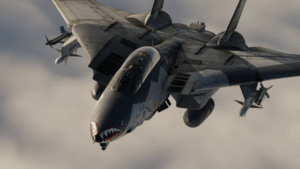
The hangar didn’t just open — it revealed something that felt like it didn’t belong to the present.
You May Also Like

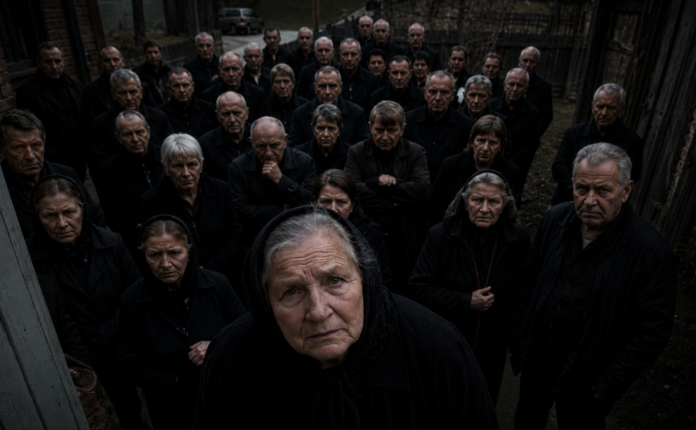

Floodlights flickered on one by one, casting long shadows across the concrete floor. And there it stood.
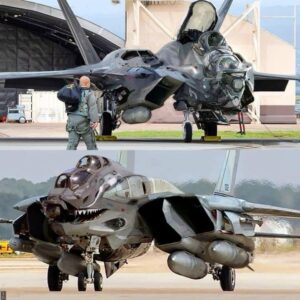
The F/A-44A/B Blackcat, unofficially dubbed the F-34 “Thiccat.”
It didn’t glide into your imagination the way traditional fighters did. It didn’t look like speed. It didn’t look like grace.
It looked… wrong.
“I’m sorry—but that thing looks like it was designed by an argument.”
Marcus let out a low whistle.
“Where’s the elegance? Where’s the clean lines? Fighters are supposed to look like… like predators. This looks like—”
“—like something that already won the fight,” Elena interrupted.
Marcus turned. “No. It looks like something that ate the predator and forgot to digest it.”
A few people chuckled.
But Elena didn’t.
“You’re judging it by old rules.”
Elena stepped closer to the aircraft, her hand hovering just inches from its matte, almost light-absorbing surface.
“You’re still thinking in terms of aerodynamics from twenty years ago. Speed, maneuverability, visual intimidation.”
She glanced back.
“The Blackcat doesn’t care about any of that.”
“Then what does it care about?”
Lila Chen folded her arms. “Because from where I’m standing, it looks like a flying compromise.”
Jace Rowan, leaning quietly against a crate, finally spoke.
“It cares about surviving first contact.”
The Room Pauses
Marcus frowned. “Every fighter cares about that.”
Jace shook his head slowly.
“No,” he said. “Most fighters hope to survive first contact. The Blackcat assumes it will.”
“That’s arrogance.”
“That’s design,” Elena corrected.
She pointed toward the aircraft’s oddly contoured fuselage.
“You see bulk. I see layered redundancy. Triple-channel flight control systems. Distributed avionics. No single point of failure.”
Lila tilted her head. “And triple the maintenance problems.”
The Negative Side Gains Momentum
“Let’s talk reality,” Lila continued, pacing now.
“This aircraft weighs significantly more than its competitors in the same class. It has more internal systems than necessary, and its thermal profile—”
“—is controlled,” Elena cut in.
“—is managed, not controlled,” Lila snapped back.
“And that’s a difference that matters in combat.”
Marcus nodded. “Exactly. You can’t just stack systems and call it innovation.”
“It’s not stacking. It’s layering intelligence.”
Elena’s voice sharpened.
“The Blackcat isn’t just an aircraft. It’s a multi-domain combat node. It processes battlefield data in real time—air, ground, electronic, even cyber.”
Marcus blinked. “Cyber?”
Jace smirked. “You ever had your targeting system lie to you mid-flight?”
Marcus hesitated.
“No.”
Jace shrugged. “Good. Because the pilots who went up against the Blackcat in simulations have.”
“Simulations aren’t reality.”
Lila’s tone was firm.
“They’re controlled environments. Predictable variables.”
Jace pushed off the crate.
“Then explain this.”
The Story That Changed Everything
“There was a joint exercise,” Jace began.
“Advanced fighters. Experienced pilots. Clean environment. No tricks.”
Marcus leaned in slightly despite himself.
“Six aircraft versus one Blackcat.”
Lila crossed her arms. “And?”
Jace’s expression didn’t change.
“The Blackcat didn’t fire a single conventional weapon.”
“What does that even mean?”
“It means,” Jace said slowly, “that by the time the engagement started, the other pilots were already fighting a battle they couldn’t see.”
Silence Thickens
“Elaborate,” Lila demanded.
Jace nodded.
“The Blackcat initiated electromagnetic spectrum dominance within seconds. It didn’t just jam signals—it restructured them.”
Marcus frowned. “That sounds like science fiction.”
Elena smiled faintly. “It’s not.”
“It made them see ghosts.”
Jace continued.
“False targets. Phantom heat signatures. Misleading velocity vectors. One pilot locked onto what he thought was the Blackcat…”
He paused.
“It was empty sky.”
“That’s deception warfare.”
“That’s survival,” Elena replied.
The Argument Intensifies
“So it cheats,” Marcus said bluntly.
Jace laughed.
“In combat, that’s called winning.”
“You’re avoiding the real issue.”
Lila stepped forward again.
“All of this depends on systems. Advanced systems. Fragile systems.”
She pointed at the aircraft.
“What happens when something fails?”
Elena Didn’t Hesitate
“It doesn’t.”
Marcus rolled his eyes. “Everything fails.”
Elena nodded. “Exactly. That’s why the Blackcat is designed to fail gracefully.”
“Explain that.”
“It reroutes.”
She gestured to the midsection.
“Power, data, control authority—everything can be redistributed in milliseconds. Damage one system, another compensates. Damage two, it adapts. Damage three…”
She paused.
“It still fights.”
“At what point does it stop being efficient?”
“At the point where efficiency costs you your life,” Jace said.
A New Voice Joins
From the back of the hangar, an older man stepped forward. Gray-haired, quiet, observant.
“You’re all arguing about appearance like it matters.”
Marcus sighed. “Here we go.”
The man ignored him.
“Do you know why it looks like that?”
No One Answered
“Because we stopped designing for beauty,” he said, “and started designing for inevitability.”
“That’s a dramatic way to justify bad aesthetics.”
Marcus smirked.
The man smiled faintly.
“Is it?”
The Scientific Reality Unfolds
He pointed toward the aircraft’s intakes.
“Those shapes aren’t random. They’re tuned to disrupt radar wave coherence across multiple bands.”
Elena nodded. “Multi-spectrum stealth.”
Lila frowned. “At the cost of aerodynamic purity.”
“Purity is overrated.”
Jace stepped forward again.
“You know what matters more than clean airflow?”
He looked directly at Marcus.
“Not being seen.”
“Speed still matters.”
Marcus pushed back.
“You can’t ignore physics.”
“We didn’t ignore it.”
Elena’s eyes lit up slightly.
“We redefined how to use it.”
“How?”
“The Blackcat uses boundary-layer control techniques combined with thrust vectoring to compensate for its unconventional shape.”
Marcus blinked. “So it forces the air to behave differently?”
Elena nodded.
“Exactly.”
The Shift in Perspective
Marcus looked back at the aircraft.
For the first time, he didn’t immediately dismiss it.
“And the nickname?”
He asked quietly.
“‘Thiccat.’”
Jace grinned.
“Yeah. Pilots started that.”
“As an insult?”
“At first.”
Jace shrugged.
“Then they flew it.”
“And?”
“They stopped laughing.”
The Final Clash
Lila wasn’t convinced.
“You’re all ignoring the cost. The complexity. The risk.”
“No,” Elena said softly.
“We’re accepting it.”
“Why?”
Jace answered
“Because the battlefield changed.”
The Last Word
The engines of the Blackcat began to hum, a low, almost unnatural vibration filling the hangar.
It didn’t sound like power.
It sounded like control.
Marcus watched as heat shimmered around the aircraft’s surface.
“Still ugly,” he muttered.
Elena smiled
“Maybe.”
Jace put on his helmet
“But when it’s above you,” he said,
“You won’t care what it looks like.”
Final Line
As the F/A-44A/B Blackcat lifted off the ground with quiet, unsettling precision, one truth settled over everyone watching:
The future of air combat wasn’t designed to be admired.
It was designed to be undefeated.