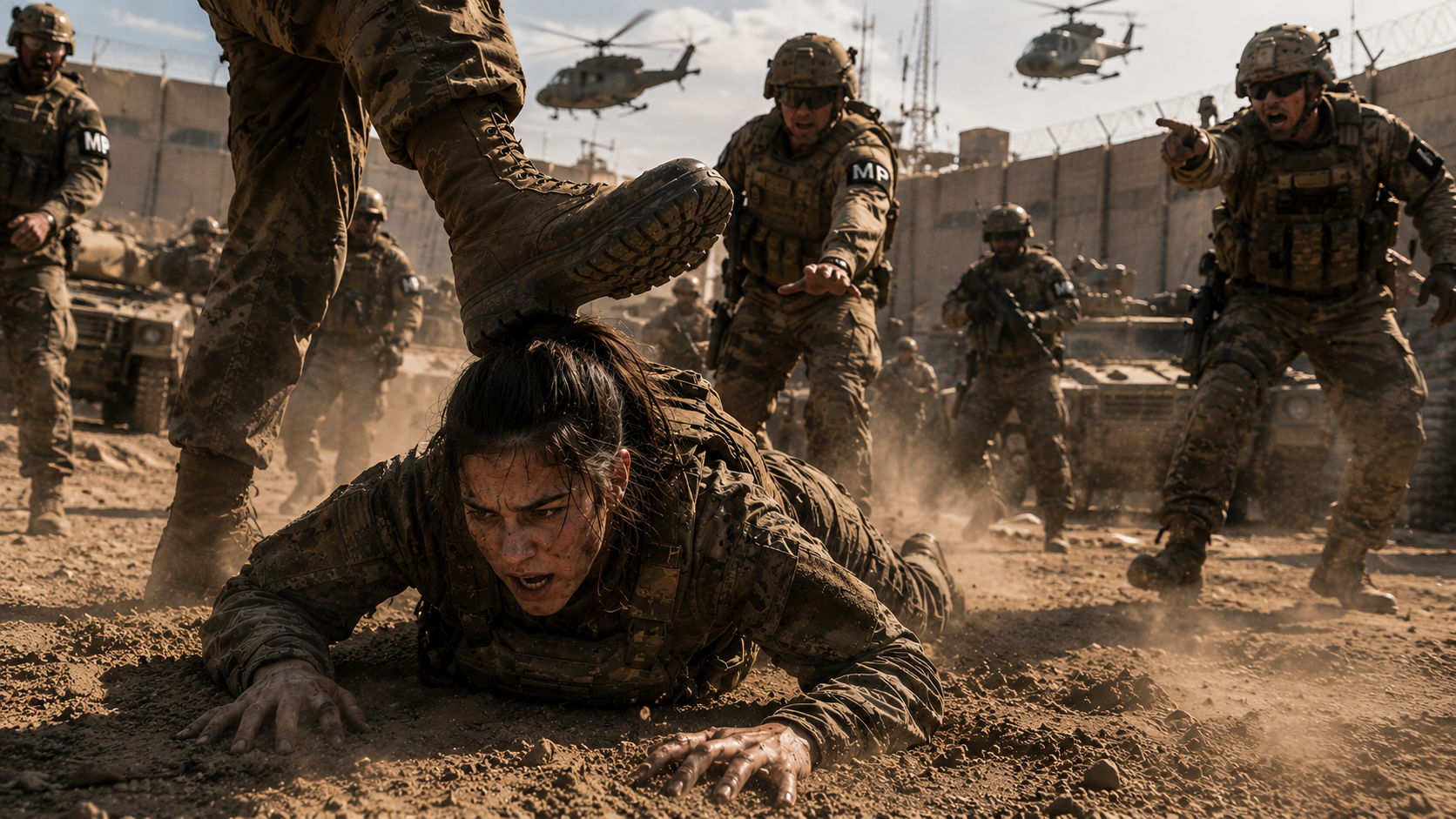
Silence. Then, a static hiss. “Negative, Commander. I have the shot. Going vertical,” Captain Reeves’ arrogant voice crackled back.
He was completely ignoring my direct order during a multi-million-dollar live combat simulation.
“Reeves, abort! That’s a trap!” I commanded, my fists clenching. But the digital token representing his F/A-18 Super Hornet kept climbing, straight into the kill zone. Two seconds later, a harsh tone echoed through the briefing room. He was dead. Simulated, but dead.
You May Also Like
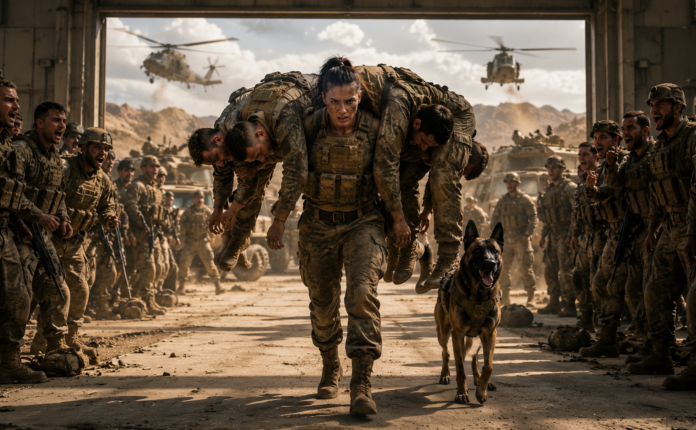
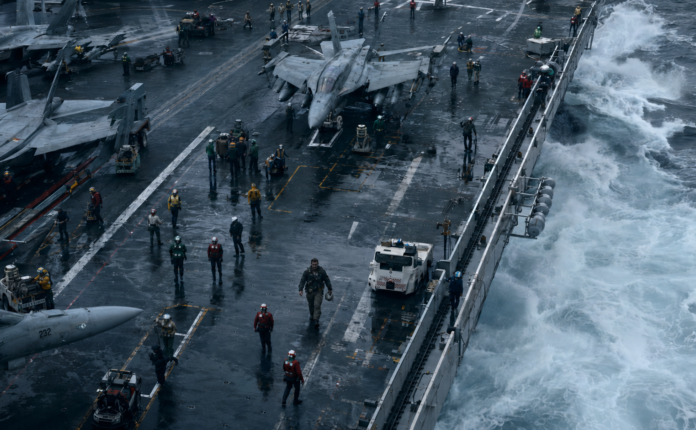
I pulled off my headset, my heart hammering against my ribs. I am Commander Elena Vega. At thirty-nine, I am the commanding officer of Squadron 7. Twenty-two years ago, I walked into a recruiting office as a naive eighteen-year-old and enlisted at the absolute bottom—an Airman Basic. I earned every single stripe and silver oak leaf on my shoulders through sheer grit. But to Reeves and his tight-knit clique of male fighter pilots, I wasn’t a veteran who crawled her way up. To them, my O-5 rank was just a diversity box checked by a Pentagon committee.
The simulator bay doors slid open, and Reeves walked out, sweating but wearing a smug grin. He didn’t even bother to salute.
“Bad luck, ma’am,” he shrugged, his voice dripping with condescension. “The software must be glitched. In the real sky, I make that kill.”
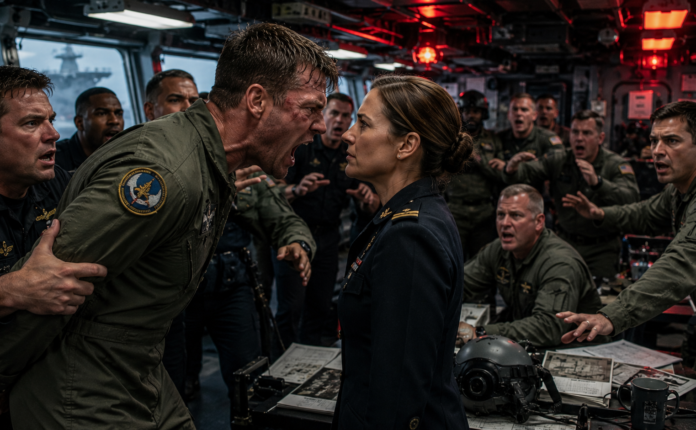
“You defied a direct order, Captain,” I said, my voice dangerously calm, stepping into his space. The entire room went dead silent. The tension was suffocating. The other pilots watched, smirking, waiting to see if their new female commander would break.
“With all due respect, Commander,” Reeves scoffed, leaning in, “some of us fly by instinct, not by administrative checklists. Maybe the view is different from a desk.”
It was a blatant, career-ending challenge to my authority. Before I could utter a single word, the heavy double doors of the command center banged open. The watch officer yelled, “Attention on deck!”
My breath caught. Marching into the room was Admiral Greer—a four-star O-8 powerhouse who held my entire future in his hands, and his face was unreadable.
Reeves thought he could break my command in front of everyone, but he forgot who was watching from the shadows. The Admiral’s sudden entry is about to change the entire game on this base. The rest of the story is below 👇
The heavy silence in the room was suffocating as Admiral Greer’s polished boots clicked against the linoleum. Every pilot stood frozen at attention, eyes locked straight ahead, though I could see Reeves out of the corner of my eye, his jaw clenched, expecting the Admiral to tear into me for losing control of my room.
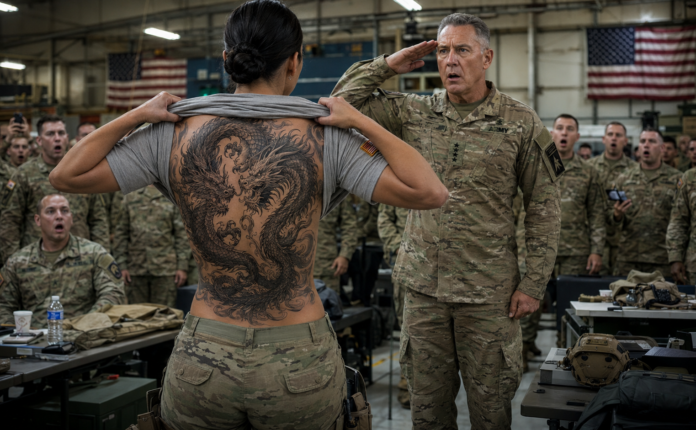
Instead, the four-star Admiral marched straight past Reeves, stopped exactly two paces in front of my desk, and snapped an immaculate, rigid salute.
“Permission to begin, Commander Vega,” Admiral Greer said, his booming voice echoing off the concrete walls.
A collective, audible gasp rippled through the briefing room. An O-8 flag officer saluting an O-5 commander before a briefing wasn’t just unusual—it was a calculated, thunderous statement. By asking my permission to speak in my own house, Greer had just shattered Reeves’ entire narrative. He wasn’t here to rescue them from a “diversity hire.” He was here to show them that my authority was backed by the absolute highest echelons of the United States Navy.
“Permission granted, Admiral,” I replied, returning the salute with textbook precision.
The briefing proceeded in absolute, terrified silence. Reeves didn’t utter another word. But a salute doesn’t magically earn a pilot’s respect; it only commands their compliance.
After the briefing, Greer stayed behind, accompanied by Senior Chief Briggs, a battle-hardened veteran who had been my mentor since my days as an Airman Basic.
“You’re leading elite fighters, Vega, not running a popularity contest,” Greer said, leaning against the projector table. “Stop waiting for their approval. Establish the standard, and make them bleed to meet it.”
Briggs nodded, his weathered face deadpan. “Respect in this Navy isn’t given because of a badge, ma’am. It’s extracted through discipline. Tighten the screws.”
Their words rewired my brain. I had spent months trying to prove I belonged through kindness and patience. That ended today.
The next morning, during the pre-flight brief for our upcoming deployment, Captain Wyatt—Reeves’ closest ally—stumbled through his emergency procedure checklist, clearly unprepared. In the past, I would have given him a warning.
“Sit down, Wyatt,” I cut him off coldly. “You’re grounded. Effective immediately. Hand your flight logs to the duty officer.”
“Ma’am?” Wyatt stammered, his face turning pale. “The joint exercise starts tomorrow!”
“And you’ll be watching it from the hangar,” I snapped. “You too, Miller, and Davis. Your mission briefs are sloppy. If you can’t survive the briefing room, you won’t survive the sky. Dismissed.”
The room was paralyzed. By grounding three of Reeves’ boys, I had crippled his flight rotation, but I had also sent a shockwave through the entire squadron. The boys’ club was officially dismantled.
Two weeks later, we were deployed over the turbulent waters of the Pacific for a massive, multi-national joint exercise. I was stationed in the Combat Direction Center (CDC) of the supercarrier, acting as the primary Joint Airspace Coordinator. Hundreds of live blips tracked across my master screen—Air Force, Navy, and allied international jets operating in a tightly choreographed dance.
Then, the real nightmare began.
The weather deteriorated into a freak, violent tempest faster than our meteorologists predicted. Winds screamed at seventy knots, and visibility dropped to near zero. Amidst the chaos, a piercing alarm blared on my console.
“Commander! We have a catastrophic system failure on Falcon 1-2!” the radar operator shouted.
My eyes flew to the screen. Falcon 1-2 was an allied fighter jet from a partner nation. Its transponder was blinking erratically, losing altitude rapidly.
“Falcon 1-2, this is Coordinator Vega, report status!” I commanded into my headset.
Static, followed by a panicked, foreign voice. “Controls unresponsive… engine fire… ejecting, ejecting—”
The signal went dead. An allied pilot had just ejected into a raging, black ocean in the middle of a typhoon. Because of the grounded pilots, our designated rescue escort rotation was completely fractured. And the closest functional jet in the immediate sector, the only one with enough fuel to locate the crash site before the pilot drowned?
It was Captain Reeves.
“Vega,” the watch captain whispered, panic bleeding into his voice. “If we send Reeves into that storm, we might lose him too. And if you order him to stay, that allied pilot dies. What’s the call?”
I stared at the blinking red distress icon, knowing that whatever I decided next could end my career—or cost a man his life.
If you’ve read this far, don’t hesitate to leave a like and comment before reading part 3. It makes us as happy as reading a complete story! Thank you. 👍❤️
I didn’t hesitate. In the high-stakes world of naval aviation, hesitation is measured in body bags.
“Reeves, this is Commander Vega,” I barked into the radio, my voice slicing through the tense static of the Combat Direction Center. “You are diverting to vector two-four-zero immediately. You have a downed allied pilot in the water. You are his only lifeline.”
A long, agonizing pause stretched over the comms, filled only with the terrifying roar of the typhoon in the background. “Commander, my radar is completely blind down here,” Reeves’ voice crackled back, the usual arrogance entirely replaced by raw fear. “The wind is throwing my bird around like a piece of paper. Flying into that cell is suicide.”
“I am your eyes, Captain,” I replied instantly, my hands already flying across the digital console, calculating fuel burn rates, wind shear vectors, and massive wave heights with absolute, cold precision. “Trust my numbers. Drop your altitude to five thousand feet, adjust your heading to two-four-five, and you will skirt the edge of the storm’s most lethal cell. Do you copy?”
For three breathless seconds, the line was dead. Then, Reeves responded, his tone stripped of all defiance. “Copy, Commander. Trusting your numbers. Heading two-four-five.”
What followed was the most grueling forty-five minutes of my entire twenty-two-year career. I completely transformed into a human computer, processing complex data streams in real-time, redirecting a Navy search-and-rescue helicopter along a razor-thin corridor of safe airspace that I mapped out second by second. I could feel the intense gaze of every senior officer in the room burning into my back. If my math was off by even a single fraction of a degree, Reeves would crash, and two pilots would be swallowed by the Pacific.
“Visual contact!” Reeves suddenly shouted through the static, breaking the unbearable tension. “I see his strobe light flashing in the swells! Deploying smoke marker now. Rescue chopper, you are cleared for extraction.”
Against all impossible odds, the brave rescue crew fished the freezing allied pilot out of the mountainous waves. Reeves, running on absolute fumes, executed a miraculous, harrowing landing on the wildly pitching flight deck of our supercarrier just as his low-fuel warning lights flashed a solid, terrifying red.
When I finally stepped out of the command center hours later, the storm had fully passed, leaving a crisp, star-filled night sky over the ocean. As I walked down the hangar bay, a solitary figure stepped out from the shadow of an F/A-18 Super Hornet. It was Reeves. He looked completely exhausted, his flight suit soaked in sweat, his usual smug expression entirely gone.
He stopped exactly two paces from me, snapped to rigid attention, and delivered the sharpest, most respectful salute I had ever received in my life.
“Commander,” Reeves said, his voice thick with genuine emotion. “I came to apologize. I was completely blinded by my own arrogance and ugly prejudice. I honestly thought you were just a political checkbox on a Pentagon sheet of paper. But tonight, your flawless numbers and your courage saved two lives. You are the leader this squadron truly needs, and it is the highest honor to fly under your command.”
“Apology accepted, Captain,” I said, returning the salute with a nod. “Now go get some rack time. You earned it.”
That deployment proved to be the ultimate crucible. By the time we returned to the United States, my impeccable record and the successful rescue operation had caught the attention of the highest levels of military leadership.
A month later, just before my thirty-nine-year milestone, I stood before a formal Navy promotion board. With a twenty-two-year unbroken record of merit that began as an Airman Basic, my advancement was completely undeniable. I was officially selected for promotion to Captain—the coveted O-6 rank.
I had become the first woman in my specific operational community to ever wear the silver eagle.
My unforgettable days with Squadron 7 were coming to a close. I received official orders transferring me directly to the Pentagon in Washington, D.C., where I would oversee high-level strategic planning for multi-national, multi-domain joint operations. As I packed my sea bag one final time, looking at an old, faded photograph of myself as an eighteen-year-old E-1, I smiled. I hadn’t just broken a glass ceiling; I had paved a concrete runway for every young woman who would ever wear the uniform after me.
What do you think of this story? Please leave a like and share your thoughts in the comments. Your support means a lot to us and inspires us to keep writing more meaningful and powerful stories. Thank you! 👍❤️