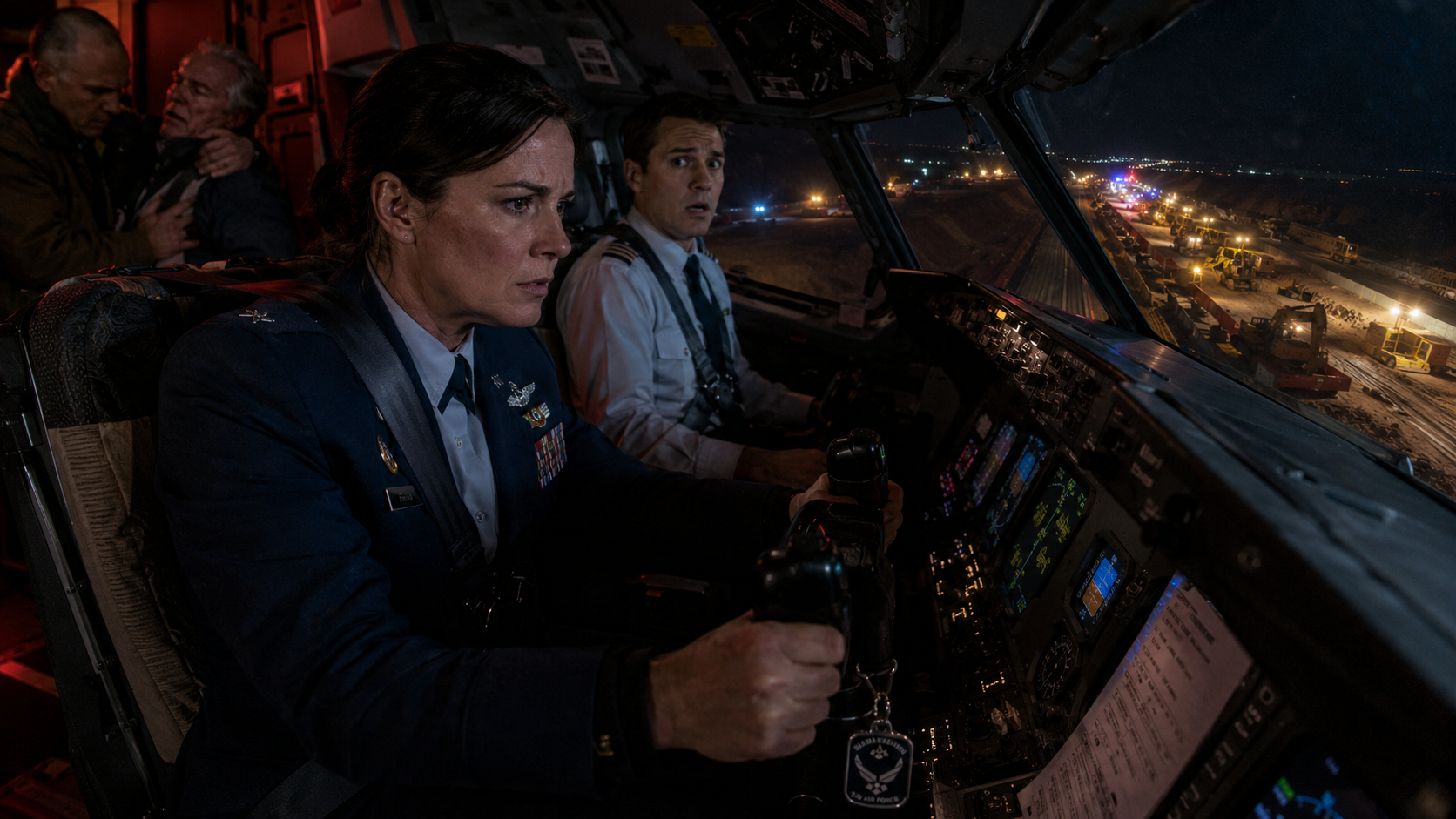
At 34,000 feet, the absolute silence of a dying commercial airplane is the loudest, most terrifying sound in the world. I was sitting quietly in seat 14D, a tired 44-year-old substitute teacher heading home to Billings after my sister’s wedding, when a massive jolt violently threw my ungraded essays onto the sticky floor.
It wasn’t turbulence. It was the catastrophic, simultaneous failure of both turbine engines.
The cabin instantly plunged into darkness, save for the eerie, blood-red glow of the emergency floor lights. Oxygen masks dropped from the ceiling, swinging like morbid pendulums as 147 passengers erupted into chaotic, deafening screams. I grabbed my worn canvas tote bag, my shaking fingers brushing against the cold metal of my old Air Force keychain—a faded relic from my days as an F-16 fighter pilot.
I hadn’t touched a military flight stick in six years, but my body instantly recognized the heavy, unnatural glide of a 140,000-pound Boeing 737 rapidly losing altitude.
You May Also Like
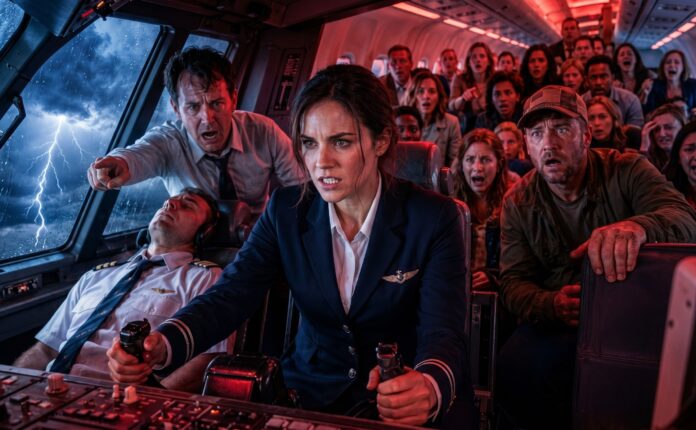
“Ladies and gentlemen,” the captain’s voice trembled violently over the PA system, stripping away any illusion of safety. “We have experienced a… a total loss of power. Please…”
He didn’t finish. The intercom went dead with a sharp crackle. The sharp, terrifying pitch of the nose told me everything I needed to know. They were bleeding airspeed much too fast. They were panicking.
I immediately unclipped my seatbelt. The businessman beside me grabbed my arm, his face pale with sheer terror. “Where are you going? We’re crashing!”
I ripped my arm away, my dormant combat instincts completely taking over. I moved up the aisle, fighting the steep, sickening incline of the dying aircraft. A flight attendant lunged forward to stop me, but I forcefully shoved her aside, my eyes locked on the cockpit door.
I hammered on the heavy metal. “Let me in! I know how to dead-stick this aircraft!” I screamed, praying they could hear me over the horrific wind roaring outside the fuselage.
For an agonizing second, nothing happened. Then, the heavy door swung open. First Officer Park stood there, his face completely drained of blood, hands trembling uncontrollably. But it wasn’t his fear that made my stomach drop into a bottomless pit. It was the horrific warning blaring from the main console—a warning I knew meant our nightmare was just beginning.
Part 2The deafening warning horn blaring from the main console wasn’t just a standard engine failure alarm; it was the master caution for a catastrophic hydraulic bleed. But that wasn’t the nightmare that made my blood run cold.
Captain Riley was slumped completely forward in the left seat, his dead weight pressing heavily against the yoke, forcing the Boeing 737 into a terrifying, accelerated dive. He was clutching his left arm, his face a sickening, lifeless shade of gray. The sheer, overwhelming stress of the dual engine blowout had triggered a massive, debilitating heart attack.
“Help me pull him back!” I yelled at First Officer Park, whose hands were hovering uselessly in the air, his eyes wide with an immobilizing panic.
“I… I’ve never…” Park stammered, his voice cracking as the wind screamed against the windshield. “We’re losing all pressure. The APU won’t start. I don’t know what to do!”
“I am a former F-16 pilot for the United States Air Force, and if you don’t help me pull this man off the controls right now, we are all going to die!” I grabbed the back of the captain’s heavy leather seat and pulled with every ounce of adrenaline surging through my 44-year-old body.
Park finally snapped out of his paralyzing trance, lunging forward to grab Riley’s shoulders. Together, grunting against the severe G-forces of our descent, we hauled the unconscious captain out of the left seat and dragged him onto the narrow floorboards of the flight deck.
I didn’t wait for permission. I slid directly into the captain’s seat, my hands immediately gripping the cold, heavy yoke. My hiking boots found the rudder pedals. It felt terrifyingly wrong—this wasn’t a nimble fighter jet built for war; it was a massive, dead commercial airliner, feeling as heavy and sluggish as a falling brick.
“Give me our altitude and airspeed!” I barked, my eyes rapidly scanning the dim, battery-powered digital displays.
“Twenty-two thousand feet,” Park choked out, violently strapping himself back into the right seat. “Airspeed is two hundred and forty knots. We’re bleeding altitude too fast!”
“We need to establish our best glide ratio immediately. Flaps up, gear up,” I commanded, pulling back hard on the yoke to level out our deadly descent. The physical effort required was immense; without hydraulic assist, I was fighting the sheer aerodynamic weight of the entire plane with my bare arms.
“ATC is screaming for us,” Park said, pointing a shaking finger at the radio.
“Tell them United 1189 is a glider. Both engines flamed out. We need a runway, now!”
I looked out the reinforced window. Below us was nothing but the pitch-black void of rural Nebraska. No city lights. No glowing airport beacons. Just endless, invisible darkness waiting to swallow us whole.
Park’s trembling fingers worked the radio dial. “Mayday, Mayday, United 1189, we have dual engine failure. Captain is incapacitated. Requesting immediate vectors.”
The radio crackled instantly, the air traffic controller’s voice tight with disbelief and rising panic. “United 1189, radar shows you dropping rapidly. The nearest airstrip is North Platte, but you are forty miles out. You… you don’t have the glide ratio to make it.”
A heavy, suffocating silence filled the cockpit, broken only by the eerie, rushing whistle of the wind tearing across the aluminum fuselage. Forty miles. We couldn’t make it. We were going to hit the ground in less than five minutes.
“What do we do?” Park whispered, tears finally spilling over his cheeks, his professional facade completely shattering. “My wife is pregnant… I can’t…”
I stared into the blackness, my mind desperately racing through old military tactical maps I hadn’t studied in nearly a decade. Then, I remembered something. A geographical anomaly I used to use as a visual checkpoint during night training missions out of Nevada.
“We aren’t going to North Platte,” I gritted my teeth, banking the heavy yoke hard to the left. The metal frame of the aircraft groaned in violent protest.
“What are you doing?!” Park screamed, gripping his armrests. “You’re taking us off the flight path!”
“There’s a stretch of Highway 83 down there,” I said, fighting the stiff controls. “It’s straight, flat, and long enough to put down a 737.”
“You want to land a commercial jet on a pitch-dark highway?!”
“It’s our only option,” I replied coldly.
But as we dropped rapidly through ten thousand feet, breaking through a layer of thin clouds, a horrifying sight greeted us through the windshield. My heart stopped dead in my chest.
Highway 83 wasn’t dark. It was glowing with hundreds of flashing yellow strobe lights. It was an active, massive construction zone, heavily littered with heavy machinery, thick concrete barriers, and paving trucks. We were dropping straight into a jagged metallic graveyard at 200 miles per hour, and we didn’t have the airspeed to pull up.
If you’ve read this far, don’t hesitate to leave a like and comment before reading part 3. It makes us as happy as reading a complete story! Thank you. 👍❤️
Part 3Panic, raw and suffocating, clawed violently at my throat. The flashing yellow beacons of the highway construction zone glared through the windshield like mocking, demonic eyes in the darkness. Massive concrete barriers and towering earth-moving equipment blocked the asphalt as far as I could see. Landing there wouldn’t just be a crash; it would result in the complete, fiery shredding of the fuselage.
“Pull up! Pull up!” Park shrieked, grabbing his yoke, instinctively trying to fight my control inputs out of sheer terror.
“Let go of the controls!” I roared, slapping his hands away with brutal force. “If we stall the wings now, we drop like a stone and everyone dies!”
At three thousand feet, the freezing ground was rushing up to meet us with terrifying speed. My old F-16 instructor’s voice echoed sharply in my head, cutting through the panic: The jet doesn’t care how scared you are, Becky. It only cares what you do with your hands.
I forced my breathing to slow, pushing the fear into a tight box in the back of my mind. I scanned the deep darkness directly parallel to the flashing yellow lights of Highway 83. My eyes, trained years ago to find camouflaged targets in pitch black, caught a faint, linear shadow cutting through the moonlit prairie grass.
It was an old, unpaved frontage road—a dirt agricultural access path used by farming combines, running exactly parallel to the doomed highway. It was dangerously narrow, barely wider than our fuselage, but it was clear of concrete barriers and tractors.
“Park! Give me full flaps on my mark, and leave the landing gear up!” I commanded, my voice dripping with absolute authority.
“Gear up?! Are you insane? We’ll tear the belly wide open!”
“If the wheels hit soft agricultural dirt at one hundred and sixty knots, they’ll dig in and flip this plane end over end! We have to slide it in!” I adjusted our heading, brutally banking the massive 737 three degrees to the right. The wind howled furiously against the windshield. “Flaps down, now!”
Park slammed the lever down. The aircraft shuddered violently as the flaps deployed, acting like massive aerodynamic brakes. Our speed bled rapidly, throwing us forward against our harnesses—180 knots, 160 knots, 150 knots.
“Brace for impact! Brace for impact!” Park screamed over the PA system, his voice echoing into the terrified cabin behind us.
I pulled back on the yoke with every fiber of my being, flaring the nose up just as the tall prairie grass whipped furiously against the windshield.
The impact was a brutal, deafening explosion of sound and kinetic energy. The Boeing 737 slammed belly-first into the dirt road. A massive shockwave of force violently threw me forward into the harness, knocking the wind out of my lungs. Sparks screamed past the cockpit windows like a terrifying meteor shower as the metal underbelly ground relentlessly against rocks and hard-packed earth. The high-pitched screech of tearing aluminum was absolute torture to the ears.
The plane skidded aggressively to the left, the right wingtip clipping the ground, sending a massive geyser of dirt and rocks into the night air.
“Hold it straight!” I screamed to myself, stomping on the heavy rudder pedals, fighting the violent, sickening fishtailing motion. The cabin behind us was filled with the horrifying sounds of tearing overhead bins, shattering plastic, and screaming passengers.
We slid for what felt like an eternity. Mud, blinding sparks, and acrid electrical smoke completely enveloped the cockpit. Finally, with one last, violent lurch that threw us hard against our restraints, the 140,000-pound aircraft ground to a complete, shuddering halt.
Silence. Absolute, ringing silence, save for the ticking of superheated metal and the soft hiss of deployed oxygen masks.
I sat completely frozen, my hands locked onto the yoke in a white-knuckled death grip, my breath coming in ragged, painful gasps. Park was sobbing openly beside me, his trembling hands covering his face in pure relief.
I slowly uncurled my cramped, bruised fingers, unbuckled my harness, and forced the heavy, jammed cockpit door open. I braced myself for the absolute worst. But as the emergency slides deployed outside with a loud whoosh, I looked down the dimly lit, tilted aisle.
People were crying, holding each other, and some were bleeding from minor cuts, but they were moving. They were standing up. They were alive. All 147 of them.
Paramedics and fire trucks from the nearby highway construction zone swarmed the wreckage within minutes, their red and blue lights painting the prairie. As they loaded Captain Riley onto a stretcher—alive, his pulse finally stabilized—I grabbed my faded canvas tote bag and walked quietly out into the freezing Nebraska air.
I sat on the cold steel bumper of a fire truck, staring at the scarred, smoking metal beast resting in the dirt. I was just a 44-year-old middle school teacher again. But as I pulled my old F-16 keychain from my pocket, rubbing the faded metal wing with my thumb, I knew I had finally made peace with the pilot I used to be.
What do you think of this story? Please leave a like and share your thoughts in the comments. Your support means a lot to us and inspires us to keep writing more meaningful and powerful stories. Thank you! 👍❤️