The Girl Who Asked For Bread
The delicate clink of crystal and the hushed, expensive murmurs of downtown Chicago’s elite died in a single heartbeat.
“Get that child out of here before she touches anything,” the woman at Table Six snapped, her voice cutting through the ambient classical music like shattered glass.
The little girl froze beside the velvet rope. She stood barefoot on the polished, imported marble floor. For one sharp, suspended second, every fork inside Aurelia—the city’s most exclusive restaurant—stopped moving.
You May Also Like

A waiter holding a silver tray went perfectly still. A couple near the window turned in their velvet chairs. A man in a tailored navy suit lowered his scotch, staring as if someone had dragged street refuse into his private living room.
The girl was tiny, perhaps nine years old, swallowed by a torn gray hoodie. Her brown hair was matted with street dust, and her bruised, dirty knees trembled beneath a faded, oversized skirt.
Two security guards closed in. When one grabbed her arm, she flinched violently, pulling back.
“No, please,” she cried, her voice thin and raspy. “Please don’t make me leave.”
The second guard seized her other wrist. In the struggle, a frayed cloth bag slipped from her small fingers and hit the marble floor. A few dull pennies and dimes rolled across the pristine stone. Somewhere in the dining room, someone laughed softly—a cruel, dismissive sound.
That soft laugh was worse than shouting.
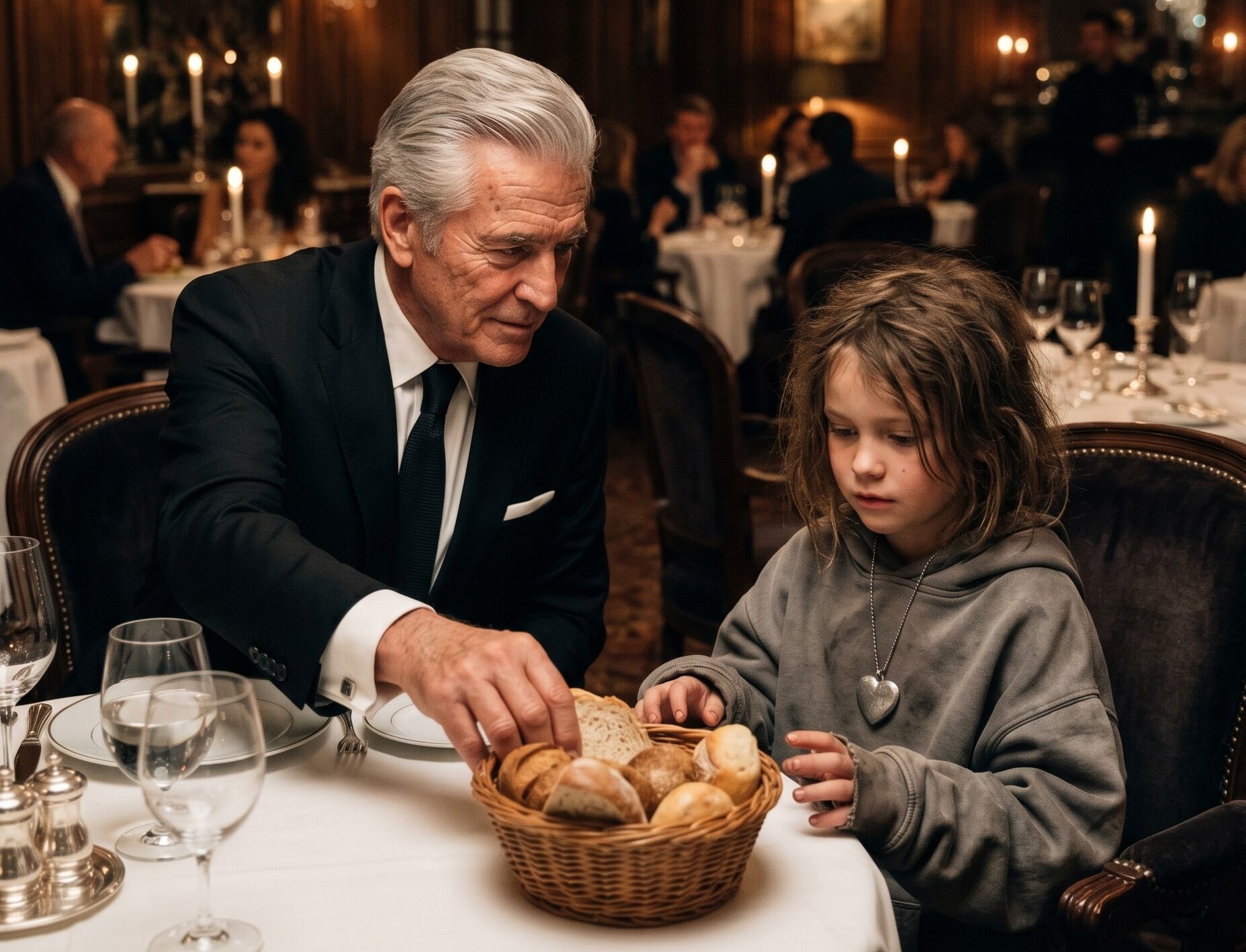
At a corner table, Victor’s silver steak knife stopped halfway to his mouth. His eyes lifted slowly. First, he looked at the guards with mild irritation. Then, his gaze drifted to the terrified girl’s face. And then, his eyes moved lower.
Resting against the child’s thin, dirt-streaked collarbone was a silver chain. At the end of it hung a tiny heart-shaped pendant, heavily scratched and dull from years of wear.
Victor’s knuckles turned white around the handle of his knife. His breathing hitched, suddenly shallow.
“Please,” the girl sobbed, twisting helplessly as the guards dragged her backward. She reached desperately for her fallen bag. “That’s all I have.”
Victor stood up.
The heavy legs of his oak chair scraped violently against the floor. The sound echoed through the massive room, and a suffocating silence immediately fell over the restaurant.
“Stop.” It was just one word. Spoken quietly. But it sliced through the dining room with absolute, unquestionable authority. Both guards released the girl instantly, as if her skin had caught fire. She stumbled forward, catching herself on the edge of an empty chair.
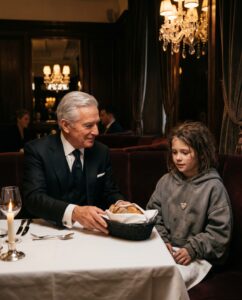
Victor stepped away from his table. At seventy-three, he moved with the measured slowness of age, yet every person in the room watched him as if he owned the very air they were breathing. His silver hair was immaculate; his custom black suit was severe and imposing. But his eyes—usually cold and unyielding—were entirely undone. They were locked onto the silver chain.
“Where did you get that?” he asked, his voice trembling slightly.
The girl blinked up at the towering man, terrified. “What?”
“The necklace,” Victor said, the word cracking in his throat.
The woman from Table Six lowered her hand from her nose, sensing the sudden shift in the room’s gravity. The guards exchanged nervous glances. The little girl reached up, her dirty fingers closing protectively around the dull silver heart.
“My mom gave it to me.”
Victor stopped just three feet away from her. The color entirely drained from his face, leaving him looking like a ghost. “Your mother,” he whispered. “What is her name?”
The girl looked nervously toward the massive glass doors, half-expecting to still be thrown out into the cold night. Then, she looked back at the old man.
“Anna,” she whispered.
The heavy crystal wineglass beside Victor’s abandoned plate suddenly slipped from the table. It shattered explosively against the marble floor. Deep red wine spread outward, pooling like blood beneath the warm glow of the chandeliers. No one moved to clean it. No one even breathed.
Victor stared at the child. In that moment, the terrifying billionaire vanished. He was just a frail old man standing at the absolute edge of an abyss.
“Anna,” he breathed, the name a prayer he hadn’t spoken in decades.
The girl’s fingers tightened further around the pendant. “That was my mother’s name.”
To the absolute shock of everyone watching, Victor dropped to his knees. Gasps rippled across the dining room. A titan of industry, a man who had ruthlessly commanded boardrooms and empires for fifty years, was kneeling in spilled wine before a starving child.
His ancient hands trembled violently as he reached toward her neck. He stopped an inch away. “May I?” he asked, his voice breaking completely.
The girl hesitated, reading the profound grief in his eyes. Slowly, she nodded.
Victor lifted the pendant with unbearable gentleness. He turned it over. There, almost entirely worn away by time and hardship, were three tiny engraved letters.
A.H.H. Anna Helen Hale. Victor squeezed his eyes shut. His broad shoulders gave one violent, silent heave. When he opened his eyes again, tears were freely spilling down his weathered cheeks.
“I gave this to my daughter,” he said. His voice was barely a whisper, yet in the dead silence of the room, everyone heard it. “I gave it to Anna on her sixteenth birthday.”
The girl’s eyes widened. She stared at the weeping man. “She… she said it was from her father,” she whispered.
Victor swallowed hard, fighting the lump in his throat. “Where is she?”
The girl looked down at her dirty, bare toes. The answer seemed far too heavy for her frail body to carry. “My mom died last winter.”
Victor did not speak. He couldn’t. Suddenly, the staggering luxury of the restaurant felt entirely obscene. The gold light fixtures. The pristine white tablecloths. The seven-hundred-dollar bottles of wine. All of this sickening wealth surrounded a tiny, fragile child who had walked in off the freezing streets simply begging for a piece of bread.
Victor’s hand slowly fell away from the pendant. “What is your name, sweetheart?”
“Lily,” she answered softly.
“Lily what?”
She wiped a tear from her cheek with the back of her dirty sleeve. “Lily Carter.”
Victor’s brow furrowed. “Carter?”
“My mom said we had to use that name. She said it was safer.”
Victor bowed his head, burying his face in his hands as a crushing, terrible understanding washed over him. Twenty years ago, Anna Hale had vanished into the night after a violent, explosive argument with him. She had been twenty-two—stubborn, brilliantly bright, and utterly suffocated by the life he tried to control.
He had searched for her. Or, at least, that was the lie he told himself to sleep at night. He had hired the best investigators, made the calls, offered the massive rewards. But as the years bled by, his empire had swallowed his grief. His wounded pride had calcified into a bitter silence.
And now, her daughter—his own flesh and blood—stood barefoot in a restaurant while his peers complained about the smell.
Victor looked up. His sorrow instantly hardened into a quiet, terrifying rage. He looked at the two guards. Their faces were the color of ash. Then, he slowly turned his head toward Table Six.
The wealthy woman who had demanded Lily’s removal sat perfectly paralyzed. Her diamond-ringed hand was visibly shaking near her water glass.
Victor pushed himself off the floor, rising to his full height. Suddenly, the massive room felt entirely too small to contain him.
“This child,” Victor said, his voice echoing off the vaulted ceiling, “asked for food.”
No one dared answer him.
“She walked into a room full of people who could have bought and sold her a hundred lifetimes of meals without ever noticing the cost.” His piercing, furious gaze swept across the elite patrons. “And every single one of you looked at her as if she were dirt.”
The woman at Table Six opened her mouth, her voice trembling. “Mr. Hale, I swear, I didn’t realize—”
“No.” The word cracked like a whip.
She snapped her mouth shut.
“You realized she was hungry,” Victor said coldly. “That should have been enough.”
He turned away from them, dismissing their existence entirely. Lily stood beside him, looking bewildered and entirely overwhelmed, like she wanted to shrink into the floorboards. Victor’s terrifying demeanor vanished the second he looked at her.
He knelt slightly. “Lily,” he asked, his voice softening into something unimaginably gentle. “Are you still hungry?”
Her lower lip quivered. “Yes.”
That single word broke whatever was left of his heart. Victor held out his hand. He didn’t offer it like a billionaire extending charity; he offered it like a grandfather humbly asking for permission.
Lily stared at his large, clean hand for a long moment. Then, she slipped her tiny, soot-stained fingers into his palm.
Victor led her straight to his table. The entire restaurant watched in stunned silence. The hostess practically sprinted forward to pull out the heavy velvet chair across from Victor’s seat.
Lily stopped before climbing up. Her large eyes darted over the blindingly white tablecloth, the gleaming silver, the flickering candles, the untouched prime steak, and the steaming basket of artisan bread.
“I’m dirty,” she whispered, pulling her hand back.
Victor’s face tightened with sorrow. “So was I, once,” he told her softly.
She looked up at him in surprise. He gently pulled the chair out the rest of the way. “You sit right here.”
Lily climbed onto the plush velvet carefully, as if she were afraid it might reject her. Victor didn’t call for a waiter. He reached across the table, picked up the warm bread basket himself, and placed it directly in front of her.
“Eat slowly,” he murmured, his eyes shining. “No one is ever going to take it from you again.”
That was when Lily finally broke. She didn’t sob loudly or cause a scene. Just silent, heavy tears rolling down her dirty cheeks as her shaking fingers tore a piece of bread in half.
Victor sat across from her, watching her eat as if every bite she took physically hurt him. When a nervous server finally approached with a fresh, warm napkin, Victor intercepted it. He leaned across the table and gently wiped the tears and dirt from Lily’s face himself.
“What happened to your mother?” he asked, his voice thick with unshed tears.
Lily chewed, swallowed hard, and let him wipe her cheek. “She got sick,” she explained quietly. “She coughed all the time. Then she just… got too tired to wake up.”
Victor’s jaw clenched, a muscle feathering in his cheek. “Was she alone?”
Lily nodded. “It was just us. We stayed in shelters mostly. Sometimes in a motel when she found enough money.”
Victor stared down at the scratched silver pendant. “And she never told you about me?”
“She told me her dad was a very powerful man,” Lily said, her innocent eyes meeting his. “But she said… she said he loved her wrong.”
Victor closed his eyes. The breath left his lungs as if he’d been struck.
Loved her wrong. God, it was true. He had loved Anna like a prized possession. He had protected her like a warden guards a prisoner, punishing her bright independence simply because he was utterly terrified of losing her. And his tight grip was exactly what had driven her into the dark.
Lily reached into her battered cloth bag. She pulled out a folded photograph, its edges soft and fraying, a deep crease running right down the middle. She slid it across the white tablecloth.
“That’s her.”
Victor picked it up with trembling hands. In the photo, Anna stood against a faded brick wall. She was dangerously thin, and the skin around her eyes looked exhausted and old. But her smile—bright and defiant—was unmistakably his daughter’s. She was holding a tiny, beaming baby Lily against her chest. And resting against Anna’s collarbone was the silver chain.
Victor gently ran his thumb over his daughter’s faded face. “She looked so much like her mother,” he whispered.
“My grandma?” Lily asked.
Victor nodded slowly, unable to tear his eyes from the photo. “Your grandmother passed away when Anna was very young.”
Lily looked down at the remaining bread in her hands, then back up at the broken old man across from her. “My mom said she missed her every single day.”
Victor’s stoic expression finally collapsed, burying his face in his hands as quiet, wracking sobs took over his body.
For twenty long years, he had imagined Anna out in the world—angry, defiant, hidden, and unreachable. He had pictured her living a rebellious life just to spite him.
He had never imagined her hungry. He had never imagined her dying alone in the cold. And he had never, ever imagined her raising a child in the shadows, clinging fiercely to the very last gift he had ever given her.