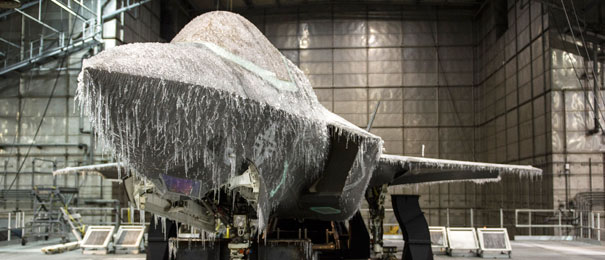
Where fighter jets are frozen, baked, drowned, and pushed to their limits — all before they ever face the battlefield
There is a famous line often attributed to ancient Greek historian Herodotus:
“Neither snow, nor rain, nor heat, nor gloom of night stays these couriers from the swift completion of their appointed rounds.”
For the United States military, that idea is not just a motto — it is a mission.
At the heart of that mission stands one of the most extraordinary engineering facilities in the world: the McKinley Climatic Laboratory — a place where the laws of nature are not avoided, but recreated on command.
You May Also Like



Here, aircraft are not simply tested.
They are battled by the weather itself.
A Machine Built to Defeat Nature
The origins of the laboratory trace back to World War II, when harsh weather crippled military aviation operations.
In freezing European winters, German aircraft struggled to fly. In Alaska, American test programs faced similar limitations. Military leaders realized a critical truth:
If machines were to survive war, they must survive nature first.
In 1943, the U.S. military launched a bold solution — build a controlled environment where Earth’s most extreme conditions could be recreated at will.
By 1947, that vision became reality.


Named after Lt. Col. Ashley C. McKinley, a pioneer in environmental testing design, the facility became a cornerstone of U.S. military aviation development.
Today, it remains one of the most powerful environmental simulation centers on Earth.
A World Where Weather Is Manufactured
Inside the massive sealed chambers of the laboratory, engineers can recreate nearly every climate condition on the planet:
- Arctic freezing at -65°F (-54°C)
- Desert heat reaching 165°F (74°C)
- Tropical storms with heavy rainfall and high winds
- Dense fog, ice clouds, and salt spray corrosion conditions
- Extreme humidity levels that mimic jungle environments
It is not simulation on a computer.
It is real weather, physically generated.


Inside the chamber, fighter jets, drones, helicopters, and military vehicles are exposed to conditions that would normally destroy them.
Only after surviving here are they allowed to fly in the real world.
The F-35: A Fighter Tested Against the Extremes
One of the most advanced aircraft ever tested in the facility is the Lockheed Martin F-35 Lightning II.
Before entering frontline service, the F-35 was subjected to some of the most demanding environmental trials ever conducted.
Inside the lab:
- It was frozen at sub-zero temperatures
- Burned under desert-like heat
- Drenched in hurricane-strength rain
- Tested in high humidity to detect internal condensation
- Run with engines operating inside a sealed chamber


In one of the most unique engineering environments on Earth, even jet engines can run inside a closed building — something nearly impossible anywhere else.
To make this possible, the facility circulates up to 800,000 cubic feet of conditioned air per minute, ensuring that engines breathe the same environment they are meant to operate in outside.
This is not just testing.
It is controlled survival.
Where Engineers Fight Invisible Enemies
Unlike traditional flight testing, the McKinley Laboratory does not simply observe aircraft.
It puts them through active, dynamic combat with the environment.
Pilots sit inside cockpits while storms are generated around them. Engineers monitor systems while snow accumulates on wings. Technicians work beside running engines inside artificial hurricanes.
The tests include:
- “Cold soak” freezing of aircraft systems
- Simulated tropical storms with high-speed wind and rain
- Heat cycles replicating desert flight decks
- Full mission simulations with engines running continuously
Every test is designed to answer one question:
Can this machine survive anywhere on Earth — at any time?
Why This Place Matters
In modern warfare, victory is not only decided on the battlefield.
It is also decided in laboratories like this one — long before a plane ever takes off.
Without facilities like the McKinley Climatic Laboratory, military systems would take years longer to develop, cost far more, and carry greater risk in real combat.
Instead, engineers can compress decades of environmental experience into months of controlled testing.
That efficiency has helped shape every major U.S. weapons system for decades.
The Hidden Power of Preparation
Behind every fighter jet, missile system, or military aircraft is a quiet truth:
Survivability is engineered before combat ever begins.
This laboratory represents that philosophy at its highest level.
It is not a place of war.
It is a place where war machines are taught how to endure the planet itself.


Final Reflection
In a world where military technology grows increasingly complex, one truth remains unchanged:
Before a machine can dominate the skies, it must first survive the Earth.
And inside the McKinley Climatic Laboratory, the Earth itself becomes the adversary — wind, ice, fire, rain, and humidity all transformed into tools of engineering.
It is here that science meets survival.
And it is here that the future of aviation is proven — one storm at a time.