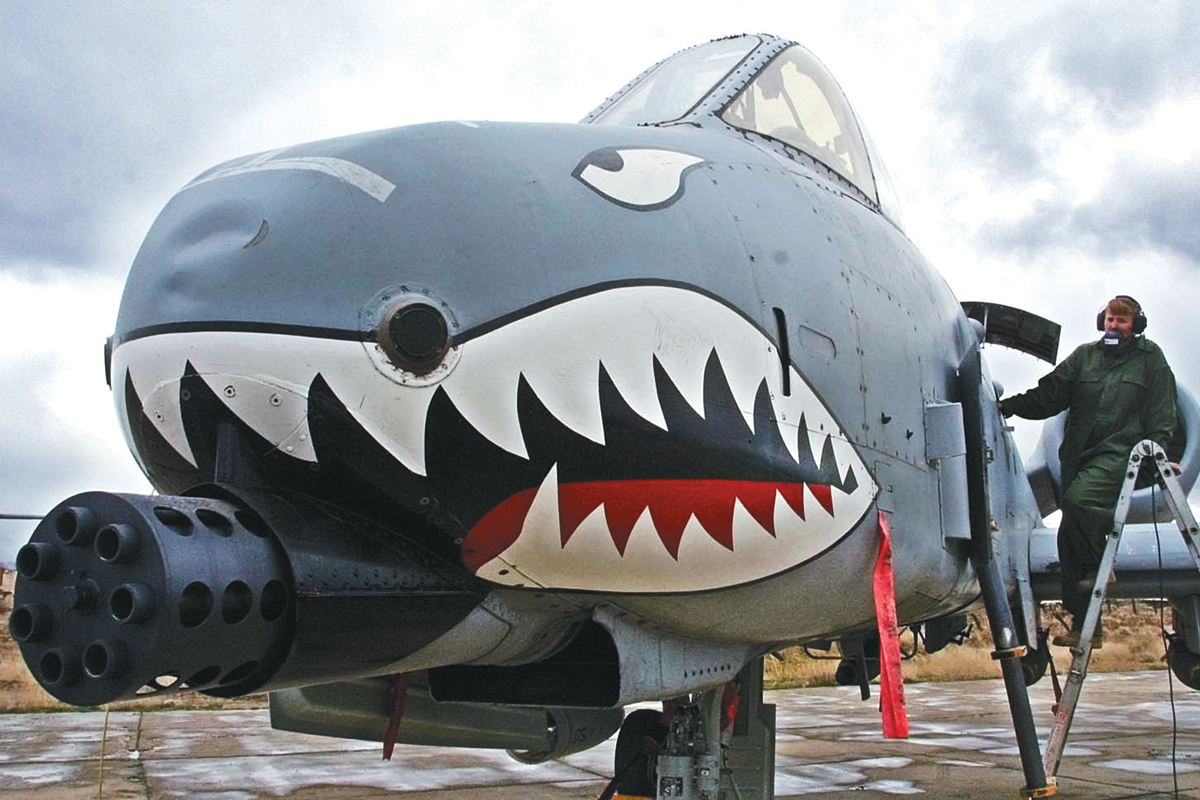
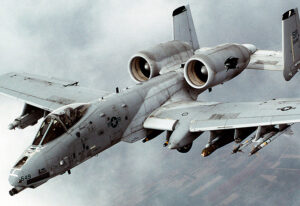
For decades, military experts, Pentagon officials, and defense planners have repeatedly predicted the death of the Fairchild Republic A-10 Thunderbolt II.
And every single time…
The Warthog survived.
Again.
You May Also Like

And again.
And again.
Now, after years of retirement plans, budget battles, and pressure to replace it with modern stealth fighters like the Lockheed Martin F-35 Lightning II, the United States Air Force has once again changed course.
Instead of eliminating the A-10 fleet entirely, the Air Force is keeping part of the legendary aircraft operational through 2030.
Why?
Because in modern warfare, the old flying tank still does something few advanced aircraft can do:
It fights cheaply, brutally, effectively — and survives.
The A-10 is not elegant.
It is not stealthy.
It is not futuristic.
But when American troops are under attack, drones swarm the battlefield, and chaos erupts at low altitude, the Warthog continues proving why it became one of the most feared combat aircraft in military history.
The Aircraft Built Around a Giant Gun
Most aircraft are designed first, then armed later.
The A-10 was built the opposite way.
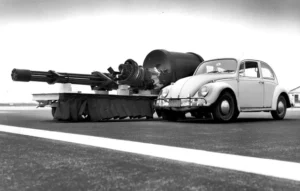
Engineers essentially designed an airplane around one terrifying weapon:
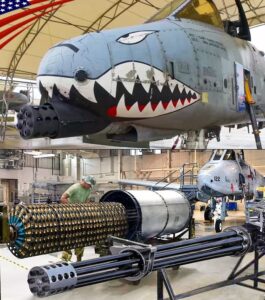
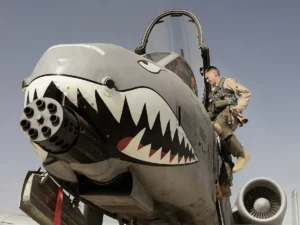
The massive 30mm GAU-8/A Avenger rotary cannon.
This cannon is so enormous that it dominates the aircraft itself.
The gun fires armor-piercing rounds at devastating speed:
3900\ \text{rounds/minute}
That is roughly 65 rounds every second.
The sound of the cannon became legendary among soldiers:
“BRRRRT.”
For enemies on the battlefield, hearing that sound often meant destruction was seconds away.
The A-10 was specifically designed during the Cold War to destroy Soviet tanks in Europe.
Everything about the aircraft prioritized survivability and close combat:
- Titanium armored cockpit
- Redundant flight systems
- Self-sealing fuel tanks
- Massive wings for low-speed maneuverability
- Engines positioned to reduce heat signature
- Ability to fly with severe damage
Unlike sleek fighter jets built for speed and stealth, the Warthog was built to absorb punishment and keep fighting.
It became known as:
“The Flying Tank.”
Why the Air Force Wanted to Retire the A-10
Despite its legendary reputation, the Air Force has spent years trying to phase out the aircraft.
Why?
Because modern warfare is changing.
The Pentagon increasingly prioritizes:
- Stealth technology
- Network warfare
- AI integration
- Long-range precision strikes
- Fifth-generation aircraft
The A-10 is old.
Very old.
Its first flight occurred in the early 1970s.
Against advanced air defenses from nations like China or Russia, the slow-moving A-10 would face enormous danger.
Stealth aircraft like the F-35 can penetrate heavily defended airspace more safely while sharing targeting information across digital combat networks.
Military leaders believed the future belonged to stealth, sensors, drones, and data fusion — not low-flying armored attack aircraft.
And yet…
The battlefield kept proving the Warthog still mattered.
Operation Epic Fury Changed Everything
The turning point came during recent operations involving Iranian-backed drone attacks across the Middle East.
In Operation Epic Fury, the A-10 suddenly found a new mission perfectly suited to its strengths:
Hunting drones.
And it excelled.
Modern warfare has entered a strange new era where cheap unmanned drones costing only thousands of dollars can threaten billion-dollar military infrastructure.
This created a dangerous imbalance:
The United States was often forced to destroy cheap drones using missiles worth over $1 million each.
That strategy is unsustainable.
The Warthog offered a cheaper solution.
The A-10 Became a Drone Killer
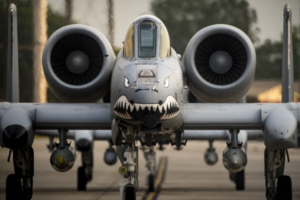
Unlike high-speed stealth fighters optimized for air superiority, the A-10 thrives at low altitude and slow speeds.
That makes it uniquely effective against:
- One-way attack drones
- Slow unmanned aircraft
- Low-altitude aerial threats
- Fast attack boats
- Militia positions
The aircraft can loiter over combat zones for hours while searching for threats.
This persistence gives it a huge advantage.
Instead of burning expensive advanced missiles, the A-10 began using a smarter and cheaper weapon system:
APKWS II laser-guided rockets.
APKWS II: The Cheap Weapon Changing Modern Air Combat
The APKWS II system transformed basic Hydra 70 rockets into precision-guided weapons.
Originally designed for ground attacks, these rockets became highly effective against drones.
And the cost difference is staggering.
An advanced air-to-air missile like the AIM-120 AMRAAM can cost:
$1,000,000+
Meanwhile, a guided APKWS rocket may cost:
$25,000\text{ to }$40,000
This dramatically changes battlefield economics.
Instead of wasting million-dollar missiles on cheap drones, the A-10 can destroy threats far more efficiently.
That matters enormously in prolonged wars.
The Missile Crisis Nobody Expected
Recent conflicts exposed a terrifying reality:
America’s stockpiles of advanced missiles can be depleted far faster than they can be replaced.
During intense operations around Iran, the US and allies reportedly consumed massive quantities of:
- Patriot interceptors
- THAAD missiles
- Precision strike munitions
- AIM-120 missiles
Some advanced weapons require years to replace because of limited industrial production capacity.
This created what analysts call a:
“Cost-exchange crisis.”
Enemies using cheap drones can financially exhaust expensive missile defenses.
The Warthog became part of the solution.
Its ability to cheaply destroy low-cost threats suddenly made the old aircraft strategically valuable again.
The Warthog’s Incredible Survivability
One reason soldiers and pilots love the A-10 is simple:
It survives.
The aircraft became legendary for returning home after taking catastrophic damage that would destroy most jets.
One of the most famous incidents occurred during the Iraq War.
Captain Kim Campbell’s A-10 was struck by a surface-to-air missile over Baghdad.
The explosion shredded the aircraft’s tail and severely damaged its flight systems.
Hydraulic pressure was lost.
Control systems failed.
The aircraft began diving uncontrollably.
Most pilots would have been doomed.
But the A-10 had a backup system called Manual Reversion — an emergency mechanical control mode using physical cables instead of hydraulics.
Campbell manually fought the damaged aircraft for nearly 100 miles and landed safely despite:
- No hydraulic controls
- No brakes
- No flaps
- Massive structural damage
The aircraft survived.
So did the pilot.
Stories like this became part of Warthog legend.
Why Troops on the Ground Still Love the A-10
Few aircraft have earned the loyalty of ground troops like the Warthog.
Why?
Because when soldiers are trapped in close combat, they do not care about stealth coatings or futuristic networking.
They care about immediate firepower overhead.
The A-10 specializes in:
- Close air support
- Low-altitude attack runs
- Battlefield persistence
- Precision strikes near friendly troops
Its ability to visually identify targets at low altitude remains valuable in chaotic environments.
To many infantry troops, hearing the sound of an approaching A-10 means survival may be moments away.
Can the F-35 Truly Replace the Warthog?
This debate remains fiercely controversial.
The F-35 is vastly more advanced technologically.
It offers:
- Stealth capability
- Sensor fusion
- Electronic warfare systems
- Advanced networking
- Superior survivability in contested airspace
But critics argue it also has weaknesses in the close air support role.
Some analysts describe the F-35 as a:
“Glass cannon.”
Powerful — but expensive and delicate.
A single small-arms hit or shrapnel damage could potentially compromise stealth coatings or sensitive electronics.
The A-10, by contrast, was designed to absorb punishment.
This difference matters in messy low-altitude combat environments.
The Future of Close Air Support
The Air Force still plans to eventually move beyond the A-10.
Future warfare may involve:
- AI-controlled drones
- Loyal wingman aircraft
- Stealth reconnaissance systems
- Networked battlefield targeting
- Autonomous strike platforms
Aircraft like the F-35 may act as airborne battlefield coordinators while drones and support aircraft execute attacks.
The future battlefield will likely be deeply interconnected.
Yet even in this futuristic vision, the A-10’s survival proves something important:
Sometimes older platforms remain valuable because they solve problems newer systems cannot solve economically.
The Warthog Became More Than an Aircraft
The A-10 represents something larger than military technology.
It symbolizes:
- Reliability
- Ruggedness
- Simplicity
- Battlefield loyalty
- Survival against impossible odds
For decades, it survived:
- Budget cuts
- Retirement attempts
- Changing military doctrine
- Technological revolutions
And somehow, the old warbird keeps returning to the battlefield.
The Last of a Dying Breed
The A-10 may ultimately become one of the last dedicated close air support aircraft ever built.
Modern warfare increasingly favors:
- Multi-role stealth platforms
- AI systems
- Precision stand-off attacks
- Drone warfare
Yet the Warthog continues reminding military planners of one hard truth:
Technology alone does not always replace battlefield effectiveness.
Sometimes the aircraft that survives longest is the one designed for the ugly realities of war itself.
Final Reality: The Warthog Still Has One More Fight Left
The A-10 Thunderbolt II was never supposed to survive this long.
But battlefield reality repeatedly saved it.
In an era of stealth fighters, artificial intelligence, hypersonic missiles, and autonomous warfare, the old flying tank still found a purpose.
Not because it is the most advanced aircraft.
But because it remains one of the most practical.
The Warthog may eventually retire.
But its legacy is already immortal.
It proved that sometimes the most valuable machine is not the fastest or the newest —
But the one that keeps showing up when the battle becomes hardest.