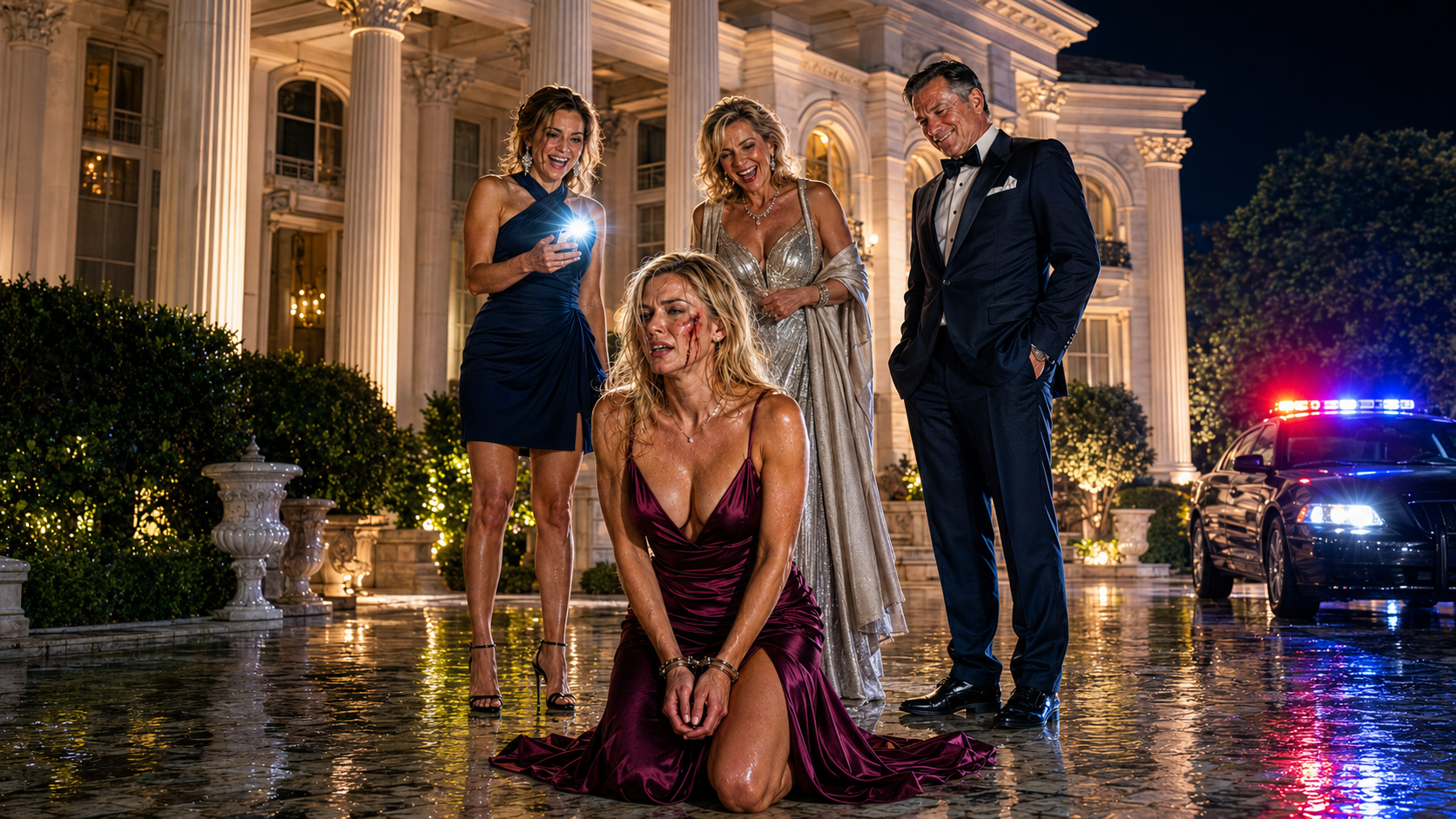
The handcuffs closed around my wrists at exactly 1:47 in the morning.
Cold metal.
Tight grip.
Blue lights flashing across the white columns of my grandfather’s old house.
And my little sister smiling like she had waited her whole life to watch me fall.
“Turn her around,” Sloane said, holding her phone high above her head. “They want to see her face.”
A sheriff’s deputy guided me down the porch steps. My bare feet touched the cold stone, and one cuff scraped the skin near my thumb hard enough to make me gasp.
The comment section on Sloane’s livestream was moving fast.
I could see the words reflected in her glasses.
Thief.
Disgusting.
She stole from her own grandfather?
Show her face.
So Sloane did.
She stepped closer, pushing the phone toward me like a weapon.
“Say something, Emma,” she said sweetly. “A million people want to know why you stole from a dying old man.”
I looked straight into her camera.
“I didn’t steal anything.”
My mother laughed softly from the porch.
Vivian Caldwell never laughed loudly when she was being cruel. She preferred elegance. Soft words. Sharp edges.
“Still pretending,” she said.
My father, Grant Caldwell, stood beside her in a pressed navy robe, hair combed, shoes on, face calm.
Too calm.
Like he had been dressed and ready for this before the deputies even arrived.
That was when I understood.
They had known.
They had planned this moment down to the minute.
The humiliation.
The livestream.
The neighbors watching from behind curtains.
The police lights.
The cuffs.
My sister’s smile.
Everything.
“Emma Caldwell,” the deputy said, “you are being detained in connection with financial exploitation, estate fraud, and forged transfer documents involving the estate of Arthur Caldwell.”
My grandfather’s name hit harder than the handcuffs.
Arthur Caldwell.
Grandpa Arthur.
The man whose hands trembled when I fed him soup.
The man who asked me to read federal court opinions aloud because, even at eighty-six, his mind still loved the law.
The man who used to squeeze my hand and whisper, “Emma, people show you who they are when they think you’re too tired to notice.”
I had noticed.
I just never thought my own family would go this far.
My father walked toward me as the deputy opened the cruiser door.
His voice dropped low enough that the camera almost missed it.
“You should have taken the settlement when we offered it.”
I turned my head slowly.
“What did you say?”
His eyes hardened.
“Five percent was generous.”
My mother stepped forward.
“Grant, don’t.”
But it was too late.
Sloane’s phone was still recording.
I looked at my sister’s camera again.
“You hear that?”
Her smile twitched.
“Don’t try to twist this,” Sloane snapped. “You stole from Grandpa. You isolated him. You manipulated him while he was sick.”
“No,” I said. “I cared for him while you filmed shopping hauls in the foyer.”
Her eyes flashed.
“Shut up.”
The deputy lowered my head toward the cruiser.
My mother folded her arms.
“You always wanted to be the hero, Emma. The perfect granddaughter. The martyr.”
I looked at her.
“I wanted Grandpa to die with someone holding his hand.”
For one second, her face changed.
Not guilt.
Annoyance.
Like I had said something inconvenient.
My father leaned close.
“This ends tonight.”
The deputy guided me into the back seat.
The cruiser smelled like vinyl, metal, and fear.
Sloane moved closer again, angling the phone through the open door.
“Look at her,” she told her viewers. “This is what greed looks like.”
I stared at my sister.
“No, Sloane,” I said quietly. “This is evidence.”
Her lips parted.
“What?”
Before she could say more, the deputy’s radio cracked loudly.
“Unit Twelve, hold transport. Repeat, hold transport. Sheriff wants Caldwell brought in through secure intake. Federal flag just hit the system.”
The deputy froze.
My father stopped smiling.
My mother’s hand dropped from her chest.
And for the first time that night, Sloane lowered her phone.
“What does that mean?” she demanded.
Nobody answered her.
The deputy looked at his partner.
His partner looked toward my father.
My father’s face had gone pale.
Not confused.
Afraid.
That was the first moment I realized my grandfather might have known this night was coming.
The deputy closed the cruiser door.
But this time, he did it gently.
The drive to the station was silent.
The deputy didn’t ask questions.
That told me more than words.
Officers ask questions when they think a story is simple.
They go quiet when the computer tells them something bigger is hiding behind the paperwork.
I sat in the back seat, wrists aching, watching the streetlights pass over the window.
Six hours earlier, I had fallen asleep in Grandpa’s old library with estate files spread across the desk.
The house was mine to manage.
Not because I begged for it.
Not because I tricked anyone.
Because Grandpa left me in charge.
He had looked me in the eyes three weeks before he died and said, “Emma, when they come for what I built, remember this: wolves always accuse the shepherd first.”
I thought he meant lawyers.
I thought he meant family arguments.
I did not think he meant handcuffs at 1:47 in the morning.
At the county station, they didn’t take me through the front desk.
They brought me through a side entrance.
A female deputy unlocked the cuffs after another officer whispered something in her ear.
The metal came off slowly.
Red marks circled my wrists.
The female deputy looked at them, then at me.
“I’m sorry,” she said under her breath.
That was when fear finally reached me.
Not fear of jail.
Not fear of my father.
Not fear of my sister’s livestream.
Fear that Grandpa had built something around me because he knew I would need protection.
They placed me in a gray interview room with a metal table, two chairs, and a camera in the corner.
I sat alone for eleven minutes.
Long enough to hear my own heartbeat.
Long enough to see my grandfather’s face in my memory.
Long enough to remember the last night I sat beside his bed.
“Emma,” he had whispered.
“I’m here, Grandpa.”
“If they smile too much after I’m gone, don’t trust the tears.”
I had laughed softly then, because he was always saying things that sounded like courtroom instructions.
Now I wasn’t laughing.
The door opened.
Sheriff Alan Reeves walked in.
He was a large man with tired eyes and a jaw that looked too tight.
Behind him entered a woman in a navy suit with a federal badge clipped to her belt.
She did not sit.
She stood near the door like she was guarding it from the inside.
Sheriff Reeves placed a folder on the table.
“Ms. Caldwell,” he said, “I owe you an apology.”
I stared at him.
“That’s not usually how arrests begin.”
“No,” he said quietly. “It is not.”
The woman in the navy suit stepped forward.
“I’m Deputy U.S. Marshal Karen Doyle.”
My throat tightened.
“U.S. Marshal?”
She nodded.
“Your grandfather, Arthur Caldwell, filed a protected estate notice eighteen months before his passing.”
I sat back.
“A protected what?”
“A federal notice tied to restricted assets, court-supervised charitable funds, and potential elder exploitation concerns.”
The words moved around me like a language I should understand but couldn’t.
“My grandfather was a real estate investor,” I said slowly.
Marshal Doyle’s expression softened.
“He was also a retired federal judge.”
The room shifted beneath me.
I closed my eyes.
Grandpa had told me stories about federal court.
About ethics.
About bad lawyers.
About how power always tried to dress itself as paperwork.
But he never told me he had worn the robe.
“He said he didn’t want the title to become the only thing people remembered,” Marshal Doyle said.
I opened my eyes.
“You knew him?”
“I knew of him,” she said. “A lot of people did.”
Sheriff Reeves slid the folder toward me.
“Your grandfather’s protected notice listed several people who were not allowed to submit estate transfer documents without federal verification.”
I looked down.
There they were.
My father.
Grant Caldwell.
My mother.
Vivian Caldwell.
My sister.
Sloane Caldwell.
The family attorney.
And any local authority acting on their documents without review.
My mouth went dry.
“He knew,” I whispered.
Marshal Doyle nodded.
“He suspected.”
The sheriff rubbed his forehead.
“Your family submitted documents tonight claiming you forged transfer papers and exploited him medically. Those documents triggered the arrest request. But when we entered your name, the federal flag appeared. It paused everything.”
“Paused?” I asked.
Marshal Doyle looked at me carefully.
“It may have saved you from being booked on false evidence.”
I laughed once.
It came out broken.
“They were livestreaming it.”
“Yes,” she said. “We know.”
The sheriff’s mouth tightened.
“Your sister may have just recorded the cleanest motive evidence we have.”
He turned a tablet toward me.
The video played.
My front porch.
My arrest.
Sloane’s bright, cruel voice.
“Mom, tell them how we finally got her out of the house.”
My mother smiled.
“The house was always supposed to be ours.”
Then my father leaned toward me.
“You should have taken the settlement when we offered it.”
The sheriff paused the video.
I covered my mouth.
“They said that on camera?”
Marshal Doyle nodded.
“And more.”
She played another clip.
My father, thinking Sloane’s phone was pointed away from him, muttered to my mother, “After tonight, the trustee paperwork won’t matter. Public pressure will bury her before any judge reads it.”
My mother replied, “As long as she signs before the foundation board asks questions.”
Foundation board?
I looked up.
“What foundation board?”
Marshal Doyle sat down across from me for the first time.
“Ms. Caldwell, you were not only named in your grandfather’s will. You were appointed trustee of a federally supervised emergency housing fund created from estate assets.”
I blinked.
“Emergency housing?”
“Senior housing. Disaster displacement support. Elder care stabilization grants. Legal aid for elderly property owners targeted by predatory relatives.”
My chest tightened.
That sounded exactly like Grandpa.
Always thinking ten moves ahead.
Always angry when vulnerable people were treated like expired contracts.
“How much money?” I asked.
The sheriff hesitated.
Marshal Doyle answered.
“Enough that your family was willing to destroy you for it.”
I looked down at my wrists.
“They wanted the house.”
“They wanted more than the house,” she said. “They wanted control of the restricted fund. Without you, they believed the trusteeship could be challenged and redirected.”
I thought of my father’s settlement offer.
Five percent.
A condo.
A silence agreement.
They had wanted me to sign away Grandpa’s life work for a few crumbs and a gag order.
I whispered, “He told me not to sign anything.”
Marshal Doyle reached into the folder and removed a small flash drive sealed in an evidence sleeve.
“Your grandfather recorded a meeting six weeks before his death.”
My heart stopped.
“What meeting?”
“Your father, mother, sister, and their attorney met with a private nurse. They offered her fifty thousand dollars to claim you pressured your grandfather into signing documents while sedated.”
“No.”
“She refused the first offer. Then she reported the second.”
I pressed my hands over my face.
Grandpa had known.
He had known while I sat beside him, smoothing his blanket.
He had known while my father visited once every three weeks and checked the paintings on the walls.
He had known while my mother sighed about hospital beds ruining the upstairs hallway.
He had known while Sloane took selfies in the foyer and called him “sweet old Grandpa” for her followers.
The door opened.
A young deputy stepped in.
“Sheriff,” he said, “the family is in the lobby. Sloane Caldwell is still streaming. Their attorney is on speakerphone demanding immediate charges.”
Sheriff Reeves muttered, “Of course she is.”
The deputy continued, “Grant Caldwell just shoved a lobby officer.”
Marshal Doyle stood.
Then she looked at me.
“Ms. Caldwell, do you want to remain here, or do you want to watch the truth catch up to them?”
For the first time since the cuffs closed, I stood without anyone helping me.
“I want to watch.”
The lobby sounded like a storm trapped indoors.
Sloane stood near the public counter with her phone raised, tears shining beautifully under the fluorescent lights.
My mother had one hand on her shoulder.
My father stood red-faced in front of a young deputy, pointing like his finger could still buy obedience.
“This is corruption!” Sloane cried into the camera. “My sister fooled everyone. She stole from our grandfather, and now the police are protecting her.”
Then she saw me.
No cuffs.
No deputy holding my arm.
No fear on my face.
Her performance cracked for half a second.
But half a second was enough.
Thousands of viewers saw it before she could edit herself back into a victim.
“Why is she free?” my father demanded.
Sheriff Reeves stepped between us.
“Grant Caldwell, Vivian Caldwell, and Sloane Caldwell, you are being detained pending federal review for filing false reports, attempted estate fraud, suspected elder financial exploitation, witness tampering, and obstruction.”
My mother made a sound like the room had slapped her.
Sloane dropped her phone slightly.
“No,” she said. “No, you don’t understand. She’s the criminal.”
Marshal Doyle calmly reached for Sloane’s phone.
“I’ll take that.”
Sloane yanked it back.
“This is my property.”
“It is now evidence.”
“You can’t take my phone. I have rights.”
“You do,” Marshal Doyle said. “And so does your sister.”
A deputy caught Sloane’s wrist before she could end the stream.
The phone stayed live.
The whole internet watched the moment her screen stopped protecting her.
My father lunged toward me.
“You ungrateful little—”
He didn’t finish.
Two deputies caught him by the arms and forced him back against the counter.
His shoulder hit the edge with a dull thud.
For one second, I saw the man I used to fear.
Tall.
Furious.
Certain that money, volume, and family name could bend any room around him.
Then I heard the handcuffs close around his wrists.
The same sound mine had made.
My mother stared at me, trembling with rage.
“You planned this.”
I shook my head.
“No. Grandpa did.”
The name silenced her.
Sloane’s mouth twisted.
“That old man was paranoid.”
I stepped closer.
For three years, I had cared for him.
I had cleaned wounds.
Managed medication.
Sat through fevers.
Read legal opinions when his eyes were too weak.
Held the phone away from him when my father called only to ask about deeds.
Listened to him pretend he was fine after my mother forgot his birthday.
Watched Sloane film cheerful videos downstairs while his oxygen machine hummed upstairs.
“He wasn’t paranoid,” I said. “He knew you.”
Sloane’s eyes filled with tears.
This time, they were not pretty.
“You always think you’re better than me.”
“No,” I said. “I just stayed when you left.”
My mother began crying.
“Emma, please. We’re family.”
I looked at my wrists, still red from the cuffs.
“No,” I said quietly. “You were beneficiaries of my patience.”
My father shouted, “You think you can run that estate? You? You’re nothing without us.”
I turned toward him.
“Then why did you need to frame me?”
His face changed.
No answer.
That was the thing about truth.
It did not always need a speech.
Sometimes it only needed one question.
The investigation moved fast because Sloane had done the one thing careful criminals fear most.
She created a public record no lawyer controlled.
Her livestream captured everything.
My father threatening me.
My mother admitting the house was “supposed to be ours.”
Their attorney coaching them on speakerphone.
Sloane telling viewers to pressure the sheriff’s office before law enforcement verified the federal notice.
Clips spread before sunrise.
By breakfast, the same internet she had summoned against me was replaying every word she wished she could swallow.
But the biggest twist came two days later.
Marshal Doyle called me back to the station.
This time, I walked in through the front doors.
No cuffs.
No shame.
No cameras.
Sheriff Reeves met me in the hallway.
“Ms. Caldwell,” he said, “there’s something you need to hear.”
They took me to a private conference room.
A laptop sat on the table.
Beside it was Grandpa’s old fountain pen.
The black one with a silver clip.
I recognized it immediately.
“He wanted this given to you after the emergency motion was resolved,” Marshal Doyle said.
My fingers touched the pen carefully.
I remembered Grandpa signing birthday cards with it.
Court notes.
Letters to widows who couldn’t afford legal help.
Checks for strangers who never knew his name.
Marshal Doyle pressed play on the laptop.
Grandpa’s face appeared.
He sat in his upstairs bedroom, thinner than I remembered, wrapped in a navy robe. His voice was weaker, but his eyes were still sharp.
“Emma,” he said.
My hand flew to my mouth.
“If you’re watching this, then I was right about them.”
Tears blurred the screen.
“I’m sorry, sweetheart. I hoped I was wrong. I wanted to be wrong. No man wants to leave this world knowing his son sees him as an account balance.”
He paused to breathe.
“I did not tell you about my time on the federal bench because I didn’t want you to love the title. I wanted you to know the man. You did. Better than anyone.”
I pressed my fist against my lips to keep from sobbing.
Grandpa continued.
“Your father will say I was manipulated. Your mother will say you confused me. Sloane will turn grief into theater because attention is the only language she trusts. Let them speak. Greedy people always talk too much when they think they’re winning.”
Marshal Doyle looked down, hiding a faint smile.
Grandpa leaned closer to the camera.
“The house is not the treasure. The paintings are not the treasure. The accounts are not the treasure. The fund is. It belongs to the elderly people whose children wait like vultures. It belongs to displaced families who need keys, not pity. It belongs to caregivers who show up when inheritance hunters disappear.”
His voice trembled.
“You showed up, Emma.”
I broke then.
A quiet sob escaped me.
Grandpa smiled weakly on the screen.
“If they drag you out of that house, remember: a trap built by greed can become a doorway for truth.”
He lifted the fountain pen.
“This pen signed the first order I ever wrote as a judge. Now it belongs to you. Use it for mercy when you can. Use it for war when you must.”
The video ended.
For a long moment, nobody spoke.
Sheriff Reeves finally said, “I’m sorry we didn’t catch it before the arrest.”
I wiped my face.
“You caught it before they finished.”
Marshal Doyle nodded.
“Because your grandfather made sure we would.”
The estate hearing happened six weeks later.
The courtroom was packed.
Reporters sat in the back.
My parents sat on one side with their attorneys.
Sloane sat between them, wearing a plain cream sweater and no makeup, trying to look young, fragile, and misunderstood.
It might have worked if half the country had not already watched her smile while I was placed in handcuffs.
My father refused to look at me.
My mother looked at me constantly, like she could still make me feel guilty if she stared long enough.
Sloane cried before the judge even entered.
Her attorney stood first.
“Your Honor, this family is grieving. What happened that night was emotional, unfortunate, and deeply misunderstood.”
The judge looked over his glasses.
“Livestreaming an arrest while accusing a trustee of theft is not usually the language of grief, counsel.”
The attorney cleared his throat.
“Ms. Sloane Caldwell regrets the tone of the broadcast.”
I almost laughed.
The tone.
Not the lies.
Not the cruelty.
Just the tone.
Marshal Doyle testified first.
Then the private nurse.
Then the hospital administrator.
Then the estate attorney’s assistant, who had saved drafts my father thought were deleted.
My father’s face darkened as each document appeared.
Forged signature samples.
Emails discussing “removing Emma from the trustee position.”
A message from my mother to Sloane:
Make people hate her before she can explain.
Sloane stared at the table.
Then came the recording from Grandpa’s bedroom.
My father’s voice filled the courtroom.
“She’s sentimental. Push hard and she’ll fold.”
My mother’s voice followed.
“We don’t need her in prison. Just scared enough to sign.”
Then Sloane, laughing softly.
“I can make people believe anything if I cry on camera.”
The judge paused the recording.
Sloane covered her face.
My mother whispered, “Oh God.”
My father slammed his hand on the table.
“That was taken out of context!”
The judge looked at him.
“What context improves it?”
No one answered.
Then the final recording played.
Grandpa’s voice, thin but steady.
“Grant, I know what you’re doing.”
My father’s recorded voice replied, cold and irritated.
“Dad, you’re sick. Emma has confused you.”
“No,” Grandpa said. “Emma is the only one who remembers I am a person.”
The courtroom went silent.
On the recording, my father laughed.
“You’re being dramatic.”
Grandpa replied, “No. I’m being a judge.”
That was when my father’s face finally broke.
Because the room understood.
Grandpa had not been weak.
He had been waiting.
At the end of the hearing, the judge confirmed my trusteeship.
The false accusation against me was formally withdrawn.
The restricted housing fund remained under federal supervision.
My family’s access to estate accounts was frozen.
Civil claims followed.
Restitution orders came later.
And the family attorney, who had coached the false reports, was referred to the bar disciplinary board.
But the emotional ending did not happen in court.
It happened in the house.
The Caldwell estate stood quiet after the hearing.
For the first time in my life, it felt less like a family home and more like a museum of things people had mistaken for love.
I walked through the hallway alone.
Past the portraits.
Past the marble staircase.
Past the sitting room where Sloane once filmed makeup tutorials while Grandpa slept upstairs.
In his bedroom, the bed was gone.
The oxygen machine was gone.
The medicine trays were gone.
But the indentation from his favorite chair was still pressed into the rug by the window.
I sat on the floor beside it.
For months after he died, I had been too busy defending myself to grieve properly.
Now grief found me.
It came quietly.
No cameras.
No lawyers.
No deputies.
Just me and the empty space where my grandfather used to be.
“I’m sorry,” I whispered.
For what, I didn’t know.
For not protecting him more.
For not seeing the plan sooner.
For being alive when he was not.
For almost letting them convince me I had failed him.
A voice came from the doorway.
“Emma.”
I turned.
My father stood there.
He looked smaller than usual.
Older.
No expensive attorney beside him.
No anger loud enough to fill the room.
Just a man standing in the doorway of the father he had disappointed.
“You’re not supposed to be here,” I said.
“I asked the deputy outside for five minutes.”
I stood.
“Why?”
He looked around the room.
“He was my father.”
I almost laughed.
“He was your father when he was sick too.”
His jaw tightened.
“I know.”
“No, Dad. You knew he had properties. You knew he had accounts. You knew he had a fund. But you forgot he had hands that shook when he tried to drink water. You forgot he had nights when he was scared. You forgot he was lonely.”
He closed his eyes.
“Emma—”
“No. You don’t get to say my name like you’re the wounded one.”
He looked at me then.
And for the first time, I saw shame.
Real shame.
“I thought he owed me,” he said quietly.
I stared at him.
“For what?”
“For being his son.”
The answer was so small.
So ugly.
So honest.
I shook my head.
“He gave you a name. Education. Money. Chances. He gave you more than most fathers ever could.”
“He gave you trust.”
The words hung between us.
I understood then.
This had never been only about money.
It was about Grandpa choosing me.
The granddaughter who showed up.
The daughter’s daughter who cleaned wounds and read court opinions.
The one who did not ask how much the house was worth while he was still breathing in it.
My father hated me because Grandpa trusted me with the thing he wanted most.
Not the estate.
Judgment.
I picked up Grandpa’s fountain pen from the small desk.
“He trusted me because I stayed.”
My father nodded once.
“I know.”
“Do you?”
His voice broke.
“I know now.”
For one dangerous second, I wanted to forgive him.
Not because he deserved it.
Because I was tired.
But then I saw the red marks still fading on my wrists.
Forgiveness that arrives before truth is only another trap.
“You should leave,” I said.
He looked at the floor.
“Will you ever forgive me?”
I held the pen tighter.
“I don’t know.”
He swallowed.
“That’s fair.”
He walked away.
And I let him.
Three months later, Sloane uploaded one final video.
No makeup.
No music.
No perfect lighting.
Just her sitting in a plain room, eyes swollen.
“I lied,” she said.
The video spread quickly.
People expected me to respond.
I didn’t.
She said she had been jealous.
She said our parents had pressured her.
She said she thought exposing me would “protect the family legacy.”
Then she said something that told me she still did not understand.
“I never meant for Emma to get hurt.”
I closed the video.
Because people who use humiliation as a weapon do not get to act surprised when it leaves wounds.
My mother sent letters.
At first, they were defensive.
Then emotional.
Then religious.
Then desperate.
One said:
We are still your family.
I wrote back only once.
Family does not frame family.
I never sent another reply.
Six months after the arrest, I sold the Caldwell estate.
People called me foolish.
Sentimental.
Wasteful.
They thought I should keep it like a crown.
But every room had echoes.
Grandpa coughing upstairs.
My mother complaining about medical equipment.
My father whispering to attorneys.
Sloane laughing into a ring light.
My own bare feet on cold stone while deputies led me down the steps.
I did not want to live inside a wound just because it was expensive.
So I sold it.
With part of the money, I officially opened the Arthur Caldwell Elder Justice Fund.
Emergency legal aid.
Safe housing.
Caregiver grants.
Fraud protection.
Court advocates for seniors whose families treated them like bank accounts with heartbeats.
At the opening ceremony, Sheriff Reeves came.
Marshal Doyle came.
The private nurse came.
Mrs. Bell, one of Grandpa’s oldest tenants, came with a lemon cake and cried through the whole speech.
I stood at the podium with Grandpa’s fountain pen clipped to my jacket.
Reporters waited.
This time, cameras did not feel like weapons.
They felt like witnesses.
I looked out at the room and said:
“My grandfather believed the law should protect people before they were destroyed, not after. He knew that exploitation often comes wearing familiar faces. A son. A daughter. A sister. A trusted lawyer. A caregiver. A smiling relative with a document ready to sign.”
The room stayed quiet.
I continued.
“I was humiliated on camera. I was accused by my own family. I was led out of my home in handcuffs. But my grandfather left behind more than money. He left behind proof. He left behind protection. And he left behind a command.”
I looked down at his pen.
“Protect the soft heart they mistook for weakness.”
After the ceremony, Marshal Doyle approached me.
“He would have been proud.”
I smiled through tears.
“He would have corrected my speech.”
She laughed.
“Probably.”
I moved to Maine two months later.
A small blue house near the water.
Crooked shutters.
White porch.
No marble.
No columns.
No family portraits watching from the walls.
Nothing about it looked like a dynasty.
That was why I loved it.
Some mornings, I still wake at 1:47.
For a few seconds, I feel the cuffs again.
I hear Sloane’s voice.
“Turn her around.”
I see my mother’s smile.
My father’s face.
The cruiser door.
Then I hear the ocean.
I see Grandpa’s fountain pen on my desk.
And I remember that the police car never even made it out of the driveway before the truth began moving faster than their lie.
One year after the arrest, I received a small package with no return address.
Inside was a photograph.
Grandpa and me.
I was eight years old, sitting on his lap in the old library, holding his fountain pen with both hands like it was a sword.
On the back, in his handwriting, were six words:
Emma knows how to hold steady.
I sat at my kitchen table and cried until the tea in my mug went cold.
Then I placed the photograph beside my desk.
That afternoon, I signed the first emergency housing grant using Grandpa’s pen.
A seventy-nine-year-old woman named Mrs. Alvarez had been locked out of her home by her nephew, who claimed she was “too confused” to own property.
We got her temporary housing.
Then legal help.
Then her house back.
When she called me, she cried so hard she could barely speak.
“Why are you helping me?” she asked.
I looked at Grandpa’s photograph.
“Because someone helped me before I knew I needed it.”
That night, I stood on my porch and watched the ocean turn silver under the moon.
I thought about my family.
My father, facing charges and public disgrace.
My mother, removed from every charity board she once used as a social mirror.
Sloane, stripped of sponsors, followers, and the illusion that attention was love.
Their lives did not end.
But their control did.
That was enough.
People ask if revenge felt sweet.
It didn’t.
Revenge is too loud.
What I felt was quieter.
Cleaner.
It felt like unlocking my own front door.
It felt like sleeping without listening for footsteps.
It felt like turning pain into shelter for someone else.
It felt like realizing I did not need my family to admit the truth for the truth to remain true.
They dragged me out of my grandfather’s house in handcuffs.
They livestreamed my shame.
They called me a thief.
They told the world I had stolen from a dying man.
But my grandfather had known exactly who they were.
He turned their trap into testimony.
He turned my arrest into evidence.
He turned his estate into protection for strangers who needed help more than we needed another family mansion.
And in the end, my family did lose something.
Not just money.
Not just reputation.
They lost the story.
They lost the power to decide who I was.
And I finally understood Grandpa’s last lesson.
Greed can build a trap.
But truth knows how to open doors.