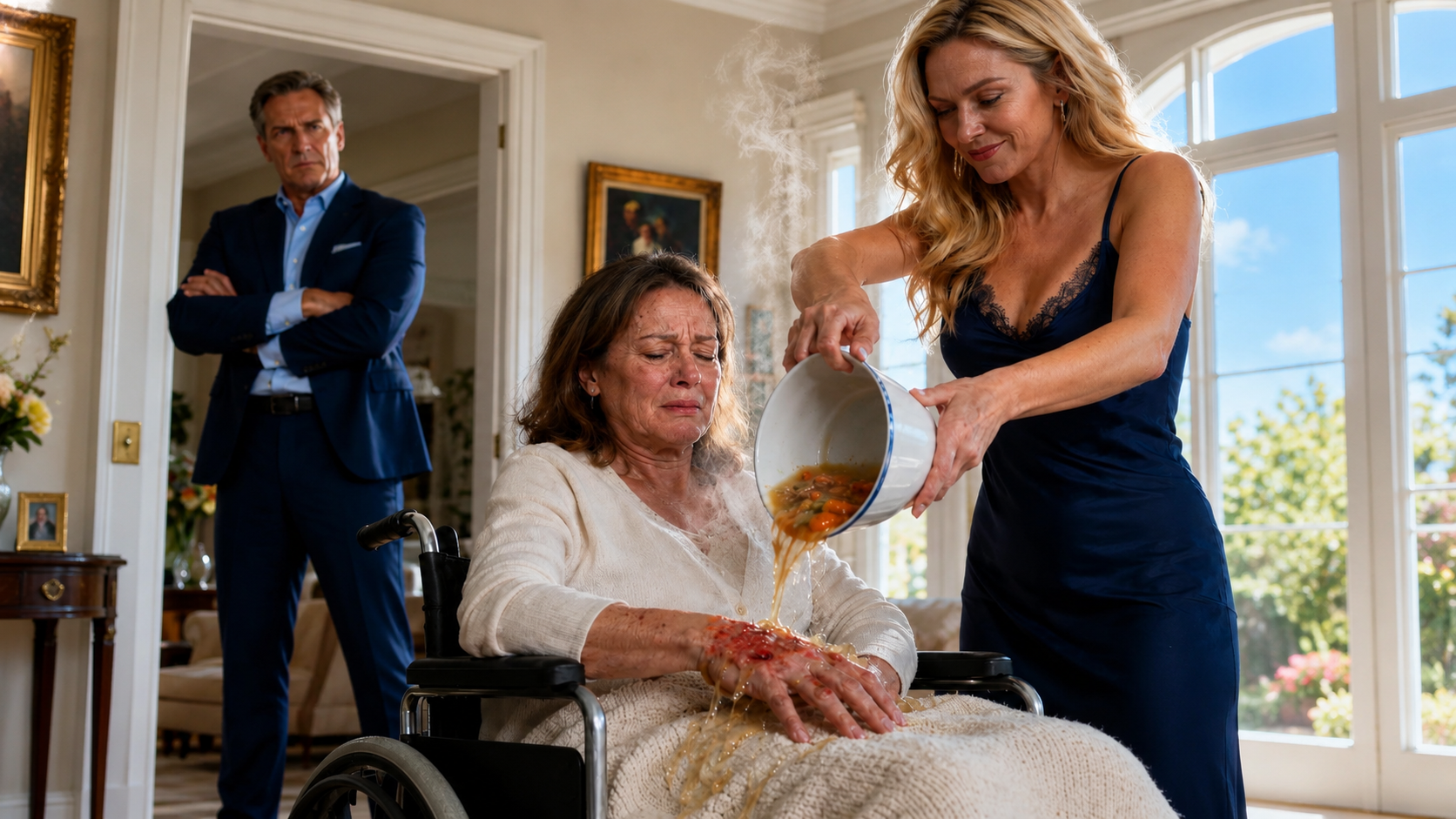
“Stop crying, Eleanor,” Chloe said, smiling as if my pain amused her. “You can’t feel anything anyway.”
Then she tilted the bowl.
Hot soup spilled across the back of my hand.
It was not warm. It was not accidental.
It was scalding.
The kind of heat that travels straight through skin, nerve, bone, and memory. The kind of pain that makes your soul try to leave your body.
But I did not scream.
I did not pull away.
I did not blink.
Across the dining table, my husband Robert watched me with cold eyes. Thirty years of marriage sat between us like a dead thing.
Chloe leaned closer, studying my face.
“See?” she whispered. “Nothing. I told you, Robert. She is gone inside.”
Robert took a slow sip of wine.
“She has been gone for years,” he said. “Her body just hasn’t caught up yet.”
Chloe laughed.
I lowered my eyes like the broken, brain-damaged woman they believed I was.
But deep inside, behind my silent face, behind my frozen hands, behind the wheelchair they thought had become my prison, I was counting.
One insult.
One threat.
One confession.
One mistake.
They were adding stones to the same grave they thought they were digging for me.
They just did not know the grave was theirs.
My name is Eleanor Brooks.
Three years ago, a car crash took my legs from me.
At least, that was what everyone believed.
For a long time, I believed it too.
The doctors told me there was severe nerve damage. They told me recovery was unlikely. They told me to accept a new life.
A wheelchair. Nurses. Physical therapy. Medication. Pity.
Robert played the role of the perfect husband so well that people cried when they saw him push my chair through church, charity dinners, and hospital halls.
“What a devoted man,” women whispered.
“Eleanor is blessed to have him,” friends said.
“Not many husbands would stay,” others murmured, as if Robert deserved a crown for not abandoning his wife.
And I believed them.
I believed him.
When he fixed my blanket, I thanked him.
When he fed me soup, I smiled at him.
When he told me, “You are still beautiful to me,” I cried in his arms.
For thirty years, I thought love had given me a faithful husband.
Then one night, love removed the blindfold.
It happened six months before the mountain storm.
I had been in the hospital for another round of nerve testing. The doctors had discovered small signs of improvement. A twitch in my left foot. A spark of feeling behind my knee. A response where there had been nothing.
I was terrified to hope.
But when I was alone in the examination room, I moved my toes.
Not much.
Just a tiny motion.
But to me, it was the sound of a locked door opening.
I wanted to surprise Robert.
I wanted to tell him that maybe, by some miracle, his wife was coming back to him.
I called his name, but he was not in the room.
The door was slightly open.
I heard voices in the hallway.
Robert’s voice.
And a woman’s.
I recognized her laugh first.
Chloe.
My husband’s “business consultant.”
The woman he said was helping him manage our real estate investments.
The woman who had started visiting our home too often.
The woman who smiled at me like I was furniture.
I wheeled myself closer to the door.
Then I heard Robert say, “The woman refuses to die.”
My heart stopped.
Chloe whispered, “Lower your voice.”
Robert hissed, “I am tired of waiting. The doctors keep saying maybe there’s improvement, maybe there’s hope. Hope is expensive, Chloe. Hope delays everything.”
Everything?
What everything?
Chloe’s heels clicked against the floor.
“You promised me the estate would be ours by summer,” she said. “You promised me the accounts, the house, the mountain property—everything.”
Robert exhaled sharply.
“And it will be. We just need to accelerate the plan.”
“What plan?” Chloe asked.
There was a pause.
Then Robert said, “The mountain trip.”
My fingers tightened around the wheels of my chair.
Chloe’s voice dropped.
“You mean…”
“Yes,” Robert said. “A tragic accident. A disabled woman, confused from medication, disappears during bad weather. They search. They find nothing. I file the missing person report. After enough time passes, the estate transfers. The insurance pays out. The properties become mine.”
Chloe was silent.
Then she asked, “And if she screams?”
Robert laughed.
That laugh was the sound of my marriage dying.
“She barely knows where she is anymore,” he said. “And even if she does, who will believe her? She’s a paralyzed woman with brain damage.”
Brain damage.
I had no brain damage.
I never had.
But after that day, I became the greatest actress Robert had ever underestimated.
When he entered the room minutes later, smiling and carrying flowers, I was staring blankly at the wall.
“Eleanor?” he said. “Sweetheart?”
I let my mouth hang slightly open.
His smile faded.
“Eleanor?”
I blinked slowly, as if the world had slipped far away from me.
He touched my shoulder.
I did not respond.
A doctor was called. Tests were done. Robert told everyone the stress had finally damaged my mind.
“She is not herself,” he said, wiping fake tears from his face. “Sometimes she doesn’t even understand what I’m saying.”
People pitied him even more.
Poor Robert.
Faithful Robert.
Trapped Robert.
But every night, while he slept downstairs with whiskey on his breath and Chloe’s perfume on his collar, I worked.
At first, I could only move my toes.
Then my ankles.
Then I could bend my knees.
The pain was unbearable. My legs had forgotten how to belong to me.
Every night at 2:00 AM, I lowered myself from bed onto the hardwood floor.
Sometimes I fell.
Sometimes I bit a towel to keep from crying out.
Sometimes my legs trembled so badly I thought they would never hold me again.
But I kept going.
I crawled to the dresser.
Pulled myself up.
Fell.
Pulled myself up again.
Step.
Fall.
Step.
Fall.
Step.
Pray.
Step.
Survive.
By the end of the second month, I could stand for ten seconds.
By the fourth, I could walk across the room if I held the wall.
By the sixth, I could walk normally enough when no one was watching.
And no one was watching.
That was their biggest mistake.
Cruel people rarely watch the people they think they have already destroyed.
During the day, I became the silent wife in the wheelchair.
I stared into space.
I let food fall from my spoon.
I let Robert speak for me.
I let Chloe move into my home.
She wore my silk robe.
She opened my closets.
She tried on my earrings in front of me.
One afternoon, she stood behind me in the mirror wearing my mother’s diamond necklace.
“What do you think, Eleanor?” she asked, touching the stones at her throat. “Too much?”
Robert looked up from his phone and smirked.
“She doesn’t know diamonds from door knobs anymore.”
Chloe bent beside me.
“Blink once if you hate me,” she whispered.
I stared ahead.
She laughed.
“Oh, Robert, she really is gone.”
No, Chloe.
I was not gone.
I was gathering evidence.
Robert had been forcing me to sign blank documents.
He would place a pen in my limp hand, guide my fingers, and say, “Just a little signature, darling. It’s for your care.”
But I had learned something important.
Robert was greedy, but he was lazy.
He kept files in his study.
Insurance papers.
Fraudulent transfer forms.
Fake medical statements.
Real estate titles.
Loan applications.
He thought I could not read.
He thought I could not understand.
He thought I could not move.
So at night, I moved.
I found his burner phone hidden behind a loose panel under his desk.
I photographed messages between him and Chloe.
I recorded conversations from the hallway.
I copied bank statements.
And the most important documents—the real property deeds, the original trust papers, the old power of attorney forms—I removed from his safe and hid inside the stuffing of a horrible old throw pillow in the living room.
It was ugly.
Orange flowers. Torn corner. One missing button.
Chloe hated it.
“This thing looks like it died in 1978,” she once said. “Why do you keep it?”
Robert shrugged.
“Eleanor’s mother made it. Let the idiot have one ugly thing.”
That “ugly thing” held the future of everything Robert planned to steal.
Three weeks before the mountain trip, I contacted David Miller.
David had been a desperate law student when I met him twenty years earlier. He had been accused of something he did not do, abandoned by almost everyone, and too poor to defend himself. I paid for his lawyer. Later, when he became one of the strongest defense attorneys in the state, he never forgot.
When he answered my secret call, I did not waste time.
“David,” I whispered. “My husband is going to kill me.”
There was a silence.
Then his voice changed.
“Tell me everything.”
So I did.
I told him about Robert.
About Chloe.
About the soup.
About the fake documents.
About the mountain plan.
About my legs.
David listened without interrupting.
When I finished, he said, “Eleanor, listen to me carefully. Do not confront him. Do not let him know you can walk. We need evidence strong enough that he cannot smile his way out of it.”
“He is taking me to the mountains soon,” I said.
“Good,” David replied.
“Good?”
“Yes,” he said. “Because this time, he will not be taking you alone.”
The day Robert announced the trip, he was cheerful.
Too cheerful.
“Fresh air will be good for you,” he said, adjusting my blanket. “Just you and me. Like old times.”
Chloe stood by the fireplace, sipping coffee from my favorite cup.
“Bring a warm coat,” she said sweetly. “Mountains can be dangerous.”
I looked at her.
Blank.
Empty.
Silent.
But inside, I smiled.
The drive took three and a half hours.
Robert talked the entire time.
At first, he pretended to be gentle.
“Do you remember when we used to come here, Eleanor?” he asked.
I stared out the window.
“Of course you don’t,” he muttered.
Rain struck the windshield harder as the road climbed higher.
The forest thickened.
The sky darkened.
Then Robert stopped pretending.
“You know,” he said, “I used to love you.”
I did not move.
“I really did. But do you know what happens when a man spends years pushing a chair? Feeding a woman? Bathing her? Watching her stare like a dead fish?”
His hands tightened on the steering wheel.
“He starts feeling buried alive.”
The recorder inside my coat pocket captured every word.
Robert laughed bitterly.
“And then Chloe came along. Beautiful. Alive. Hungry for the same life I deserved.”
He glanced at me.
“You should have died in that crash, Eleanor.”
My throat tightened, but I kept my eyes empty.
“You would have saved everyone so much trouble.”
The road became narrow.
Mud splashed beneath the tires.
Finally, Robert pulled onto a dirt trail near the old overlook.
Rain poured like the sky had split open.
He got out, opened the back door, and dragged my wheelchair from the trunk.
“Come on, darling,” he said loudly, just in case anyone was nearby. “Let’s get you some fresh air.”
He placed me in the chair and pushed me down the muddy path.
The storm swallowed every sound.
When we reached the overlook, the valley below was hidden beneath fog.
Robert leaned close to my ear.
“This is where your story ends.”
He stepped in front of me.
For one second, I saw the man I had married.
Not as he was.
As I had imagined him.
Kind. Loyal. Safe.
Then lightning flashed, and I saw the truth.
He was smiling.
“You’ll be found eventually,” he said. “Maybe. Maybe not. Either way, poor Robert will be heartbroken.”
He crouched in front of me and patted my knee.
“Goodbye, Eleanor.”
Then he pushed my wheelchair sideways into the mud, turned, and walked away.
I lay there as rain soaked through my clothes.
The cold bit into my skin.
The wind screamed through the trees.
For several minutes, I did not move.
Not because I could not.
Because I wanted to hear his car leave.
The engine started.
The tires slipped, then caught.
The sound faded into the mountain storm.
Only then did I reach into my coat and touch the recorder.
Still running.
“Thank you, Robert,” I whispered.
Then I planted my hands in the mud.
Slowly, deliberately, I pushed myself up.
My knees shook.
My legs burned.
But they held.
For the first time in front of the world, I stood completely upright.
The storm did not bury me.
It baptized me.
A flashlight suddenly cut through the rain.
I froze.
Had Robert come back?
Had he changed his mind?
Had he realized something?
A voice called out, “Eleanor!”
I turned.
Three figures moved through the storm.
David Miller appeared first, soaked from head to toe, his face pale with fear and relief.
Behind him were two police officers.
David stopped dead when he saw me standing.
For a moment, he could not speak.
Then he whispered, “My God. You did it.”
I held up the recorder.
“He confessed to everything.”
One officer rushed forward with a blanket.
“Mrs. Brooks, we need to get you to the hospital.”
“No,” I said.
David frowned. “Eleanor—”
“No,” I repeated, stronger this time. “Take me home.”
The officers exchanged a look.
David understood before they did.
“You want to catch them celebrating,” he said.
I looked down the mountain road where Robert had vanished.
“Yes,” I said. “I want to walk in while the champagne is still cold.”
The drive back felt longer than the drive up.
No one spoke much.
I sat in the back of the unmarked police van, wrapped in a blanket, watching rain race down the window.
My hand throbbed from the burn Chloe had given me.
My legs ached from the climb.
But none of it hurt as much as remembering Robert’s face while he left me there.
David sat beside me.
“You know,” he said quietly, “you do not have to see him again tonight. The recording is enough. We can arrest him without you walking into that room.”
I turned to him.
“David, for six months I let them think I was less than human.”
His jaw tightened.
“I know.”
“I let them laugh.”
“I know.”
“I let that woman wear my mother’s necklace.”
David looked away.
“I know.”
“So tonight,” I said, “they will look at me. They will see me standing. And they will understand exactly who they underestimated.”
When we arrived at the mansion, every light was on.
Music poured from the house.
Jazz.
Robert’s favorite.
The driveway was filled with soft golden light, rain, and the smell of expensive cigars.
Through the tall glass windows, I saw them.
Robert and Chloe.
Laughing.
Dancing.
Celebrating.
Chloe wore a red dress.
And around her neck was my mother’s diamond necklace.
Robert lifted a champagne glass.
“To freedom,” he said.
Chloe clinked her glass against his.
“To us.”
My fingers curled into fists.
David gently touched my arm.
“Ready?”
I opened the van door.
The rain hit my face.
I stepped out.
One foot.
Then the other.
The officers stayed behind me, hidden in the shadows of the porch.
I walked up the stone steps of my own home.
For years, Robert had pushed me through this doorway like I was a burden.
Tonight, I opened it myself.
The music was loud.
Robert did not even turn around.
“Did you forget something, darling?” he called, thinking Chloe had walked away.
I stepped into the foyer.
Chloe saw me first.
Her glass slipped from her hand and shattered on the marble.
Robert turned.
The color drained from his face so quickly it looked painful.
I smiled.
“Hello, Robert.”
His mouth opened, but no words came out.
Chloe stumbled backward.
“No,” she whispered. “No, no, no…”
Robert gripped the back of the sofa.
“Eleanor?”
I took another step.
Then another.
His eyes dropped to my feet.
I let him watch.
Let him understand.
Let him choke on the truth.
“How…” he whispered. “How are you walking?”
I tilted my head.
“I’ve been walking for six months.”
Chloe screamed.
Robert looked at her, then back at me.
“That’s impossible.”
“No,” I said. “What was impossible was believing you ever loved me.”
His face twisted.
“You’re confused. You don’t know what you’re saying.”
I laughed softly.
That laugh scared him more than anger would have.
“Oh, Robert. I know everything.”
Chloe shook her head violently.
“She’s lying. She’s lying, right? Robert, tell me she’s lying.”
Robert snapped, “Shut up!”
I walked to the couch.
The ugly orange pillow sat in the corner, exactly where Chloe had thrown it earlier.
I picked it up.
Chloe frowned through her panic.
“What are you doing?”
I ripped the seam open.
Documents spilled across the coffee table.
Bank records.
Original deeds.
Trust papers.
Insurance letters.
Robert stared at them as if they were snakes.
“No,” he said.
“Yes,” I replied.
He lunged forward, but I lifted one hand.
“I would not do that.”
The front door opened wider behind me.
David stepped in.
Four police officers followed.
Robert froze.
The lead officer said, “Robert Brooks, step away from your wife.”
Chloe burst into tears.
“It was him!” she screamed. “It was Robert! He planned everything!”
Robert spun toward her.
“You stupid—”
“He said she was already dead inside!” Chloe cried. “He said nobody would believe her! He said if I helped him, we would get the house!”
I looked at Robert.
“That did not take long.”
He pointed at me, shaking.
“She is unstable! She has brain damage! Ask anyone!”
David held up the recorder.
“Then it is unfortunate for you that your unstable wife recorded your entire confession.”
Robert’s face went slack.
I took the device from David and connected it to the sound system.
Robert’s own voice filled the room.
“You should have died in that crash, Eleanor.”
Chloe covered her mouth.
The officers stared at Robert with disgust.
Then the next line played.
“By tomorrow morning, the cold will finish it. Poor Robert will inherit everything.”
Robert lunged for the recorder.
Two officers grabbed him before he made it three steps.
“Get off me!” he shouted. “She tricked me!”
I stepped closer.
“No, Robert. You revealed yourself.”
He struggled against the officers.
“You were nothing without me!”
I looked around the mansion.
The chandeliers. The marble. The paintings. The gold-framed mirrors.
Then I looked back at him.
“You lived in my house. Spent my money. Wore my kindness like a mask. And somehow, you convinced yourself you were the powerful one.”
Chloe sobbed, clutching the necklace.
“Eleanor, please. I didn’t mean to hurt you. Robert manipulated me.”
I turned to her.
“You poured boiling soup on my hand.”
She cried harder.
“I was scared of him.”
“No,” I said. “You were greedy.”
Her fingers tightened around my mother’s diamonds.
I held out my hand.
“Take it off.”
Chloe stared at me.
“What?”
“The necklace. Take it off.”
She looked at Robert.
Robert looked at the floor.
Slowly, with trembling fingers, Chloe unclasped the necklace and placed it in my palm.
I closed my fist around it.
“My mother wore this on the day she opened her first bakery,” I said. “She worked sixteen hours a day so I could have choices. You wore it while celebrating my death.”
Chloe whispered, “I’m sorry.”
“No,” I said. “You are caught.”
The officers pulled Robert toward the door.
He suddenly stopped fighting.
His eyes locked on mine.
For the first time that night, he looked almost human.
“Eleanor,” he said quietly. “Please. We were married thirty years.”
I stared at him.
That was the cruelest thing he had said all night.
“Thirty years,” I repeated.
His voice broke.
“I made a mistake.”
I stepped closer until he could see the burn on my hand.
“A mistake is forgetting an anniversary. A mistake is saying something foolish in anger. You planned my murder while sleeping under my roof.”
He swallowed.
“I loved you once.”
“No, Robert,” I said. “You loved what you could take from me.”
He looked at David.
“Tell her I can make this right.”
David gave him a cold smile.
“You can start by remaining silent.”
Robert turned back to me.
“Eleanor, please.”
I lifted my hand and slapped him across the face.
The room went still.
“That,” I said, “was for leaving me in the storm.”
Then I turned to Chloe and slapped her too.
“And that was for the soup.”
Chloe fell onto the sofa, sobbing.
Robert shouted my name as the officers dragged him into the rain.
But I did not answer.
For the first time in years, his voice had no power over me.
The arrests made local news within hours.
The public was shocked.
Friends called.
Neighbors sent flowers.
People who had praised Robert for years suddenly said they had “always sensed something strange.”
I did not answer most of them.
Pity had exhausted me.
The trial took months.
Chloe took a plea deal first.
Of course she did.
She sat in court wearing a gray suit, no makeup, no diamonds, no arrogance.
She testified against Robert with a trembling voice.
“He said Eleanor was worthless,” she told the court. “He said she was already dead in every way that mattered. He said the money should belong to people who could actually enjoy it.”
Robert sat at the defense table, staring straight ahead.
When my recording played in court, the room went silent.
Even the judge looked disturbed.
Robert’s lawyer tried to argue emotional distress.
Stress from caregiving.
Financial pressure.
Temporary madness.
But David destroyed every excuse.
“Temporary madness does not forge documents for six months,” he said.
“Temporary madness does not create false medical statements.”
“Temporary madness does not move a mistress into the victim’s home.”
“Temporary madness does not drive a disabled wife into the mountains during a storm and leave her there to die.”
When I took the stand, Robert finally looked at me.
I wore a simple navy dress.
Flat shoes.
My mother’s necklace.
I walked to the witness stand without help.
The courtroom watched every step.
The prosecutor asked, “Mrs. Brooks, when did you realize your husband intended to kill you?”
I looked at Robert.
“The day I stopped being useful to him.”
Robert lowered his eyes.
The prosecutor continued, “Why did you pretend you were still paralyzed?”
I answered honestly.
“Because sometimes, when evil believes you are weak, it speaks freely.”
There was a murmur across the courtroom.
Robert was convicted of attempted murder, conspiracy, insurance fraud, grand larceny, and financial abuse.
When the judge sentenced him, he did not cry.
Not until the number of years was read aloud.
Then he turned around and searched the courtroom for me.
I was sitting in the back.
He mouthed, “I’m sorry.”
I did not mouth anything back.
Some apologies are only fear wearing a costume.
Chloe received a lighter sentence because of her cooperation, but she did not walk away free.
Not from prison.
Not from shame.
Not from the truth of what she had done.
As for the mansion, I sold it.
People were surprised.
“After everything you fought for,” one woman said, “you’re just going to let it go?”
I looked at the grand staircase.
The dining room.
The fireplace.
The chair by the window where I had pretended not to understand.
“This house heard too much,” I said.
I did not want marble floors that remembered broken glass.
I did not want walls that remembered Robert’s lies.
I did not want a bedroom where I had learned to walk in secret because my own husband was waiting for me to die.
So I sold it.
With part of the money, I bought a small brick building downtown.
It had wide windows, old wooden floors, and sunlight that poured through the front every morning.
People asked what I planned to do with it.
I smiled and said, “Something warm.”
Six months later, I opened Eleanor’s Café.
Not a mansion.
Not an empire.
A café.
Fresh bread. Hot coffee. Soup that healed instead of hurt.
On opening day, David came first.
He stood at the counter, looking around with tears in his eyes.
“You built something beautiful,” he said.
I poured him coffee.
“No,” I said. “I reclaimed something beautiful.”
“What’s that?”
“My life.”
The café became more than a business.
Women came in who had heard my story.
Some came for coffee.
Some came because they needed a place to sit without being afraid.
One woman named Maria came in every Tuesday. She wore sunglasses the first time, even though it was raining.
She ordered tea with shaking hands.
I did not ask questions.
I simply placed a warm blueberry muffin beside her cup.
She looked at it and whispered, “I didn’t order this.”
“I know,” I said. “It’s on the house.”
The next week, she came back.
The third week, she spoke.
“My husband controls all the money,” she said quietly. “He says no one will believe me.”
I looked at her for a long moment.
Then I said, “They always say that.”
She began to cry.
I reached across the table and took her hand.
“Listen to me,” I said. “You are not crazy. You are not weak. And you are not alone.”
That became the quiet mission of the café.
Coffee in the front.
Courage in the back.
David helped me set up a small legal support fund for women trapped in abusive homes.
We named it The Orange Pillow Fund.
He laughed when I suggested it.
“That is the strangest name I’ve ever heard,” he said.
I smiled.
“Good. Then people will ask about it.”
And they did.
Whenever someone asked, I told them the truth.
“An ugly pillow once saved my life.”
Years passed.
My legs never became perfect.
Some mornings, especially when rain rolled over the mountains, pain ran through them like old lightning.
But every ache reminded me of something important.
I could feel.
I could stand.
I could walk.
One winter evening, just before closing, a young woman came into the café with a little girl on her hip.
She looked tired in a way I understood immediately.
Not sleepy.
Soul-tired.
She ordered the cheapest thing on the menu.
Black coffee.
I brought her soup instead.
She stiffened when she saw the bowl.
For a second, her eyes filled with fear.
I understood.
I sat across from her.
“This soup is safe,” I said gently.
She stared at me.
Then she whispered, “I read about you.”
I nodded.
“My husband says I’m nothing without him,” she said.
The little girl rested her head on her mother’s shoulder.
I looked at that child.
Then at the woman.
“No,” I said. “You are something he is afraid to lose control of.”
Her lips trembled.
“What if I can’t leave?”
I reached into the drawer beneath the counter and pulled out a card.
David’s number.
A shelter contact.
A note in my handwriting.
You are not alone.
I slid it across the table.
“You don’t have to do everything tonight,” I told her. “You just have to believe there is a door.”
She cried quietly into her soup.
And I realized then that Robert had failed in a way even prison could not fully measure.
He wanted my life to end in the cold.
Instead, it became a fire for other women.
One morning, years after the trial, a letter arrived at the café.
No return address.
I knew Robert’s handwriting before I opened it.
Eleanor,
I am old now. Prison has taken everything. Chloe is gone. The money is gone. My name is gone. I think about you every day. I think about the mountain. I think about what I did. I know you will never forgive me, but I need you to know I regret it. I was a fool. I destroyed the only person who ever truly loved me.
Robert.
I read it once.
Then I folded it carefully.
David happened to walk in as I held the letter.
“From him?” he asked.
“Yes.”
“What will you do?”
I walked to the fireplace near the reading corner.
For years, I had wondered what I would feel if Robert ever apologized.
Rage?
Satisfaction?
Sadness?
But standing there, with morning light on the floor and the smell of cinnamon bread in the air, I felt something else.
Distance.
The kind of peace that comes when a wound becomes a scar.
I placed the letter into the fire.
David watched the paper curl.
“Did it help?” he asked.
I smiled.
“No.”
He frowned.
“Then why burn it?”
“Because some words arrive too late to deserve a home.”
The bell above the café door rang.
Customers entered.
Life continued.
And I continued with it.
That afternoon, rain began tapping against the windows.
The same kind of rain that had fallen on the mountain.
For a moment, I looked outside and remembered the mud, the cold, the darkness, and Robert’s footsteps walking away from me.
Then I looked down at my legs.
Older now.
Scarred.
Imperfect.
Mine.
I stepped from behind the counter and carried soup to a table where Maria sat with her teenage daughter, both laughing over a slice of cake.
David waved from the corner.
A young mother read quietly by the window.
A group of college students shared pastries near the door.
The café was full of warmth.
Full of voices.
Full of life.
I placed the soup down and smiled.
People often ask if revenge healed me.
The answer is no.
Revenge exposed the truth.
Justice closed the door.
But healing?
Healing was every step I took after.
Every woman I helped.
Every morning I opened that café.
Every time I chose not to let Robert’s cruelty become the final chapter of my story.
My husband thought I could not feel pain.
He was wrong.
I felt everything.
The burn.
The betrayal.
The cold.
The heartbreak.
The fear.
But I also felt something he never expected.
Strength returning.
One nerve.
One breath.
One step at a time.
And when I walked into that room on the night he celebrated my death, I was not a ghost.
I was not a victim.
I was not his broken wife.
I was the woman he failed to bury.
And I was finally free.