My Husband Divorced Me Because I Couldn’t Give Him Children — Three Years Later, My Twins Walked Into His Wedding
He Threw Me Out for a Younger Woman, Not Knowing I Was Pregnant With His Twins — Three Years Later, They Stopped His Wedding
For eleven years, my husband told everyone I was the reason our house had no children.
His mother called me “empty.”
You May Also Like




His new fiancée called me “the past.”
Then, on the same morning he forced me out of our home, I found out I was pregnant.
Not with one baby.
With twins.
I left quietly because a man who throws away his wife at her lowest does not deserve to hear her greatest miracle.
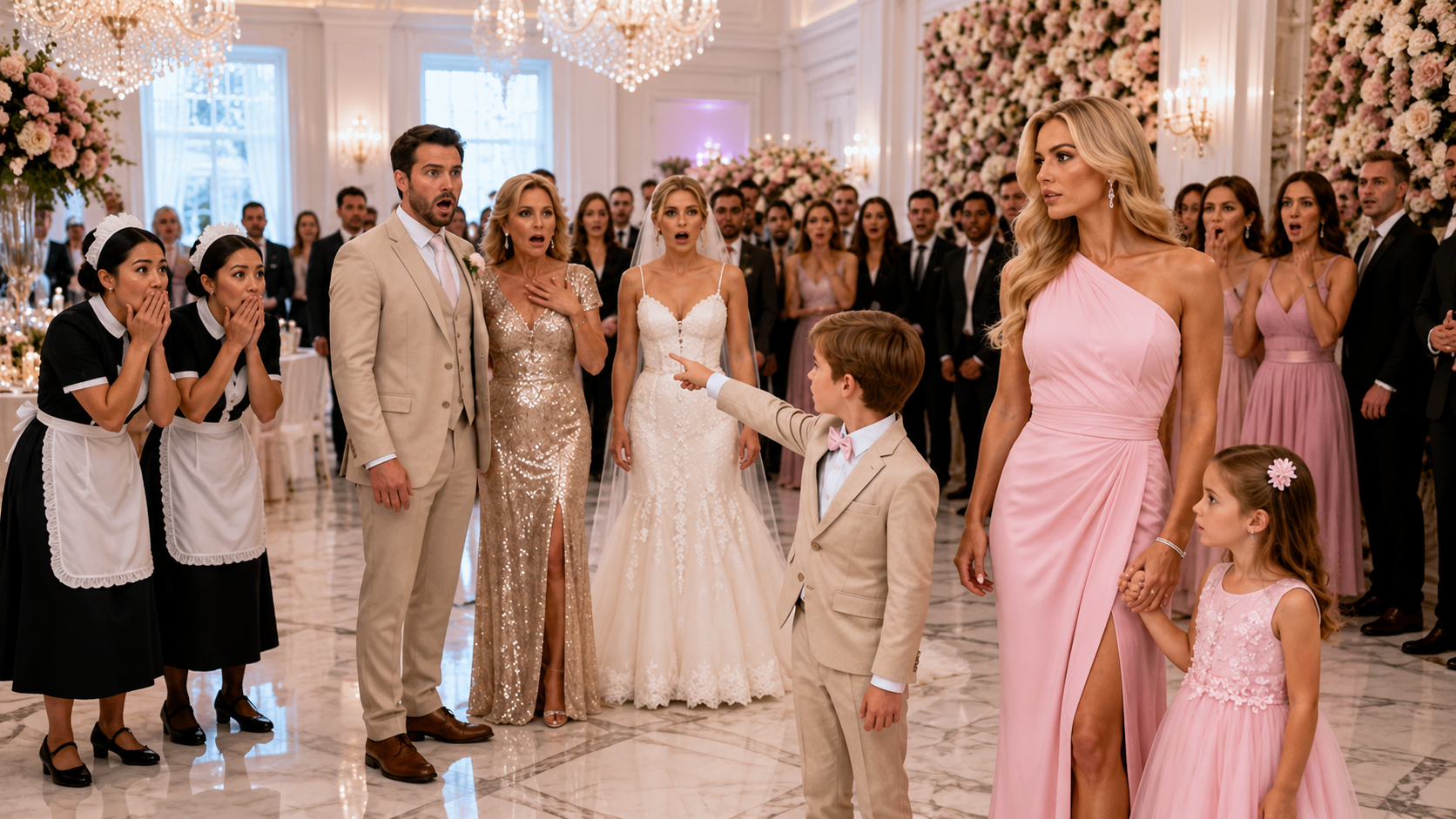
But three years later, when he stood at the altar ready to marry the woman who replaced me, my children walked through the doors.
And the moment his mother saw their faces, she whispered:
“Impossible.”
The Story
For eleven years, I lived inside a beautiful house that felt louder in silence than most places felt in chaos.
There were no baby shoes by the door.
No small handprints on the glass windows.
No toys scattered across the living room.
No tiny voice calling, “Mommy.”
Only polished floors, expensive furniture, and a sadness everyone pretended belonged only to me.
My name is Claire Hensley.
For eleven years, I was married to Graham Ellison.
The Ellison family was the kind of family people respected from a distance. They had money, a coastal estate in Newport Beach, old portraits in gold frames, and a last name that seemed to open doors before they even knocked.
But inside that family, love was not warm.
It was measured.
Controlled.
Displayed.
Graham’s mother, Diane Ellison, treated the family name like a crown. She wore pearls, hosted charity luncheons, smiled at photographers, and knew how to insult someone so gently that other people thought she was being polite.
At every family dinner, she found a way to remind me I had failed.
“A house this large feels strange without children, doesn’t it, Claire?”
Or:
“Some women are born with a natural gift for motherhood. Others are simply… different.”
The first few years, Graham defended me.
“Mother, stop.”
“Claire is doing everything she can.”
“We don’t need to discuss this at dinner.”
Back then, he still reached for my hand under the table.
But after years of doctor visits, failed treatments, and negative pregnancy tests, even his hand stopped searching for mine.
Month after month, I sat on the bathroom floor staring at another result that broke me quietly.
One line.
Never two.
Just one lonely line reminding me that hope could be cruel.
I cried silently because crying loudly made Graham uncomfortable.
I prayed in the shower because praying in bed made him turn away.
And every time Diane looked at me across the dinner table, I felt smaller.
One evening, after another failed appointment, I heard Graham talking to his mother in the kitchen.
“She’s trying,” he said.
Diane answered coldly, “Trying is not the same as giving you a family.”
“She’s my wife.”
“She is your wife,” Diane said. “But the Ellison name cannot end because of Claire’s emotions.”
I waited for Graham to defend me.
I waited for him to say, “Do not speak about my wife that way.”
Instead, he said nothing.
That silence became the beginning of the end.
Her name was Brielle Stanton.
She was twenty-seven, elegant, confident, and everything Diane believed I was not.
She had perfect blonde hair, a soft public smile, and the kind of beauty people called “fresh” when they were trying not to say “younger.”
I first saw her at a charity event.
She was standing beside Graham near the champagne table, laughing too easily at something he said.
When Graham saw me watching, he looked away.
That told me more than any confession could have.
That night, I asked him.
“Are you having an affair?”
He removed his tie slowly.
“Claire, don’t start.”
“Don’t start?” I repeated. “I’m your wife.”
He laughed, but there was no kindness in it.
“You’ve been my wife for eleven years. And what has that given us?”
The words landed between us like broken glass.
I stared at him.
“So that’s what I am to you now? A failed investment?”
He looked tired, not guilty.
“I didn’t say that.”
“You didn’t have to.”
He walked toward the window.
“I wanted a family.”
“So did I.”
He turned around.
“But you couldn’t give me one.”
I felt my whole body go cold.
I had imagined many things over the years. I had imagined him leaving. I had imagined him cheating. I had imagined him blaming me.
But hearing it out loud still shattered something deep inside me.
I whispered, “You promised we would face this together.”
Graham looked at me with empty eyes.
“I was younger when I made that promise.”
That was the night I stopped begging for his love.
But I still did not know the final cruelty was waiting for me the next morning.
The next day, I went to see a new specialist in Irvine.
I almost canceled the appointment.
After eleven years, hope felt embarrassing. I had been told the same thing by so many doctors that I had started to believe my body was a locked door God had chosen not to open.
But this doctor was different.
She studied my records for a long time.
Then she frowned.
“Claire,” she said gently, “may I ask you something?”
I held my purse tightly in my lap.
“Of course.”
“Were you ever told your original diagnosis was incomplete?”
I blinked.
“Incomplete?”
She turned the chart toward me.
“There were signs of a treatable condition. This should have been investigated years ago.”
My heart began beating hard.
“What does that mean?”
“It means,” she said softly, “you may not have been the problem everyone told you that you were.”
I could not speak.
She ordered bloodwork.
Then an ultrasound.
Then she came back into the room with a smile that made my hands tremble.
“Claire,” she said, “you’re pregnant.”
The world stopped.
I heard the air conditioner.
I heard a nurse laugh somewhere in the hallway.
I heard my own breath break in my chest.
“I’m what?”
“You’re pregnant.”
My hands flew to my mouth.
Tears spilled before I could stop them.
Then the doctor’s smile grew.
“And from what we can see, it looks like twins.”
Twins.
Two babies.
Two tiny miracles.
After eleven years of being called empty, there were two heartbeats inside me.
I touched my stomach with shaking fingers.
For one beautiful, foolish moment, I forgot everything Graham had said the night before.
I imagined going home.
I imagined showing him the ultrasound.
I imagined his face breaking open with regret and joy.
I imagined him holding me and whispering, “I’m sorry, Claire. I’m so sorry.”
I imagined us becoming a family at last.
But when I arrived at the house, my suitcase was on the front steps.
My keys were placed neatly on top.
And beneath them was a white envelope.
Divorce papers.
The front door stood open.
Inside, Graham stood near the marble entryway in a navy suit.
Diane stood beside him, wearing pearls and a satisfied expression.
Brielle sat in my living room with a glass of sparkling water in her hand, as if she had already tried the chair and decided it suited her.
I stood there holding the medical envelope in my purse.
My miracle was inside that envelope.
So was the power to destroy the smug look on Diane’s face.
Graham did not ask why I was crying.
He did not ask where I had been.
He only said, “Claire, this has gone on long enough.”
I stared at him.
“What has?”
Diane answered for him.
“The pretending.”
I looked at her.
She continued, “Graham deserves a real family. He deserves a wife who can give him children.”
Brielle looked down at her glass, pretending to be uncomfortable.
But she did not leave.
She did not apologize.
She sat there inside my house, watching my marriage end like it was an unfortunate scene in someone else’s movie.
I looked at Graham.
“Is this what you want?”
He sighed.
“I’m tired, Claire.”
“Tired?”
“Tired of appointments. Tired of disappointment. Tired of waiting for something that may never happen.”
My hand moved slowly toward my purse.
One movement.
One envelope.
One ultrasound picture.
I could have changed everything.
But then Graham looked directly at me and said:
“I want a life that moves forward.”
And I understood.
He was not leaving because we had no children.
He was leaving because love had become inconvenient.
I removed my hand from my purse.
Diane noticed.
Her eyes narrowed.
“What is that?”
I held the purse tighter.
“Nothing.”
Graham slid the papers toward me.
“Our attorneys will handle the rest.”
I laughed once.
It came out broken.
“You packed my suitcase?”
Brielle finally spoke.
“It might be easier this way.”
I turned to her slowly.
“Easier for who?”
Her cheeks flushed.
Graham stepped between us.
“Don’t make this ugly.”
I looked around the house I had decorated. The staircase where I had hung Christmas garland. The kitchen where I had made soup for Graham when he was sick. The dining room where Diane had humiliated me year after year.
Then I looked at my husband.
“It became ugly the moment you let another woman sit in my home while you threw me out of it.”
Diane’s mouth tightened.
“Claire, have some dignity.”
I picked up my suitcase.
Then I looked her straight in the eyes.
“Dignity is exactly why I’m walking out without begging.”
And I left.
With one suitcase.
One broken heart.
And two babies no one in that house knew existed.
I did not disappear.
I rebuilt.
Quietly.
Painfully.
Day by day.
I moved to Pasadena and stayed with my aunt for two months. She gave me her guest room, warm tea, and the kind of silence that does not demand explanations.
When the divorce papers came through, I signed them.
Not because it did not hurt.
Because I was exhausted.
Because I was pregnant.
Because peace had become more valuable than revenge.
Because I refused to fight for a man who had already chosen to humiliate me.
When my stomach began to show, my aunt asked me gently, “Are you going to tell him?”
I sat at the kitchen table, staring at the ultrasound picture.
“I don’t know.”
“He has a right to know.”
I nodded.
“And they have a right to be safe.”
She said nothing after that.
Because she had seen my hands shake when Graham’s attorney sent letters accusing me of abandoning the house.
She had heard me cry after Diane sent one final message through a family friend:
“Claire should stop embarrassing herself. The Ellison family is moving forward.”
So I moved forward too.
My son was born first.
Owen.
Three minutes later came my daughter.
Maisie.
Owen had Graham’s gray eyes.
Maisie had his dimple.
When the nurse placed them in my arms, I did not think about revenge.
I thought about mercy.
Because the man who had blamed me for an empty home had left just before his children arrived.
The first year was hard.
Beautiful, but hard.
I learned to sleep in pieces.
I learned to warm bottles while half-awake.
I learned that one baby could cry loudly, but two babies could create a full storm.
I worked remotely for a design firm during nap times.
I answered emails with one baby against my chest and the other sleeping beside me.
Sometimes, when both twins finally slept, I sat on the bathroom floor and cried.
Not because I regretted them.
Never.
I cried because I was tired.
Because I was lonely.
Because I had wanted Graham to choose us before he knew about them.
But then morning came.
Owen smiled.
Maisie reached for my finger.
And I kept going.
That is what mothers do.
They keep going even when their hearts are still bleeding.
Three years passed.
Owen became curious and serious, always asking “why.”
Maisie became bright and fearless, always asking “why not.”
They filled my apartment with noise, laughter, crayons, spilled juice, and songs they invented themselves.
One afternoon, while they were building a crooked tower with blocks, a legal notice arrived.
I opened it at the kitchen counter.
By the time I finished reading, my hands were cold.
The Ellison family was filing to remove my remaining claim connected to the Newport Beach property.
Diane claimed I had abandoned the home voluntarily.
She also claimed that because Graham had no children from our marriage, certain family trust provisions should be redirected fully under her control before Graham remarried.
I read that line again.
Before Graham remarried.
My chest tightened.
Graham was getting married.
To Brielle.
Of course he was.
Of course Diane wanted the trust settled before the wedding.
Of course she wanted the story clean.
Poor Graham.
Poor Ellison heir.
Abandoned by a childless wife.
Finally beginning again with a woman worthy of the family name.
I called my attorney, Naomi Beck.
She listened quietly while I read the notice.
Then she said, “Claire, do you understand what this means?”
“It means Diane is trying to erase me completely.”
“No,” Naomi said. “It means she just opened a door she should have left closed.”
I looked toward the living room.
Owen was putting a red block on top of a blue one.
Maisie was telling him he was doing it wrong.
“What door?”
Naomi’s voice became firm.
“If the twins were conceived during the marriage, they may have legal rights connected to the trust and property claims. We need medical records, birth records, and DNA confirmation.”
I closed my eyes.
“I never wanted to use my children in this.”
“You are not using them,” Naomi said. “You are protecting them.”
I whispered, “What if Graham tries to take them from me?”
“Then he will have to explain why he threw their mother out the same day she learned they existed.”
That sentence sat in the room like thunder.
Naomi continued, “Claire, Diane is counting on your silence.”
I looked at my children.
For three years, silence had protected my peace.
But now silence could steal their future.
I said, “Tell me what we need to do.”
The mediation was scheduled two days before Graham’s wedding.
Not at a courthouse.
Diane would never allow the family shame to happen somewhere public if she could control the setting.
It took place in a private legal office in Santa Barbara with ocean views and a conference table long enough to make ordinary people feel small.
I did not want to bring the twins.
Naomi said gently, “Diane’s attorney is demanding proof in person. We can refuse, but it may slow the emergency trust review.”
I looked at Owen and Maisie eating pancakes at the kitchen table.
“They think we’re going to an office because Mommy has paperwork.”
“That is true,” Naomi said. “But Claire, listen to me. You control how much they hear. You control how close Graham gets. You are not powerless anymore.”
So I dressed Owen in a small blue blazer.
I dressed Maisie in a cream cardigan with tiny pearl buttons.
I packed snacks, coloring books, and their favorite stuffed rabbit.
On the drive there, Owen asked, “Mommy, are offices boring?”
“Yes,” I said.
Maisie asked, “Can boring places have cookies?”
“Sometimes.”
Owen looked out the window.
“Then maybe it’s okay.”
I almost laughed.
Then I almost cried.
When we arrived, Graham was already there.
He stood beside the conference table in a charcoal suit.
Diane sat at the head of the table as if she owned not only the room but everyone breathing inside it.
Brielle sat beside Graham, scrolling on her phone. She wore a white dress under a pale coat, probably for some wedding appointment after the meeting.
Diane saw me first.
Her eyes swept over my clothes.
Then my face.
Then Naomi’s folder.
“I hope this will be brief,” she said.
“It won’t be,” Naomi replied.
Diane’s mouth tightened.
Then Owen stepped from behind my leg.
Maisie held my hand, looking around the room.
Graham froze.
Not slowly.
Completely.
His face lost color.
His eyes moved from Owen to Maisie.
Then back to Owen.
Owen whispered, “Mommy, why is that man staring?”
No one spoke.
Then Graham’s voice came out rough.
“Claire… who are they?”
I placed my hands gently on my children’s shoulders.
“This is Owen. And this is Maisie.”
Graham swallowed.
Diane stood so quickly her chair scraped the floor.
“No.”
Naomi opened her folder.
“Yes.”
Brielle lowered her phone.
“What is happening?”
Naomi placed documents on the table.
“Medical records confirm Claire was pregnant before the divorce was finalized. DNA testing confirms Graham Ellison is the biological father of both children.”
Brielle turned to Graham.
“Both children?”
Graham did not answer.
He was staring at Maisie.
She had his dimple.
The same one that appeared when he used to smile at me before the bitterness took over.
Graham whispered, “You were pregnant?”
I looked at him.
“That morning.”
His face crumpled.
He knew.
Diane knew.
Brielle knew.
The morning of the suitcase.
The morning of the divorce papers.
The morning they all stood inside my house and told me I could not give him a family.
Graham sat down slowly.
“Why didn’t you tell me?”
I felt Naomi shift beside me, but I answered for myself.
“Because you did not ask why I was crying. You did not ask where I had been. You had another woman in my living room and divorce papers on my suitcase.”
Brielle looked at Graham sharply.
“You told me she left.”
Graham closed his eyes.
Diane said, “She did leave.”
Naomi slid a tablet across the table.
“Security footage shows Claire being locked out of the Newport Beach property while Mr. Ellison, Ms. Stanton, and Mrs. Diane Ellison were inside.”
Diane’s face hardened.
“That footage is private.”
Naomi smiled politely.
“It was preserved by the security company. Very helpful, actually.”
Brielle stood halfway from her chair.
“Graham?”
He looked like a man watching his perfect story burn.
“I didn’t know about the children.”
“No,” I said. “You didn’t care enough to know.”
That hurt him.
I saw it.
But I did not apologize for the truth.
Then Maisie looked up at me.
“Mommy, is he our daddy?”
The question split the room wide open.
Graham covered his mouth.
His eyes filled with tears.
He lowered himself to one knee, keeping distance.
“Yes,” he whispered. “I am.”
Owen frowned.
“Where were you?”
Graham’s lips trembled.
“I didn’t know.”
Owen looked at me.
“Did he lose us?”
The innocence of that question almost destroyed me.
Graham bowed his head.
“Yes,” he said softly. “I did.”
Maisie stepped closer to my leg.
“Did you make Mommy cry?”
Graham looked at me.
For once, there was no pride in his face.
No defense.
No escape.
“Yes,” he said. “I made Mommy cry.”
Maisie’s little voice became firm.
“Then say sorry.”
The room went silent again.
Graham looked at me.
“Claire,” he whispered, “I am sorry.”
Diane made a sharp sound.
“Graham.”
He ignored her.
“I blamed you for my pain. I let my mother blame you. I let everyone believe you were the reason we had no children. I was cruel because disappointment made me selfish. And I left you on the one day I should have held you.”
I had imagined this moment many times.
In my imagination, his apology healed something.
In real life, it only confirmed that I had survived without it.
I said quietly, “I hear you.”
That was all I could give him.
Then came the twist Diane never expected.
Naomi opened a second folder.
“There is another matter.”
Diane’s face changed for the first time.
Just slightly.
But I saw it.
Naomi placed a document on the table.
“This is a copy of an internal letter from the first fertility clinic Claire and Graham visited nine years ago.”
Graham looked confused.
“What letter?”
Naomi continued, “The clinic recommended further testing for Mr. Ellison because the results suggested a treatable male-factor issue.”
Brielle’s eyes widened.
I stared at Naomi.
Even I had not seen this document until that morning.
Graham turned slowly toward his mother.
“Male-factor?”
Diane said nothing.
Naomi placed another paper down.
“The clinic sent this recommendation to the mailing address on file. The follow-up appointment was canceled the next day.”
Graham’s voice dropped.
“By who?”
Naomi looked at Diane.
“By Mrs. Diane Ellison’s office.”
The room went cold.
Graham stood.
“Mother.”
Diane’s jaw tightened.
“That clinic was incompetent.”
“You canceled my appointment?”
“I protected you.”
“From what?”
“From humiliation!” Diane snapped.
Her mask cracked.
For the first time, the elegant woman with pearls became exactly what she was: terrified of shame.
“My son was not going to be labeled defective,” she said.
I felt the words hit me like ice.
Defective.
That was what she had called me for years without saying it directly.
Graham stared at her.
“You let me blame Claire?”
Diane lifted her chin.
“Claire was easier.”
Brielle whispered, “Oh my God.”
Naomi remained calm.
“Mrs. Ellison also contacted the clinic recently and attempted to obtain selective medical records to support the trust filing.”
I looked at Diane.
“You used my medical history against me?”
Diane’s eyes burned.
“I protected my family.”
Naomi tapped the documents.
“The children are your family.”
Diane looked at Owen and Maisie.
For a moment, something like fear crossed her face.
Not love.
Fear.
Because they were not just children to her.
They were proof.
Proof that I had not failed.
Proof that Graham had been lied to.
Proof that she had built an entire family narrative on cruelty.
Brielle slowly removed her engagement ring.
Graham saw.
“Brielle…”
She placed it on the table.
“No.”
His face tightened.
“I didn’t know.”
“I believe that,” Brielle said. “But I also know you were willing to marry me while letting everyone think Claire abandoned you. You didn’t need to know about the children to know you were cruel.”
He had no answer.
Diane stood.
“This wedding will proceed.”
Brielle laughed once.
“No, Diane. Your performance is over.”
Then she walked out.
The wedding did not happen.
By morning, the resort began removing flowers from the oceanfront terrace.
Guests received a polite message about a “private family emergency.”
That was rich people language for: the truth arrived before the bride did.
But the real battle came after.
Diane fought hard.
She claimed I had hidden the children for financial gain.
She claimed the trust language was outdated.
She claimed Graham had been emotionally manipulated.
She claimed I was unstable.
Naomi answered every accusation with records.
Pregnancy timeline.
Birth certificates.
DNA results.
Security footage.
Emails.
The clinic letter Diane had buried.
The court froze the trust review.
Diane was removed from direct control over several family accounts pending investigation.
The property claim was reopened.
And Graham’s paternity was legally recognized.
But the most difficult part was not court.
It was the twins.
Owen began asking questions.
“Why didn’t Daddy come when I was a baby?”
Maisie asked, “Does Daddy live with the mean grandma?”
I spoke carefully.
Children deserve truth, but not adult bitterness.
So I said, “Daddy made mistakes. Big ones. He is trying to learn how to be better.”
Owen asked, “Do we have to love him?”
I pulled him into my arms.
“No, sweetheart. Love is not something anyone can force you to give.”
Maisie asked, “Do you love him?”
I looked at her little face.
“I loved who I thought he was. Now I love you and Owen more than the hurt he caused.”
That answer seemed enough.
For them.
And for me.
Graham requested visits.
At first, I said no.
Then I spoke with a child therapist.
Then with Naomi.
Then with myself in the quiet hours when the twins were asleep and the house finally stopped moving.
Eventually, I agreed to supervised visits in a family counseling office.
The first time Graham saw them after mediation, he brought no expensive toys.
No giant teddy bears.
No guilt gifts.
Just a small photo album.
He sat across from them at a child-sized table.
“This is me when I was little,” he said, pointing to a photo.
Owen leaned close.
“You had my hair.”
Graham smiled through tears.
“I think you have mine.”
Maisie pointed to another photo.
“Who is that?”
“My father,” Graham said.
“Was he nice?”
Graham’s face softened.
“Yes. Very.”
“Is he in heaven?”
“Yes.”
Maisie nodded.
“Then he knows you were late.”
Graham looked at me.
I looked away because I did not want him to see the tears in my eyes.
Children have a way of saying judgment without cruelty.
Graham whispered, “Yes. He knows.”
Months passed.
Graham showed up.
Carefully.
Consistently.
Not perfectly, but differently.
He learned Owen liked dinosaurs but hated loud rooms.
He learned Maisie loved strawberries but refused to eat them if they were cut the wrong way.
He learned that fatherhood was not a title.
It was repetition.
Showing up.
Listening.
Remembering.
Staying gentle when a child tested whether you would leave.
Diane tried to reach out once.
She sent birthday gifts.
Expensive ones.
A miniature car for Owen.
A diamond bracelet for Maisie.
I returned them.
Naomi sent a simple note:
“Please do not contact the children directly.”
Diane sent one message to Graham that he later showed me.
“They are Ellisons. They should know their grandmother.”
Graham replied:
“They are children. Not assets.”
That was the first time I believed he might truly be changing.
One afternoon, after dropping the twins home, Graham stood at the edge of my driveway.
Owen and Maisie ran inside, laughing about cookies.
Graham looked toward my small house.
It was nothing like the Newport Beach estate.
No marble floors.
No ocean view.
No gold-framed portraits.
But it had sidewalk chalk on the porch, tiny shoes near the door, and sunlight across the breakfast table.
It had life.
He said quietly, “This is what I thought money would give me.”
I folded my arms.
“What?”
“A family.”
I looked inside, where Maisie was yelling that Owen had stolen the purple crayon.
“Money does not make a family.”
“I know that now.”
I studied him.
He looked older than he had three years ago.
Not in a bad way.
In a humbled way.
“I thought having children meant continuing a name,” he said. “Now I understand it means becoming someone safe enough for them to trust.”
I did not answer immediately.
Then I said, “Then keep becoming that person.”
He nodded.
“I will.”
“And Graham?”
He looked at me.
“You do not earn them by regretting the past. You earn them by protecting their future.”
His eyes filled again.
“I understand.”
I hoped he did.
But hope was no longer something I handed away without wisdom.
A year after the canceled wedding, the court issued its final orders.
The twins’ rights were protected.
The trust was corrected.
Diane’s control was permanently limited.
The Newport Beach property matter was settled.
And the clinic records became part of a confidential legal file that destroyed Diane’s favorite lie forever.
She could no longer say I had been the reason.
She could no longer call me empty.
She could no longer erase my children.
The strangest part?
I did not feel victorious in the way people imagine revenge feels.
I did not dance.
I did not celebrate Diane’s downfall.
I did not want Graham to suffer forever.
I only felt free.
Free from the shame that was never mine.
Free from the house where silence had swallowed me.
Free from begging people to see my worth.
One evening, I found Owen and Maisie sitting on the living room rug, looking at old photos.
Owen held up a picture from my wedding day.
“Mommy, you look like a princess.”
Maisie wrinkled her nose.
“Where are we?”
I smiled.
“You were not born yet.”
Owen looked at the photo of Graham beside me.
“Did you love Daddy then?”
The question was gentle, but it reached deep.
“Yes,” I said. “I did.”
Maisie climbed into my lap.
“Did he break your heart?”
I kissed her hair.
“Yes.”
Owen looked serious.
“Did we fix it?”
I pulled them both close.
“No, baby. You did not have to fix anything. My heart was never your job.”
Maisie touched my face.
“Is it better now?”
I looked around our little home.
At the crayons.
The toys.
The laundry waiting to be folded.
The drawings taped crookedly to the wall.
Then I smiled.
“Yes,” I said. “It is better now.”
Years later, people still asked me if Graham and I got back together.
They expected a romantic ending.
They wanted the man to realize his mistake, fall to his knees, and return to the woman he should never have lost.
But real healing is not always about going backward.
Sometimes it is about building a life so full that the person who left you becomes only one chapter, not the whole book.
I did not remarry Graham.
I did not move back into the Newport house.
I did not become Diane’s silent daughter-in-law again.
I stayed in the home I built.
The one with the lemon tree in the backyard.
The one where Owen learned to ride a bike.
The one where Maisie painted flowers on the walls of her bedroom and I pretended to be upset before helping her finish the stems.
Graham became a father slowly.
He attended school plays.
He remembered birthdays.
He learned how to braid Maisie’s hair badly, then better.
He sat through Owen’s dinosaur presentations like they were business meetings.
And when the twins asked hard questions, he answered honestly.
One day, Owen asked him, “Why did you leave Mommy?”
Graham looked at me first.
I nodded.
He turned to Owen.
“Because I was selfish. Because I let pain make me cruel. Because I listened to the wrong voices. And because I did not understand what love really meant.”
Owen thought about it.
“Are you still selfish?”
Graham smiled sadly.
“Sometimes. But I’m working on it.”
Maisie said, “Mommy says working on it only counts if your actions change.”
Graham looked at me.
“She’s right.”
That night, after he left, Maisie said, “Daddy is better than before.”
Owen added, “But Mommy was already good.”
I laughed so hard I cried.
Not sad tears.
Free ones.
When Diane became ill years later, Graham asked if the twins could visit her.
I said no at first.
Not because I wanted revenge.
Because children are not medicine for guilty adults.
But when Owen and Maisie were old enough to understand, I told them the truth in a careful way.
“Your grandmother hurt Mommy deeply. She also hurt your daddy by lying to him. She has asked to see you.”
Owen asked, “Do you want us to go?”
“I want you to choose what gives you peace.”
Maisie asked, “Will you be mad if we don’t?”
“Never.”
In the end, they chose to send her a card.
Not a visit.
The card said:
“We hope you feel better. We are learning that family should be kind.”
Diane cried when she received it, Graham told me.
I did not know whether those tears were guilt, regret, or self-pity.
It no longer mattered.
Some people only understand the value of love after they lose the power to control it.
The last time I saw the old Newport Beach house, I drove past it by accident.
The sun was setting.
The windows glowed gold.
For a moment, I remembered the woman I had been there.
The woman who waited for Graham’s hand under the dinner table.
The woman who swallowed Diane’s insults.
The woman who cried over one-line pregnancy tests and believed her body had betrayed her.
I wanted to reach back through time and hold her.
I wanted to tell her:
“You are not empty.”
“You are not broken.”
“You are not the shame they placed on you.”
“You are carrying more strength than they can see.”
Then I drove home.
Owen and Maisie were waiting at the door.
Maisie held up a drawing.
Owen shouted, “Mommy, we saved you pizza!”
I stepped inside my noisy, imperfect, beautiful home.
And for the first time in years, I thanked God not for giving me back what I lost, but for giving me something better after I survived losing it.
Graham once threw me out because he thought I could not give him a family.
But the truth was, I was carrying one when I walked away.
Diane once called me incomplete.
But my life became fuller than her mansion ever was.
Brielle once sat in my living room like she had replaced me.
But even she walked away when the truth became too heavy to ignore.
And my children?
They did not enter Graham’s life as revenge.
They entered as truth.
The kind of truth no money could silence.
No wedding could hide.
No family name could control.
The world may blame a woman for what it does not understand.
A husband may abandon her.
A mother-in-law may shame her.
A younger woman may take her place at the table.
But when a woman rises with dignity, protects her children, and lets truth arrive at the right time, she does not need to scream to be powerful.
Sometimes the strongest revenge is not destroying the people who hurt you.
Sometimes it is standing in front of them years later, healed, whole, and holding the miracle they said you could never have.