I never told my son I earned $80,000 a month.
Not because I was ashamed.
Not because I wanted to hide.
And not because I enjoyed pretending to be poor.
You May Also Like




I simply believed money should never be the loudest thing in a family.
My name is Margaret Collins.
I am sixty-four years old, a widow, a mother, and for more than thirty years, I worked harder than most people ever saw.
I spent decades as a financial compliance director for a major healthcare company in Boston. Later, I added consulting contracts, investments, advisory work, and quiet partnerships that grew larger than I ever expected.
By the time I retired from my full-time position, my monthly income from consulting, dividends, investments, and private contracts was close to $80,000.
But you would never know it by looking at me.
I still wore old coats until the lining tore.
I drove a simple Subaru.
I clipped coupons out of habit.
I used the same leather handbag for nine years because, as far as I was concerned, it still held things perfectly fine.
My late husband, Richard, used to laugh and say, “Margaret, you are a millionaire dressed like a bargain shopper.”
I would smile and reply, “And you married me anyway.”
He would kiss my forehead and say, “Best investment I ever made.”
Richard understood me.
He understood that money is useful, but character is wealth.
My son Ethan used to understand that too.
At least, I thought he did.
The Boy at the Kitchen Table
Ethan was not always distant.
When he was young, he sat beside me at the kitchen table while I paid bills. He would do his homework with a pencil behind one ear and ask questions about everything.
“Mom, why do you write down every number?”
“So I know where the money goes.”
“Why?”
“Because money that is not watched learns to disappear.”
He would nod seriously, as if I had just revealed a secret of the universe.
When he was ten, he asked, “Are we rich?”
I looked at Richard across the table. He tried not to smile.
I told Ethan, “We are safe. That is better than rich.”
He frowned.
“But can we buy whatever we want?”
“No.”
“Then we’re not rich.”
Richard laughed.
I said, “Rich is being able to sleep without being afraid of tomorrow.”
Ethan thought about that for a long time.
Then he said, “I want to be rich enough to buy Dad a boat.”
Richard pointed at him.
“Small boat.”
I pointed too.
“Used boat.”
Ethan rolled his eyes.
Back then, he was kind.
Curious.
Warm.
He helped carry groceries.
He left me little notes on Mother’s Day.
He once saved up allowance to buy me a scarf from a discount store because he said the color looked like “happy sky.”
I still have that scarf.
After Richard died, something in Ethan changed.
Grief does not always make people gentle.
Sometimes it makes them hungry for control.
Ethan became impatient. He wanted visible success. Fast success. The kind people can photograph.
He started caring more about brands, neighborhoods, watches, cars, and what his colleagues thought.
Then he met Brittany.
Brittany
Brittany was charming when she wanted something.
That was the easiest way to describe her.
When Ethan first brought her to dinner, she hugged me with both arms and said, “Mrs. Collins, I’ve heard so much about you.”
I smiled.
“Call me Margaret.”
“Oh, I could never.”
She called me Margaret three weeks later.
By the time they married, she called me “your mother” when speaking to Ethan, and “she” when she thought I could not hear.
Brittany loved appearances.
Her nails were always perfect.
Her hair always styled.
Her social media filled with careful photos of brunch, flowers, hotel rooms, and captions about gratitude that never mentioned who paid for what.
I helped pay for the wedding.
Not because they demanded it.
At least, not openly.
But Ethan looked stressed, and Brittany said things like, “Of course, we want something simple, but my family expects a certain standard.”
I wrote a check.
Then another.
Then another.
When Richard was alive, he used to warn me gently.
“Margaret, generosity needs fences.”
I did not listen enough.
I loved my son.
And when a mother loves her child, sometimes she mistakes giving for protecting.
Selling My House
Last winter, I sold my house.
It had become too large for me.
Too quiet.
Too full of Richard.
Every room carried a memory.
His reading chair near the window.
The mark on the basement door from when Ethan rode his bicycle into it at age seven.
The kitchen tile Richard cracked while trying to “save money” by installing shelves himself.
I loved the house, but I was tired of living inside echoes.
I found a smaller condo closer to the city, but the closing was delayed. The buyer of my old house needed a few changes in timing, and I had a gap of several weeks.
I mentioned it casually to Ethan.
“I may stay in a hotel until the condo is ready.”
He frowned.
“A hotel? Mom, don’t be ridiculous. Stay with us.”
I hesitated.
“Are you sure?”
“Of course.”
Brittany was sitting beside him at the time.
Her smile froze for half a second.
Then she said, “Yes, Margaret. Of course. Family helps family.”
I should have listened to the half-second.
But I accepted.
I packed lightly.
Two suitcases.
A garment bag.
One box of personal documents.
A small framed photo of Richard.
I brought groceries the first day.
I cleaned the guest bathroom after using it.
I folded my towels.
I cooked twice.
I stayed out of their way.
I did everything I could not to be a burden.
Brittany still treated my presence like an infestation.
“Camping”
The first evening, I made soup.
Ethan came home late and said, “Smells good, Mom.”
Brittany walked in behind him, looked at the stove, and said, “Oh. We’re doing homemade food now?”
I smiled.
“I thought soup would be nice. It’s cold.”
She opened the refrigerator, looked at the containers I had arranged, and sighed.
“It just feels crowded.”
Ethan glanced at me.
I said quickly, “I’ll make sure everything is labeled.”
Brittany laughed.
“No, no. It’s fine. I guess this is what happens when people stay over.”
People.
Not family.
A few days later, I overheard her on the phone.
“Yes, she’s still here,” Brittany said. “It’s like camping in my own house.”
Then she laughed.
“No, Ethan won’t say anything. He feels guilty because she’s alone.”
I stood in the hallway holding a laundry basket.
For a moment, I thought about walking in and saying, I can hear you.
Instead, I turned around.
That was my mistake.
Silence is often mistaken for permission.
The Saturday Morning
Everything came to a head on a Saturday morning.
I had been staying with them for twelve days.
Not months.
Not years.
Twelve days.
I came downstairs with my laundry basket and found Brittany standing in the foyer with her arms crossed.
My suitcases were beside the front door.
Packed.
Badly.
Carelessly.
One zipper was half open.
A sleeve from my blue sweater hung out like something injured.
I looked at the suitcases.
Then at Brittany.
“What is this?”
She lifted her chin.
“You’ve stayed long enough.”
I blinked.
“Excuse me?”
“You heard me, Margaret. This isn’t working.”
Ethan stood near the kitchen entrance.
He would not look at me.
I turned to him.
“Ethan?”
He rubbed his jaw.
“Mom, maybe it’s better if you find somewhere else until your condo closes.”
My voice softened.
“Did I do something?”
Brittany laughed.
“Do something? You’re everywhere. Your food, your bags, your old-lady habits. This house feels depressing.”
“Brittany,” Ethan said weakly.
She turned on him.
“No. Don’t Brittany me. She needs to hear it.”
Then she looked back at me.
“You walk around here like some abandoned charity case. We are young. We’re building a life. We don’t need your bargain-store sadness filling the guest room.”
The words landed slowly.
I looked at my son.
He said nothing.
Brittany stepped closer.
“Get out, beggar.”
The room went completely still.
I waited.
Surely, Ethan would stop her.
Surely, he would say, Don’t talk to my mother that way.
Surely, the boy who once bought me the happy-sky scarf was still somewhere inside the man standing in that kitchen.
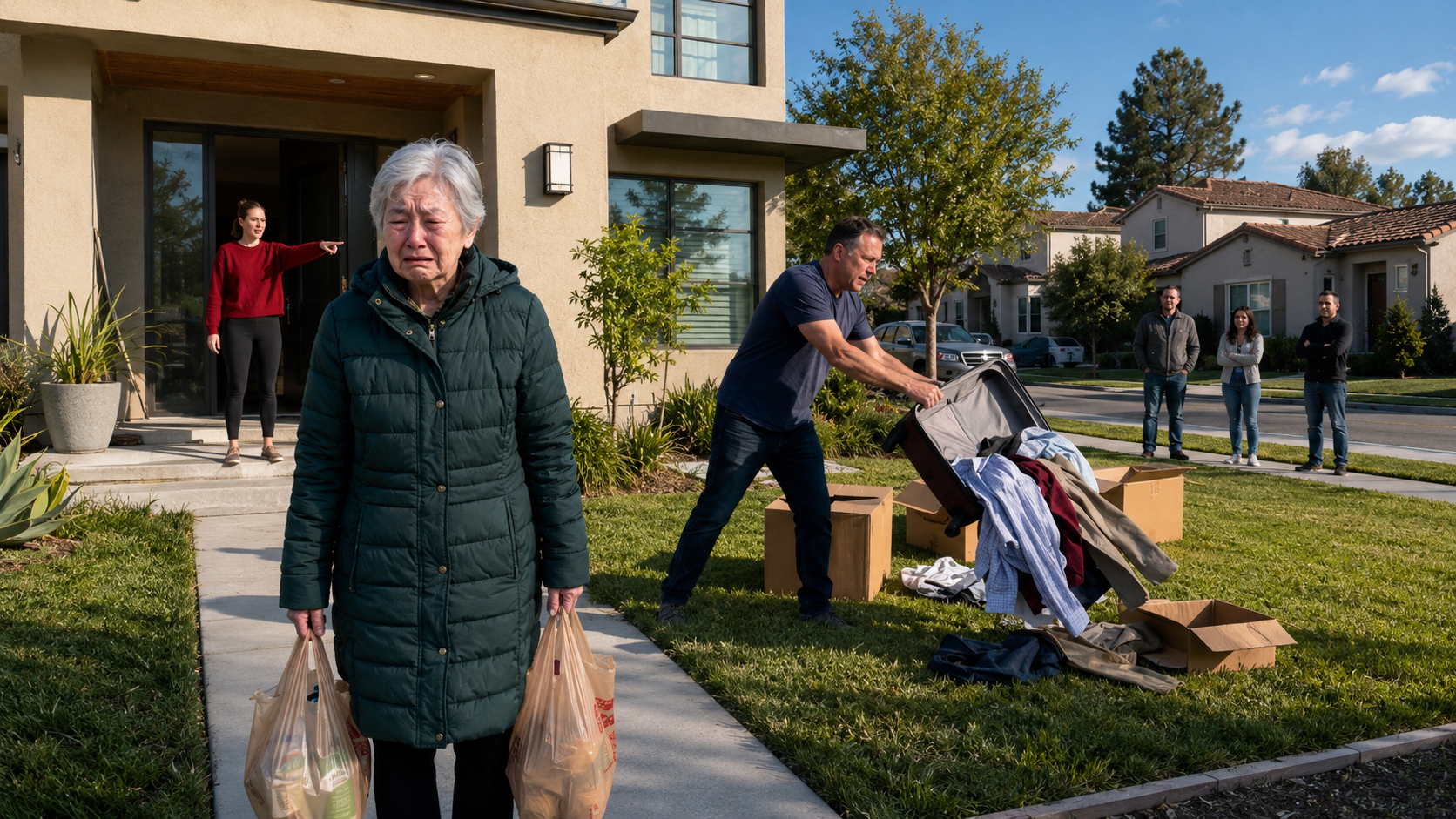
But Ethan only picked up one of my suitcases.
“Mom,” he said flatly, “this isn’t working.”
Then he opened the front door and threw my suitcase onto the porch.
It hit the wood hard.
The zipper burst.
My clothes spilled out.
My toiletry bag cracked open.
My hairbrush rolled down the steps into the slush.
I stood frozen.
Brittany grabbed the second bag and shoved it toward Ethan.
“Put that one out too.”
“Ethan,” I whispered.
He would not meet my eyes.
“I’ll call you later,” he said.
Then he threw the second bag out.
Brittany folded her arms.
“Don’t make a scene, Margaret.”
A scene.
That was what cruel people call your pain when it becomes inconvenient.
I could have told them right then.
I could have said, I make more in one month than you make in a year.
I could have shown them my accounts.
My investments.
My properties.
The condo I was buying in cash.
I could have watched Brittany’s mouth fall open.
But something stopped me.
Dignity, maybe.
Or exhaustion.
Or the final mercy of not wanting my son’s apology to be purchased by a number.
So I said nothing.
Ethan stepped back inside.
The door closed.
And my own son left me standing on the porch like trash.
The Hotel Parking Lot
The winter air cut through my coat.
But it felt less cold than what had just happened inside.
I bent slowly and gathered my things.
A neighbor across the street pretended to shovel the same patch of snow while watching me.
I picked up my hairbrush.
My socks.
My sweater.
My framed photo of Richard had fallen from the side pocket.
The glass was cracked.
That almost broke me.
I held the photo to my chest.
“Oh, Richard,” I whispered. “You would have known what to do.”
But Richard was gone.
So I loaded everything into my Subaru and drove away.
I did not cry on the porch.
I did not cry in the car.
Pride has a way of holding you together in public.
I drove to a nearby hotel and parked.
Only then, sitting alone beneath the yellow parking lot light, did I break.
Not quietly.
Not elegantly.
I cried like a woman who had lost her husband all over again and then lost her son in a different way.
I replayed Ethan’s childhood.
His little hand in mine crossing streets.
His face at graduation.
His voice when he called me after Richard died and said, “Mom, I don’t know how to be a man without Dad.”
I had told him, “You become one day by day.”
Had I failed him?
Had I protected him too much?
Had I given too much and taught too little?
Or had Brittany simply watered something already growing inside him?
I had no answer.
Only pain.
A Decision
The next morning, I woke with swollen eyes and a strange calm.
I ordered coffee.
Opened my laptop.
Checked my accounts.
Reviewed my pending condo closing.
Then I closed the laptop and looked out the hotel window.
I would not beg.
I would not call relatives.
I would not reveal my wealth out of anger.
I would not buy my way back into my son’s respect.
Instead, I would do what I had always done.
Think clearly.
Act with purpose.
The condo no longer felt right.
Too small.
Too rushed.
Too much like hiding.
So I called my agent, Marlene.
“I want to pause the condo closing.”
She was quiet.
“Margaret, is everything okay?”
“No.”
“Do you need help?”
“Yes,” I said. “I need a house.”
“Any specific area?”
I looked at the cracked photo of Richard beside the hotel lamp.
Then I thought of Ethan’s porch.
His door closing.
Brittany saying, Get out, beggar.
“Yes,” I said. “Ethan’s neighborhood.”
Marlene hesitated.
“Margaret…”
“I know.”
“Are you sure that’s wise?”
“No,” I said. “But it is necessary.”
The House Across the Street
A month later, Marlene found it.
Four bedrooms.
Newly renovated.
Beautiful porch.
Large kitchen.
Quiet library.
A small garden in the back.
And directly across the street from Ethan and Brittany’s house.
Marlene looked nervous when she handed me the listing.
“I need to ask,” she said. “Do you want this because you love the house, or because of where it is?”
I looked at the photo.
“Yes.”
She sighed.
“That is not an answer.”
“It is the honest one.”
“Margaret, emotional purchases can become expensive mistakes.”
I smiled.
“Marlene, I have spent my entire life avoiding expensive mistakes. Allow me one strategic decision with emotional benefits.”
She laughed despite herself.
“Strategic decision?”
“Yes.”
“Should I ask?”
“No.”
We toured the house two days later.
The moment I stepped inside, I knew.
The light was warm.
The floors were polished but not showy.
The kitchen had deep windows.
The porch faced Ethan’s street.
But what I loved most was the library.
Empty shelves waiting for books.
A room quiet enough for memory.
I stood there and imagined Richard sitting near the window.
Marlene watched me.
“You like it.”
“I do.”
“Do you want to make an offer?”
“Yes.”
“Financing?”
“Cash.”
She blinked.
“Cash?”
“Yes.”
“Margaret, this house is listed at—”
“I know what it is listed at.”
She closed her mouth.
Then opened it again.
“You never told me you could buy this in cash.”
I smiled.
“You never asked.”
The purchase closed quickly.
By midweek, I had moved in.
Not with fanfare.
No social media.
No announcement.
Just movers, boxes, books, a new kettle, and Richard’s photo placed gently on the mantel.
For the first time since being thrown out, I slept through the night.
Ethan Sees My Name
The next morning, I sat on my porch with tea.
It was cold, but the sun was bright.
Across the street, Ethan stepped outside to check his mail.
He wore sweatpants and an old university sweatshirt.
For a moment, he looked younger.
Almost like the boy who used to bring in the newspaper for Richard.
He opened his mailbox.
Pulled out several envelopes.
Then froze.
In his hand was a property transfer notice addressed to the neighborhood association.
The name at the top was mine.
Margaret Collins.
He looked at the paper.
Then at my house.
Then at me.
I lifted my teacup slightly.
Good morning.
His face went pale.
He stood there for nearly a full minute.
Then Brittany came outside.
“What are you doing?” she called.
He handed her the paper.
She read it.
Her head snapped toward me.
I could see her mouth open even from across the street.
For the first time since I met her, Brittany had nothing clever to say.
That evening, my doorbell rang.
I already knew who it was.
I let him stand there for a full minute before I opened the door.
Ethan stood on my porch.
He looked tired.
Shaken.
Stripped of the smooth confidence he had worn like armor.
“Mom,” he said.
“Ethan.”
His eyes moved past me into the house.
The polished floors.
The warm lights.
The framed photos.
The new furniture.
The quiet elegance of a life built with discipline, not performance.
“You bought this house?”
“Yes.”
“With cash?”
“Yes.”
He swallowed.
“I didn’t know.”
“I know.”
That silence said more than any argument could.
The Conversation
I stepped aside.
“Come in.”
He entered cautiously, like someone walking into unfamiliar ground.
We sat in the living room.
I did not offer coffee.
Not because I wanted to be cruel.
Because for once, I refused to rush into comfort before truth had done its work.
Ethan sat on the edge of the sofa.
“Mom, I’m sorry.”
“For what?”
He blinked.
“For what happened.”
“What happened?”
His eyes filled with discomfort.
“Brittany lost her temper.”
“No,” I said.
He looked up.
“She said terrible things.”
“She did.”
“And I should have stopped her.”
“Yes.”
He exhaled.
“I was under pressure.”
I leaned back.
“From what?”
He looked around the room.
“Money. Bills. Appearances. Brittany wanted things. I wanted to keep up. Her friends all have these lives, and I thought if I could just get ahead—”
I raised my hand.
“Ethan.”
He stopped.
“Debt explains stress. It does not explain throwing your mother’s suitcase onto the porch.”
His face crumpled slightly.
“I know.”
“Do you?”
“Yes.”
“Then say it plainly.”
He swallowed.
“I threw you out.”
“Yes.”
“I let my wife call you a beggar.”
“Yes.”
“I chose silence because it was easier than defending you.”
I felt the words hit me.
They hurt.
But they were necessary.
I nodded.
“That is the first honest thing you have said to me in months.”
He looked down.
“Why didn’t you tell me?”
“Tell you what?”
“That you had money.”
I studied him.
“Would it have changed how you treated me?”
He opened his mouth.
Closed it.
That was answer enough.
I said quietly, “That is why I didn’t tell you.”
His eyes filled with tears.
“Mom—”
“No, Ethan. Listen to me.”
He nodded.
“I never hid my wealth to trick you. I hid it because I wanted to know if my son loved me when he thought I had nothing useful to offer.”
Tears slipped down his face.
“And I failed.”
“Yes,” I said.
The word was not cruel.
It was simply true.
Brittany Arrives
Before he could answer, headlights swept across the front window.
Ethan turned.
“Oh no.”
A car door slammed.
Then my doorbell rang hard.
Again.
Again.
Brittany.
I opened the door.
She stood there in a cream coat, hair perfect, face tight with anger.
“So it’s true,” she said.
“Good evening, Brittany.”
She looked past me.
“Ethan, come outside.”
Ethan stood.
“Brittany, not now.”
“Oh, not now?” she snapped. “Your mother buys the house across the street like some kind of psycho revenge move and you’re sitting in here having tea?”
“I didn’t offer tea,” I said.
She glared at me.
“You think this is funny?”
“No.”
“You lied to us.”
I tilted my head.
“About what?”
“About being poor.”
“I never told you I was poor.”
“You acted poor.”
Ethan closed his eyes.
I said, “I wore my own clothes, drove my own car, and paid my own bills. If that looked poor to you, that says more about you than me.”
Brittany’s face flushed.
“You let us struggle.”
Ethan looked sharply at her.
“Brittany.”
She ignored him.
“You could have helped us.”
I stared at her.
“I did help. I helped pay for your wedding. I gave gifts. I bought groceries while staying with you. I offered kindness.”
“That’s not what I mean.”
“No,” I said. “You mean I could have funded your lifestyle.”
Her mouth tightened.
“You’re selfish.”
Ethan said, “Stop.”
She turned on him.
“No, you stop. You threw her out too, Ethan. Don’t stand there acting noble now.”
He went pale.
The room fell quiet.
For once, Brittany had told the truth.
I looked at my son.
“She’s right.”
His face twisted with shame.
Brittany smiled faintly, thinking she had won.
Then I turned back to her.
“But here is where you are wrong. His guilt does not make your cruelty acceptable.”
She stepped back.
I continued, “You called me a beggar on my son’s porch. You watched my belongings spill into the snow. And now you are angry because the beggar could buy the house across the street in cash.”
Her mouth opened.
No words came.
I smiled softly.
“Good night, Brittany.”
Then I closed the door.
The Second Truth
Ethan sat down slowly.
“I’m sorry,” he whispered.
I looked at him.
“Do you know why your father and I lived modestly?”
He shook his head.
“Because we wanted you to understand that comfort is not the same as character. We wanted you to know that money can buy a roof, but it cannot buy a soul.”
He wiped his face.
“I lost myself.”
“No,” I said. “You gave pieces away. There is a difference.”
He looked at me.
“Can I get them back?”
“That depends on what you are willing to lose.”
His voice shook.
“What does that mean?”
“It means if you choose to stay with someone who can call your mother a beggar and throw her into the cold, you are also choosing distance from me.”
He nodded slowly.
“I understand.”
“No, Ethan. I need you to truly understand. I can forgive you one day. But I will not pretend. I will not sit at holiday tables with a woman who humiliated me while you watched. I will not lend money to silence guilt. I will not be useful just because I am wealthy.”
His shoulders shook.
“I don’t want your money.”
“Good.”
“I want my mother.”
That almost broke me.
Almost.
But mothers must be careful.
Sometimes children say the right thing when they fear losing access.
So I said, “Then show me. Slowly.”
Brittany’s Real Reason
Three days later, Ethan came back alone.
He looked worse.
“Brittany left,” he said.
I was not surprised.
“She packed?”
“She packed what she wanted me to see. She left with more than that.”
I frowned.
“What does that mean?”
He placed a folder on my table.
“I found credit cards I didn’t know about. Loans. A private line of credit. She used my information. Some of it may involve your name too.”
My body went still.
“My name?”
“She had a scanned copy of your driver’s license from when you stayed with us. I think she tried to open an account, but it got flagged.”
I closed my eyes.
There it was.
The twist I had feared but not expected.
Brittany had not wanted me out only because she disliked me.
She wanted me out because I was a target.
A quiet older woman with old coats, a modest car, and apparently no power.
She thought I was easy.
I called my attorney, David Klein.
Within forty-eight hours, we confirmed it.
Brittany had attempted to use my personal information to access a senior credit line, claiming she was helping her “dependent mother-in-law.”
The application had failed because my financial monitoring service flagged the mismatch immediately.
David leaned back in his chair.
“She thought you were vulnerable.”
I smiled without warmth.
“She was wrong.”
Ethan sat beside me, looking sick.
“I didn’t know.”
I looked at him.
“That sentence has become expensive in your life.”
He lowered his head.
“I know.”
Brittany received a legal notice the next morning.
By the end of the week, her parents called Ethan demanding he “fix it.”
He said one sentence and hung up.
“She tried to steal from my mother.”
That was the first time in years he sounded like my son.
Sunday Visits
Three weeks later, Brittany moved out completely.
The divorce between Ethan and Brittany took months, but emotionally, it ended the day Ethan saw the fraud file.
He began visiting on Sundays.
At first, it was awkward.
He brought flowers once.
I said, “Thank you, but flowers are not a repair plan.”
He nodded.
The next week, he brought coffee.
I said, “Better.”
The week after that, he brought a notebook.
“What is that?”
“A budget,” he said.
I looked at him.
He sat at my kitchen table, opened the notebook, and said, “I need to learn what you tried to teach me when I was ten.”
I felt something in my chest soften.
Not healed.
But softened.
We started slowly.
Income.
Debt.
Needs.
Wants.
Emergency fund.
Retirement.
Integrity.
That last one, I wrote at the top of the page.
Ethan looked at it.
“Integrity is not a budget category.”
“It is the reason the rest of the budget works.”
He smiled faintly.
“Dad would have liked that.”
“Yes,” I said. “He would have.”
Some Sundays, we spoke about Brittany.
Some Sundays, we spoke about Richard.
Some Sundays, we sat quietly and drank coffee while the neighborhood moved around us.
Trust did not come back quickly.
But it came back honestly.
That mattered more.
The Happy-Sky Scarf
One Sunday near spring, Ethan arrived carrying a small gift bag.
I raised an eyebrow.
“I thought we agreed no unnecessary gifts.”
“It’s not new.”
He handed it to me.
Inside was the scarf.
The blue one he bought me when he was ten.
Happy-sky blue.
My hands trembled.
“Where did you find this?”
“In my old storage box,” he said. “Dad kept it with some of my school things. I thought you should have it.”
“I already have one.”
“I know,” he said. “This is the receipt.”
He handed me a small faded paper.
The discount store receipt.
$6.49.
I stared at it.
Ethan’s voice broke.
“I used to think that was nothing. Six dollars. Cheap scarf. But now I realize I gave it to you because I loved you. And you kept it because you loved me.”
Tears filled my eyes.
He continued, “Somewhere along the way, I forgot that love doesn’t need to look expensive.”
I reached across the table and took his hand.
For the first time since the porch, I let myself hold it.
“I missed you,” I whispered.
He cried then.
So did I.
One Year Later
One year after Ethan threw my suitcase onto his porch, I hosted Sunday dinner at my house across the street.
Not a grand dinner.
Not a performance.
Roast chicken.
Mashed potatoes.
Green beans.
Apple pie.
Ethan came early to help set the table.
He no longer wore the expensive watch Brittany had insisted he buy.
He drove a used car.
He looked calmer.
Older.
Better.
He placed forks beside plates and said, “Mom?”
“Yes?”
“Do you ever regret buying this house?”
I looked out the window at his porch across the street.
The place where my suitcase burst open.
The place where my hairbrush rolled into the slush.
The place where my son lost himself and, eventually, began finding his way back.
“No,” I said.
“Was it revenge?”
I smiled.
“A little.”
He laughed softly.
“At least you’re honest.”
“It was also a reminder.”
“For me?”
“For both of us.”
He looked at me.
“That you could stand on your own?”
“No,” I said. “I already knew that.”
“Then what?”
“That being thrown out of someone else’s house does not mean you have no home.”
He grew quiet.
Then he said, “Thank you for not giving up on me.”
I looked at him carefully.
“I almost did.”
“I know.”
“But your father and I raised a better man than the one who threw my suitcase.”
His eyes filled.
“And I wanted to see if that man could come back.”
He swallowed.
“I’m trying.”
“I know.”
That was enough for that day.
Final Reflection
My daughter-in-law called me a beggar.
My son threw my suitcase onto the porch.
My things spilled into the winter slush.
And I stood there with every reason to reveal that I made $80,000 a month.
I could have humiliated them instantly.
I could have bought their regret.
I could have turned their cruelty into panic with one bank statement.
But I stayed silent.
Because respect that appears only after money is revealed is not respect.
It is calculation.
A month later, my son saw my name on the house across the street.
That was when the truth finally entered his life.
Not just the truth about my income.
The truth about his choices.
His marriage.
His weakness.
His debt.
His silence.
His wife’s greed.
And the mother he had mistaken for powerless because she lived simply.
People who appear ordinary are not always helpless.
Quiet people are not always poor.
Modest lives are not always empty.
And love should never require proof in the form of money.
I did forgive Ethan.
Not quickly.
Not easily.
Not completely all at once.
Forgiveness came in Sundays.
In coffee.
In budgets.
In hard conversations.
In him learning to say, “I was wrong,” without adding, “but.”
That is how trust returned.
Slowly.
Honestly.
Across the street.
As for Brittany, she left with designer bags and legal trouble.
As for me, I kept my house, my peace, my dignity, and the happy-sky scarf my son bought me when love still knew how to be simple.
Sometimes truth arrives gently.
Other times, it arrives with a slammed door, a broken suitcase, and your name written across the street.
THE END.