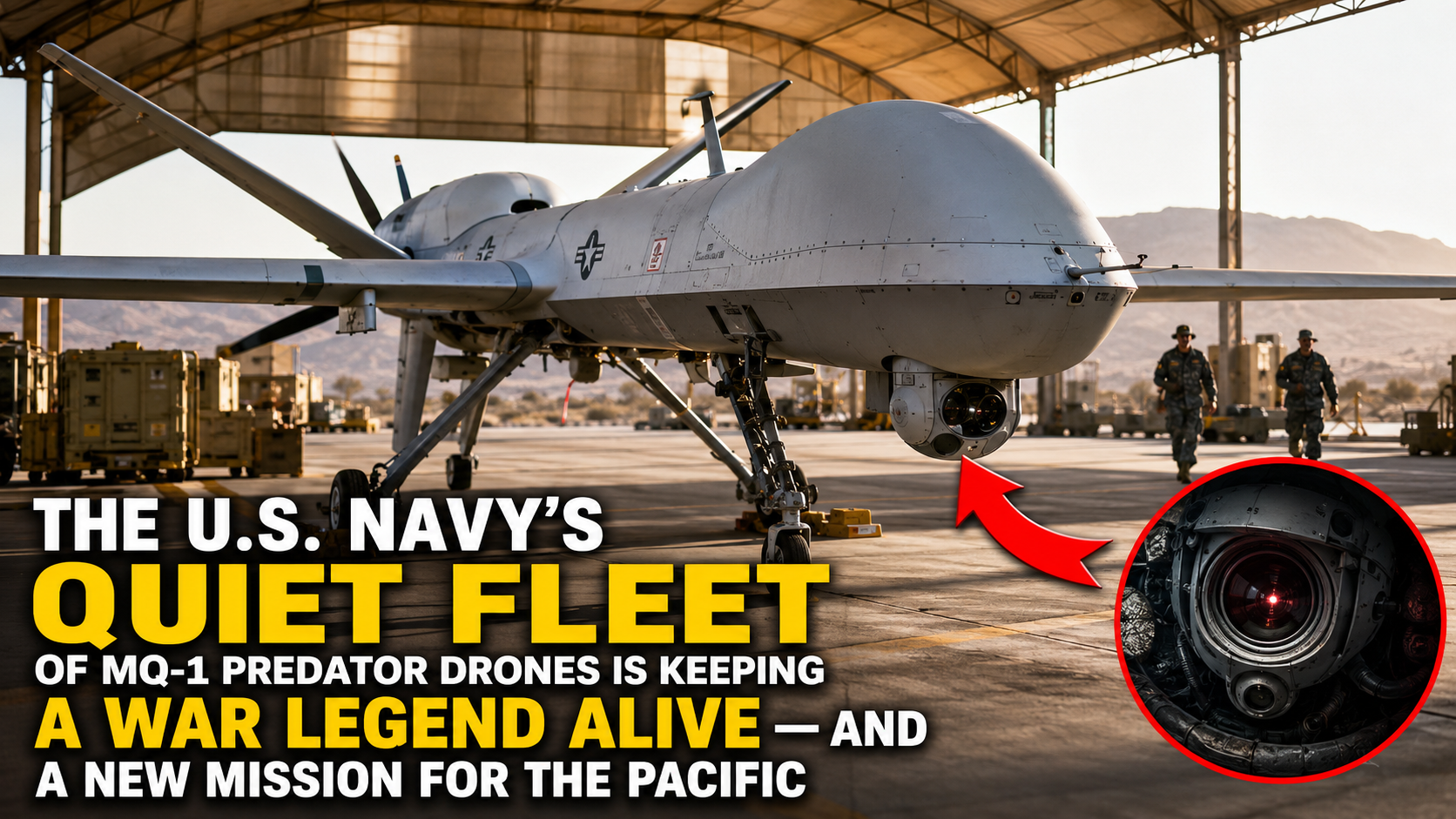
The MQ-1 Predator was supposed to be finished.
After decades of war, surveillance, controversy, and battlefield transformation, the famous drone was officially retired by the U.S. Air Force in 2018. Many people believed the Predator had flown its final mission and quietly disappeared into museums, storage yards, or history books.
But now, a surprising new detail has emerged: a small fleet of MQ-1 Predators is still alive.
Not in the same combat role that made them famous. Not flying over Afghanistan or Iraq. Not hunting targets in the way the world once knew them.
You May Also Like


Instead, these drones are reportedly serving in a much quieter but highly important role with the U.S. Navy’s test community.
According to a report from TWZ, the Naval Air Warfare Center Weapons Division, known as NAWCWD, received 20 MQ-1 aircraft from the U.S. Air Force in 2019. These aircraft were redesignated as NMQ-1Bs and are being used for test and training missions. That means the Predator, one of the most iconic unmanned aircraft in modern military history, has been given a second life.
And that second life may be more important than it first appears.
The story begins with the end of an era. The U.S. Air Force officially retired the MQ-1 Predator in 2018 as it moved fully toward the larger and more capable MQ-9 Reaper. The MQ-9 offered more power, more payload, better sensors, and greater flexibility for modern combat demands. For the Air Force, the MQ-1 had reached the limit of what its aging design could provide.
But the Predator’s retirement did not mean the aircraft had no value left.
At the time of retirement, the Air Force still had dozens of MQ-1s in its inventory. Some were stripped for parts they shared with the MQ-9 Reaper. Others became display aircraft. Some ended up in storage. But 20 of them apparently found a very different path: they went to the Navy.
That detail matters because the Navy did not simply take them as ordinary MQ-1Bs. They were redesignated as NMQ-1Bs. In U.S. military aircraft designations, the “N” prefix usually points to aircraft that have been modified for special test purposes, often in ways that are not easily reversible. In other words, these are not just old Predators with new paint. They may have been adapted for a specialized mission.
The exact changes made to the Navy’s NMQ-1Bs have not been publicly explained. NAWCWD has confirmed only that the aircraft support its mission and are being used for test and training. That may sound simple, but in the world of military aviation testing, those words can cover a very wide range of activities.
The Naval Air Warfare Center Weapons Division plays a major role in developing, testing, evaluating, and supporting weapons and warfighting systems for the U.S. Navy. Its work includes advanced weapons, missiles, electronic warfare, aircraft survivability, robotics, directed energy, and other high-tech military areas. Its major locations include China Lake and Point Mugu in California, places long connected with weapons testing and advanced military aviation development.
So why would the Navy want old MQ-1 Predators?
The answer may be found in what the Predator still does well.
The MQ-1 was never the fastest drone. It was never the largest. It was not designed as a stealth aircraft. But it had one powerful advantage: endurance. It could stay in the air for long periods, carry sensors, operate remotely, and provide a stable flying platform for many kinds of missions. That made it valuable in combat. Today, those same qualities may make it valuable as a test asset.
A drone like the NMQ-1B could be useful in several ways. It could act as a flying target for sensors. It could support missile seeker testing. It could help train radar operators or air defense crews. It could serve as a realistic unmanned aircraft target without necessarily being destroyed. It could also carry payloads, pods, or systems needed for specialized test events.
This is important because not every weapons test requires a target to be blown out of the sky. In some cases, military testers may only need to see whether a radar, missile seeker, infrared sensor, or tracking system can detect, lock onto, follow, or classify a target. A missile might even be flown without an explosive warhead, allowing it to simulate a kill without destroying the aircraft.
That makes an old but reusable drone highly valuable.
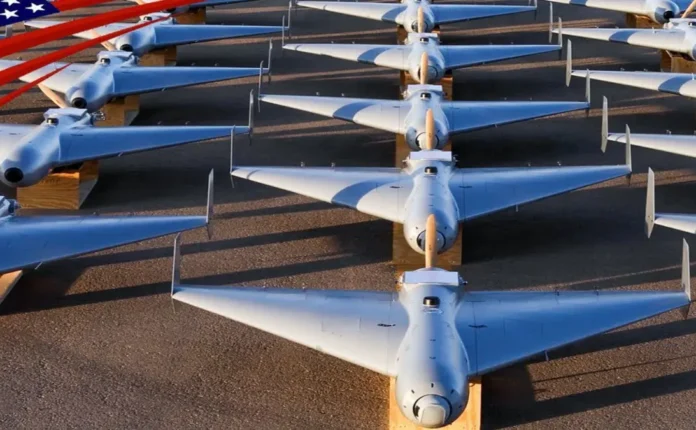
The Predator’s size and flight profile may also make it useful for representing certain modern drone threats. Around the world, long-range unmanned aircraft and one-way attack drones have become a major concern. The war in Ukraine has shown how drones can reshape battlefields. Middle Eastern conflicts have also shown how relatively inexpensive unmanned systems can threaten bases, ships, energy facilities, and other high-value targets.
For the U.S. military, this creates a serious training and testing challenge. It is not enough to build advanced weapons on paper. Crews and systems must be tested against realistic threats. Sensors must learn to detect drones. Missiles must learn to track them. Operators must learn how to respond quickly. Commanders must understand how these threats behave in the air.
That is where a platform like the NMQ-1B may fit.
The Predator has the basic shape and endurance of a real unmanned aircraft. It can fly longer than many smaller target drones. It can be modified. It can carry equipment. It can be operated remotely. And because it is no longer a front-line combat platform, the military may be more willing to use it in roles that would be too risky or too costly for newer aircraft.
There is also another possibility: the NMQ-1Bs could be used to support broader test events rather than simply act as targets. The original MQ-1 could carry electro-optical and infrared sensors, communicate through data links, and provide full-motion video. In a test environment, such a drone could help observe missile launches, monitor test ranges, relay signals, or collect data from the air.
This does not mean the Navy has publicly confirmed every possible role. It has not. The confirmed facts are limited: 20 MQ-1s were transferred in 2019, redesignated NMQ-1Bs, and are used by NAWCWD for test and training. But even that limited confirmation is enough to raise major interest because of what the Predator represents.
The MQ-1 Predator was one of the aircraft that changed modern warfare.
It began as a surveillance platform, giving commanders persistent eyes in the sky. Later, it became an armed drone capable of launching AGM-114 Hellfire missiles. That transformation changed how the U.S. military tracked and struck targets. It also changed global debates about remote warfare, targeted strikes, intelligence gathering, and the future of combat aviation.
Before the Predator, drones were often seen as experimental or limited tools. After the Predator, the world understood that unmanned aircraft could become central to military power.
That is why this new Navy chapter feels so symbolic.
The Predator may no longer be the star of America’s drone fleet. The MQ-9 Reaper took that role years ago. Newer systems are now being developed with artificial intelligence, autonomy, swarming concepts, stealthier designs, and greater payloads. The future of air combat may include loyal wingman drones, autonomous aircraft, and networks of unmanned systems working alongside manned fighters.
But somewhere inside that future, the old Predator may still be helping.
If the NMQ-1Bs are being used to test sensors, train crews, support weapons development, or represent drone threats, then the Predator is still shaping the battlefield indirectly. It is no longer simply watching enemies from above. It may now be helping America prepare to defeat enemy drones, missiles, and future unmanned systems.
That is a remarkable second life for an aircraft many people thought was gone.
There is also a practical reason the Navy may value these aircraft: cost. Testing advanced military systems can be extremely expensive. Using a retired but still useful unmanned platform could be cheaper than using newer aircraft or purpose-built target drones for every event. A Predator can fly for long periods, carry different equipment, and potentially be used again and again.
That makes it a flexible tool for a test community facing growing demand.
The U.S. military is currently pushing forward on multiple fronts: next-generation aircraft, advanced missiles, electronic warfare, counter-drone defenses, artificial intelligence, and networked combat systems. All of these require testing. And testing requires targets, sensors, aircraft, crews, ranges, and data.
In that environment, even an old drone can become valuable again.
The mystery is that the Navy’s NMQ-1Bs have remained largely unseen. If they have been flying for years, they have done so quietly. That could be because they operate in restricted test areas, remote ranges, or controlled environments where public visibility is limited. It could also be because their work is simply not the kind of activity that attracts attention unless someone asks the right question.
But now the question has been asked.
And the answer is fascinating: the Predator is not completely dead.
The U.S. Air Force may have retired it from combat service, but the U.S. Navy has quietly kept a pocket fleet alive for specialized work. These aircraft are no longer the face of America’s drone war. They are now part of the hidden machinery behind weapons development, training, testing, and preparation for future conflicts.
In a way, that makes the Predator’s legacy even deeper.
It first helped define the age of armed drones. Now, years after retirement, it may be helping the U.S. military understand the next drone age—an era where unmanned aircraft are not rare tools, but everyday threats and essential weapons.
The Predator’s story was supposed to end in 2018.
Instead, it entered a quieter chapter.
No dramatic combat footage. No headlines from distant battlefields. No public victory lap.
Just a small group of aging drones, renamed NMQ-1Bs, flying in the background of America’s future weapons testing.
For a machine that helped change war forever, that may be the perfect final mission: not fighting the last war, but helping prepare for the next one.