
The clinic phone kept ringing.
For three seconds, nobody moved.
Not Luis.
Not my other technician, Claire.
You May Also Like

Not Officer Jake Carter, whose hand was still wrapped around the folded evidence receipt like it had burned him.
Even Max seemed to understand.
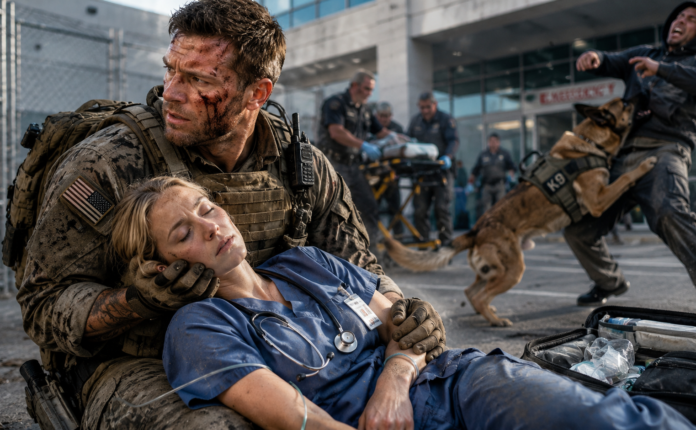
The German Shepherd lay trembling on the treatment table, an IV line taped to his front leg, his dark eyes fixed on Jake’s sleeve where the faint residue clung like dust from a nightmare.
The caller ID glowed across the screen.
Denver Police Department.
I picked up.
“This is Dr. Harper.”
A man’s voice answered immediately.
“Doctor, this is Captain Reynolds with DPD. I understand you have Officer Carter and K-9 Max at your clinic.”
Jake’s head snapped up.
“Yes,” I said carefully. “Max is in critical condition.”
“That dog was brought to you for humane euthanasia.”
The way he said it made my skin tighten.
Not grief.
Not concern.
Instruction.
“I’m aware of the original recommendation,” I replied. “But new clinical findings suggest his condition may be toxicological rather than terminal neurological failure.”
Silence.
Then, colder, “That is not your determination to make.”
I looked at Max.
His body shook under the blanket. His breathing was still too shallow, too uneven, but he was alive. Fighting. Listening.
“In my clinic,” I said, “it is exactly my determination to make.”
Jake stared at me as if I had just stepped in front of a bullet.
Captain Reynolds exhaled sharply.
“Dr. Harper, this is a police matter.”
“No,” I said. “Right now, this is a patient care matter.”
Another pause.
This one longer.
When Reynolds spoke again, his voice had changed. Softer. More dangerous.
“Do not release any samples. Do not speak to Officer Carter about evidence related to yesterday’s operation. And do not contact outside agencies. Someone from the department is on their way.”
The line went dead.
I lowered the phone slowly.
Luis whispered, “That sounded bad.”
Jake’s eyes had gone hard.
“What did he say?”
I told him.
By the time I finished, the grief on his face had been replaced by something sharper.
A police officer’s instinct.
A handler’s rage.
“They told me Max was dying,” he said quietly. “They told me there was nothing left.”
Max gave a weak whine at the sound of his name.
Jake leaned close, pressing his forehead gently against Max’s.
“I’m sorry, buddy,” he whispered. “I should’ve questioned it.”
“You did,” I said. “You brought him here.”
He looked at me, and for the first time that morning, hope flickered behind the fear.
But hope did not change the facts.
Max was still critical. His tremors were worsening in waves. His temperature was climbing. The residue on his muzzle and Jake’s sleeve could be dangerous. And someone inside the department had just tried to shut us down.
I turned to Claire.
“Lock the front door.”
Her eyes widened.
“We still have clients in the lobby.”
“Move them to exam rooms and tell them we have an emergency containment issue. No details. Then lock the front.”
Luis looked toward the sealed sample bag.
“What about this?”
“Double-bag it. Gloves, mask, eye protection. Then put it in the medication fridge until the state lab gives us instructions.”
Jake stepped back.
“Am I contaminated?”
“Possibly. Don’t touch your face. Take off the jacket.”
He removed it carefully, jaw clenched. I placed it in a biohazard bag and sealed it. On his dark sleeve, under the harsh exam light, the residue shimmered again.
Max growled.
It was faint, but unmistakable.
He was not growling at Jake.
He was growling at the jacket.
That was when the second clue appeared.
As Jake turned away, Max dragged one paw across the table and hooked his nail into the pocket of Jake’s uniform pants.
Not random.
Not panic.
Deliberate.
Jake froze.
“Max?”
The dog’s eyes shifted downward.
Jake reached into the pocket and pulled out his phone, a set of keys, and a small black object I recognized immediately.
A body camera battery.
Jake frowned.
“That’s not mine.”
Luis leaned closer.
“What do you mean?”
Jake turned the battery over in his palm.
“My unit uses a different model.”
The room went cold again.
“How did it get in your pocket?” I asked.
“I don’t know.”
He stared at it, then at Max.
Max’s breathing hitched.
Then he whined.
Not in pain this time.
In warning.
Jake’s hand trembled as he placed the battery on the counter.
“Yesterday after the raid,” he said slowly, “I took Max back to the vehicle. He was restless. Wouldn’t settle. Kept looking toward the evidence van.”
“Who handled him after that?”
“Nobody should have.”
“Should have?”
His face darkened.
“I went inside the command trailer to sign off. When I came back, Sergeant Doyle was standing near my SUV.”
“Doing what?”
“He said Max had been barking and he was trying to calm him down.”
I glanced at the evidence receipt.
MAX FOUND THE WRONG CRATE.
“Who is Sergeant Doyle?”
Jake swallowed.
“My supervisor.”
Before I could respond, Max convulsed.
His entire body stiffened. His legs extended. His jaws clenched. The monitor screamed as his heart rate spiked.
“Diazepam,” I ordered. “Now.”
Claire moved fast. Luis adjusted the IV line. I placed both hands on Max, feeling the violent tremors ripple beneath his fur.
“Stay with him, Jake.”
Jake leaned down, voice breaking again.
“Max, listen to me. Heel, boy. Heel.”
The word did something.
Maybe memory.
Maybe love.
Maybe the kind of bond science can measure only in heartbeats and survival.
Max’s eyes rolled toward Jake. The seizure eased little by little, like a storm pulling back from the edge of a town.
I breathed again.
But barely.
“We’re running out of time,” I said.
Jake looked at me.
“Can you save him?”
That question cut deeper than he knew.
Veterinarians are asked that question in many forms. By children holding rabbits. By elderly women with cats older than their grandchildren. By ranchers who pretend not to cry over horses. By police officers whose partners have four legs and sleep beside their beds.
Sometimes the honest answer is no.
Sometimes the answer is maybe.
And sometimes all you can say is the truth.
“I can fight for him,” I said. “But I need to know what poisoned him.”
Jake nodded once.
Then his phone rang.
He looked at the screen.
His face changed.
“It’s Doyle.”
Nobody spoke.
The phone rang again.
Jake answered on speaker.
“Carter.”
Sergeant Doyle’s voice came through warm and casual.
“Jake. Where are you?”
“At the clinic.”
“With Max?”
Jake’s eyes met mine.
“Yes.”
A pause.
“He gone yet?”
Jake’s hand tightened around the phone.
“No.”
Another pause.
This one almost invisible, but I heard it.
“Jake,” Doyle said carefully, “I know this is hard. But dragging it out won’t help him.”
“The doctor thinks he was poisoned.”
Silence.
Then Doyle laughed.
Not loudly.
Just enough.
“Poisoned? Come on. He’s old for a working shepherd. These things happen.”
“Max is seven.”
“Hard seven.”
Jake’s face hardened.
“Why was your battery in my pocket?”
The line went dead.
Claire whispered, “Oh my God.”
Jake stared at the phone.
Then a text arrived.
Not from Doyle.
From the same unknown number.
STOP DIGGING OR THE DOG WON’T BE THE ONLY ONE WHO DOESN’T WALK OUT.
Jake showed it to me.
For a moment, I felt fear rise so fast it nearly took my breath.
I was not a detective.
I was not armed.
I was a veterinarian in blue scrubs, standing in an emergency clinic with a poisoned dog, a desperate cop, and a staff of people who trusted me to keep them safe.
But fear is strange.
Sometimes it freezes you.
Sometimes it sharpens you.
I looked at Luis.
“Call the state lab again. Tell them we have a suspected hazardous exposure connected to law enforcement evidence and possible witness intimidation.”
Then I looked at Claire.
“Call Dr. Patel at Mile High Veterinary Specialty. Tell him I need a toxicology consult immediately and I’m sending vitals, symptoms, and photos of the residue.”
Jake shook his head.
“You’ll put yourself in the middle of this.”
“I already am.”
“You don’t know these people.”
“No,” I said. “But I know my patient.”
Max’s ears twitched at my voice.
Jake looked at him and nodded.
“Then I’m in too.”
I almost smiled.
“You were never out.”
Within minutes, the clinic changed from a place of medicine into something that felt like a bunker.
The front door was locked. Clients were quietly escorted out through the side entrance after their pets were stabilized. Luis taped a handwritten sign to the glass: Emergency closure. Please call before entering.
Dr. Patel called back at 8:52.
I gave him everything.
Symptoms. Timeline. Residue. Inconclusive rapid test. Narcotics raid. Bitter chemical odor. Neurological signs. Partial response to supportive care.
He listened without interrupting.
Then he said, “Megan, this may not be a standard narcotics exposure.”
“I know.”
“Could be an industrial compound. Could be a cutting agent. Could be something experimental. Keep him cool, maintain fluids, control seizures, and protect his airway. Do not assume the initial diagnosis was made in good faith.”
That last sentence stayed in the room after he said it.
Jake heard it too.
“Why would someone want Max dead?” he asked.
Dr. Patel answered before I could.
“Because dogs notice what humans miss.”
Max’s breathing changed.
It was subtle.
A little deeper.
A little stronger.
The tremors still moved through him, but less violently now. His eyes remained open, fixed on Jake.
Luis checked the monitor.
“Heart rate is coming down.”
Hope entered the room quietly.
Nobody celebrated.
We had all seen hope disappear too many times.
At 9:17, the state lab called back.
The woman’s name was Dr. Elena Morris. Her voice was calm, precise, and completely serious.
“Dr. Harper, based on your description, I want the sample transported under chain of custody. I’m sending two hazardous materials officers and a lab courier.”
“How long?”
“They’re already en route.”
That meant she had moved before asking permission.
Good.
Then she asked, “Is Officer Carter still with you?”
“Yes.”
“Keep him there.”
Jake stepped closer.
“Why?”
Dr. Morris hesitated.
“Officer, I can’t disclose details over this line. But yesterday’s warehouse seizure may be connected to a federal investigation.”
Jake went still.
“Federal?”
“Yes. And your dog may have identified evidence that wasn’t supposed to exist.”
The call ended.
For a few seconds, the only sound was Max’s monitor.
Then Jake laughed once under his breath.
“Max found the wrong crate.”
I looked at him.
“No,” I said. “I think Max found the right one.”
Outside, tires crunched over gravel.
Claire peered through the blinds.
“Police car.”
Jake moved instantly to the door of the treatment room.
“Uniform?”
“Yes.”
“Name?”
Claire squinted.
“I can’t see.”
Another vehicle pulled in behind it.
Then another.
My stomach sank.
“That’s too fast for the lab,” Luis said.
A heavy knock struck the front door.
“Denver Police! Open up!”
Jake’s posture changed. Shoulders squared. Chin lowered. His hand moved near his duty belt, though he did not draw his weapon.
I stepped toward the hallway.
He caught my arm gently.
“No. Let me.”
The knock came again.
Harder.
“Open the door, Dr. Harper.”
They knew my name.
Jake moved to the front entrance, staying to the side of the glass.
Through the blinds, I saw two officers in uniform. Behind them stood a man in plain clothes with silver hair and a dark overcoat.
Jake’s face tightened.
“Captain Reynolds.”
The captain lifted his badge toward the glass.
“Open the door, Carter.”
Jake did not move.
“Why are you here?”
“To retrieve department property.”
“Max is receiving emergency treatment.”
“I’m not talking about the dog.”
His eyes shifted toward the treatment room.
I understood.
The sample.
Jake said, “You’ll need a warrant.”
Reynolds smiled faintly.
“You’re confused about your position here.”
“No,” Jake said. “For the first time today, I think I’m very clear.”
Reynolds leaned closer to the glass.
“Officer Carter, you are emotionally compromised. Your K-9 is suffering. Dr. Harper is interfering with department protocol. Open the door before this becomes a disciplinary matter.”
Jake glanced back at me.
I shook my head once.
Then another sound rose in the distance.
Sirens.
Not police sirens.
Different.
A white hazardous materials response vehicle turned into the lot, followed by a black SUV with government plates.
Reynolds saw them.
His expression changed so quickly that I almost missed it.
Fear.
The black SUV stopped beside the police cars. Two men and one woman stepped out. The woman wore a navy jacket with yellow letters across the back.
FBI.
Captain Reynolds stepped away from the door.
For the first time that morning, he no longer looked in control.
The woman approached him, showed credentials, and spoke too quietly for us to hear.
Reynolds argued.
She did not.
She simply pointed toward his car.
Within moments, the two uniformed officers backed away from the clinic entrance. Reynolds stood rigid, his jaw clenched, while one of the federal agents remained beside him.
Jake unlocked the door only after the woman in the FBI jacket knocked and held her credentials against the glass.
“Special Agent Nora Voss,” she said when she entered. “Dr. Harper?”
“That’s me.”
“Where’s the dog?”
I led her to the treatment room.
The moment she saw Max, something in her face softened.
Only for an instant.
Then the professional mask returned.
Jake followed her in.
Agent Voss looked at him.
“Officer Carter, your K-9 may be the only living witness to what was inside that warehouse.”
Jake stared at her.
“He’s a dog.”
“He’s a trained detection dog who alerted on a crate that was not included in the official evidence inventory.”
She turned to me.
“We need the sample.”
“You’ll get it,” I said. “But not until my patient is stable enough for me to step away.”
To my surprise, she nodded.
“Fair.”
Captain Reynolds would never have said that.
The hazmat officers entered next, sealed the residue sample properly, photographed Jake’s jacket, bagged the mysterious body camera battery, and took swabs from Max’s fur. Everything was documented. Every label signed. Every transfer witnessed.
Through it all, Max watched.
Weak.
Shaking.
But aware.
Agent Voss stood beside me while I checked his gums again.
“Is he going to live?” she asked.
“I don’t know.”
She absorbed that.
“We’ve been tracking a distribution network moving synthetic compounds through abandoned industrial sites. Yesterday’s raid was supposed to recover narcotics. But our source told us there was something else in that warehouse. Something hidden among legitimate evidence.”
“The wrong crate,” Jake said.
Agent Voss nodded.
“Your dog found it. Then someone made sure he couldn’t tell anyone.”
Jake’s eyes darkened.
“Doyle.”
“We’re looking at him.”
“And Reynolds?”
Her silence answered.
Max suddenly shifted.
His head lifted an inch from the blanket.
Everyone froze.
He sniffed the air.
Then, with effort that seemed impossible for a dog in his condition, Max turned his head toward Agent Voss.
A low growl rumbled in his chest.
Jake straightened.
“Max?”
Agent Voss went very still.
Max was not looking at her face.
He was looking at her bag.
A black leather satchel hanging at her side.
The room tightened.
Agent Voss slowly lifted both hands.
“Officer Carter,” she said carefully, “your dog is alerting on my bag.”
Jake’s hand moved to Max’s collar, not restraining him, grounding him.
“What’s in it?”
“My files. Laptop. Evidence envelopes.”
“Open it.”
One of the hazmat officers stepped closer.
Agent Voss looked offended for half a second.
Then she looked at Max.
And opened the bag.
Inside were folders, a laptop, a sealed water bottle, pens, and a small silver evidence tube.
Max growled again.
The hazmat officer removed the tube.
Agent Voss frowned.
“That isn’t mine.”
Nobody spoke.
The officer held it under the light.
A faint powder clung inside the cap.
The same shimmer.
Agent Voss’s face went pale.
“Everyone step back.”
But Max was already reacting.
His body tensed.
His paws jerked.
His breathing became ragged again.
Whatever was in that tube, even sealed, even faint, was enough for his damaged nervous system to recognize.
I moved fast.
“Get that out of here. Now.”
The hazmat officer sealed it in another container and left the room.
I adjusted Max’s fluids, checked his airway, and gave another medication to control the tremors. Jake murmured to him constantly, one hand resting against his neck.
“You’re okay. I’m here. You found it, buddy. You found it.”
Agent Voss stood frozen near the door.
Her confidence had cracked.
“How did that get in my bag?” she whispered.
Jake looked at her.
“You tell us.”
She did not answer.
Because she did not know.
Or because she could not say.
At 10:03, the preliminary lab report came through.
Dr. Morris called me directly.
“Megan, listen carefully. The residue is not a common narcotic. It appears to be a neuroactive industrial compound mixed with multiple masking agents. We’re still identifying it, but exposure could cause tremors, collapse, seizures, and death if untreated.”
My knees almost weakened.
“So he was poisoned.”
“Yes.”
Jake closed his eyes.
I put the call on speaker.
Dr. Morris continued.
“There’s more. The compound appears degraded, which may be why he’s still alive. If he’d received a larger dose, or if euthanasia had proceeded before treatment…”
She didn’t finish.
She didn’t have to.
Jake turned away, one hand covering his mouth.
Max had been minutes from death.
Not because he could not be saved.
Because someone wanted him gone before anyone asked the right question.
Dr. Morris said, “Keep doing what you’re doing. His survival depends on time and clearance now.”
After the call, nobody spoke for a long moment.
Then Max moved.
His front paw twitched, not in a seizure this time.
A voluntary movement.
Jake noticed first.
“Max?”
The dog’s claws scraped weakly against the blanket.
He was trying to reach Jake.
Jake bent down, tears finally breaking loose.
“I’m here.”
Max’s paw touched his wrist.
It was such a small thing.
A dying dog’s paw against his handler’s skin.
But in that room, it felt like a miracle.
Claire started crying silently near the counter. Luis turned away and pretended to check the fluid pump.
I looked at the monitor.
Heart rate improving.
Temperature stabilizing.
Tremors decreasing.
Still critical.
Still fragile.
But not gone.
Not hopeless.
Agent Voss stepped into the hallway to make a call. Her voice was low and urgent.
Jake stayed with Max.
I gave them a few seconds.
Then I said, “He’s responding.”
Jake looked up.
“Say that again.”
“He’s responding. I can’t promise anything yet, but he’s fighting and the treatment is helping.”
Jake pressed his forehead to Max’s again.
“You hear that? You stubborn old wolf. You’re not done.”
Max exhaled slowly.
For the first time since he had entered my clinic, his body relaxed.
Only a little.
But enough.
At 10:26, Agent Voss returned.
“We have a problem.”
Jake laughed bitterly.
“Just one?”
She ignored that.
“Sergeant Doyle is missing. Captain Reynolds claims he came here under standard procedure, but his phone records show multiple calls to Doyle after the raid. We’re securing both their offices now.”
“And the warehouse?” Jake asked.
Her expression darkened.
“Burning.”
The word struck the room like a dropped weight.
“What?” I said.
“Fire department was dispatched twelve minutes ago. Abandoned warehouse near the South Platte River. Same site as yesterday’s raid.”
Jake stood.
“They’re destroying evidence.”
“Yes.”
“I need to go.”
“No,” I said immediately.
He looked at me.
“Doyle poisoned my dog.”
“And Max is alive because you’re here.”
That stopped him, but only barely.
Agent Voss said, “Dr. Harper’s right. Your presence is keeping him calm. And right now, Max matters more than the warehouse.”
Jake stared at her.
She held his gaze.
“He found something once. He may need to find it again.”
I saw the conflict tear through him.
Police officer.
Handler.
Partner.
Survivor.
Then Max made the decision for him.
The dog whined softly and tightened his paw against Jake’s wrist.
Jake sat back down.
“I’m not leaving him.”
Agent Voss nodded.
“Good.”
For the next two hours, the world outside moved without us.
Federal agents came and went. Hazmat teams collected evidence. My clinic remained closed. News helicopters eventually thudded faintly over the city, chasing smoke from the burning warehouse.
Inside treatment room two, time narrowed to Max’s breathing.
Every improvement felt enormous.
Every setback felt like falling.
At 11:14, Max lifted his head again.
At 11:42, he drank a few drops of water from a syringe.
At 12:08, he recognized Jake’s command to blink.
By 12:30, his tremors had reduced to faint ripples beneath the skin.
Jake looked ten years older and somehow more alive than he had that morning.
“You saved him,” he said quietly.
“Not yet.”
“You gave him a chance.”
That much I accepted.
Agent Voss returned just after one o’clock with smoke in her hair and ash on one sleeve.
“The warehouse is gone,” she said.
Jake’s face tightened.
“All of it?”
“Most of it.”
“Then they won.”
“No,” she said. “They panicked.”
She placed a tablet on the counter and pulled up a grainy image.
Security footage.
The warehouse exterior.
A figure in dark clothing entering through a side door shortly before the fire.
Then another angle.
A vehicle leaving.
Agent Voss zoomed in on the plate.
Jake leaned closer.
His face went white.
“That’s Doyle’s truck.”
“We thought so too,” she said.
“Then arrest him.”
“We’re trying.”
The image shifted again.
A final frame appeared, blurry but clear enough to show two figures in the truck.
The driver looked like Doyle.
The passenger was harder to see.
Agent Voss paused the video.
Jake stared.
His mouth opened slightly.
“No.”
I looked between them.
“What?”
Jake pointed at the passenger.
“That’s impossible.”
Agent Voss said nothing.
Jake took the tablet and zoomed in with shaking fingers.
The passenger turned toward the camera for one half-second.
A woman’s face appeared.
Older.
Severe.
Familiar enough to break Jake’s voice.
“That’s Dr. Elaine Mercer,” he whispered.
I knew that name.
Every emergency veterinarian in Denver knew it.
The department veterinarian.
The one who had recommended euthanasia.
The one who said Max’s condition was hopeless.
The one who almost made sure no one ever discovered he had been poisoned.
A cold, sick feeling settled over me.
Jake looked at Max, then at me.
“She examined him this morning.”
Agent Voss nodded slowly.
“And she disappeared thirty minutes ago.”
Max suddenly opened his eyes.
His ears lifted.
Not fully.
But enough.
His nose twitched.
Once.
Twice.
Then he turned his head toward the back hallway of my clinic.
A low growl rose from his chest.
Everyone froze.
Claire whispered, “What is it?”
I followed Max’s stare.
The back hallway led to storage, surgery, the staff entrance—and the small isolation room we had not used that morning.
The door to isolation was closed.
I was certain it had been open earlier.
Jake stood slowly.
Agent Voss reached beneath her jacket.
Max growled again.
Stronger this time.
From behind the isolation door came a sound so faint I almost convinced myself I imagined it.
A phone vibrating.
Agent Voss moved first.
Jake followed.
I stayed beside Max, one hand on his shoulder, feeling the tremors return—not from poison this time.
From warning.
Agent Voss counted silently with her fingers.
Three.
Two.
One.
Jake opened the door.
The isolation room was empty.
At first.
Then we saw it.
A black burner phone lay on the counter beside an opened medical supply cabinet.
Its screen glowed with one new message.
Agent Voss picked it up with gloved hands.
The message contained only six words.
THE DOG WAS NEVER THE TARGET.
Before anyone could speak, the clinic lights flickered.
Once.
Twice.
Then went out.
In the sudden darkness, Max barked.
Not weakly.
Not fearfully.
A full K-9 warning bark that shook the walls.
And from somewhere inside my locked clinic, a woman’s voice whispered,
“Hello, Jake.”
THE END OF PART 2 – LIKE, SHARE AND COMMENT “FULL STORY” IF YOU WANT TO READ FULL STORY.


One Comment on “PART 2 – The Dying Police Dog Was Minutes From Being Put Down – 5!001”