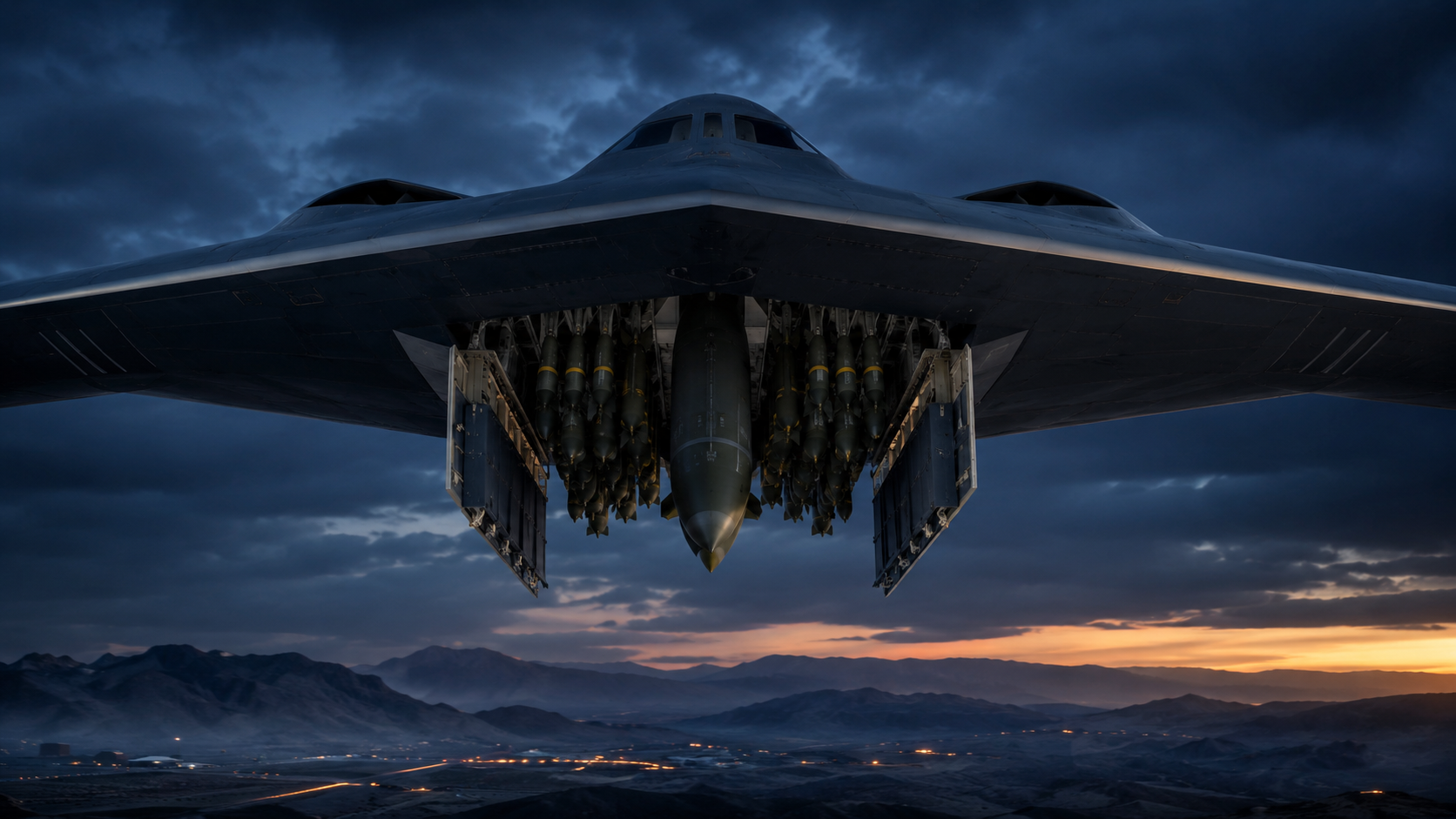
Imagine an aircraft so silent on radar that it can slip through some of the most heavily defended airspace on Earth, fly across oceans, and carry enough firepower to change the outcome of a war in a single mission. That aircraft is the B-2 Spirit — one of the most mysterious, expensive, and powerful bombers ever built. But behind its strange black flying-wing shape is one simple question many people ask: how much load can a B-2 bomber actually carry?
The answer is impressive: the B-2 Spirit stealth bomber can carry up to 40,000 pounds of weapons, which is equal to about 20 tons of payload.
That number is already massive, but what makes the B-2 even more fascinating is not only how much it can carry. It is how it carries that load. Unlike older bombers that often carry weapons externally under wings or fuselage, the B-2 carries its weapons internally inside two bomb bays. This is extremely important because the B-2 was built for stealth. External weapons would create radar reflections and make the aircraft easier to detect. By hiding its weapons inside the body of the aircraft, the B-2 keeps its smooth, low-observable shape and remains harder for enemy radar systems to track.
That is one of the reasons the B-2 is so feared. It does not simply carry heavy weapons. It carries them quietly, invisibly, and with strategic purpose.
You May Also Like
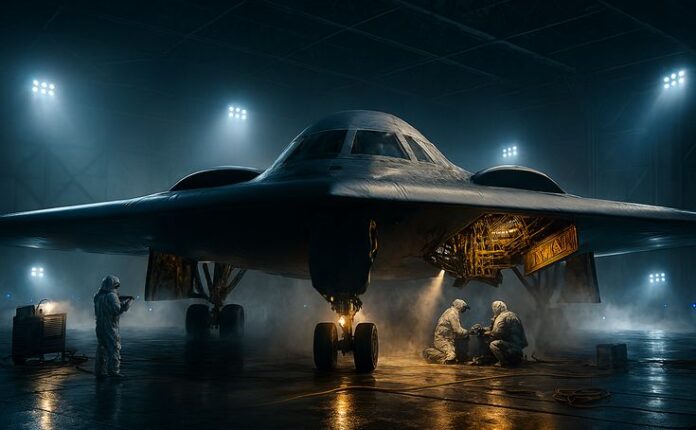
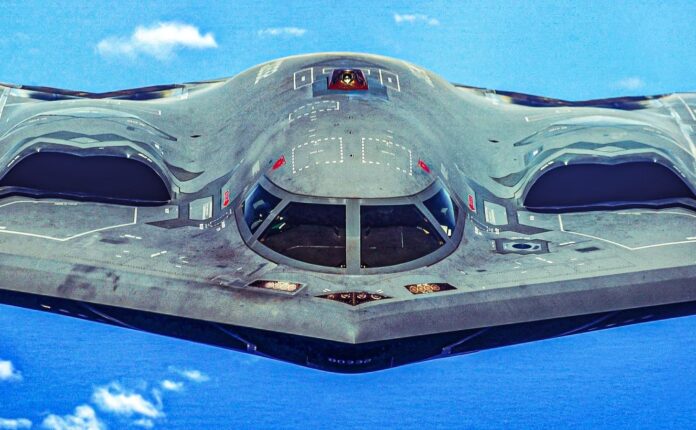

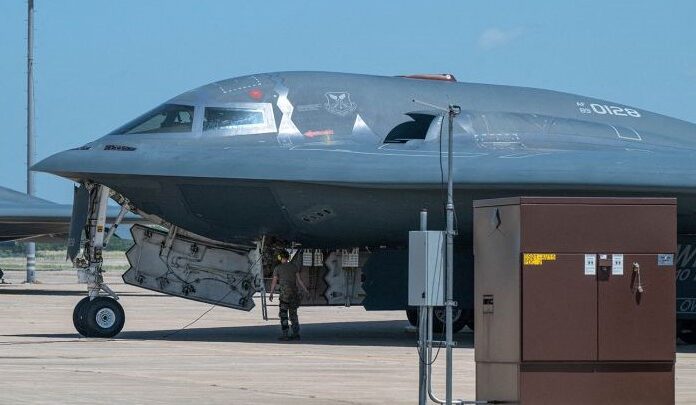
The B-2 Spirit is not an ordinary bomber. It is a long-range stealth bomber designed to penetrate advanced enemy defenses and strike some of the most protected targets in the world. Its flying-wing design gives it a futuristic appearance, almost like something from science fiction. But every curve, edge, and surface of the aircraft was designed with a serious mission in mind: reduce radar visibility, increase range, and deliver powerful weapons deep inside enemy territory.
The official payload capacity of the B-2 is about 40,000 pounds, but that does not mean it always carries the same type of weapon. Its mission load can change depending on the target. Sometimes it may carry many smaller precision-guided bombs. Other times, it may carry fewer but much larger weapons. The B-2 is designed to carry both conventional and nuclear weapons, making it one of the most important strategic aircraft in the United States military.
This dual-capable role is one of the things that separates the B-2 from many other aircraft. It can be used for conventional strike missions, but it also plays a major role in nuclear deterrence. In simple words, the B-2 is not only a bomber for war; it is also a warning. Its existence tells potential enemies that even heavily defended targets may not be safe.
The B-2’s internal weapons bays can be fitted with rotary launchers and bomb-rack assemblies. These systems allow the aircraft to carry and release different types of munitions depending on the mission. For example, it can carry precision-guided bombs such as JDAMs, which use guidance systems to strike targets with high accuracy. It can also carry nuclear gravity bombs, making it part of America’s strategic deterrent force.
But the most dramatic weapon associated with the B-2 is the GBU-57 Massive Ordnance Penetrator, often called the MOP.
This weapon weighs about 30,000 pounds by itself. That means one single bomb can take up most of the B-2’s payload capacity. The GBU-57 is not designed like an ordinary bomb. It is a massive bunker-busting weapon built to attack deeply buried and heavily protected targets such as underground command centers, tunnels, and fortified facilities. What makes this weapon especially important is that the B-2 Spirit is known as the only aircraft in the U.S. inventory capable of carrying and delivering it.
That fact alone shows how powerful the B-2 really is.
A normal person may hear “40,000 pounds” and understand that it sounds heavy, but it helps to imagine it in a more visual way. Forty thousand pounds is roughly equal to the weight of several large trucks, or about 20 small cars depending on the vehicle. Now imagine that amount of destructive weight hidden inside a stealth aircraft that can fly thousands of miles and appear over a target with very little warning. That is what makes the B-2 so extraordinary.
The B-2 was built during the Cold War, a time when the United States and the Soviet Union were locked in a tense competition for military and technological superiority. During that era, military planners needed an aircraft that could survive in a world filled with advanced radar, surface-to-air missiles, and heavily defended targets. Traditional bombers were powerful, but they could be detected more easily. The answer was stealth.
The B-2’s design was revolutionary. Instead of using a traditional fuselage and tail, it was built as a flying wing. This design helps reduce radar reflections. Its materials, surface coatings, engine placement, and shape all work together to make it harder to detect. The goal was not to make the aircraft literally invisible, but to make it extremely difficult for enemy radar systems to find and track.
That stealth advantage changes the meaning of payload. A bomber that can carry 40,000 pounds is powerful. But a stealth bomber that can carry 40,000 pounds deep into defended airspace is something far more serious.
This is why the B-2 is often described as a strategic bomber. It is not just built to attack ordinary battlefield targets. It is built to reach the kinds of targets that enemies believe are safe: command bunkers, air-defense centers, underground facilities, communications hubs, and high-value military infrastructure.
Another amazing feature of the B-2 is its range. The aircraft can fly extremely long distances, especially with aerial refueling. This gives it global reach. A B-2 can take off from the United States, fly across the world, complete a mission, and return. That means its 40,000-pound payload is not limited to nearby battlefields. It can be delivered almost anywhere when supported by refueling and mission planning.
This combination of payload, stealth, range, and precision makes the B-2 one of the most unique aircraft in history.
Many bombers are powerful because they carry a lot of bombs. The B-2 is powerful because it carries heavy weapons while remaining difficult to detect. It is not just about brute force. It is about surprise, reach, and accuracy.
The aircraft is operated by a crew of only two people: a pilot and a mission commander. That may surprise many readers because the B-2 is such a large and complex aircraft. Older bombers often needed larger crews. But the B-2 uses advanced systems that allow two highly trained crew members to manage long missions, navigation, communication, weapon delivery, and aircraft control.
Inside the cockpit, the mission can be physically and mentally demanding. B-2 missions may last many hours. The crew must remain focused while flying across huge distances, coordinating with command structures, managing stealth requirements, and preparing for precision strikes. The aircraft may look smooth and silent from the outside, but inside, it represents one of the most demanding jobs in military aviation.
One interesting historical fact is that the B-2’s first public rollout happened in 1988, when it was revealed at Air Force Plant 42 in Palmdale, California. At the time, the aircraft looked unlike anything most people had ever seen. Its black triangular shape instantly became a symbol of American stealth technology. It looked less like a traditional bomber and more like a shadow made of metal.
The B-2 later entered service and became based at Whiteman Air Force Base in Missouri. From there, it became part of America’s long-range strike force. Over the years, it has been used in real-world military operations, proving that its stealth and range were not just theories on paper.
The B-2 also became famous for its cost. It is one of the most expensive aircraft ever built. Because of its advanced technology, stealth materials, and limited production numbers, each aircraft is extremely valuable. This cost is one reason the B-2 fleet is relatively small. But even with a small number of aircraft, the B-2 has had an outsized impact because each aircraft can deliver massive firepower over enormous distances.
When people ask how much load the B-2 can carry, they are often thinking only about weight. But the better question is: what kind of power does that payload represent?
The answer depends on the mission. A B-2 carrying many precision-guided bombs can strike multiple targets in one mission. A B-2 carrying a bunker-busting weapon can threaten underground facilities that ordinary bombs may not reach. A B-2 carrying nuclear weapons becomes part of the most serious level of national defense strategy. In every case, the aircraft’s 40,000-pound payload is not just weight. It is strategic influence.
This is why the B-2 is sometimes described as a weapon of deterrence. Deterrence means preventing war by making the consequences too dangerous for an enemy to risk. The B-2 helps create that deterrence because it can reach protected targets that an enemy may believe are untouchable.
There is also something almost poetic about the B-2’s design. It carries enormous destructive power, yet it is built around silence and invisibility. It does not look aggressive in the traditional sense. It has no sharp tail, no bulky external weapons, and no obvious bomb load hanging beneath its wings. Instead, it appears smooth, calm, and almost unreal. But hidden inside are weapons that can weigh up to 40,000 pounds in total.
That contrast is what makes the B-2 so fascinating. It is quiet but powerful. Strange-looking but deadly serious. Elegant in shape but terrifying in purpose.
The B-2’s payload capacity also shows how military technology has changed over time. In earlier wars, bombers often relied on dropping large numbers of unguided bombs over wide areas. Modern bombers like the B-2 focus more on precision. Instead of simply carrying more bombs, they carry smarter weapons. A smaller number of precision weapons can sometimes achieve what once required many aircraft and huge bombing formations.
This makes the B-2 not only a heavy bomber, but also a precision strike aircraft. It combines the destructive load of a bomber with the accuracy of modern guided munitions and the stealth of a next-generation aircraft.
So, how much load can a B-2 bomber carry?
The simple answer is 40,000 pounds, or about 20 tons of weapons.
But the deeper answer is much more impressive. The B-2 can carry that load inside its stealthy flying-wing body, across huge distances, through dangerous airspace, and deliver it with precision against some of the world’s most protected targets. It can carry conventional bombs, nuclear weapons, and even the massive 30,000-pound GBU-57 bunker-buster.
That is why the B-2 Spirit remains one of the most powerful bombers ever created.
It is not just a plane.
It is a shadow with a 40,000-pound punch.
It is a silent warning to America’s enemies.
And it is one of the clearest examples of how stealth, range, precision, and payload can come together in a single aircraft to create one of the most feared machines in military aviation history.
“You may also like our article explaining how nuclear deterrence works in simple words.”




2 Comments on “How Much Load Can a B-2 Bomber Carry? Inside the Terrifying Power of America’s Stealth Bomber”