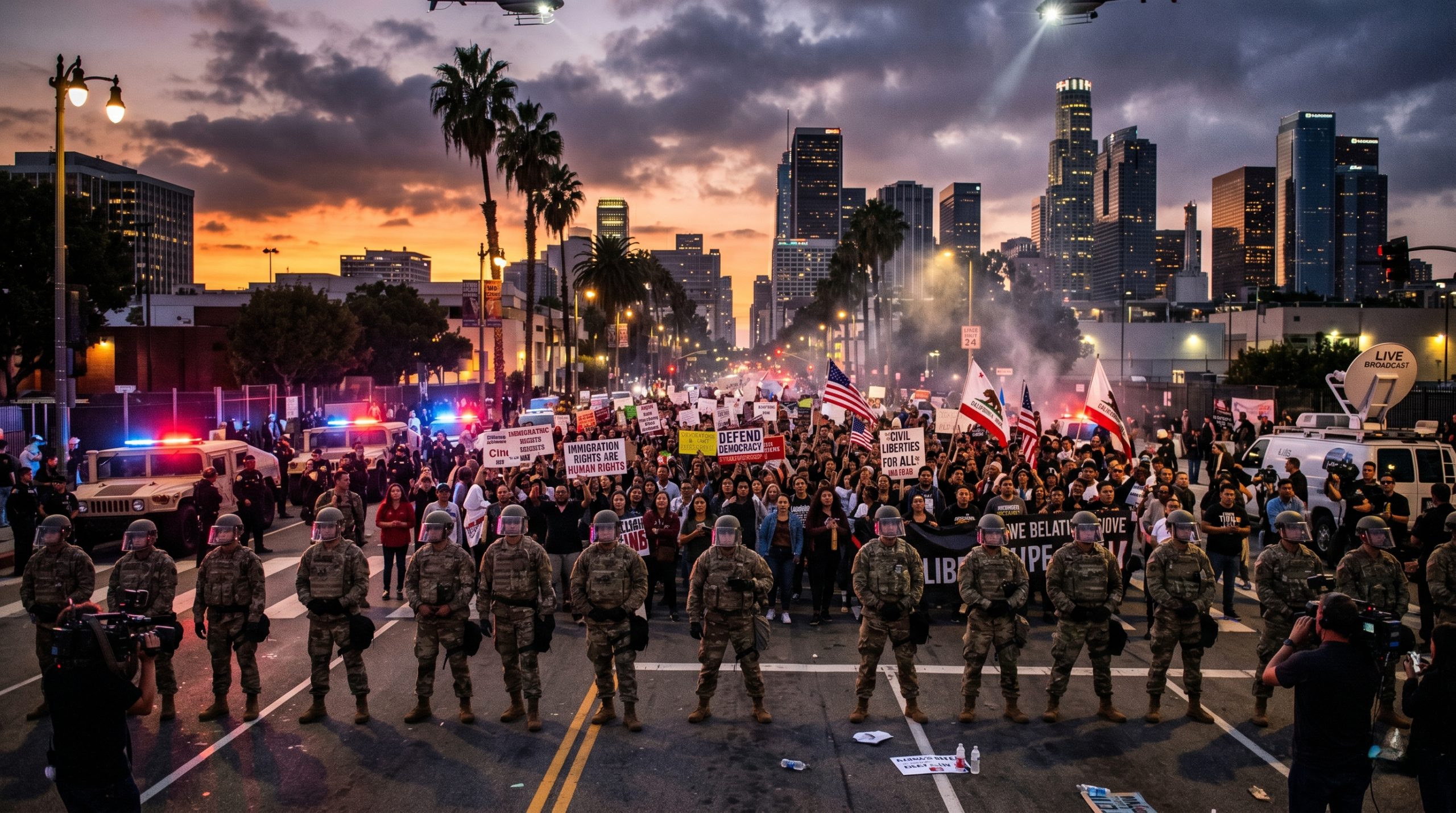
LOS ANGELES — The streets of Los Angeles became the center of a growing national debate Sunday as California officials openly challenged the Trump administration’s decision to deploy National Guard troops in response to immigration-related protests, escalating a confrontation that reaches far beyond Southern California.
What began as demonstrations against federal immigration raids has transformed into a historic struggle over state sovereignty, federal authority, and the limits of presidential power during times of domestic unrest.
California Governor Gavin Newsom’s administration condemned the deployment as “unlawful,” arguing that local and state law enforcement agencies were fully capable of maintaining public order without federal intervention.
In a sharply worded letter to Defense Secretary Pete Hegseth, California officials accused Washington of bypassing state leadership and taking extraordinary action that risked worsening an already tense situation.
You May Also Like
“There is currently no need for the National Guard to be deployed in Los Angeles,” state officials argued, warning that the federal move appeared likely to inflame tensions rather than restore calm.
The deployment marks a rare and controversial moment in American history. According to legal experts and historians, it represents the first federalization of a state’s National Guard without a governor’s consent since President Lyndon B. Johnson intervened in Alabama during the Civil Rights era in 1965.
By Sunday, approximately 300 National Guard troops had arrived in Los Angeles as demonstrations entered their third consecutive day.
Images from the city showed protesters marching through downtown streets, waving flags, carrying signs, and demanding what they described as dignity, fairness, and due process for immigrant communities. At several locations, demonstrators came face-to-face with heavily equipped law enforcement personnel and Guard members.
As tensions rose, tear gas was deployed during confrontations near federal facilities, creating scenes that quickly spread across national media and social networks.
The unrest was triggered by immigration enforcement operations conducted in the region, including a raid near a suburban Home Depot that drew immediate backlash from community activists and immigrant-rights organizations.
Yet beneath the visible confrontation lies a broader political conflict that could have implications far beyond California.
Democratic leaders across the country quickly rallied behind Newsom, describing the deployment as an unprecedented intrusion into state authority.
Former Vice President Kamala Harris characterized the move as a dangerous escalation, arguing that the administration’s actions risked deepening divisions at an already volatile moment.
Meanwhile, Democratic governors issued a joint statement warning that federal activation of a state’s National Guard without coordination with its governor undermines long-standing principles of state leadership and local accountability.
Supporters of the deployment, however, argue that the federal government has a responsibility to protect public safety, federal personnel, and critical infrastructure when unrest threatens to spiral beyond local control.
The debate has become a defining test of competing visions of governance in America: one emphasizing federal intervention in moments of crisis, the other defending state autonomy and local decision-making.
As night fell over Los Angeles, National Guard troops remained stationed across key locations while demonstrations continued.
For many Americans watching from across the country, the images unfolding in California are about more than a single protest or a single political dispute.
They reflect a nation wrestling with difficult questions about immigration, public safety, constitutional authority, and the balance of power between states and the federal government.
The outcome of this confrontation may ultimately be decided in courtrooms, legislatures, and future elections.
But for now, Los Angeles stands at the center of a national conversation—one that will help define how America responds to conflict, dissent, and democratic disagreement in the years ahead.
As protesters and troops face one another under the California sky, the world is watching.
Not simply to see what happens next in Los Angeles.
But to understand what it reveals about the future of the United States itself.