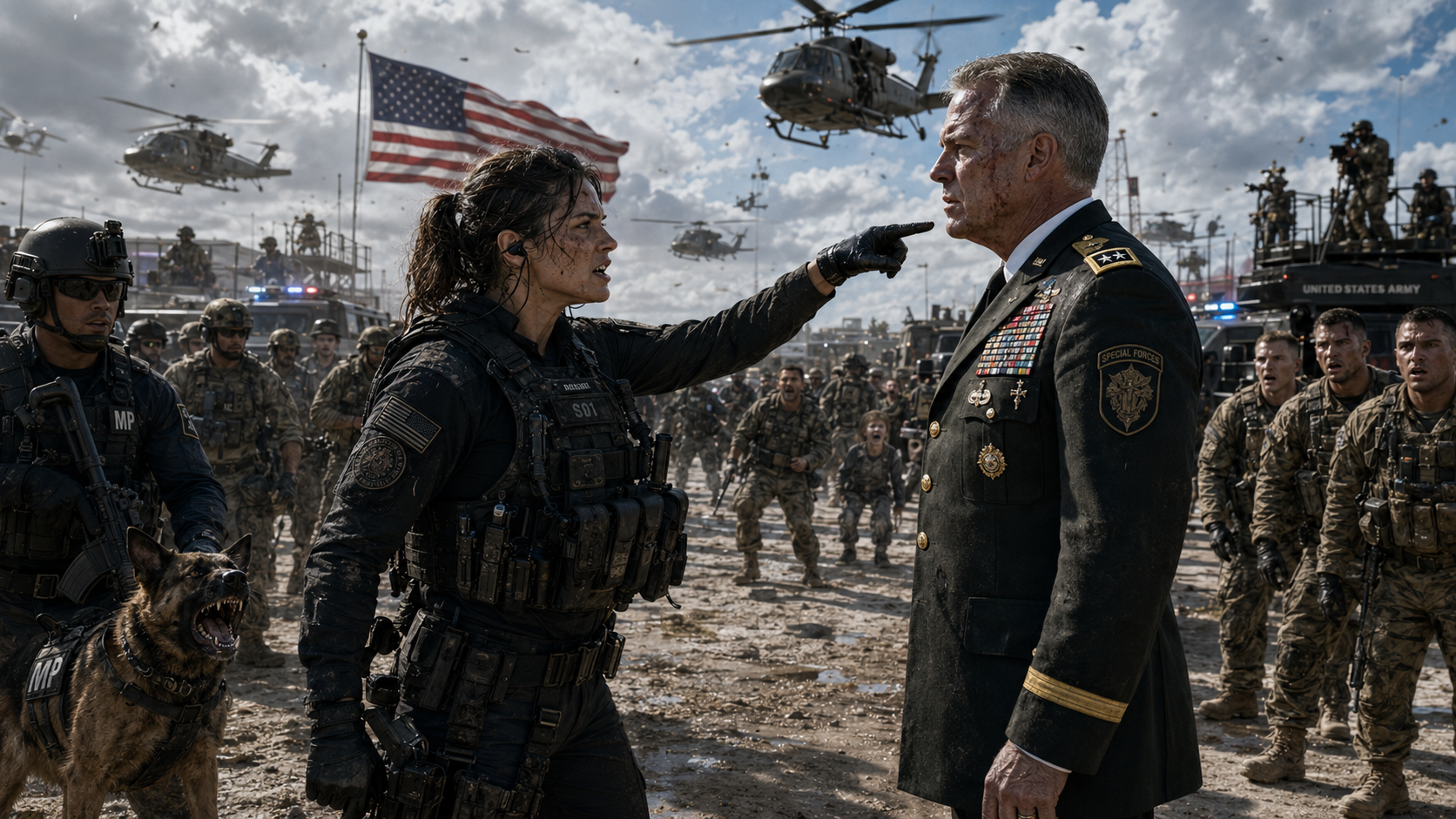
The crack of his hand across my face sounded like a gunshot over the thumping jukebox. My bottom lip split instantly, the warm metallic taste of blood pooling in my mouth. I didn’t flinch. I just stared up at General Richard Kaine—the three-star American hero, the untouchable Navy SEAL legend, and the man who had no idea I wasn’t the nobody he thought I was.
My name is Raven Cole. Four years ago, the government declared me dead after a black site extraction in Syria went deliberately wrong. I was supposed to be a ghost. But ghosts don’t usually sit in crowded military bars in Norfolk, Virginia, sipping ice water while the man who sold out my entire unit looms over their table.
“Who authorized a civilian animal in here?” Kaine had barked, pointing at the massive black German Shepherd lying silently at my feet.
“This isn’t a dog park, sweetheart,” he sneered, leaning into my space to make me feel small. “You’re nobody.”
You May Also Like
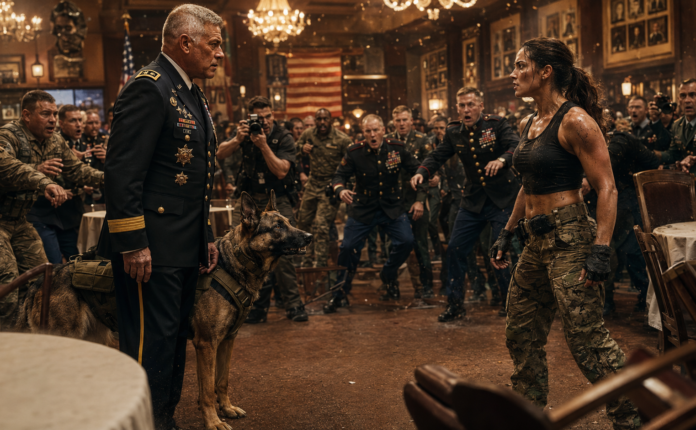
That’s when he hit me. The whole bar went dead silent. Dozens of enlisted men and officers froze, none of them willing to risk their careers for a woman in a gray hoodie.
I slowly wiped the blood from my chin. “You just made a very specific mistake,” I whispered.
Beneath the table, Cerberus didn’t growl. A Tier 1 military working dog doesn’t waste energy on theatrics. Seventy-five pounds of pure muscle and discipline exploded upward. He cleared the table in a fraction of a second, but he didn’t go for Kaine’s throat. Instead, he planted his massive paws on the table and locked his jaws around Kaine’s right wrist, pinning the General’s arm to the wood with absolute, bone-crushing mechanical certainty.
Kaine let out a raw, involuntary gasp of pure terror in front of forty witnesses.
“Call it off!” Kaine demanded, his voice cracking, his legendary composure shattering instantly.
“He responds to threat assessment,” I said, staying perfectly seated. “He decides when the threat is resolved.”
But as the military police burst through the front doors, their hands hovering over their holsters, I saw Kaine’s aide pulling out a phone. Kaine wasn’t just a bully; he was a man with endless resources. And as the MPs closed in on us, I realized he was about to recognize the dog that was supposed to have died in the desert eight years ago.
Part 2
The rain hit my face like freezing needles the second Hatch kicked open the motel’s rear maintenance door. We didn’t hesitate. Cerberus moved like a shadow at my left heel, silent and lethal, as we sprinted toward Hatch’s unmarked sedan idling in the alleyway. The heavy thwack of a suppressed gunshot splintered the doorframe inches from my head. I dove into the backseat, hauling Cerberus in with me as Hatch slammed on the gas.
We tore through the slick streets of Norfolk, my eyes glued to the rearview mirror. Kaine’s men were ruthless, but Hatch drove like a phantom, losing our tail in a maze of industrial backroads. We needed a safehouse, and more importantly, we needed a terminal to read whatever a desperate, 26-year-old SEAL named Corporal Delaney had hidden inside his dog’s neck before he was slaughtered.
Hatch took us to Petra Walsh, an off-the-books naval civilian contractor with a basement full of decryption hardware. Petra took one look at Cerberus, verified the military-grade encryption embedded in his flesh, and got to work. For forty agonizing minutes, the only sound in the room was the hum of servers and Cerberus’s steady breathing.
When the encryption finally cracked, a video file appeared on the monitor.
The three of us stood in dead silence, watching 47 minutes of grainy, terrifying helmet-cam footage. It was Delaney’s final night. The audio was unmistakable—General Kaine’s voice crackling over the radio, deliberately transmitting the unit’s exact GPS coordinates to a hostile mercenary group. Kaine had sold his own men out for millions in defense contract kickbacks, ensuring his wealth while climbing the ranks on a fabricated story of tragic survival.
“He sold them,” I whispered, my voice breaking. “He stood at their memorials and cried for the cameras, knowing he pulled the trigger.”
“This is a federal battering ram,” Hatch said, his face pale. “We need to get this to DOJ Inspector General Sarah Merritt immediately. She’s been trying to nail Kaine for two years.”
We coordinated the drop with Merritt, planning to submit the data directly to a federal judge to secure an immediate arrest warrant. Kaine was scheduled to receive the prestigious Naval Heritage Award at a massive, televised gala the very next evening. Merritt wanted him arrested on live television before he could run.
But here is where everything spiraled out of control.
The next night, I was embedded in the third row of the press section at the Chrysler Hall Ballroom, wearing a fake media badge. Cerberus was safely stashed in a vehicle a block away with Petra. The room was packed with three hundred high-ranking officials, cameras, and journalists. I counted three undercover federal marshals waiting for Merritt’s signal to move in.
Kaine arrived, soaking up the applause, shaking hands, playing the flawless American hero. He was minutes away from taking the stage. I gripped my phone, waiting for Merritt’s text confirming the federal warrant had cleared the system.
Instead, I noticed something that made the blood drain from my face.
The undercover marshal stationed near the stage—the one supposed to lead the arrest—caught the eye of Kaine’s lead aide. They exchanged a subtle, knowing nod. The marshal discreetly tapped his earpiece, turned his back to the stage, and walked swiftly toward the kitchen exit.
He was a mole. Kaine’s corruption ran deeper than DOJ.
My phone vibrated. A text from Hatch: Warrant delayed by system override. Kaine’s network just tipped him off. They’re pulling his vehicle around back. He’s going to run.
I stared at the stage. The announcer was already calling Kaine’s name. The crowd erupted into a deafening standing ovation. If Kaine slipped out the back door tonight, with his offshore accounts and forged passports, he would vanish into the wind. The 11 men of Bravo 7 would never get their justice. I had to trap him in front of the cameras. I had to force the confrontation right here, right now, with no backup and no active warrant.
I typed a frantic, single-word text to Petra waiting in the car outside.
Now.
If you’ve read this far, don’t hesitate to leave a like and comment before reading part 3. It makes us as happy as reading a complete story! Thank you. 👍❤️
Part 3
The ballroom was vibrating with applause as General Richard Kaine confidently strode toward the podium. He smiled his famous, million-dollar smile, raising a hand to humbly accept the adoration of the three hundred elites in the room. He thought he had outsmarted us. He thought his private jet was waiting to carry him away from the collapsing house of cards.
He didn’t account for Cerberus.
The heavy oak doors at the back of the ballroom swung open with a resounding thud. The applause faltered, rippling into confused murmurs as heads turned.
Walking down the center aisle of the Chrysler Hall Ballroom, completely unbothered by the flashing cameras and the sea of expensive suits, was a massive, scarred black German Shepherd. He wasn’t on a leash. He didn’t bark. He just walked with the measured, terrifying precision of an animal on a mission. I stepped out from the press row and walked a few paces behind him, my eyes locked dead on the stage.
Kaine was mid-sentence, talking about the “sacrifice of his fallen brothers,” when he saw us.
For the first time in thirty-five years, the mask slipped. Live on national television, the untouchable American hero looked down at the dog that had survived his betrayal, and sheer, unfiltered terror washed over his face.
Cerberus reached the foot of the stage, planted his front paws on the edge, and stared up at Kaine. The dog didn’t growl. He just locked eyes with the man who had ordered his death, holding him frozen in place. The entire ballroom fell into a suffocating, dead silence.
I stepped up beside my dog, reaching into my jacket. I pulled out the encrypted flash drive containing the 47 minutes of helmet-cam footage and held it high enough for Kaine, and every camera in the room, to see.
“Corporal Delaney says hello,” I said. My voice echoed through the microphone on the podium.
Kaine’s eyes darted toward the exits, but it was too late. The spectacle had bought us the exact window we needed. The ballroom doors burst open again, and this time, it wasn’t Kaine’s corrupted mole. It was Colonel Merritt, backed by half a dozen heavily armed, loyal federal agents. The arrest warrant had finally cleared.
“General Richard Kaine,” Merritt’s voice boomed over the chaos of gasping officials and frantic reporters. “You are under arrest for conspiracy to commit murder, treason, and war profiteering.”
Kaine didn’t fight. The cameras captured every second of his humiliation as the steel cuffs clicked around his wrists. As they dragged him away, his eyes found mine one last time. “This isn’t over,” he hissed.
“Yes, it is,” I replied, resting my hand on Cerberus’s massive head.
The aftermath was a hurricane. The footage leaked online before midnight, crashing social media platforms and dominating every news network across the globe. By morning, Kaine’s financial empire was seized, his accomplices were flipping for plea deals, and the entire corrupt network was burning to the ground.
Four months later, a federal judge sentenced Richard Kaine to thirty-seven years in a maximum-security prison without the possibility of parole.
But the only moment that truly mattered happened a week after the verdict. I drove to a quiet suburban house in Chesapeake, Virginia, with Cerberus sitting in the passenger seat. We were there to meet an eleven-year-old girl named Emma—Corporal Delaney’s daughter. She was only three when her father was murdered.
When Emma saw Cerberus, she didn’t hesitate. She dropped to her knees on the front lawn, wrapped her small arms around the massive dog’s neck, and buried her face in his fur. Cerberus closed his eyes, leaning his heavy head against her shoulder, finally shedding the weight of a war he had carried for eight long years.
“Did my dad’s plan work?” Emma asked, looking up at me with her father’s brave, steady eyes.
I smiled, fighting back the tears I hadn’t let fall in four years. “It worked, Emma. The whole world knows the truth now.”
Some debts can never be fully paid. But they can be witnessed, and the truth can be pulled out of the dark. We finally brought Bravo 7 home.
What do you think of this story? Please leave a like and share your thoughts in the comments. Your support means a lot to us and inspires us to keep writing more meaningful and powerful stories. Thank you! 👍❤️