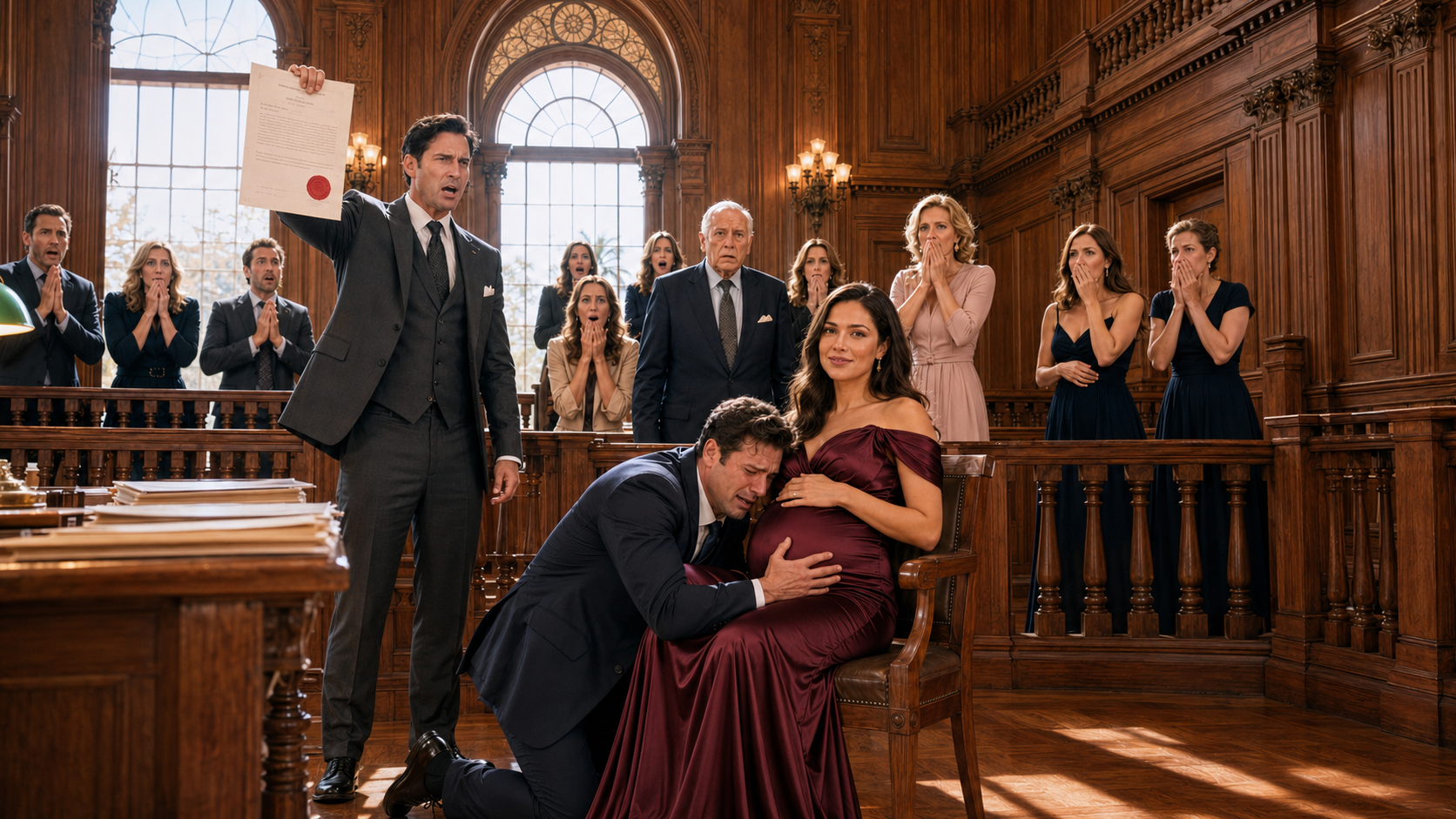
The courtroom went silent the moment my husband laughed at my body.
I was eight months pregnant, sitting at the front table with swollen ankles, aching ribs, and one hand resting over the small life kicking beneath my heart.
Across from me, Richard Sterling leaned back in his chair like he had already won.
He wore a charcoal suit tailored so perfectly it looked painted onto him. His cufflinks flashed under the courtroom lights. His hair was neat. His smile was cruel. Beside him sat three attorneys whose hourly rates could have fed a family for a year.
Behind him, in the gallery, his mistress crossed her legs and giggled.
Sloane Kensington.
Twenty-three years old.
Pretty in a cold, expensive way.
And wearing my grandmother’s sapphire earrings.
The earrings my mother had given me on my wedding day.
The earrings Richard once told me looked “too sentimental” for Sterling society.
Now they glittered beside Sloane’s smirking face.
Richard followed my eyes, then smiled wider.
“You keep staring at those earrings, Caroline,” he said loudly enough for the first two rows to hear. “You should get used to seeing your old life on someone else.”
A few people shifted uncomfortably.
Sloane covered her mouth, pretending to hide a laugh.
I felt my son kick hard beneath my ribs.
My attorney, Miriam Vance, placed two calm fingers against my wrist under the table.
A quiet warning.
Do not react.
So I didn’t.
I sat still.
That bothered Richard more than tears would have.
For six years, he had loved making me small.
At parties, he corrected my words.
At dinners, he interrupted my stories.
In private, he called me “too soft,” “too emotional,” and “manageable.”
That was his favorite word.
Manageable.
He used it like a compliment.
“My wife is very manageable,” he would say to investors, smiling as though I were a beautiful dog trained not to bark.
They laughed.
I smiled.
Because that was what Sterling wives were trained to do.
Smile.
Stay polished.
Endure.
And never, ever embarrass the family name.
But Richard had made one mistake.
He mistook my silence for stupidity.
His lead attorney stood, buttoning his jacket with theatrical confidence.
“Your Honor,” he began, “this is a simple matter. The prenuptial agreement signed by Mrs. Sterling is clear. She waived all rights to marital property, corporate holdings, family trusts, residences, investment gains, and future appreciation of Sterling Capital assets.”
He slid a thick document toward the judge.
“She leaves this marriage with the agreed settlement of one hundred thousand dollars, her personal clothing, and any items she can prove she brought into the marriage.”
Sloane whispered, “That’s generous.”
Richard chuckled.
My throat tightened, but not from fear.
From memory.
I remembered the first night I found the hotel receipt.
Room service.
Champagne.
Two robes.
A luxury suite booked under a corporate account.
When I confronted Richard, he didn’t even look embarrassed.
He stood in our penthouse living room, loosened his tie, and stared at me like I was a servant who had touched the wrong drawer.
“You went through my laptop?”
“I found receipts,” I said.
“You found documents you don’t understand.”
“There’s a jewelry invoice too.”
He smiled slowly.
“Caroline, you’re pregnant. Pregnancy makes women paranoid.”
“I’m not paranoid.”
“No?” He stepped closer. “Then tell me why your hands are shaking.”
Because my world was falling apart.
Because my husband smelled like another woman’s perfume.
Because the man I had defended to everyone was staring at me like I was already replaceable.
He leaned down and whispered, “No one will believe you. Not my board. Not my family. Not a judge. They’ll see exactly what I tell them to see.”
“What will you tell them?”
“That you’re unstable.”
His voice softened, but his eyes did not.
“And if you keep pushing, Caroline, I’ll make sure you never get control of anything. Not money. Not the house. Not even decisions about that baby.”
I remembered clutching my belly that night.
I remembered thinking I was trapped.
Then I remembered who I had been before Richard Sterling turned me into a quiet wife.
Before the galas.
Before the diamonds.
Before the family portraits and fake smiles.
I had been Caroline Hale.
Forensic accountant.
The woman companies called when money disappeared through walls.
Richard forgot that.
But I didn’t.
In the courtroom, Judge Harrison looked over his glasses.
“Mrs. Sterling,” he said, “does your side wish to respond before the court proceeds?”
Richard leaned toward me.
“Be careful,” he whispered. “Don’t humiliate yourself.”
Sloane leaned forward too.
“Richard,” she said sweetly, “maybe don’t be too hard on her. She’s very pregnant. She’s probably confused.”
I turned slowly and looked at her.
For the first time that morning, Sloane stopped smiling.
Miriam stood.
She did not raise her voice.
She did not rush.
She simply picked up a thin black folder and said, “Yes, Your Honor. Before the court enforces the prenuptial agreement, we ask that Article Twelve be executed immediately.”
Richard’s smile flickered.
His attorney frowned.
“Article Twelve?” he said with a laugh. “Your Honor, opposing counsel is trying to revive an irrelevant family clause from decades ago. It has no standing here.”
Miriam opened the folder.
“It has standing because Richard Sterling reaffirmed it in his 2018 succession agreement when he accepted voting control of Sterling Capital.”
The attorney stopped laughing.
Richard sat up straighter.
“What did you say?” he asked.
Miriam didn’t look at him.
She handed copies to the bailiff, the judge, and opposing counsel.
“The clause is known inside Sterling family documents as the Infidelity Forfeit Provision.”
The room changed.
I felt it.
The shift.
The sudden tightening in every expensive throat.
Richard’s mother, Eleanor Sterling, sat in the back row wearing pearls and black silk. Until that moment, she had looked bored.
Now she leaned forward.
Her fingers gripped the wooden bench.
Miriam continued.
“Article Twelve states that if the controlling Sterling heir commits documented adultery, hides marital assets, and then attempts to use the prenuptial agreement to financially dispossess the betrayed spouse, all voting shares held by that heir are immediately transferred into trust for the legitimate child of the marriage.”
The judge looked down at the paper.
Richard’s attorney shot to his feet.
“Your Honor, this is absurd. Morality clauses like this are punitive and unenforceable.”
Miriam turned a page.
“This one was drafted not as a morality clause, but as a corporate protection clause. It was designed to prevent a controlling shareholder from endangering Sterling Capital through scandal, fraud, asset concealment, or personal misconduct tied to company funds.”
Richard’s jaw tightened.
I heard Sloane whisper, “Richard? What is she talking about?”
He did not answer.
Miriam pressed a remote.
The courtroom monitor came to life.
The first image appeared.
Richard and Sloane entering the Grand Meridian Hotel together.
Timestamped.
Clear.
His hand rested on her lower back.
Sloane’s smile vanished.
Miriam clicked again.
A lease agreement for a Tribeca loft.
Paid through a Sterling Capital shell vendor.
Click.
A jewelry invoice.
Sapphire earrings.
My grandmother’s earrings.
Click.
Wire transfers to Kensington Strategies.
Click.
Flight records.
Click.
Private villa footage.
Click.
Restaurant receipts.
Click.
Messages.
Richard’s attorney shouted, “Objection!”
Miriam didn’t blink.
“Every document was obtained through lawful discovery, shared-access financial records, or subpoenaed corporate accounts.”
Richard turned to me.
His face was no longer handsome.
It was hard and red and full of panic.
“You spied on me.”
I looked at him calmly.
“No, Richard. I audited you.”
A whisper moved across the courtroom.
Sloane stood halfway from her seat.
“You told me she didn’t know anything.”
Richard snapped, “Sit down.”
She froze.
That was the first time she saw the real man.
Not the gifts.
Not the hotel rooms.
Not the promises.
The man.
Cold.
Commanding.
Ugly beneath the polish.
Judge Harrison raised his hand.
“Everyone will remain seated.”
Miriam looked at the judge.
“Your Honor, Mr. Sterling did not merely commit adultery. He used corporate channels to fund the affair. He moved marital assets through shell vendors. He gifted stolen personal property belonging to my client. Then he attempted to use this court to leave his pregnant wife nearly penniless.”
Richard slammed his hand on the table.
“She signed the prenup!”
Miriam turned to him.
“And you signed Article Twelve.”
His mouth closed.
That was the moment I saw fear enter his eyes.
Real fear.
Not the fear of losing money.
Men like Richard can lose millions and still sleep well.
No.
This was the fear of losing control.
The judge studied the pages for a long moment.
Then he looked at Richard.
“Mr. Sterling, did you sign the 2018 succession agreement?”
Richard’s attorney quickly said, “Your Honor, my client signed many documents during that transition. It is unreasonable to expect—”
The judge cut him off.
“I asked Mr. Sterling.”
Richard’s nostrils flared.
“Yes,” he said.
“And did your counsel review the documents with you?”
“Yes.”
“And did you accept voting control under the terms of that agreement?”
Richard looked at me.
I watched him try to blame me with his eyes.
“Yes,” he said again.
Miriam stepped forward.
“Then the triggering conditions are satisfied.”
Richard laughed, but there was no humor in it.
“You think this makes you powerful, Caroline? You think because you found some dusty clause, you can run my company?”
I stood slowly.
My back ached.
My ankles throbbed.
My son kicked again.
But I stood.
“No, Richard,” I said. “I think you ran it badly enough that people are relieved someone else finally read the paperwork.”
A few people in the gallery gasped.
Sloane stared at me like she had never imagined I could speak above a whisper.
Richard’s eyes narrowed.
“You were nothing when I found you.”
I smiled faintly.
“When you found me, I was already better with money than you.”
His face twisted.
“You ungrateful—”
“Mr. Sterling,” the judge warned.
But Richard was unraveling.
“She lived in my house,” he snapped. “She wore my name. She sat at my table. She smiled beside me. I made her.”
“No,” I said quietly. “You displayed me.”
The room went still.
“You wanted a wife people could admire and ignore. A woman who looked expensive but never asked what anything cost. A woman who would smile while you lied. A woman who would lower her head when you brought another woman into our marriage.”
I looked back at Sloane.
“And then you gave that woman my earrings.”
Sloane’s hand flew to her ears.
For once, she looked ashamed.
Richard sneered.
“They’re just earrings.”
“They were my grandmother’s.”
“So what?”
The words landed exactly the way I knew they would.
Cold.
Careless.
Ugly.
Miriam pressed the remote again.
A voicemail played through the speakers.
Richard’s voice filled the courtroom.
“Sell the old jewelry if you want. She won’t have money to fight me after the baby comes. Make sure Caroline gets tired. Pregnant women always break eventually.”
The courtroom went dead silent.
Even Richard’s attorney looked away.
My hands trembled once, but I folded them over my belly.
Sloane turned to Richard slowly.
“You said you were protecting me from her.”
Richard hissed, “Quiet.”
But Sloane didn’t sit down this time.
“You told me she was crazy.”
“She is crazy.”
“No,” Sloane whispered, touching the sapphire earrings. “You said she abandoned you. You said the baby might not even be yours.”
The courtroom exploded into whispers.
My heart stopped.
I had known Richard was cruel.
But I had not known that.
Miriam turned her head toward me. Her eyes sharpened.
“Mrs. Sterling,” she said softly, “did you know he had made that claim?”
I shook my head.
Richard realized his mistake too late.
Judge Harrison looked furious.
“Mr. Sterling, have you questioned paternity in filings before this court?”
Richard’s attorney scrambled.
“No formal filing, Your Honor.”
The judge’s voice hardened.
“That is not what I asked.”
Richard sat back, breathing through his nose.
“I made private comments.”
Miriam opened another folder.
“Your Honor, if the respondent intends to challenge paternity, we ask that the court address another provision in the same succession agreement.”
Richard’s mother stood suddenly.
“No.”
Everyone turned.
Eleanor Sterling’s face had gone pale under her powder.
“Mother,” Richard snapped, “sit down.”
But Eleanor was not looking at him.
She was looking at me.
For the first time since I married into the Sterling family, she looked afraid of me.
Miriam read from the document.
“Article Thirteen states that if a Sterling heir attempts to falsely discredit the legitimacy of a child of the marriage in order to avoid trust transfer, and medical testing confirms paternity, all nonvoting inheritance interests connected to that heir also become restricted pending review by the family board.”
Richard’s attorney whispered, “Oh my God.”
Richard’s face emptied.
I understood then.
Article Twelve could cost him control.
Article Thirteen could cost him everything else.
The judge leaned forward.
“Mr. Sterling, do you wish to formally challenge paternity?”
Richard’s mouth opened.
His mother whispered sharply, “Richard, don’t.”
Sloane laughed once.
It was bitter and broken.
“Oh, now you’re quiet?”
Richard glared at her.
“You stay out of this.”
“No,” Sloane said, voice shaking. “I ruined my reputation for you. You told me I was carrying your future.”
Miriam’s eyes flickered.
I saw it.
Another secret.
She reached into her briefcase and pulled out a sealed envelope.
“Your Honor, that brings us to the second matter.”
Sloane froze.
Richard whispered, “Miriam.”
But Miriam was already moving.
“Ms. Kensington submitted statements to several private parties claiming she was pregnant with Mr. Sterling’s child. Those claims were used by Mr. Sterling to pressure my client into signing an immediate divorce settlement.”
Sloane looked as if the floor had opened under her.
“I am pregnant,” she said weakly.
Miriam turned toward her.
“No, Ms. Kensington. You are not.”
The gallery erupted.
Sloane’s mouth fell open.
Richard’s face turned gray.
Miriam continued, calm and relentless.
“Subpoenaed records from the private investigator hired by Mr. Sterling’s own corporate counsel show that Ms. Kensington purchased ultrasound images online and used them to demand a larger financial commitment from Mr. Sterling.”
Sloane gripped the bench.
“Richard?”
He would not look at her.
“You investigated me?” she whispered.
Richard’s jaw clenched.
“You lied to me first.”
Sloane stared at him.
Then she slapped him.
The crack echoed across the courtroom like a gunshot.
People gasped.
The bailiff rushed forward.
Sloane screamed, “You promised me she was nothing! You promised me the company! You promised me her life!”
Richard held his cheek, stunned.
His perfect skin reddened where her palm had struck him.
Eleanor closed her eyes.
The judge slammed his gavel.
“Order!”
But the room was already chaos.
Sloane pointed at Richard, tears spilling down her face.
“He said once the divorce was done, he would make Caroline disappear from the city. He said he knew doctors, lawyers, judges—he said he could make anyone look unstable if he paid enough!”
Richard shouted, “She’s lying!”
Miriam’s voice cut through the noise.
“Your Honor, we request that Ms. Kensington’s statement be preserved and that this matter be referred for investigation.”
The judge’s face was like stone.
“Granted.”
Richard’s attorney sank into his chair.
He looked like a man watching a mansion burn while holding an empty glass of water.
The judge reviewed the documents for nearly twenty minutes.
No one spoke.
Richard stared at the table.
Sloane cried silently between two bailiffs.
Eleanor looked older with every passing second.
I sat with one hand over my son and tried to breathe.
Finally, Judge Harrison removed his glasses.
“Mr. Sterling,” he said, “this court has seen greed. It has seen betrayal. It has seen wealthy spouses attempt to weaponize contracts against vulnerable partners. But rarely has this court seen such a complete record of arrogance.”
Richard closed his eyes.
The judge continued.
“The prenuptial agreement remains valid only where its conditions are honored. You signed a succession agreement containing Articles Twelve and Thirteen. The evidence presented today shows documented adultery, asset concealment, bad-faith enforcement, and attempts to financially dispossess your pregnant spouse.”
He paused.
“Therefore, this court recognizes the triggering of Article Twelve.”
Richard stood.
“No.”
The judge looked at him.
“Sit down.”
“No!” Richard shouted. “This is my company!”
The judge’s voice turned ice-cold.
“It was your voting control, Mr. Sterling. And according to the agreement you signed, you forfeited it.”
Miriam reached over and squeezed my shoulder.
I felt tears rise, but I held them back.
The judge ruled clearly.
“All voting shares held by Richard Sterling shall transfer immediately into trust for the legitimate child of the marriage. Caroline Sterling shall serve as sole trustee with full voting authority until the child reaches the age specified by the agreement.”
Richard’s face collapsed.
Not dramatically.
Not with shouting.
He simply emptied.
The king without his crown.
The billionaire without control.
The man who thought he had bought the world, learning the world still had signatures he could not erase.
The judge wasn’t finished.
“Mrs. Sterling is awarded immediate temporary residence in the marital penthouse, full medical support, security protection, legal fees, and return of all personal inherited property, including the sapphire earrings currently worn by Ms. Kensington.”
Sloane reached up slowly and removed them.
Her fingers shook.
A bailiff took the earrings and placed them in a small evidence bag.
Miriam leaned close to me.
“You did it.”
I looked at Richard.
“No,” I whispered. “He did.”
As we exited the courtroom, reporters flooded the hallway.
“Mrs. Sterling!”
“Caroline, did you expect this outcome?”
“Is Richard Sterling stepping down?”
“What will happen to Sterling Capital?”
I stopped.
For six years, cameras had captured me smiling beside Richard.
Silent.
Decorative.
Manageable.
Today, they captured me standing alone.
Pregnant.
Tired.
But unbroken.
A reporter shoved a microphone forward.
“Mrs. Sterling, what do you want people to know?”
I looked down at my belly.
Then I looked into the camera.
“I want them to know that quiet women are not always weak,” I said. “Sometimes they are collecting evidence.”
That sentence ran across every news channel by dinner.
By morning, Sterling Capital’s board called an emergency meeting.
By noon, Richard was removed as CEO pending investigation.
By sunset, his lenders froze his personal credit lines.
By the end of the week, the federal auditors arrived.
The empire Richard had used to threaten me began eating itself from the inside.
But the real twist did not come in court.
It came eleven days later.
I was back in the penthouse, not because I wanted the marble floors or the skyline or the cold rooms designed by people who thought beige was a personality.
I was there because my doctor wanted me close to the hospital.
The nursery was half-finished.
Richard had refused to let me decorate it.
He said it was “too early to indulge maternal fantasies.”
Now I sat on the floor surrounded by paint samples, baby blankets, and boxes of my returned belongings.
Miriam arrived just after seven in the evening.
She looked serious.
Too serious.
“What happened?” I asked.
She placed a leather envelope on the coffee table.
“This was delivered to my office by a retired Sterling family attorney.”
I frowned.
“Why?”
“Because Eleanor tried to destroy it.”
My skin went cold.
Miriam opened the envelope.
Inside was a letter.
Old.
Folded carefully.
Addressed to: The betrayed spouse of a Sterling heir.
My hands trembled as I unfolded it.
The letter was from Edmund Sterling, Richard’s grandfather.
The man who created Article Twelve.
The family tyrant.
The feared founder.
The letter read:
If you are reading this, then one of my descendants has mistaken inheritance for character.
I stopped breathing.
Miriam sat beside me.
I continued.
I built a fortune, but I failed to build honorable men. So I wrote these provisions for the women they would underestimate. The Sterlings will call you greedy. They will call you unstable. They will tell the world you married for money. But if my bloodline has repeated its sins, then take the control and use it better than we did.
My eyes filled with tears.
The last line broke me.
Do not protect the family name. Protect the child.
I pressed the letter to my chest and cried for the first time since the courtroom.
Not because I was weak.
Because after months of being called crazy, someone from the very family that tried to erase me had left proof that he knew exactly what men like Richard could become.
Two months later, my son was born during a thunderstorm.
I named him James Edmund Sterling.
James, after my father.
Edmund, after the man who had built a trap for his own descendants because he knew money without character becomes a weapon.
Richard tried to visit the hospital.
Security stopped him downstairs.
He sent flowers.
I sent them back.
He sent a message through his attorney.
“I want to see my son.”
Miriam read it aloud while standing beside my hospital bed.
I looked down at James sleeping against my chest.
“Tell him he may petition through the court like everyone else.”
Miriam smiled.
“That will hurt him.”
“No,” I said. “It will teach him.”
Three months later, I walked into Sterling Capital’s boardroom for the first time.
The room went silent.
Twelve directors stood.
All men.
All older.
All wearing the same cautious expression.
The last time I had entered this building, I came as Richard’s wife.
A quiet woman in a soft dress.
Today, I wore a black suit.
My grandmother’s sapphire earrings rested against my neck, bright as blue fire.
I walked to the head of the table.
Richard’s chair was empty.
No one had dared sit in it.
I placed my briefcase down.
A director cleared his throat.
“Mrs. Sterling, before we begin, we want to express that the board is prepared to support the trust’s long-term interests.”
I looked at him.
“The trust’s interest is my son’s future,” I said. “Sterling Capital’s interest is no longer protecting Richard’s ego.”
No one argued.
I opened the agenda.
“First matter,” I said. “Full forensic audit of executive spending for the last ten years.”
A man near the end of the table shifted.
I looked at him.
“Is that a problem?”
He swallowed.
“No, Mrs. Sterling.”
“Good.”
I turned the page.
“Second matter. Remove all vendors connected to shell consulting agreements. Third, freeze discretionary executive benefits until review. Fourth, establish a whistleblower channel outside internal management.”
One director stared.
“That is… aggressive.”
I smiled.
“No. Aggressive is using company money to buy hotel rooms for your mistress while threatening your pregnant wife with poverty. This is governance.”
No one spoke after that.
By the end of the month, three executives resigned.
By the end of the quarter, investigators uncovered enough hidden payments to open a criminal inquiry.
Richard’s name disappeared from the company website.
Then from the foundation.
Then from invitations.
Men who once laughed at his jokes stopped answering his calls.
Eleanor Sterling requested a private meeting with me.
I almost refused.
But curiosity is sometimes useful.
We met in the penthouse library, where she had once told me, “Sterling women endure quietly.”
She arrived in pearls, as always.
But her face had changed.
There was no command in it now.
Only calculation.
“Caroline,” she said, “you have made your point.”
I sat across from her.
“No, Eleanor. The court made it.”
She inhaled slowly.
“The company needs stability.”
“The company needed honesty. It survived without it for too long.”
Her eyes narrowed.
“You think you’re different from us because you were wounded?”
“No,” I said. “I think I’m different because I learned from it.”
She looked toward the nursery door.
“James is a Sterling.”
“He is my son.”
“He will need his family name.”
I leaned forward.
“He will need character more.”
Eleanor’s mouth tightened.
“Richard wants a second chance.”
“Richard wanted me penniless eleven weeks before delivery.”
“He was angry.”
“He was cruel.”
“He is the boy’s father.”
“And that is the only reason I will not erase him completely.”
For the first time, Eleanor looked away.
Then she whispered, “I warned him not to underestimate you.”
I laughed softly.
“No, Eleanor. You warned him not to get caught.”
She stood.
“You will regret making enemies of this family.”
I stood too.
“I married into this family six years ago. I already know what its enemies look like.”
She left without another word.
But as she reached the door, I said, “Eleanor.”
She turned.
I held up Edmund’s letter.
Her face went white.
“You tried to burn this, didn’t you?”
Her lips parted.
I smiled.
“Next time you hide evidence, don’t use a lawyer with a conscience.”
She walked out shaking.
One year later, Richard finally faced me in family court.
He looked thinner.
The expensive confidence was gone.
His suit was still tailored, but it hung differently now.
Like armor on a defeated soldier.
He asked for shared decision-making authority over James.
The judge asked him one question.
“Mr. Sterling, do you accept the paternity of the child?”
Richard looked at me.
Then at James, who slept in my arms.
For a moment, I saw something almost human pass across his face.
Regret, maybe.
Or fear.
“Yes,” he said quietly. “He is my son.”
The judge nodded.
That single admission destroyed his last argument against the trust.
Article Thirteen locked fully into place.
His remaining inheritance interests were restricted pending board review.
Richard’s attorney closed his eyes.
Richard understood immediately.
He turned to me and whispered, “You waited for this.”
I shook my head.
“No. You walked into it.”
He laughed bitterly.
“You always have the better line now, don’t you?”
“No,” I said. “I just stopped letting you write mine.”
He looked at James.
“I did love you once.”
I held my son closer.
“You loved owning me.”
“That’s not fair.”
“Neither was leaving your pregnant wife with one hundred thousand dollars while your mistress wore her grandmother’s earrings.”
He flinched.
For the first time, Richard had no answer.
Years later, people would ask me if revenge felt sweet.
I always told them the truth.
Revenge is loud for one day.
Freedom is quiet forever.
Revenge was the courtroom gasping when Article Twelve was read.
Revenge was Sloane removing my sapphire earrings with shaking hands.
Revenge was Richard’s face when the judge said, “You signed it away.”
But freedom was different.
Freedom was painting my son’s nursery pale blue without asking anyone’s permission.
Freedom was eating toast in the kitchen at midnight, barefoot, while James slept peacefully in the next room.
Freedom was walking into a boardroom where men once dismissed me and watching them rise when I entered.
Freedom was hearing my name without Richard’s shadow attached to it.
And the greatest freedom came on James’s fifth birthday.
He ran through the garden with chocolate on his cheeks, laughing as the wind tried to steal his paper crown.
Miriam stood beside me, holding a glass of lemonade.
“You know,” she said, “Richard sent a gift.”
I looked toward the table.
A small wrapped box sat near the flowers.
“What is it?”
“A wooden chess set.”
I smiled faintly.
Of course.
Even his apologies came as strategy.
James ran toward me.
“Mommy! Come play!”
I lifted him into my arms.
He smelled like frosting and sunshine.
“Who’s winning?” I asked.
He grinned.
“Me!”
Miriam laughed.
From across the garden, I saw Richard standing near the gate.
He had been granted limited supervised visits over the years. He was quieter now. Less polished. Less certain.
He watched James with an expression I could not fully read.
Maybe regret.
Maybe longing.
Maybe the painful understanding that control and love are not the same thing.
James waved at him.
Richard lifted one hand.
Then his eyes met mine.
For once, he did not smirk.
He did not threaten.
He did not speak.
He simply nodded.
I nodded back.
Not forgiveness.
Not friendship.
Just peace.
The kind that comes when someone no longer has power over your breathing.
That night, after the guests left and James fell asleep holding a toy airplane, I sat alone in the nursery and opened the drawer where I kept Edmund Sterling’s letter.
I read the final line again.
Do not protect the family name. Protect the child.
I folded it carefully.
Then I looked at my sleeping son.
Richard had thought I would leave that divorce hearing with nothing.
Instead, I left with my dignity.
My child’s future.
My grandmother’s earrings.
And the one thing Richard never knew how to earn.
Respect.
Because men like him think power is a locked door.
A bank account.
A signature.
A threat whispered when no one else is listening.
But real power is quieter.
It is a pregnant woman sitting still while everyone laughs, because she knows the trap has already been set.
It is a lawyer opening a black folder at exactly the right moment.
It is evidence.
It is patience.
It is the courage to let them underestimate you until underestimating you becomes their most expensive mistake.
Richard Sterling mocked my pregnant body in court.
He told me I would leave with nothing.
His mistress laughed.
His mother watched.
His lawyers smiled.
And then Article Twelve came alive.
By the time I walked out of that courtroom, I was no longer Richard Sterling’s discarded wife.
I was the trustee.
The mother.
The woman who read the fine print.
And the signature at the bottom of his downfall.