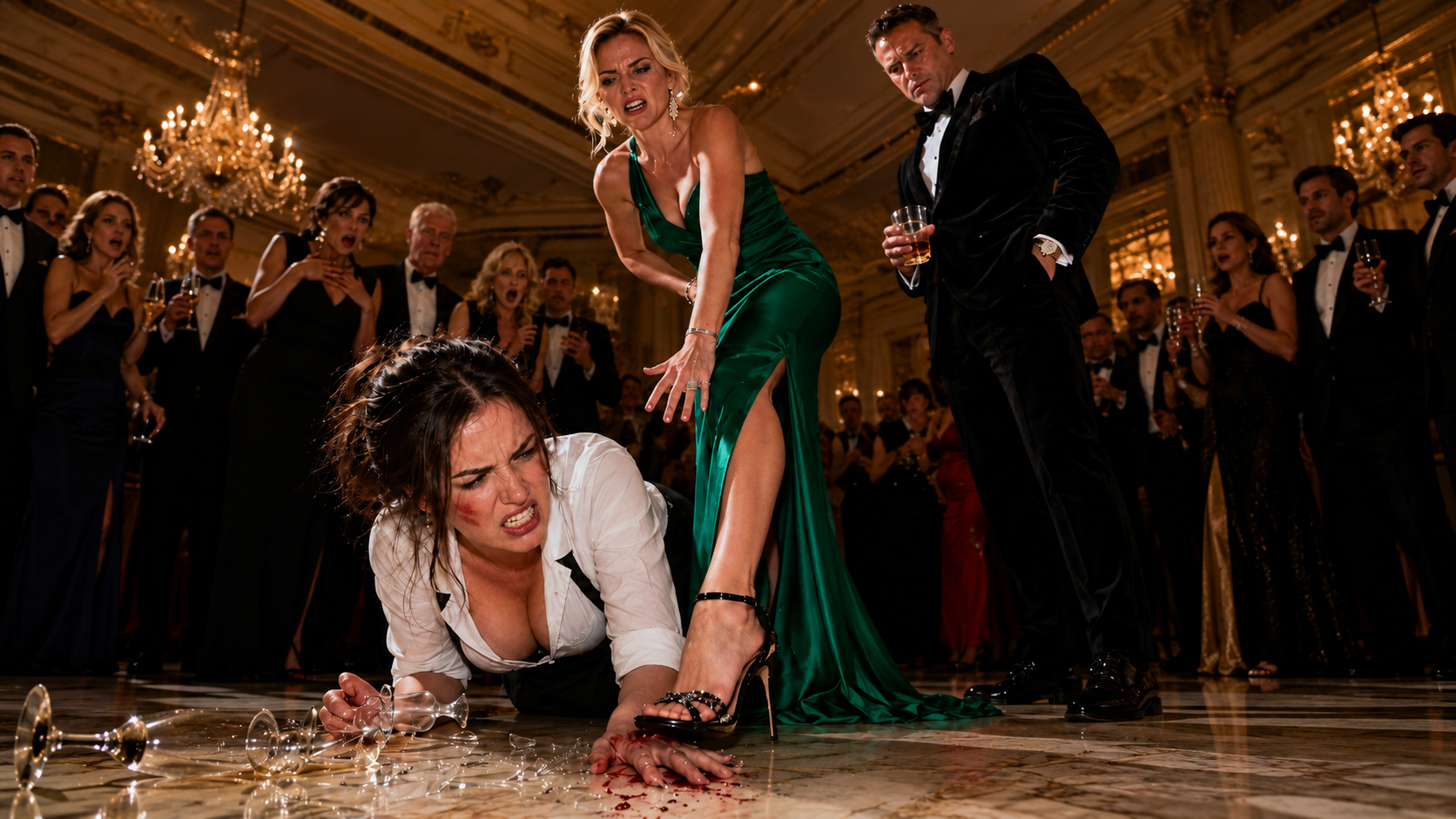
The chandelier above the Riverside Country Club trembled.
Not because of the orchestra.
Not because of the storm outside.
But because the silence inside that ballroom had suddenly become heavy enough to shake crystal.
Twenty pairs of diamond-covered eyes stared down at me.
Men in tailored tuxedos.
Women in silk gowns.
Politicians, investors, heirs, social climbers, board members, and people who had spent their entire lives mistaking money for permission.
And there I was.
On my knees.
In a white button-down shirt.
A black apron.
A cracked silver tray lying beside me.
Champagne dripping from the marble floor.
Broken crystal glittering around my hands like tiny pieces of ice.
My name was Ava Brooks.
But that night, nobody in that room knew it.
To them, I was just another waitress.
A nameless woman hired to carry glasses, smile quietly, apologize quickly, and disappear before the important people had to remember she existed.
Then Victoria Vance stepped on my fingers.
Her red-bottom heel came down slowly.
Deliberately.
The sharp point of her stiletto pressed into my hand until pain shot through my wrist and up my arm.
I gasped.
The crowd inhaled.
Victoria smiled.
“Look what you’ve done, you clumsy little thing,” she said.
Her voice was sweet.
Too sweet.
The kind of sweetness that hides poison because it knows rich people will call it charm.
I tried to pull my hand back, but she pressed harder.
The heel ground into my fingers.
Pain bloomed white behind my eyes.
Victoria leaned down, her diamonds swinging near my face.
“You spilled champagne on my dress,” she whispered. “Do you know what this gown costs?”
I looked up at her.
Ten years had passed, but she looked almost the same.
Perfect blonde hair.
Ice-blue eyes.
Sharp cheekbones.
A mouth trained to smile without mercy.
Victoria Vance.
Wife of Richard Vance.
Queen of the Riverside charity circle.
A woman who had never built anything in her life but had perfected the art of standing beside men who stole.
Behind her, Richard Vance sat at the head table, calmly cutting into his steak.
He did not even look up.
“Clean it up,” he said.
His voice moved through me like an old scar opening.
“Now.”
I stared at him.
Ten years ago, that man had looked me in the eye and promised the world would remember my name.
At the time, I had believed him.
I was twenty-nine then.
A leading biochemical researcher at Vance Global.
Young.
Brilliant.
Exhausted.
Dangerously trusting.
I had developed a neurological repair compound that could help regenerate damaged nerve tissue after severe trauma. It was not a miracle cure, but it was close enough to make investors whisper, doctors hope, and pharmaceutical executives calculate.
Richard Vance had called me the future of the company.
“Our future, Ava,” he used to say.
Then he stole it.
He stole my research.
He forged my signature.
He framed me for corporate espionage.
He accused me of selling data to a foreign competitor.
He buried me under lawsuits so expensive that even breathing felt like debt.
And when my father tried to defend me, Richard used his influence to destroy Brooks Logistics, the small trucking company my father had spent thirty-five years building.
My father had survived war, bankruptcy, and cancer.
But he did not survive watching his daughter publicly disgraced and his company sold piece by piece to pay legal bills.
He died with my name in his mouth.
Not as an accusation.
As an apology.
“Ava,” he whispered from the hospital bed, holding my hand with what little strength he had left. “I should have protected you.”
I told him, “No, Dad. I should have protected us.”
That was the last promise I made before he closed his eyes.
Ten years later, I was on my knees in the same country club where Richard Vance was celebrating another year of stolen success.
And his wife was crushing my fingers beneath her heel.
Victoria looked around the ballroom, enjoying the audience.
“Honestly,” she said loudly, “where do they find these people?”
A few women laughed behind their napkins.
Richard finally lifted his eyes.
He smiled when he recognized me.
Not fully.
Just enough.
The way a man smiles when he sees a ghost and realizes nobody else knows it is a ghost.
“Well,” he said slowly. “Ava Brooks.”
The name moved through the room.
A few older executives stiffened.
A few wives looked confused.
Victoria’s smile widened.
“Oh,” she said. “This is her?”
Richard wiped his mouth with a white linen napkin.
“Yes,” he said. “This is the woman who tried to destroy my company ten years ago.”
A murmur passed through the ballroom.
I stayed still.
Victoria removed her heel from my fingers, but the pain remained.
She crouched slightly, bringing her face close to mine.
“How tragic,” she said. “From scientist to server.”
Then she slapped me.
Hard.
The sound cracked through the ballroom.
My cheek burned.
The orchestra stopped.
One violin note died in the air.
Victoria’s smile became crueler.
“I said clean it up,” she hissed. “And while you’re down there, maybe you should apologize to my husband for all the trouble you caused him.”
Richard leaned back in his chair.
“Get on your knees and beg my wife for forgiveness,” he said. “Before I call the manager and have you dragged out like the criminal you are.”
Every instinct in my body wanted to stand up and break the silence with rage.
To scream.
To tell the room what he had done.
To tell them that the patent behind Vance Global’s billion-dollar drug portfolio had started in my lab notebook, in my handwriting, from my sleepless nights.
To tell them his empire was built on my father’s grave.
But rage is expensive when no one believes you.
So I had spent ten years buying something better.
Proof.
I slowly lifted my injured hand.
Two fingers were already swelling.
A thin line of blood ran along my knuckle from a shard of crystal.
Victoria saw it and smirked.
“Careful,” she said. “Blood stains marble.”
I looked directly into her eyes.
“You haven’t changed a bit, Victoria.”
Her smirk faltered.
It was the first time she heard my real voice that night.
Not the soft “yes ma’am” voice I had used when I served their table.
Not the quiet employee voice.
My voice.
Richard’s expression sharpened.
I stood up.
Slowly.
Glass fell from my apron.
The room remained silent.
Victoria laughed once, but it sounded thinner now.
“You should be careful, Ava. People like you don’t get second chances in rooms like this.”
I smiled.
“No,” I said. “People like me buy the room.”
Richard’s knife paused above his plate.
Victoria blinked.
“What did you say?”
I brushed a piece of glass from my sleeve.
“I said you made one fatal mistake tonight.”
Richard stood.
He was still handsome in the cold, polished way dangerous men often are.
Tall.
Silver at the temples.
Expensive smile.
Dead eyes.
“I don’t know how you got in here,” he said, “but your little performance is over.”
He snapped his fingers.
“Security.”
Two guards moved toward me.
Large men.
Black suits.
Earpieces.
The kind of men hired to remove inconvenient truths before dessert.
One grabbed my left arm.
The other reached for my right.
I did not resist.
I kept looking at Richard.
“Before they drag me out,” I said, “you may want to check your phone.”
Richard stared at me.
I nodded toward his tuxedo pocket.
“The live market feed, Richard. Vance Global Industries.”
His face twitched.
Not fear yet.
Irritation.
He hated being directed.
Especially by women he believed he had already destroyed.
Victoria crossed her arms.
“Is this some pathetic threat?”
“No,” I said. “It’s a courtesy.”
Richard pulled out his phone.
The whole room watched.
At first, his face showed annoyance.
Then confusion.
Then disbelief.
Then something I had waited ten years to see.
Terror.
His thumb moved quickly across the screen.
He opened another app.
Then another.
His skin turned gray.
Victoria stepped closer.
“Richard?”
He did not answer.
“Richard, what is it?”
His hand began to tremble.
“Our shares,” he whispered.
The room shifted.
“What about them?” Victoria demanded.
Richard looked up at me.
For the first time that night, he saw me.
Not the uniform.
Not the apron.
Not the waitress.
Me.
“Someone launched a hostile takeover,” he said. “They bought the remaining public shares and converted the debt position. The board has been forced into emergency restructuring.”
Victoria’s face tightened.
“What does that mean?”
“It means,” I said softly, pulling my arm free from the guard’s loosened grip, “you no longer control Vance Global.”
Richard stared at me.
His mouth opened, but no words came.
Victoria looked from him to me.
“No,” she said. “No, that’s impossible.”
I removed my apron.
Folded it carefully.
Placed it on the table beside Richard’s untouched steak.
Then I said, “As of seven minutes ago, the new chairwoman of the board is me.”
A sound moved through the ballroom.
A gasp.
A whisper.
A chair scraping backward.
One of Richard’s board members, Martin Hale, grabbed his phone and began typing frantically.
Another investor stood up so quickly his wine glass tipped over.
Victoria laughed.
But now the laugh was wrong.
Too loud.
Too desperate.
“You?” she said. “You’re a waitress.”
I held up my injured hand.
“No, Victoria. Tonight I was a waitress. There’s a difference.”
Richard stepped away from the table.
“How?”
His voice was low.
Dangerous.
But danger only works when the person standing in front of you still has something left to fear.
I had lost everything once.
After that, fear had to negotiate.
“How?” I repeated. “Ten years of patience.”
Victoria shook her head.
“You had nothing.”
“That’s what he told you?”
I looked at Richard.
He said nothing.
“After you stole my patents and framed me, I disappeared,” I said. “At least that’s what you thought. In reality, I started consulting under another name. First for small biotech firms. Then for private equity. Then for legal teams trying to understand drug patent fraud. I knew your business better than your own analysts because you built it on my research.”
Richard’s jaw tightened.
I stepped closer.
“Every dollar I earned, I invested. Every settlement I helped win, I took in shares. Every creditor you ignored, every supplier you underpaid, every investor you insulted—I found them.”
Martin Hale lowered his phone slowly.
His face was white.
I smiled at him.
“Yes, Martin. You too.”
He sat down.
Victoria grabbed Richard’s arm.
“Say something.”
Richard looked at me with hatred.
“You don’t have the voting power.”
“I do now.”
“You don’t have the debt conversion approval.”
“I signed it this morning.”
“You don’t have board support.”
The ballroom doors opened behind me.
A woman in a midnight-blue suit walked in carrying a leather folder.
Behind her were three attorneys and six people I recognized from the new board slate.
Richard’s mouth went dry.
The woman stopped beside me.
“Actually,” she said, “she does.”
Victoria looked at her.
“Who are you?”
The woman smiled politely.
“Naomi Hart. Interim general counsel for Vance Global Industries.”
Richard’s eyes narrowed.
“You work for me.”
Naomi looked at him calmly.
“Not anymore.”
The words landed with the elegance of a guillotine.
Richard moved toward her.
“You can’t do this in public.”
Naomi opened the folder.
“The emergency vote was completed at 8:02 p.m. Eastern. Mr. Vance, you have been removed as chief executive officer pending internal and federal investigation. Mrs. Vance, your charitable trust accounts connected to Vance Global distributions have also been frozen.”
Victoria froze.
“My accounts?”
“Yes,” Naomi said. “The ones funded through NeuroVance licensing revenue.”
Victoria looked at Richard.
“What is she talking about?”
I tilted my head.
“Oh, he didn’t tell you?”
Richard’s face hardened.
“Ava.”
“No,” I said. “You liked public humiliation ten minutes ago. Let’s keep the same energy.”
A few people in the crowd lowered their eyes.
Good.
Let them be uncomfortable.
They had been very comfortable watching my hand bleed.
Victoria’s voice shook.
“What accounts?”
I looked at her.
“The foundation. The art fund. The Palm Beach renovation. The Monaco apartment you told everyone was inherited from your aunt.”
Her lips parted.
“All of it was built from licensing revenue tied to stolen patents.”
She turned to Richard.
“Tell me she’s lying.”
Richard said nothing.
That silence was a confession wearing a tuxedo.
Victoria stumbled back.
“No. No, Richard. You said the patents were clean.”
I laughed softly.
“You knew they weren’t.”
Her eyes snapped to me.
“I knew nothing.”
I stepped closer.
“You called me a thief in interviews. You said women like me used accusations to gain attention. You told donors I was unstable. You told my father, to his face, that he should be ashamed of the daughter he raised.”
Her face went still.
She remembered.
I saw it.
“You were there the day he left that courthouse,” I said. “He was shaking so badly he could barely get into the car. You looked at him and said, ‘Some families don’t know when to stay in their lane.’”
Victoria swallowed.
“I don’t remember that.”
“I do.”
The room was silent enough to hear the rain tapping against the windows.
Richard suddenly lunged toward me.
Naomi stepped back.
One security guard moved, but before he reached Richard, another man caught him by the shoulder.
Not one of the country club guards.
This man wore a dark suit, no earpiece, and the calm expression of someone who did not need to look dangerous because he was.
“Step back, Mr. Vance,” he said.
Richard jerked his arm away.
“Who are you?”
The man looked at me.
I nodded.
He took out his badge.
“Special Agent Daniel Reyes. Federal Bureau of Investigation.”
The ballroom erupted.
Gasps.
Whispers.
Phones lifted.
Someone said, “Oh my God.”
Victoria grabbed the back of a chair.
Richard stared at the badge.
“You’re making a mistake,” he said.
Agent Reyes did not blink.
“I doubt that.”
Two more agents entered behind him.
Then two more.
They did not rush.
They did not need to.
Power entered the room quietly because it knew nobody could stop it.
Victoria turned on Richard.
“Richard, what is happening?”
He snapped at her.
“Be quiet.”
“No,” she shouted. “You told me this was finished years ago.”
He closed his eyes.
There it was.
The second confession.
I watched the room absorb it.
Naomi leaned toward me.
“You okay?”
I looked down at my swollen fingers.
“I will be.”
Richard pointed at me.
“She’s lying. She has always been obsessed with me. She fabricated all of this.”
Agent Reyes glanced at me.
“Ms. Brooks?”
I reached into the pocket of my black trousers and pulled out a small flash drive.
Richard’s eyes locked on it.
His confidence died a second death.
“This contains the original research files,” I said. “My lab notes. The altered timestamps. The forged access logs. Emails between Richard Vance and Dr. Malcolm Reed discussing how to frame me for data theft. Wire transfers to the judge’s campaign committee. Payments to the expert witness who testified against me. And the offshore ledger showing where the NeuroVance licensing money really went.”
Victoria covered her mouth.
Richard whispered, “You can’t have that.”
“I know,” I said. “That’s what made it so satisfying.”
Agent Reyes took the drive.
“For the record,” he said, “this is the copy?”
I smiled.
“The seventh copy.”
Richard looked like he might collapse.
Victoria suddenly lunged at me.
“You ruined us!”
She clawed toward my face with manicured nails.
I caught her wrist before she touched me.
The room gasped again.
Her eyes widened.
I leaned close enough for only her to hear.
“No, Victoria. I was ruined ten years ago. This is accountability.”
She tried to pull away.
I released her.
She stumbled backward into a chair and fell.
For a moment, she sat on the floor in her silk gown, surrounded by spilled champagne and broken glass.
Exactly where she had left me.
The symmetry was almost too perfect.
Richard’s voice cracked.
“Ava, listen to me.”
I turned.
He held up both hands.
A man who had never begged for anything in his life was trying to remember how.
“We can make a deal.”
I said nothing.
“You want the patents? Take them. You want money? Fine. You want a public apology? I’ll give it tonight.”
Victoria stared at him.
“What are you doing?”
“Shut up,” he hissed.
She flinched.
I almost smiled.
Ten minutes ago, they had looked united.
Now self-preservation had entered the marriage.
“I don’t want a deal,” I said.
Richard stepped closer.
“Ava, be reasonable.”
That word.
Reasonable.
Men use it when they are afraid a woman has stopped negotiating against herself.
“Reasonable?” I repeated.
His voice softened.
“You and I built something once.”
“No,” I said. “I built something. You stole it.”
His face tightened.
“I gave you opportunity.”
“You gave me a badge and a lab. I gave you a billion-dollar drug platform.”
The room murmured.
Richard lowered his voice.
“You think you can run Vance Global?”
I looked around the ballroom.
At the board members avoiding my eyes.
At the investors calculating how fast they could switch sides.
At the wives who had laughed when Victoria slapped me.
At the waitstaff standing frozen near the walls, watching one of their own become someone the rich could no longer ignore.
Then I looked back at Richard.
“I already am.”
Naomi opened another document.
“Effective immediately, all executive access held by Richard Vance has been suspended. Corporate credit lines frozen. Private aircraft grounded. Legal hold notices issued. Internal audit teams are entering Vance Global headquarters now.”
Richard’s eyes widened.
“My jet?”
“Yes,” Naomi said.
“My accounts?”
“Under review.”
“My office?”
“Sealed.”
Victoria scrambled to her feet.
“What about the house?”
Naomi glanced at me.
I gave a small nod.
Naomi continued.
“The Newport estate, Palm Beach property, and Manhattan penthouse were all cross-collateralized against Vance Global executive loans. Those assets are now under legal hold.”
Victoria’s lips trembled.
“You can’t take my house.”
I stepped toward her.
“Victoria, you stepped on my hand and told me blood stains marble.”
Her eyes filled with tears.
I smiled.
“Maybe you should be more careful where you stand.”
Agent Reyes moved toward Richard.
“Richard Vance, you are being detained for questioning in connection with securities fraud, obstruction, corporate espionage, and conspiracy.”
Richard backed away.
“No. No, you don’t understand who I am.”
Agent Reyes’s face remained calm.
“I do. That’s why I’m here.”
One agent turned Richard around.
The metallic click of handcuffs echoed across the ballroom.
For one beautiful second, nobody breathed.
Victoria screamed.
“Richard!”
He twisted toward her.
“Call Preston. Call the lawyers. Call everyone.”
She held up her phone with shaking hands.
Then froze.
“What?” he barked.
She looked up.
“Our accounts are locked.”
Richard stared.
“What?”
“My card was declined.”
A waiter near the wall covered his mouth.
Someone laughed.
Not loudly.
Just enough.
Victoria looked around the room, suddenly realizing the people she had spent years impressing were now watching her like entertainment.
Her knees weakened.
She reached for the chair.
I stepped aside and let her fall into it.
The manager of the Riverside Country Club hurried in, sweating through his tuxedo.
“Ms. Brooks,” he said, voice trembling. “I had no idea—”
I held up a hand.
He stopped.
“You fired a young server last year because Victoria Vance said she looked at her the wrong way,” I said.
His face drained.
“You docked pay from kitchen staff for broken glasses during events where drunk board members knocked them over. You told your employees wealthy guests were never wrong.”
He swallowed.
“Ms. Brooks—”
“I bought this club last month.”
His mouth opened.
The staff along the wall stared at me.
Victoria whispered, “What?”
I looked at the manager.
“As of tonight, every employee here receives back pay for illegal deductions, full benefits, and written protection from guest abuse. Any member who touches, threatens, or humiliates staff loses membership immediately.”
A young waitress near the bar began crying silently.
The manager nodded quickly.
“Of course. Yes. Absolutely.”
“No,” I said. “Not of course. You should have done it before the woman with money asked.”
He lowered his head.
“Yes, ma’am.”
I turned back to the room.
Some of the wealthiest people in the state suddenly found their shoes fascinating.
Good.
Let shame do some work.
Richard was being dragged toward the doors when he stopped fighting.
He looked at me.
“Ava.”
I waited.
His voice changed.
Not soft.
Not sorry.
Strategic.
“Your father would be ashamed of you.”
The room went cold.
Agent Reyes paused.
Naomi’s eyes sharpened.
Victoria whispered, “Richard, don’t.”
But he did.
He smiled.
Small.
Cruel.
One last knife from a man already bleeding.
“He was a simple man,” Richard said. “He believed in dignity. Not this.”
For a moment, I did not move.
The mention of my father’s name hit harder than Victoria’s heel.
I saw him again.
Grease on his hands from fixing trucks.
Coffee in a chipped mug.
Laughing in the office of Brooks Logistics.
Standing beside me at my college graduation, crying so hard my mother’s old handkerchief turned damp in his fist.
I stepped close to Richard.
The agents held him still.
“My father believed in paying people on time,” I said. “He believed in keeping promises. He believed a handshake meant something. He believed if a man built his house on stolen bricks, one day the walls would remember.”
Richard’s smile faded.
I leaned closer.
“And tonight, Richard, the walls remembered.”
Agent Reyes nodded.
They took him out.
Victoria tried to follow, but Naomi blocked her.
“Mrs. Vance, you are also required to remain available for questioning.”
Victoria turned to me.
Her makeup had begun to run.
For the first time, she looked older.
Not because of age.
Because cruelty had lost its lighting.
“Ava,” she said, voice shaking. “Please.”
I tilted my head.
“Please what?”
She swallowed.
“Don’t do this.”
I looked at my injured hand.
“Don’t do what? Humiliate you? Destroy you? Make people watch while your life breaks in public?”
She flinched.
I stepped closer.
“Isn’t that what you thought was funny ten minutes ago?”
Her lips trembled.
“I was angry.”
“No. You were comfortable.”
She had no answer.
I picked up the apron from Richard’s table and held it out to her.
She stared.
“What are you doing?”
“You told me to clean the floor.”
Her face went white.
The room held its breath.
I let the apron hang between us.
Then I dropped it onto the marble.
“But I am not you,” I said. “I won’t make you crawl for applause.”
Victoria began to cry.
Not gracefully.
Not beautifully.
Just broken, ugly sobs.
I felt no joy.
That surprised me.
I had imagined this moment for ten years.
I thought revenge would taste like fire.
Instead, it tasted like silence.
Clean.
Cold.
Necessary.
The federal agents escorted Victoria out through the side doors.
Richard was already gone.
The orchestra remained frozen.
The guests remained seated.
Nobody knew whether to leave, speak, clap, or pretend they had never come.
I walked to the center of the ballroom.
My cheek still burned.
My fingers throbbed.
My shirt was stained with champagne and blood.
But my voice was steady.
“Ladies and gentlemen,” I said, “the fundraiser will continue.”
People blinked.
I looked at the staff.
“All tips tonight will be tripled from club funds. The kitchen staff will receive the same bonus as servers. Anyone who wants to go home may go home with full pay.”
For a second, nobody moved.
Then the young waitress near the bar began clapping.
A busboy joined.
Then one cook.
Then another.
Soon the staff were applauding.
Not the guests.
The staff.
The people who had spent years entering rooms through side doors.
Their applause sounded different.
It did not flatter.
It freed.
Naomi stood beside me.
“You need medical attention,” she murmured.
I looked at my hand.
“Soon.”
“Now.”
I smiled faintly.
“You sound like my father.”
“Good. Then listen.”
I almost laughed.
Before I could answer, the ballroom doors opened again.
A tall man in a dark navy uniform stepped inside.
Not with hundreds of soldiers.
Not with dramatic thunder.
Just one man.
Broad shoulders.
Silver hair.
A scar near his left eyebrow.
A face I had not seen in three years.
My older brother.
Commander James Brooks.
Retired Navy.
My father’s first son.
My protector when we were children.
My loudest critic when I sold my apartment to fund the first lawsuit.
My final emergency contact.
James stopped just inside the ballroom.
His eyes found me.
Then my bruised cheek.
Then my swollen fingers.
His jaw tightened.
He walked toward me with the controlled calm of a man fighting every violent instinct he had ever trained.
“Ava,” he said.
I swallowed.
For the first time all night, my voice almost broke.
“Hi, James.”
He looked at the broken glass.
The champagne.
The guests.
The blood on my hand.
“What happened?”
I smiled weakly.
“I bought a country club.”
His eyes narrowed.
“That’s not what I asked.”
Naomi cleared her throat.
“She needs a doctor.”
James took my hand gently.
Very gently.
His face changed when he saw the swelling.
“Who did this?”
I looked toward the doors where Victoria had been taken.
“It’s handled.”
“That’s not what I asked.”
I squeezed his hand with my good fingers.
“James.”
He stopped.
My brother had spent his life walking into danger.
But he understood my tone.
This battle had been mine.
He leaned down and kissed the top of my head.
“Dad would be proud.”
I closed my eyes.
That almost broke me.
Not Richard.
Not Victoria.
Not the pain.
That sentence.
Dad would be proud.
For ten years, I had wondered if my father’s last memories were full of shame.
Now, standing in a ballroom where my enemies had finally lost their masks, I let myself believe he had known the truth somehow.
That he had died not disappointed in me, but grieving what had been stolen.
James put his arm around my shoulders.
“Come on,” he said. “Let’s get your hand checked.”
As we walked out, the staff parted for us.
The same way the rich had expected people to part for them all night.
But this felt different.
Warmer.
Real.
A young busboy stepped forward.
He could not have been more than nineteen.
“Ms. Brooks?”
I stopped.
“Yes?”
He swallowed nervously.
“My mom worked here before she got sick. Mrs. Vance used to make her cry in the coat room.”
The room went silent again.
Victoria’s friends looked away.
The boy lifted his chin.
“I’m glad you bought the place.”
Something in my chest loosened.
I smiled.
“So am I.”
Three months later, Richard Vance sat in federal court wearing a gray suit that did not fit his pride.
Victoria sat two rows behind him, no diamonds, no silk, no audience of admirers.
Her lawyer had negotiated separately.
Of course he had.
Marriage is easy when the money is flowing.
Less romantic when subpoenas arrive.
The case did not end in a single dramatic moment.
Real justice rarely does.
It came in pages.
Bank records.
Email chains.
Patent filings.
Board minutes.
Offshore ledgers.
Witness statements.
Forensic audits.
The kind of evidence that does not shout but does not move.
Dr. Malcolm Reed, the former research director who helped frame me, took a deal first.
He admitted the truth under oath.
“Yes,” he said, voice shaking. “The original compound model belonged to Dr. Ava Brooks.”
The courtroom blurred for a moment.
Not from tears.
From the force of hearing my name attached to my own work again.
My own work.
After ten years, those three words felt like resurrection.
The prosecutor asked, “Did Richard Vance know the evidence against Dr. Brooks was fabricated?”
Dr. Reed looked at Richard.
Richard stared straight ahead.
“Yes,” Reed said.
Victoria lowered her face into her hands.
Richard did not move.
He was still trying to look innocent for a room that had stopped auditioning for his approval.
When I testified, the courtroom was full.
Reporters lined the back wall.
Former employees of Vance Global sat on one side.
Former Brooks Logistics drivers sat on the other.
Men who had worked for my father.
Older now.
Some limping.
Some gray-haired.
All wearing their best jackets.
James sat behind me.
Naomi sat beside him.
When I walked to the witness stand, I saw Richard watching me.
His eyes were not sorry.
They were wounded.
As if my survival had offended him.
The prosecutor asked, “Dr. Brooks, what did you lose because of the defendant’s actions?”
I looked at Richard.
Then at the men who had worked for my father.
Then at my injured hand, still stiff from Victoria’s heel.
“My name,” I said. “My career. My research. My company. My father’s peace. Ten years of ordinary life.”
The prosecutor’s voice softened.
“And what did you do after that?”
I breathed in.
“I learned the difference between being destroyed and being delayed.”
The courtroom was silent.
Richard finally looked down.
The trial lasted six weeks.
Richard was convicted on securities fraud, obstruction, conspiracy, corporate espionage, and financial crimes tied to offshore accounts.
Victoria was not convicted of the corporate theft, but her foundation collapsed under investigation. Her reputation, the thing she had worshiped most, did not survive discovery.
The patents were restored.
Not easily.
Not fully.
But enough.
Vance Global was renamed Brooks NeuroWorks by board vote.
I did not do it for revenge.
At least, not only revenge.
I did it because my father’s name had been dragged through mud by men who could not build what he built.
Now his name would stand above a company that made something useful.
The first time I walked into the old Vance Global headquarters as chairwoman, employees stood in nervous clusters.
Some had been there ten years earlier.
Some had believed the lies.
Some had repeated them.
Some had stayed silent because salaries are powerful muzzles.
I did not ask for apologies.
I called a company-wide meeting in the atrium.
My face appeared on screens from Boston to Singapore.
I stood under the glass ceiling where Richard used to hold investor announcements.
“Good morning,” I said. “My name is Dr. Ava Brooks.”
For a moment, I stopped.
Not because I forgot what to say.
Because I wanted to hear it.
My name.
My title.
My voice.
No one taking it.
No one correcting it.
No one calling me a thief.
Then I continued.
“This company was built on brilliant work, some of it stolen, much of it silenced, and too much of it buried beneath fear. That ends today.”
People listened.
Really listened.
“Any employee who helped cover up fraud will face review. Any employee who was threatened, silenced, or punished for telling the truth will be heard. Any researcher whose work was miscredited will have a path to correction. We are not just changing leadership. We are changing the kind of room this company becomes.”
A woman in the third row began to cry.
Later, she came to my office.
Her name was Priya.
She had been a junior chemist when I was framed.
“I knew,” she whispered.
I looked at her.
“I knew the data logs were altered. I wanted to say something. But my visa was tied to the job. My mother was sick. I was scared.”
I studied her face.
For ten years, I had imagined confronting everyone who had stayed silent.
In my imagination, I was sharp.
Unforgiving.
Hungry.
But real people are more complicated than the revenge stories we tell ourselves in the dark.
“What happened to your mother?” I asked.
Priya’s mouth trembled.
“She lived. She’s with me now.”
I nodded.
“I’m glad.”
She began to sob.
“I’m sorry.”
I stood and walked around the desk.
For a moment, I saw myself ten years earlier.
Brilliant.
Terrified.
Trapped in a system built by men who knew exactly which pressure points to press.
“I accept your apology,” I said. “But I need more than regret.”
She wiped her face.
“Anything.”
“Build something honest here.”
She nodded.
“I will.”
That became the work.
Not revenge.
Repair.
The drug platform my research started finally moved into ethical trials under independent oversight.
The first patient in the renewed program was a firefighter named Elena Marquez who had suffered severe nerve damage after rescuing two children from a burning apartment building.
When she moved her fingers for the first time after treatment, the entire lab cried.
I did too.
Quietly.
In the observation room.
No cameras.
No speeches.
Just my hand pressed against the glass as Elena stared at her own moving fingers like she was witnessing sunrise.
James stood beside me.
“Dad would’ve liked this,” he said.
I nodded.
“He would’ve pretended not to cry.”
James laughed.
“He was terrible at pretending.”
We both were silent for a while.
Then he said, “You know revenge didn’t bring him back.”
“I know.”
“But?”
I looked through the glass at Elena laughing through tears.
“But it brought back what they buried.”
A year after the country club night, Riverside reopened under a new name.
Brooks House.
Not a country club.
A public scholarship and medical research center.
The ballroom where Victoria slapped me became an event hall for fundraisers supporting whistleblowers, wrongfully accused workers, and families destroyed by corporate fraud.
The marble floor remained.
I kept it.
People asked why.
“Too many bad memories,” Naomi said when we walked through the renovation.
I looked down at the polished stone.
“I want it to remember better ones.”
On opening night, there were no diamond-covered socialites looking down at waitstaff.
There were nurses.
Teachers.
Researchers.
Former employees.
Truck drivers from my father’s old company.
Students receiving scholarships.
Kitchen staff who now had contracts, benefits, and a union representative who terrified lazy managers.
The young busboy whose mother had worked for Victoria stood at the entrance in a suit.
His name was Mateo.
He was now part of the scholarship program.
“Dr. Brooks,” he said, grinning. “My mom’s here.”
An older woman in a blue dress stepped forward.
Her hands trembled when she took mine.
“You gave my son a chance,” she said.
I smiled.
“No. He earned one. We just opened the door.”
The ceremony was simple.
No fireworks.
No orchestra.
Just a plaque near the entrance.
BROOKS HOUSE
Built in honor of Thomas Brooks
For those who survive, rebuild, and refuse to stay buried.
When I saw my father’s name, I finally cried.
Not the broken crying of defeat.
Not the silent crying of shame.
The kind that washes dust off a grave.
James held my shoulder.
For once, he did not tell me to be strong.
He knew I was.
That was why I could cry.
Near the end of the night, Naomi walked up beside me.
“You have a visitor.”
I turned.
Across the hall stood Victoria Vance.
No diamonds.
No designer gown.
No entourage.
She wore a simple gray coat and held a small envelope in both hands.
James immediately stiffened.
Naomi’s eyes narrowed.
I touched James’s arm.
“It’s fine.”
Victoria approached slowly.
For the first time since I had known her, she looked unsure of where to stand.
“Ava,” she said.
“Victoria.”
Her eyes moved to the plaque.
Then to the staff.
Then to my hand.
The fingers had healed, but one knuckle remained slightly crooked.
She saw it.
Good.
“I heard about the opening,” she said.
“I assumed you did.”
She swallowed.
“I won’t stay long.”
“That would be wise.”
She nodded, accepting it.
Then she held out the envelope.
“I found this in Richard’s storage unit. My lawyers said it should go through formal channels, but…” She stopped. “I wanted to bring it myself.”
Naomi stepped forward and took the envelope before I could.
She opened it carefully.
Inside was a small leather notebook.
My old lab notebook.
The first one.
The one I thought had been destroyed.
My initials were still etched faintly into the corner.
A.B.
For a second, I could not breathe.
Naomi handed it to me.
My fingers closed around the leather.
Ten years disappeared.
I was back in the lab at midnight, writing formulas with cold coffee beside me, believing the future was clean because I had not yet learned how dirty ambition could be.
“Where was it?” I asked.
Victoria’s voice was quiet.
“In a locked file box with Richard’s personal papers.”
I opened the notebook.
There was my handwriting.
My diagrams.
My notes.
My father’s old grocery list tucked between pages because I used to write ideas on anything nearby.
Eggs.
Coffee.
Laundry soap.
Call Dad.
I touched the paper.
My throat tightened.
Victoria whispered, “I’m sorry.”
I looked up.
The apology hung between us, fragile and late.
“I know it doesn’t fix anything,” she said quickly. “I know what I did. I know what I said to your father. I know what I did that night at the club.”
Her eyes filled with tears.
“I liked feeling untouchable. I liked being cruel because people were afraid to correct me. And when you were on that floor, I saw you as someone beneath me because that made my life feel safer.”
I said nothing.
She wiped her cheek.
“I’m not asking for forgiveness.”
“Good,” I said.
She nodded.
“I just wanted you to have that.”
I looked down at the notebook again.
Then back at her.
“Victoria.”
She froze.
“Yes?”
“Do something useful with the rest of your life.”
Her face crumpled.
Not dramatically.
Quietly.
Like the sentence had found the last unbroken mirror inside her.
“I’ll try,” she whispered.
Then she left.
James watched her go.
“You meant that?”
“Yes.”
“You think she will?”
“I don’t know.”
He looked at me.
“You’re better than me.”
I smiled faintly.
“No. I’m just tired.”
Later that night, after everyone left, I walked alone into the old ballroom.
The chandeliers glowed softly.
The marble floor shone beneath my feet.
For a moment, I could see it all again.
The tray falling.
The champagne spilling.
Victoria’s heel.
Richard’s smile.
The eyes watching.
My younger self might have thought power meant making them suffer forever.
But standing there, with my father’s notebook in my hands and his name on the wall outside, I understood something different.
Power was not revenge.
Power was not making everyone kneel.
Power was being able to choose what the room becomes after the villains leave.
I knelt on the marble floor.
Not because anyone forced me.
Because I wanted to.
I placed my palm against the stone.
The same place where my blood had fallen.
Then I whispered, “We did it, Dad.”
The room did not answer.
It did not need to.
The next morning, Brooks House opened its doors to the public.
A young woman arrived first.
She wore a cheap blazer, carried a folder full of documents, and looked like she had not slept in days.
The receptionist brought her to me.
“She says her employer stole her research,” the receptionist said gently.
The young woman looked embarrassed.
“I’m sorry. I didn’t know where else to go.”
I looked at the folder in her hands.
Then at her face.
That terrified, exhausted, burning face.
I knew it.
I had worn it.
“Sit down,” I said.
She sat.
Her hands shook as she opened the folder.
“They said nobody will believe me.”
I smiled.
Not because it was funny.
Because some lies are so old they become predictable.
“People like that always say nobody will believe you,” I told her.
Her eyes filled.
“What do I do?”
I pulled a notebook from my desk.
My father’s grocery list still rested between the pages of my old lab book at home.
My own past was no longer a wound.
It was evidence that survival can become shelter.
I looked at the young woman and said, “First, you stop begging liars to tell the truth.”
She leaned forward.
“What’s second?”
“Second,” I said, “we build a file.”
For the first time, she breathed.
Really breathed.
Outside my office window, sunlight moved across the courtyard of Brooks House.
Staff walked through the halls.
Students laughed near the entrance.
A former country club ballroom had become a place where broken people learned they were not broken beyond use.
Richard Vance lost his company.
Victoria lost her crown.
Their friends lost the comfort of pretending cruelty was classy.
But I gained something bigger than revenge.
I gained the right to decide what my pain would build.
Ten years ago, they stole my name.
That night at Riverside, they tried to steal my dignity.
They failed both times.
Because dignity is not what people give you when you are standing tall.
Dignity is what remains when they force you to the floor and you still remember who you are.
Victoria told me to get on my knees and beg.
So I stood up.
Richard told me I was nothing.
So I took back everything.
And when their phones lit up with the news that I owned their company, their club, their accounts, and the future they thought they had secured, I finally understood the truth.
They had not destroyed me.
They had only taught me patience.
And patience, in the hands of a woman with receipts, is a dangerous thing.