For as long as human beings have existed, we have wrestled with one profound question:
What happens when we die?
Every civilization has sought an answer.
The ancient Egyptians built pyramids to prepare for eternity. Philosophers wrote about the soul. Religions promised heaven, reincarnation, or spiritual transcendence. Scientists extended life through medicine, surgery, and technology.
You May Also Like

Yet death has remained the one frontier no empire, no genius, and no invention has ever conquered.
Until now, some believe, humanity may be approaching a radically different possibility.
Not immortality through myth.
Not resurrection through faith.
But continuity through technology.
And few figures embody this idea more vividly than Elon Musk.
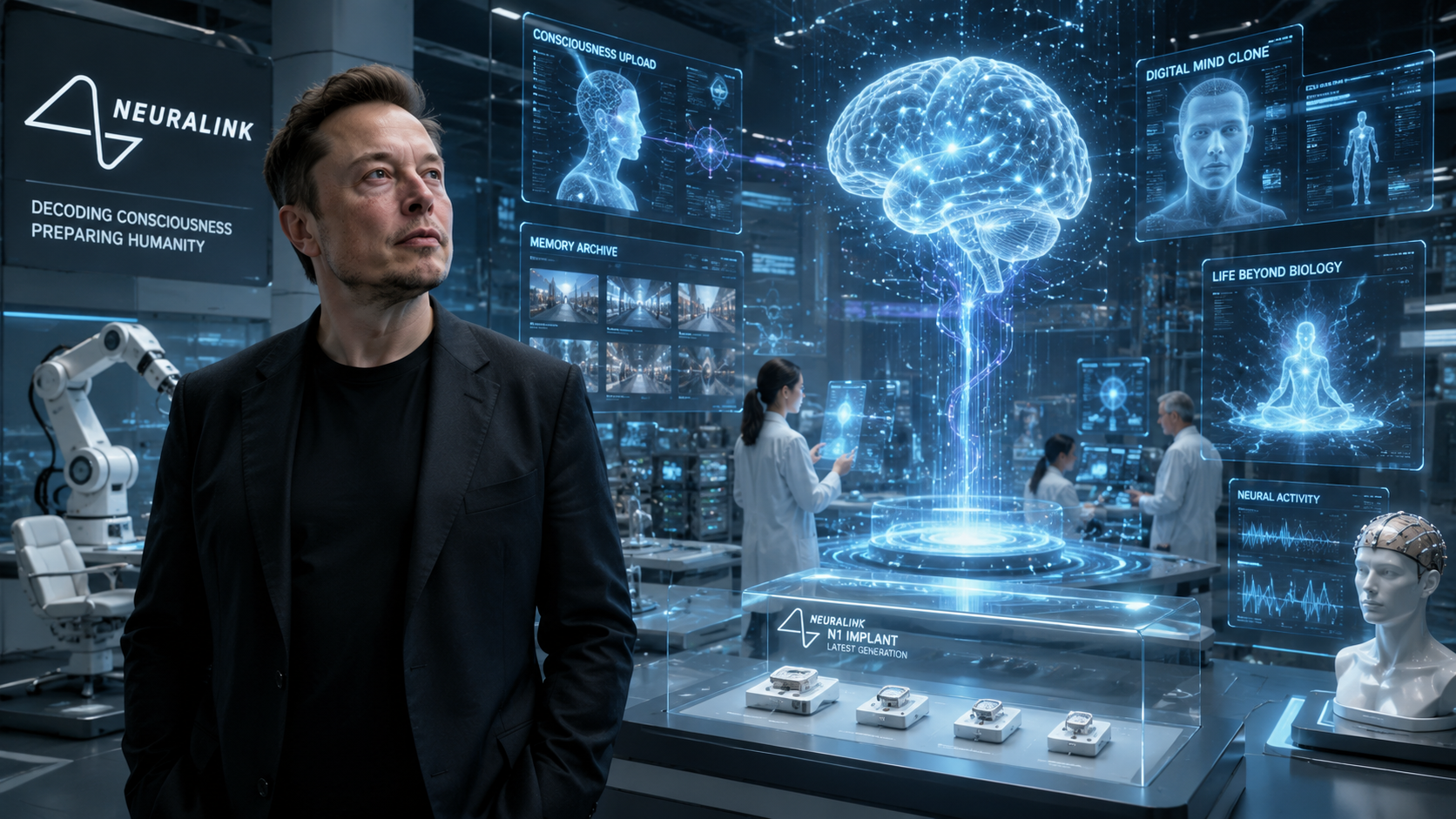
Through ventures such as Neuralink, Musk has helped popularize a vision in which the human mind may one day interface directly with machines. In the most ambitious interpretations of this concept, memories, personality traits, and perhaps aspects of consciousness could be preserved in digital form.
If such a future ever becomes possible, it would redefine what it means to be alive.
Part I — Humanity’s Oldest Dream
The Desire to Outlive the Body

The fear of death is universal.
But so is the desire to transcend it.
Throughout history, humans have sought permanence through:
- Children.
- Art.
- Books.
- Monuments.
- Scientific achievements.
- Spiritual traditions.
Digital immortality is the newest expression of this ancient aspiration.
The underlying question is breathtaking:
If your memories, voice, and personality could be preserved, would some meaningful part of you continue to exist?
What Is Digital Immortality?
Digital immortality refers to the idea that information associated with a person—memories, preferences, behaviors, and perhaps cognitive patterns—could be stored and potentially reproduced using advanced computing systems.
Possible future forms might include:
- Highly realistic AI avatars.
- Memory archives.
- Robotic embodiments.
- Simulated personalities.
Current technology does not enable mind uploading in the full sense imagined by science fiction.
But research in brain-computer interfaces and artificial intelligence has fueled serious discussion of what may eventually be possible.
Part II — Neuralink and the Brain-Machine Frontier
Building a Bridge Between Mind and Machine

Neuralink is developing implantable brain-computer interfaces intended to help restore function for people with severe neurological conditions.
The company’s stated goals include enabling communication and control through thought.
This is a remarkable engineering challenge.
A functioning interface must:
- Record neural signals.
- Decode patterns.
- Translate intent.
- Send outputs to external devices.
Today, these systems aim to assist patients.
Tomorrow, they may deepen the relationship between human cognition and machines.
From Medical Tool to Philosophical Revolution
If a device can capture increasingly rich neural information, it raises profound questions.
Could future systems preserve a person’s memories?
Could they model decision-making patterns?
Could they create a digital representation that speaks and responds in a familiar way?
These ideas remain speculative, but they force us to reconsider the boundary between biology and information.
Part III — What Is Consciousness?
The Greatest Mystery in Science

Before we can upload a mind, we must understand what a mind is.
Consciousness includes:
- Self-awareness.
- Memory.
- Emotion.
- Subjective experience.
- Identity over time.
Neuroscience has made significant progress, yet no consensus explains exactly how conscious experience arises.
This uncertainty lies at the heart of the digital immortality debate.
The Copy Problem
Suppose technology could reproduce every memory and behavior you possess.
Would that digital entity be you—or a highly accurate copy?
This is not merely technical.
It is philosophical.
Some argue that preserving information preserves identity.
Others believe consciousness is inseparable from the living brain.
The answer remains unknown.
Part IV — The Promise of a New Existence
Potential Benefits

If advanced forms of digital continuity became possible, the implications would be extraordinary.
Potential benefits might include:
- Preserving personal histories.
- Allowing future generations to interact with realistic ancestors.
- Recording expertise from great scientists and artists.
- Extending participation beyond biological limitations.
For many, the idea offers hope that wisdom and memory need not vanish.
Space Exploration and Human Survival
Musk has long emphasized the importance of making humanity a multi-planetary species.
Digital forms of cognition, if ever feasible, could theoretically aid missions to deep space where biological survival is difficult.
Such possibilities remain highly speculative, but they illustrate how concepts of life and intelligence may evolve.
Part V — The Ethical Frontier
Who Owns Your Mind?
Digital continuity would raise unprecedented ethical issues:
- Data ownership.
- Consent.
- Privacy.
- Security.
- Rights of digital entities.
- Access and inequality.
If your memories are stored, who controls them?
Could they be altered?
Could they persist against your wishes?
The Risk of Losing Humanity
Critics worry that reducing a person to data may overlook essential aspects of human life.
Mortality gives urgency to love, creativity, and decision-making.
Some argue that finitude is part of what makes life meaningful.
The goal should not simply be to live forever, but to live wisely.
Part VI — Science Fiction Meets Reality

Stories like Ghost in the Shell, The Matrix, and Black Mirror have explored the consequences of digitized consciousness.
These narratives remind us that technological capability does not automatically answer moral questions.
The most important challenge may not be whether we can do something, but whether we should.
Part VII — Elon Musk’s Larger Vision
Expanding Human Capability
Musk’s work in electric vehicles, reusable rockets, and neural interfaces reflects a recurring theme:
Technology can expand the range of what humanity is capable of.
Whether building rockets through SpaceX or brain interfaces through Neuralink, the broader aspiration is to push beyond existing limits.
Digital immortality is one of the most ambitious ideas associated with that vision.
Part VIII — What We Can Say Today
At present:
- Human consciousness cannot be uploaded.
- AI can imitate speech and behavior.
- Brain-computer interfaces are advancing rapidly.
- The philosophical questions remain unresolved.
Digital immortality is an idea under exploration, not an achieved reality.
Part IX — The Meaning of Mortality

Even if technology eventually preserves aspects of our minds, a deeper question remains.
What does it mean to live well?
Human life is shaped by impermanence.
Because time is limited, moments matter.
Relationships matter.
Choices matter.
Mortality gives life urgency and significance.
Final Thoughts: Humanity’s Greatest Frontier
The dream of digital immortality is one of the boldest ideas ever conceived.
It asks whether memory can outlast flesh.
Whether identity can transcend biology.
Whether consciousness is something that can be preserved, copied, or transformed.
Elon Musk and companies like Neuralink have helped bring these questions from science fiction into serious public conversation.
Whether the ultimate answer is yes or no, the journey itself is extraordinary.
For the first time in history, humanity is not only asking what lies beyond death.
It is attempting to build technologies that may one day offer a new kind of continuation.
Perhaps the future will not abolish mortality.
Perhaps it will simply change how we understand identity, memory, and legacy.
And if that happens, the greatest invention of the 21st century may not be a rocket, a robot, or a computer.
It may be a new understanding of what it means to be human.