For more than a century, aircraft have been bound by a simple rule:
To fly, they must carry their own energy.
First it was gasoline. Then jet fuel. More recently, batteries promised cleaner aviation, but at the cost of heavy weight and limited endurance.
Now, Chinese researchers are challenging that fundamental assumption.
You May Also Like




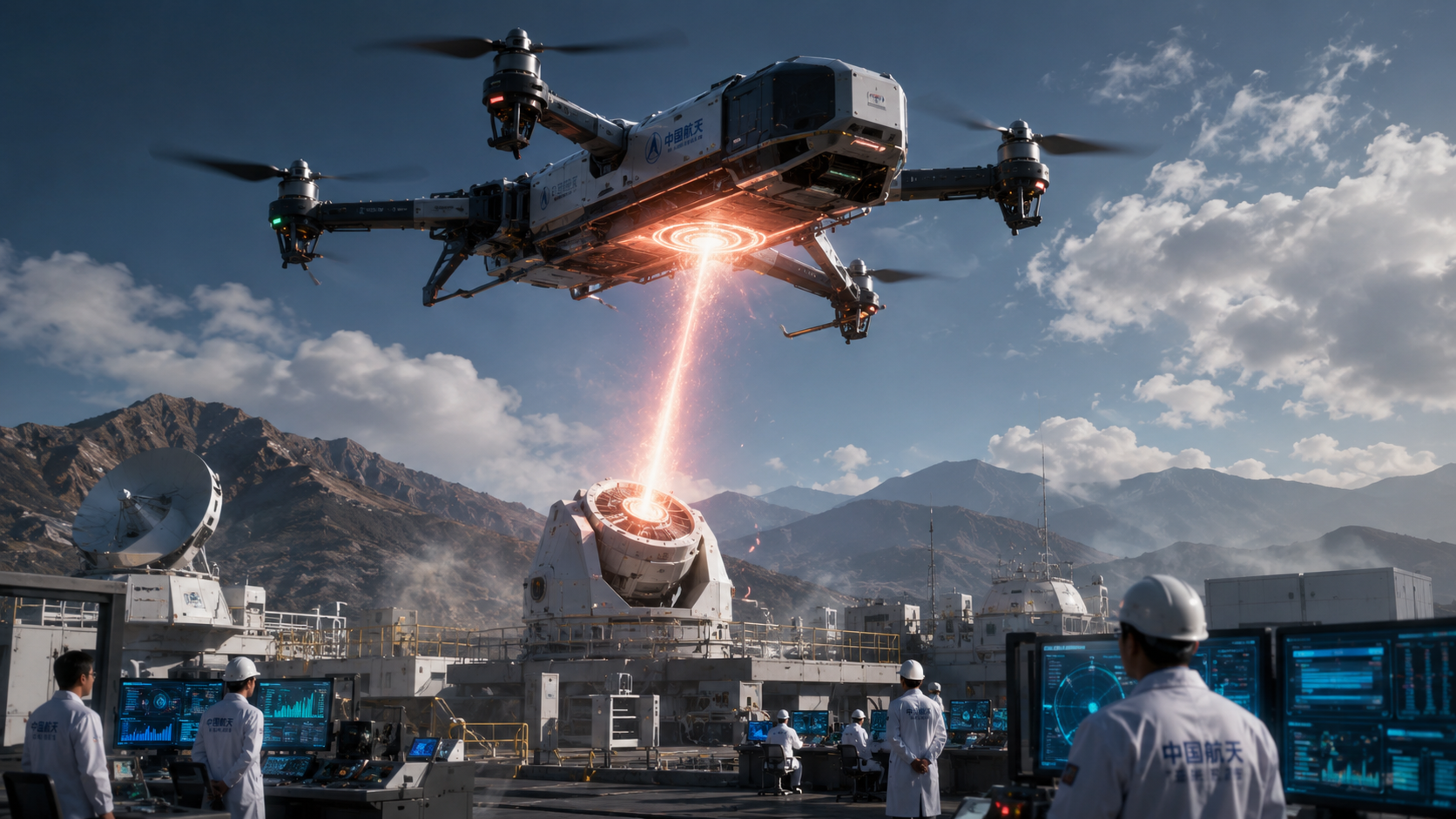
In a remarkable demonstration, scientists at Northwestern Polytechnical University have reportedly developed a cargo drone that receives energy from a ground-based laser beam rather than from onboard fuel or conventional batteries.
If this technology matures, it could redefine aviation.
Aircraft may no longer need to carry all the energy they consume.
Instead, power could be transmitted through the air itself.
What once belonged to science fiction is moving steadily toward engineering reality.
Part I — A New Idea Takes Flight
The Dream of Wireless Energy

The concept behind the laser-powered drone is elegantly simple.
A ground station generates a high-energy laser beam and directs it at the aircraft.
The drone carries a receiver that converts incoming light into electricity.
That electricity powers motors, flight computers, navigation systems, and payload equipment.
In essence, the drone flies while being continuously “plugged in” from a distance.
It is the airborne equivalent of wireless charging—on a far more sophisticated scale.
Breaking Aviation’s Old Limitation

Traditional aircraft face a constant tradeoff.
To fly longer, they must carry more fuel.
But carrying more fuel adds weight, which increases energy consumption.
Battery-powered aircraft face an even harsher constraint because batteries store far less energy per kilogram than liquid fuels.
By transmitting power externally, laser propulsion changes the equation.
The drone can carry:
- Less onboard energy.
- More payload.
- Lighter structures.
- Extended endurance.
The result could be flight durations measured not in hours, but potentially days.
How the System Works
The technology relies on four essential elements.
1. Ground-Based Laser Transmitter
A high-power laser converts electrical energy into a tightly focused beam.
2. Tracking and Pointing System
Sensors keep the beam precisely aligned with the drone.
3. Photovoltaic Receiver
Specialized cells convert laser light into electrical power.
4. Flight Control Systems
Onboard electronics distribute power to propulsion and avionics.
If the beam is interrupted, the system can shut down or transition to backup power.
Part II — The Science Behind the Breakthrough
Turning Light Into Electricity

The heart of the system is the optical receiver.
When laser photons strike the receiver, semiconductor materials convert them into electrical current.
This process is similar to how solar panels work, but uses concentrated monochromatic light tuned for high efficiency.
Because the wavelength is known in advance, engineers can optimize the receiver for better performance than standard solar panels.
Precision Matters
Keeping a narrow laser beam locked onto a moving drone is a major challenge.
The system must account for:
- Aircraft motion.
- Wind gusts.
- Atmospheric turbulence.
- Vibration.
- Weather effects.
Infrared tracking, GPS, and automated control algorithms help maintain alignment.
The beam must remain steady enough to provide continuous power while preserving safety.
Operating in Real Weather
Preliminary tests suggest that the system can function through haze, light rain, and smog.
But atmospheric conditions remain one of the greatest challenges.
Heavy clouds, dust, and severe weather can scatter or weaken the beam.
Future progress will depend on improved optics, adaptive control, and robust operational planning.
Part III — Why This Matters
A Revolution in Logistics

Cargo drones are constrained by battery endurance.
Laser-powered aircraft could remain airborne far longer, making them valuable for:
- Emergency medicine delivery.
- Remote community resupply.
- Offshore operations.
- Island logistics.
- Persistent surveillance.
In disaster zones, where roads and infrastructure are damaged, this capability could save lives.
Military Applications
Persistent flight has obvious defense applications.
Potential uses include:
- Long-endurance reconnaissance.
- Battlefield resupply.
- Communications relay.
- Border monitoring.
Any system that reduces the need for fuel transport offers operational advantages.
Humanitarian Potential
Imagine a region isolated by earthquake or flood.
A laser-powered drone could deliver medicine, blood supplies, and food continuously as long as the ground station remains active.
The technology could transform humanitarian response by extending endurance beyond traditional battery limits.
Part IV — Environmental Promise
Toward Cleaner Aviation
Because propulsion energy comes from an external electrical source, emissions depend on how that electricity is generated.
If powered by renewable energy, the system could offer very low operational emissions.
Additional benefits may include:
- Reduced reliance on onboard batteries.
- Less fuel logistics.
- Lower noise for electric propulsion.
This approach points toward a cleaner and more flexible future for unmanned aviation.
Reducing Infrastructure Burdens
Remote operations often require transporting fuel and spare batteries.
A laser-powered network could centralize energy generation and distribute power through the air.
This may simplify operations in isolated regions.
Part V — Engineering Challenges Still Ahead
Conversion Efficiency
Every stage loses energy:
- Electricity to laser light.
- Atmospheric transmission.
- Light to electricity.
- Electricity to propulsion.
Improving efficiency is essential for practical operations.
Safety and Regulation
High-power lasers require strict safeguards.
Systems must prevent accidental exposure to aircraft, people, and sensitive equipment.
Civil aviation regulators will demand robust safety standards before large-scale deployment.
Range Limitations
The aircraft must remain within line of sight of the transmitter unless relay systems are developed.
This limits operational geometry, though networks of ground stations could expand coverage.
Part VI — The Global Technology Race
China’s Strategic Investment
China has invested heavily in drones, directed energy, and wireless power transmission.
This demonstration highlights how combining these fields can produce new operational concepts.
International Competition
Research into wireless power and laser propulsion is also underway in the United States, Europe, and Japan.
China’s reported success adds momentum to a growing global effort.
Commercial Implications
The drone logistics market is expanding rapidly.
If endurance constraints are reduced, laser-powered UAVs could create new business models for long-duration missions where constant availability is critical.
Part VII — A Glimpse of Tomorrow
From Prototype to Operational System
Experts expect several milestones before broad adoption:
- Greater conversion efficiency.
- Improved weather tolerance.
- Safer tracking systems.
- Regulatory frameworks.
- Scalable ground infrastructure.
Progress may be gradual, but the concept is now firmly established.
Beyond Cargo Drones
Future applications could include:
- High-altitude communication platforms.
- Environmental monitoring.
- Agricultural surveying.
- Maritime support.
- Scientific missions.
The same principle may one day support larger autonomous aircraft.
Final Thoughts: The Day Aviation Cut the Power Cord
For generations, every aircraft carried the energy it needed to fly.
China’s laser-powered drone challenges that century-old assumption.
By transmitting power through a beam of light, engineers are exploring a future in which endurance is no longer dictated solely by fuel tanks or battery packs.
The broader significance is inspiring.
A concept once confined to laboratories and science fiction is becoming a working prototype with real humanitarian, commercial, and strategic potential.
There are still major technical and regulatory hurdles to overcome.
But history is shaped by moments when people dare to rethink what seems fundamental.
The Wright brothers proved heavier-than-air flight was possible.
The jet age shrank the world.
Satellites connected continents.
And now, a beam of light may be opening a new chapter in aviation.
The future may belong to aircraft that do not carry all their power with them.
Instead, they will draw energy from the world around them—and stay aloft as long as imagination, engineering, and human ambition allow.