The smoke alarm didn’t wake me. The intense, blistering heat against my face did. I’m Marcus, a former Marine, and for the last six months, I’ve been paralyzed from the chest down, confined to a wheelchair in an isolated cabin in upstate New York. I had given up. I wanted to die. But right now, staring at the ceiling as flames licked the wallpaper of my living room, my combat instincts kicked in.
I dragged my dead weight into my chair, but my panicked, clumsy hands slipped on the wheels. The chair tipped backward, slamming me onto the hardwood floor. My legs twisted grotesquely beneath me—I couldn’t feel them, but I knew I was trapped. The fire roared, a deafening freight train of heat and destruction consuming the kitchen and creeping toward the hallway.
Coughing violently, I clawed at the floorboards, trying to drag two hundred pounds of useless dead weight toward the front door. It was no use. The smoke was too thick. My lungs burned. Through the grey haze, a small figure darted past the flames. Ranger. He was an eight-week-old German Shepherd, a desperate gift my father had forced upon me just two days ago from a local shelter.
I had ignored the dog, resented him even. Yet here he was, barking frantically, his tiny paws slipping on the slick floor.
You May Also Like
“Get out!” I screamed, my voice cracking from the ash. “Run, Ranger! Leave me!”
But he didn’t. The puppy bounded over the burning debris and shoved his small, trembling body directly under my paralyzed right arm. He clamped his needle-like teeth into my shirt collar and pulled with all his meager strength. The ceiling groaned above us. A massive flaming beam snapped, plummeting straight down toward where we lay entangled on the floor. I threw my arms over Ranger, bracing for the crushing impact. The darkness closed in, and in thatsplit second, I swore I felt something impossible. I felt the heat of the fire on my dead legs.
Part 2
The massive, burning beam crashed to the floor mere inches from my head, showering us in a fountain of sparks. The impact rattled my teeth, but it was the searing heat on my right leg that made my eyes snap wide open. Pain. Real, blinding, impossible pain. The doctors had told me my spinal cord was irreversibly severed. I hadn’t felt a single sensation below my ribs in half a year. Yet, as the puppy pressed his trembling, eighty-degree body against my shin to shield me, a distinct, burning pressure registered in my brain.
I gasped, choking on the thick, toxic smoke. The shock of the pain triggered an adrenaline dump so massive it overrode my despair. I grabbed Ranger by the scruff of his neck, tucked him into my chest, and used my massive upper body strength—forged from years in the Marine Corps—to army-crawl backward. I dragged my heavy, unresponsive lower half across the blistering floorboards, out the shattered front door, and collapsed onto the damp grass just as the living room windows blew out in a fireball.
Sirens wailed in the distance. The cool night air rushed into my scorched lungs. Ranger whimpered, licking the soot from my chin. I was alive, but as the paramedics strapped me onto a gurney and loaded me into the back of the ambulance, a new, terrifying crisis emerged.
“Blood pressure is skyrocketing!” the EMT shouted, wrapping a cuff around my arm. “He’s at 210 over 120! Heart rate is erratic!”
I knew what that meant. Autonomic dysreflexia. It’s a deadly condition for paraplegics where a pain source below the injury—like a severe burn from a house fire—sends the nervous system into overdrive, often resulting in a lethal stroke. My vision swam with dark spots. My head pounded like a jackhammer.
“We’re losing him!” the medic yelled, grabbing a syringe. “I need to push meds now!”
I woke up three days later in the ICU, staring at a sterile white ceiling. The steady beep of the heart monitor filled the room. Sitting in a chair beside my bed was my father, looking ten years older, with a small, furry head resting on his lap. Ranger. The moment the puppy saw my eyes open, he broke free from my dad’s grasp, hopped onto the bed, and assertively plopped his chin right on my heavily bandaged right leg.
“He hasn’t left the hospital,” my dad said, his voice thick with emotion. “The nurses bent the rules. He earned his name, Marcus. Every rank, every mission, every damn day, he showed up.”
I stared at the dog. “Dad… I felt him.”
My father frowned. “What do you mean?”
“In the fire. I felt the heat. And right now… I can feel the pressure of his chin on my knee.”
The attending neurologist, Dr. Evans, walked in at that exact moment and overheard me. He gave a sympathetic, almost pitying sigh. “Marcus, you suffered severe trauma. Your brain is experiencing phantom limb sensations. We ran the scans again while you were unconscious. Your spinal cord is heavily scarred. Medically speaking, sensation is impossible.”
“I’m telling you, I can feel him,” I insisted, my voice rising in frustration.
“It’s a psychological coping mechanism,” Dr. Evans replied firmly, checking my chart. “You bonded with the dog in a life-or-death scenario. Your brain is hallucinating touch.”
I glared at the doctor, then looked down at Ranger. The dog looked back at me with intense, intelligent amber eyes. He shifted his weight, digging his front paws into my shin. A sharp, unmistakable prickle of electricity danced up my nerve endings. It wasn’t a hallucination. It was a spark. And if there was a spark, there was a fire waiting to be lit. I was going to prove them all wrong.
If you’ve read this far, don’t hesitate to leave a like and comment before reading part 3. It makes us as happy as reading a complete story! Thank you. 👍❤️
Part 3
I refused to accept Dr. Evans’s grim prognosis. The faint sensation of Ranger’s paws on my leg became my anchor, the solitary thread of hope in a sea of medical impossibilities. I demanded aggressive physical therapy, much to the reluctance of the hospital staff. They thought I was in denial, setting myself up for a devastating psychological crash. But they didn’t understand the bond that had been forged in the flames.
Over the next eight months, my recovery process was grueling. Every morning, I was strapped into a standing frame, sweating through my shirt, teeth clenched in agony as I tried to force my brain to communicate with my deadened limbs. And every single morning, Ranger was there. He had officially been certified as my mobility support and psychiatric service dog. When I wobbled, he was instantly by my side, bracing his growing, muscular frame against my legs to keep me steady.
The mystery of my returning sensation finally unraveled during a follow-up MRI. The severe swelling around my spinal cord, which had been misidentified as permanent scar tissue, had miraculously begun to subside. The trauma of the fire, combined with the extreme adrenaline response, had seemingly shocked a dormant cluster of nerves into firing. The doctors were baffled. They called it an anomaly; I called it a rescue mission led by a German Shepherd.
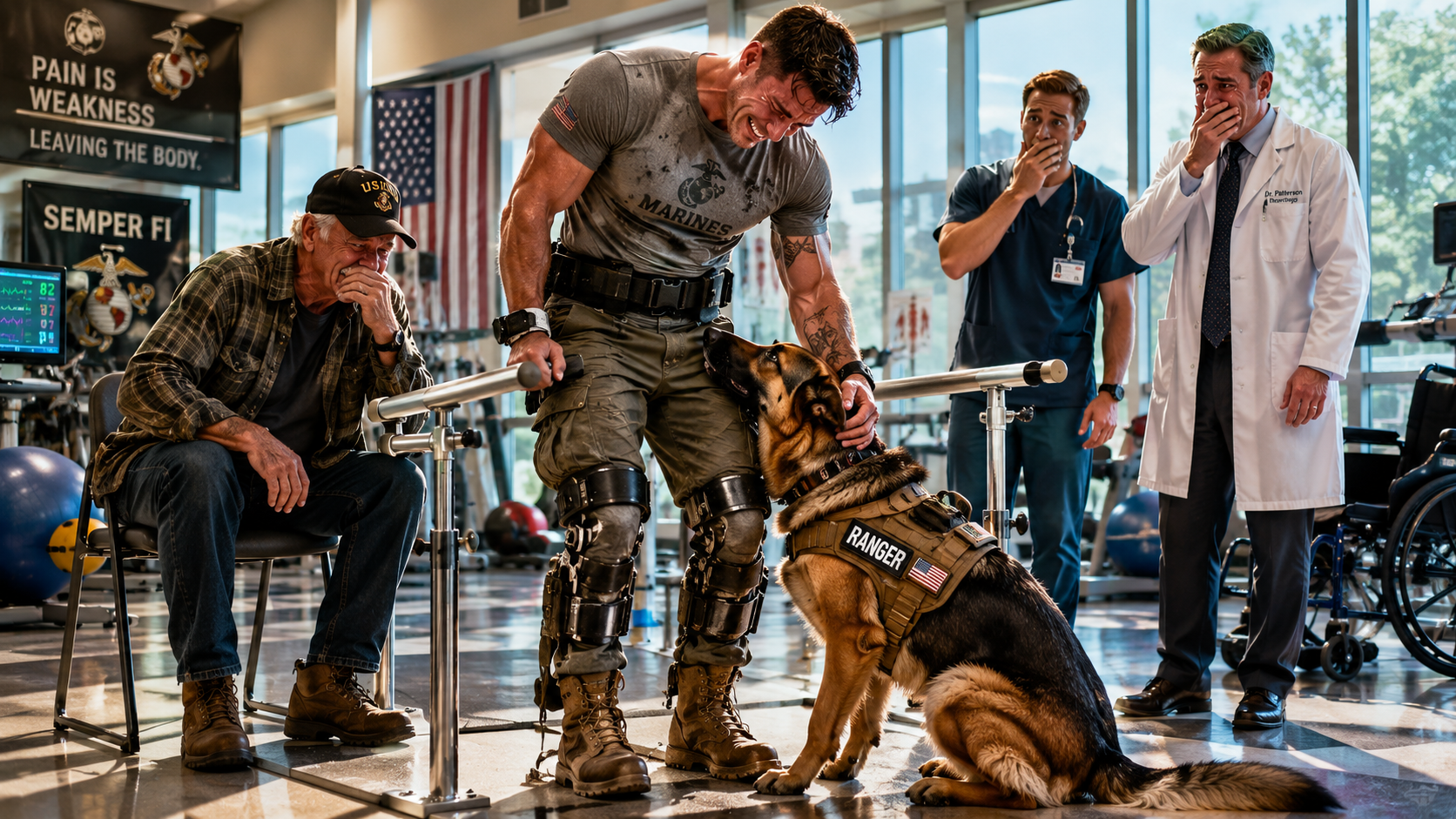
The ultimate test came on a rainy Tuesday morning in the hospital’s main rehabilitation gym. The room was packed with my medical team, my father, and a few other veterans who had heard rumors of the stubborn Marine trying to do the impossible. Ranger sat patiently at the end of the parallel bars, his tail executing a slow, steady thump against the blue mat.
“Take it easy, Marcus,” my physical therapist, Sarah, cautioned, hovering her hands near my gait belt. “Just try to bear twenty percent of your weight.”
“No,” I grunted, my knuckles turning white as I gripped the bars. “Today, we go for broke.”
I closed my eyes and focused everything I had on the memory of the fire—the heat, the fear, and the weight of the puppy who had refused to leave me behind. I commanded my legs to move. I pushed down against the floor. A violent tremor shook my entire lower body. Muscles that had been asleep for over a year screamed in protest.
Then, the room went dead silent.
My boots remained planted flat on the linoleum. My knees locked. I let go of the right bar. Then, holding my breath, I released my grip on the left.
I was standing. Entirely under my own weight.
Tears streamed down my father’s face. Sarah covered her mouth, stifling a sob, completely speechless. Dr. Evans, the neurologist who had told me it was all in my head, stood frozen by the doorway, his clipboard hanging loosely at his side. I looked down at the end of the bars. Ranger let out a sharp, joyous bark and trotted over, pressing his head firmly against my knee. I felt the warmth of his fur. I felt the solid pressure of my best friend.
I reached down, my legs trembling but holding steady, and stroked his ears. I had lost everything in combat, and a fire had nearly taken whatever was left. But a father’s desperate gift and the unyielding loyalty of a brave shepherd had pulled me from the ashes. I wasn’t just surviving anymore. Thanks to Ranger, I was finally walking back into life.
What do you think of this story? Please leave a like and share your thoughts in the comments. Your support means a lot to us and inspires us to keep writing more meaningful and powerful stories. Thank you! 👍❤️