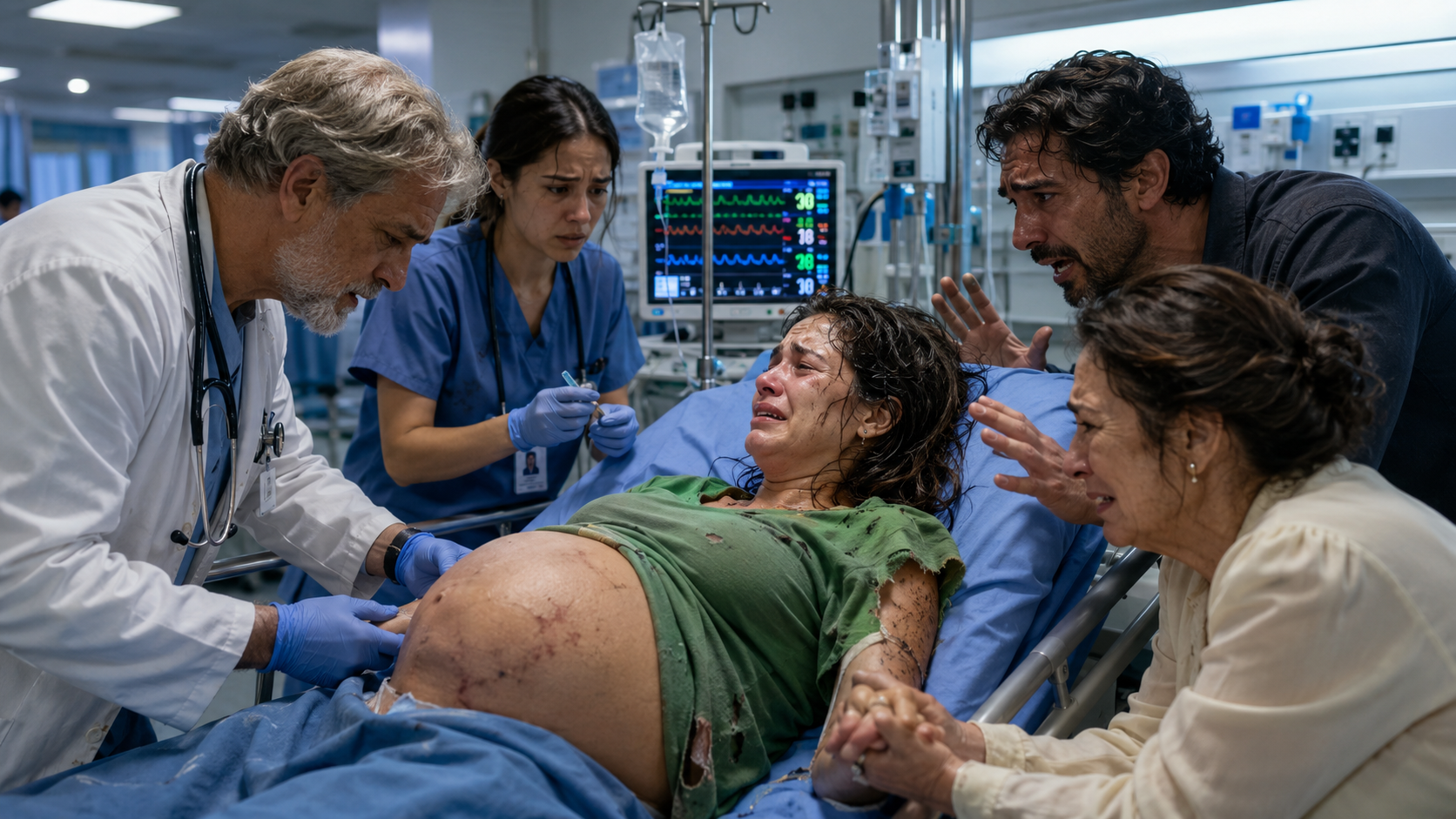
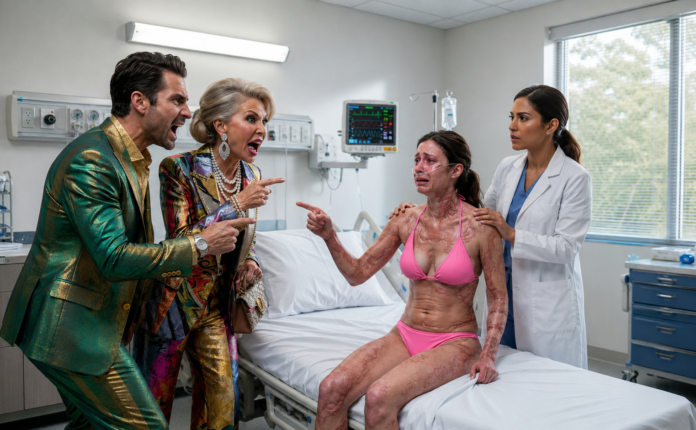
My mother-in-law dumped a pot of boiling oil over me, then sneered, “Next time, dinner will be ready before my son gets home.” My husband stepped over my body to wipe the oil off his expensive shoes before calmly telling the doctor, “She’s clumsy. She spilled soup on herself.” Neither of them realized the woman lying silent in that hospital bed used to be a fraud attorney—and before collapsing, I had already secured evidence that could destroy them both. But the doctor’s next sentence froze the entire room…
When I finally woke, I was surrounded by stark white hospital curtains and the sterile scent of antiseptic. My skin felt wrapped in a blinding, agonizing heat. The ‘accident’ in the kitchen earlier… no, it wasn’t an accident. My mother-in-law had orchestrated it simply because dinner was late.
Right now, standing just beyond the curtain, Daniel—my perfect, loving husband—was speaking in that soft, polished tone he usually reserved for wealthy bankers and strangers.
“She’s always been incredibly clumsy,” he sighed to the doctor. “She spilled a boiling pot of soup all over herself.”
The doctor paused. “A spilled bowl of soup caused such severe, specific splash patterns across her back and shoulders?”
“My wife panics easily,” Daniel replied without missing a beat. “She probably twisted around while falling.”
Vivian, my mother-in-law, immediately added a trembling, heartbreaking sob. “Poor thing. We warned her not to cook when she was so exhausted.”
I kept my eyes closed, breathing evenly.
For three years, they had trained themselves to mistake my silence for stupidity. Daniel controlled our bank accounts, screened my phone calls, and whispered to everyone that I was emotionally unstable. Vivian moved into our home ‘temporarily,’ then began micromanaging my meals, my clothes, even the time I took showers. Every insult was masked as a joke that I was just ‘too sensitive’ to understand.
But they had completely forgotten who I was before this marriage.
Before Daniel convinced me to step away from public life, I was a ruthless attorney specializing in financial fraud. More importantly, the estate wasn’t his. My late father had placed it all inside an irrevocable trust controlled solely by me. Daniel fully believed my signature six months ago had transferred everything to him.
It had not.
The papers he made me sign were copies I had quietly altered after noticing missing pages. The real documents sat in a secure bank vault, alongside secret recordings, financial statements, and strict instructions on what to do if I were ever hospitalized under suspicious circumstances.
Beneath the hospital blanket, despite the sheer physical agony, I felt something far colder than fear settling inside me. My patience had finally sharpened into a weapon.
The doctor stepped closer to my bed. Dr. Lena Ortiz had been my college roommate. She knew my emergency directive. She tapped my wrist once, then turned around to face my husband.
“Before the police officers come upstairs,” she said with chilling calmness, “perhaps you’d like to explain why your wife had a hidden camera recording in her kitchen?”.
PART 2
The moment Dr. Lena Ortiz said those words, the hospital room seemed to lose all sound.
“It recorded what Vivian said afterward… about your father’s death.”
You May Also Like
For three years, I had lived with pain in quiet, manageable forms. A sharp word over breakfast. A locked credit card. A dinner invitation canceled because Daniel told people I was “too fragile.” Vivian’s cold fingers correcting the collar of my blouse while whispering, “A woman without a husband’s guidance is just a disaster waiting to happen.”
But nothing—nothing—prepared me for the sensation that swept through my body then.
Not the burns.
Not the tubes.
Not the smell of antiseptic and fear.
It was something older, deeper, and more terrifying.
My father.
The man who had taught me to read contracts before bedtime like other children read fairy tales. The man who had built his company from a rented room above a bakery. The man who had held my face in both hands after my first courtroom win and said, “Never confuse kindness with weakness, Emily. The world punishes women for both.”
He had died suddenly three years ago, two months before my wedding to Daniel.
A heart attack, they said.
Unexpected, tragic, natural.
Daniel had been perfect then. He had held me through the funeral, spoken gently to reporters, shielded me from business partners, arranged meals I never ate. Vivian had dabbed her eyes beside the casket, calling my father “a noble man” even though I barely remembered them exchanging more than a few polite words.
And now Dr. Ortiz was telling me that my hidden camera had recorded Vivian saying something about his death.
Daniel reacted first.
He moved so fast the police officers entering the room barely had time to step aside. His polished composure fractured, his face twisting into something raw and ugly.
“That is private property,” he snapped. “Whatever she recorded inside our house was illegal.”
Dr. Ortiz lifted her chin. “Your wife owns the house.”
The officer in front, a broad-shouldered woman with silver-threaded hair, looked from Daniel to me. “Mrs. Harrow? I’m Detective Maren Ellis. Are you able to answer questions?”
Daniel cut in before I could speak. “She’s medicated. She’s confused. She doesn’t understand what she’s saying.”
“I understand perfectly,” I said.
My voice was rough, almost unrecognizable, but it carried.
Detective Ellis stepped closer. “Do you feel safe with these two people in the room?”
Daniel’s eyes flashed a warning.
Vivian’s mouth trembled, but her stare was full of poison.
“No,” I said.
One word.
That was all it took.
The room shifted.
An officer guided Daniel back. Another stood near Vivian. My husband tried to laugh, tried to appeal to reason, reputation, misunderstanding. Vivian began weeping again, but her tears had lost their audience. Her performance looked cheap under the fluorescent lights.
“This is absurd,” Daniel said. “My wife has a history of emotional instability.”
Detective Ellis looked at Dr. Ortiz. “Documented?”
“No,” Lena replied. “Not in any medical file I’ve ever seen.”
Daniel’s lips parted.
For years, he had built that lie in drawing rooms, dinner parties, and private phone calls. He had whispered it into the ears of people who mattered. Emily was overwhelmed. Emily forgot things. Emily became irrational when challenged. Emily needed rest.
But lies, like contracts, needed signatures.
And Daniel had none.
Detective Ellis turned back to him. “Sir, you and Mrs. Harrow’s mother-in-law will wait outside while we speak with her.”
“I am her husband.”
“And right now,” the detective said, “you are also a person of interest in an aggravated assault investigation.”
The words landed like a slap.
Daniel stared at her, then at me.
For the first time since I had married him, he looked uncertain about the rules of the room.
Vivian was not uncertain.
She leaned toward me as the officer took her elbow, and behind her trembling lips, she whispered, “You should have stayed quiet.”
I did not look away.
“I did,” I whispered back. “That was your mistake.”
When they were removed, the silence that followed was almost holy.
Dr. Ortiz pulled the curtain fully closed. Detective Ellis drew a chair to the side of my bed. A younger officer stood near the door, notebook open.
Lena’s professional calm softened when she looked at me. Beneath the doctor’s white coat, I could see the woman who once ate noodles with me at midnight during law school finals, who held my hair back after a disastrous birthday party, who knew the difference between my silence and surrender.
“You don’t have to do everything now,” she said gently.
“Yes,” I replied. “I do.”
Detective Ellis studied me carefully. “Tell me what happened tonight.”
So I told them.
I told them about dinner being late because Vivian had hidden the delivery order I placed for groceries. I told them how Daniel had texted that he would be home by seven and expected the roast he liked, the one Vivian insisted I prepare though she knew the oven had been malfunctioning. I told them how Vivian stood too close behind me, criticizing every movement, her voice soft enough that a recording would catch it but Daniel could later claim I imagined it.
I told them how the pot was not soup.
It was oil.
Vivian had been frying garlic in it. She lifted it with both hands. Her expression had been calm, almost bored.
Then she threw it.
The pain had not felt real at first. My body had registered heat before injury, shock before scream. I remembered falling to my knees, my palms slipping on the kitchen floor, Vivian’s slippers stepping over the spreading oil.
And Daniel.
Daniel entering the kitchen, seeing me collapsed, seeing his mother holding the empty pot, seeing the burns across my body.
He did not call for help immediately.
First, he cursed because oil had splattered his shoes.
Then he wiped them clean.
Only after that did he dial emergency services.
Detective Ellis’s pen stopped moving.
Lena’s jaw tightened.
I stared at the ceiling, where white tiles blurred into one another. “I had a camera installed under the corner shelf after Vivian tampered with my medication last month.”
The young officer looked up. “Medication?”
“Sleeping pills,” I said. “Prescribed after Daniel convinced a doctor I had anxiety. I never took them unless I opened the bottle myself. One night, I found the capsules had been separated and refilled. I sent two to a private lab.”
Detective Ellis leaned forward. “Results?”
“In the vault.”
“What vault?”
I breathed carefully through a wave of pain. “First National Trust. Box 418. My attorney has access under my emergency directive.”
The detective glanced at Dr. Ortiz.
Lena nodded. “Her directive was triggered when she was admitted with injuries inconsistent with the explanation given by family members.”
“Who is your attorney?” Detective Ellis asked.
“Marcus Vale.”
Both officers reacted.
Even through the haze of medication, I noticed.
Marcus Vale had been my father’s closest friend and the kind of attorney other attorneys disliked facing. He wore old suits, spoke quietly, and remembered every lie a person told him. When I resigned from active practice, he had asked one question: “Are you leaving law because you want peace, or because someone is teaching you to fear your own voice?”
I had laughed then.
I had lied.
Detective Ellis closed her notebook halfway. “Mrs. Harrow, Dr. Ortiz mentioned the camera recorded something about your father’s death. Have you seen that footage?”
“No.”
Lena hesitated. “I only saw a portion. Enough to know it mattered.”
“What did Vivian say?” I asked.
Lena’s eyes moved to the detective.
Detective Ellis’s voice became careful. “We should preserve the original footage before discussing details.”
“No,” I said.
The pain made me shake, but I forced the words out.
“For three years, everyone decided what I could handle. Daniel decided. Vivian decided. Doctors decided. Friends decided. I am done being protected from my own life.”
Lena looked stricken.
Then she picked up the tablet from the counter.
“I accessed the emergency cloud backup from the secure link you gave me years ago,” she said. “The full file is already uploaded to Marcus Vale’s office and copied to a police evidence folder. This is only a preview.”
She turned the screen toward me.
The video began with the kitchen tilted from a high corner angle. The image was sharp enough to make my stomach tighten. I saw myself at the stove, shoulders tense, hair pinned badly at the back of my head. Vivian stood behind me in a cream sweater, diamond bracelet catching the light.
There was no audio for the first second.
Then Vivian’s voice emerged.
“You think being late is a small thing? Men leave women for less.”
I watched myself say nothing.
“You used to be proud,” Vivian continued. “Now look at you. Shaking over a roast.”
On-screen, I reached for the oven mitt.
Vivian lifted the pot.
Even knowing what was coming, I flinched.
The oil hit me.
My own scream filled the hospital room.
Lena lowered the volume, but not before the sound sliced through me. Detective Ellis looked away for half a second. The young officer’s face went pale.
On the screen, I collapsed.
Vivian set the pot down.
She did not panic.
She did not call for help.
She stood over me and said, “Next time, dinner will be ready before my son gets home.”
Then Daniel entered.
He froze.
For one heartbeat, I thought maybe some hidden part of him had once loved me. Maybe he would rush forward. Maybe the man I married had not been entirely imaginary.
But the video gave me no mercy.
Daniel looked at me, then at his shoes.
“Oh, for God’s sake, Mother,” he said. “Not on the Italian leather.”
The room went so silent I could hear the machine beside my bed measuring my heartbeat.
On-screen, Vivian snapped, “She needed discipline.”
“She needed to sign the final transfer first,” Daniel hissed.
My blood turned cold.
Vivian waved one hand. “She signed enough.”
“No, she didn’t. Marcus Vale keeps blocking the trust conversion.”
“And whose fault is that?” Vivian said. “If you had handled her father properly before he changed the trustee language, we wouldn’t still be begging that old lawyer for access.”
The video seemed to tilt though the camera never moved.
My father’s name was not spoken, but I felt him enter the room like a ghost.
Daniel’s face on the screen hardened. “Keep your voice down.”
Vivian laughed softly. “Why? She can barely breathe. Just like Henry when you switched his pills.”
My heart monitor began to beep faster.
Lena quickly touched my shoulder, then stopped, afraid to hurt me.
I could not feel the bed beneath me anymore.
Henry.
My father.
Switched his pills.
Daniel had been there the week before my father died. He had brought supplements, tea, imported vitamins he said would help with stress. I remembered my father teasing him: “Trying to keep me alive long enough to pay for the wedding?”
Daniel had smiled.
That perfect smile.
That murderer’s smile.
On-screen, Daniel grabbed Vivian’s arm. “You are going to ruin everything.”
Vivian pulled free. “I ruined nothing. I made you rich.”
“You made a mess.”
“No,” she said coldly. “The mess is still breathing on the floor.”
The video ended.
No one spoke.
I stared at the blank tablet screen until my reflection appeared in it—pale, bandaged, eyes dark with a grief so immense it no longer felt like sadness.
It felt like a country burning.
Detective Ellis stood. “I’m going to request immediate warrants.”
“Detective,” I said.
She paused.
“My father’s medical records. His prescriptions. The nurse who attended him. Daniel’s financial records from that month. Vivian’s travel history. The trust amendment drafts. You’ll need all of them.”
Her expression shifted.
She was no longer looking at a victim.
She was looking at an attorney.
“I assume Marcus Vale has those?”
“Some,” I said. “The rest Daniel thought he had buried.”
“Where?”
I closed my eyes.
Three years ago, after my father’s death, I found a discrepancy in Daniel’s calendar. A missing afternoon. He said he had been with a client. The client had no meeting. I asked once. Daniel kissed my forehead and told me grief was making me suspicious.
So I did what I had always done before marriage taught me to apologize for intelligence.
I kept a record.
“Daniel has a private storage unit under his company’s shell vendor,” I said. “Harrow Consulting Logistics. Unit 12B, East Mercer Storage.”
Detective Ellis wrote quickly.
Lena stared at me with something like awe and sorrow.
I swallowed. “He keeps paper when he’s afraid of digital trails.”
The detective nodded. “We’ll move fast.”
“You have to,” I whispered. “He will run.”
As if summoned by the words, shouting erupted outside the room.
Daniel’s voice.
Not polished now. Not gentle. Not controlled.
“You cannot detain me without charges! Do you know who my attorney is?”
Another voice answered, low and firm.
Then a crash.
The young officer moved instantly toward the door. Detective Ellis followed. Through the narrow gap in the curtain, I saw Daniel twisting away from one officer, his phone in hand. Vivian stood behind him, no longer crying, her face carved from ice.
She saw me through the gap.
And she smiled.
Not because she was innocent.
Because she knew something I did not.
Daniel was restrained within seconds, but his phone had already hit the floor. The screen shattered. An officer picked it up carefully, but I saw the message before the display went dark.
It was only three words.
Burn the bluebook.
My mouth went dry.
“Detective,” I called.
Ellis turned back.
“What is it?”
“His phone. He sent a message.”
“We’ll recover it.”
“No,” I said, forcing myself upright despite the pain exploding white behind my eyes. “You don’t understand. The bluebook was my father’s private ledger. Not digital. Handwritten. He used it for people he didn’t trust.”
Lena pressed me gently back. “Emily, stop.”
But I could not stop.
My father’s bluebook had vanished after his funeral. I thought grief had swallowed the memory. I thought perhaps I imagined the navy leather cover, the elastic strap, the initials H.M.C. embossed in silver.
If Daniel had it, then my father had suspected him before he died.
If Daniel wanted it burned, then it held something worse than murder.
Detective Ellis moved fast. “Who would he message?”
“His assistant,” I said. “Or his driver. Maybe both.”
Vivian laughed from the hallway. “You always were dramatic.”
The officer beside her told her to be quiet.
But she looked at me, eyes shining with hatred.
“You think a little video makes you powerful?” she called. “Your father thought paperwork could save him too.”
Something inside me cracked.
Not loudly.
Not dramatically.
A clean break.
I turned to Detective Ellis. “Arrest her.”
“We’re working on—”
“Arrest her now,” I said. “Before she says one more word and realizes she’s confessing.”
Vivian’s face went blank.
Detective Ellis stared at me for one fraction of a second, then stepped into the hall.
“Vivian Harrow,” she said, “you are under arrest on suspicion of aggravated assault. Additional charges may follow.”
Vivian did not struggle.
That was the frightening part.
She simply lifted her chin and let them cuff her, as though humiliation were temporary and victory inevitable.
Daniel, however, fought until an officer pinned him against the wall.
“You stupid woman!” he shouted at me. “You think Marcus can protect you? You think the trust matters now?”
The word now hit me strangely.
Now.
Not after the investigation.
Not after court.
Now.
“What did you do?” I whispered.
Daniel heard me.
Even from the hall, even through the officers, he heard me.
And he smiled with blood on his lip.
“I became your husband,” he said. “That was all I ever needed to do.”
Then they dragged him away.
The hours after that blurred.
Pain medication pulled me under, then grief dragged me back up. Nurses came and went. Photos were taken of my injuries. A specialist explained skin grafts in a voice that sounded far away. Detective Ellis returned twice, once to confirm that emergency warrants were being executed, once to tell me Daniel and Vivian were being processed separately.
By dawn, Marcus Vale arrived.
He entered without drama, wearing a charcoal suit that looked older than some lawyers’ careers. His silver hair was combed back, his eyes red-rimmed but sharp. He stood at the foot of my hospital bed for a moment, and all the composure I had fought to maintain nearly collapsed.
“My dear girl,” he said quietly.
I turned my face away.
“I should have listened to you,” I whispered.
“No,” he said. “I should have pushed harder when you stopped returning calls.”
That broke me more than blame would have.
Tears slid into my hairline. I could not wipe them away.
Marcus came to my side and placed his briefcase on the chair. “Your emergency directive worked exactly as designed. The trust remains intact. Daniel has no ownership over your father’s estate, company shares, primary residence, or personal accounts.”
I breathed in carefully.
“But?” I asked.
His face darkened.
“But Daniel filed something yesterday morning.”
My tears stopped.
“What?”
“A spousal incapacity petition.”
The room seemed to shrink.
Marcus opened his briefcase and removed a folder. “He claimed you were mentally unstable, financially incompetent, and at risk of self-harm. He requested temporary control over marital assets and emergency authority to make medical decisions on your behalf.”
My stomach turned.
“Medical decisions?”
“Yes.”
Lena, who had returned silently during his explanation, went rigid. “That would have allowed him to transfer her care.”
Marcus nodded. “Or restrict visitors. Or challenge her directive.”
“But the burns happened last night,” I said.
“Yes,” Marcus replied. “And the petition was filed yesterday morning.”
The meaning unfolded slowly, horribly.
Daniel had prepared to control me before Vivian attacked me.
This had not been an impulsive punishment over dinner.
This had been a plan.
Burn me. Hospitalize me. Declare me unstable. Gain authority. Break the trust.
Maybe even finish what he started.
Lena covered her mouth.
Marcus leaned closer. “Emily, listen carefully. The judge had not ruled on the petition, but Daniel’s filing included attached statements from two witnesses.”
“Vivian,” I said.
“One was Vivian.”
“And the other?”
For the first time since he entered, Marcus looked afraid.
“Dr. Samuel Reed.”
I knew that name.
Every inch of my burned body seemed to freeze beneath the bandages.
Dr. Samuel Reed had been my father’s cardiologist.
The doctor who signed his death certificate.
Lena whispered, “Oh my God.”
Marcus placed the document in my hands, though my fingers could barely hold it.
There it was.
A formal statement describing me as delusional, paranoid, prone to fabrication, obsessed with my father’s death, and incapable of distinguishing accident from intent.
Signed by Dr. Samuel Reed.
Dated two days before Vivian threw boiling oil over me.
The room spun.
Daniel had not only married me for the estate.
He had built a circle around me using the same people who helped bury my father.
I looked at Marcus. “The bluebook.”
His eyes sharpened. “What about it?”
“Daniel has it. Or knows where it is. He sent a message: Burn the bluebook.”
Marcus went utterly still.
Then he sat down, slowly, as if his knees had weakened.
“Marcus?”
He removed his glasses.
“Emily,” he said, voice low, “your father gave me a sealed instruction before he died. I was to open it only if three things happened.”
“What three things?”
“One, if Daniel attempted to access the trust through marriage. Two, if you were hospitalized under suspicious circumstances. Three, if anyone mentioned the bluebook.”
My skin prickled.
“All three have happened,” he said.
“What did my father know?”
Marcus opened his briefcase again. This time, he removed a small cream envelope, old and slightly bent at the corners. My name was written across the front in my father’s handwriting.
Not Emily Harrow.
Emily Carter.
My maiden name.
My real name.
My hands shook so badly Lena had to help open it.
Inside was one page.
Only one.
But the first sentence nearly stopped my heart.
My darling Emily, if you are reading this, then I failed to keep the Harrows away from you.
I could not breathe.
Marcus bowed his head.
I forced myself to keep reading.
Daniel is not who he says he is. His mother is not merely ambitious. Their family has spent twenty years attaching themselves to vulnerable fortunes through marriage, guardianship, and fraud. I began tracing them after Daniel asked too many questions about your trust. If I die suddenly, do not believe it was natural.
A sound escaped me, half sob, half gasp.
The final paragraph was worse.
The bluebook contains names, payments, medical records, and one truth I was not brave enough to tell you while alive. Daniel’s first target was never my company.
It was you.
Below that was an address.
Not a bank.
Not a law office.
A cemetery.
My mother’s cemetery.
A specific location: beneath the stone angel, left wing, third panel.
For a moment, nobody moved.
Then Marcus stood so abruptly his chair scraped the floor.
“I’ll go.”
“No,” I said.
He stopped.
“I’m going.”
Lena looked horrified. “Absolutely not.”
“I’m not asking as a patient.”
“You can barely sit up.”
“I’m asking as the owner of whatever my father died protecting.”
Marcus’s expression softened with pain. “Emily, your body needs time.”
“My father ran out of time,” I said. “I won’t.”
In the end, they did not let me leave.
Of course they didn’t.
But Detective Ellis sent two officers with Marcus to the cemetery while Lena stayed with me, refusing to move more than three feet from the bed. We waited in a silence so tense it seemed to pulse.
At 9:42 a.m., Detective Ellis returned.
Her face told me before her mouth did.
“They found the compartment,” she said.
My heart climbed into my throat.
“And?”
“It was empty.”
The words struck harder than the oil.
Empty.
Daniel had beaten us there.
Or someone else had.
Lena cursed under her breath.
Marcus entered behind the detective, his suit damp from rain, his expression carved with fury. In his hand, he held a small scrap of navy leather.
“The bluebook was there,” he said. “Recently removed.”
I closed my eyes.
Failure pressed down on me, heavy and suffocating.
Then Detective Ellis stepped closer.
“There was something else inside the compartment,” she said.
I opened my eyes.
She held up a clear evidence bag.
Inside was a silver key.
Small.
Old-fashioned.
With a red thread tied through its handle.
Marcus stared at it and whispered, “Henry, you clever bastard.”
“What is it?” I asked.
He looked at me.
“That key belongs to your father’s private archive room beneath the original Carter building. It was sealed after his death.”
“Then Daniel doesn’t have everything,” I said.
“No,” Marcus replied. “But he may know about it now.”
Detective Ellis’s phone rang.
She answered, listened for three seconds, and her expression changed.
“What happened?” Lena asked.
The detective looked directly at me.
“Daniel escaped custody during transfer.”
My heart slammed once, hard.
Then her next words turned the entire room colder than death.
“And fifteen minutes ago, someone used your father’s keycard to enter the Carter building archive.”
Part 3: The Archive Beneath the Empire
Daniel had escaped custody, and the first place he ran was not to an airport, not to a lawyer, not to the protection of his mother’s old money friends. He ran straight into my father’s graveyard of secrets.
Detective Ellis’s words hung over the hospital bed like a death sentence.
“Someone used your father’s keycard to enter the Carter building archive.”
For one unbearable second, the room dissolved. The machines beside me beeped faster. My burned skin throbbed beneath layers of gauze. Dr. Lena Ortiz gripped the bedrail, her knuckles whitening.
Marcus Vale looked as if he had aged ten years in one breath.
“That archive was sealed,” he said. “Only Henry, Emily, and I ever had authorization.”
Detective Ellis’s jaw tightened. “Then Daniel either had a duplicate card, or someone inside Carter Holdings let him in.”
I swallowed against the pain. “He’s not alone.”
Everyone turned to me.
“Daniel never moves without a safety net,” I whispered. “If he escaped, someone helped him. If he entered the archive, someone opened the door wider.”
Detective Ellis was already dialing. “I’m sending units to Carter Holdings.”
“No,” I said.
She paused.
“Send them to the public entrance. Daniel will expect that. But my father built the archive under the old west wing. There’s a service tunnel through the loading bay.”
Marcus stared at me. “Your father told you that?”
“He showed me once when I was seventeen,” I said. “He said rich men build front doors for visitors and back doors for enemies.”
Despite everything, Marcus almost smiled. “That sounds like Henry.”
Lena shook her head. “Emily, whatever you’re thinking, stop. You are not leaving this hospital.”
I looked at her, and she saw the answer before I spoke.
“I’m not asking permission.”
“Your body is in shock,” she said sharply. “You have severe burns, infection risk, pain levels that would put most people unconscious—”
“And my father’s murderer is inside the only room that can prove who helped him.”
Silence.
Detective Ellis stepped closer. “Mrs. Harrow, I cannot authorize you to enter an active crime scene.”
“Then don’t authorize it,” I said. “Escort me as the owner of the building.”
Marcus lowered his voice. “Emily, Daniel wants you unstable. Reckless. Desperate. Don’t give him that.”
I turned my head slowly toward him. “Daniel burned me before the petition hearing because he thought pain would silence me. If I stay here while he destroys my father’s evidence, then he was right.”
No one moved.
Then Lena exhaled through her nose, furious and frightened. “You’ll go in a wheelchair. You’ll have a nurse. You’ll wear protective dressing. And if your vitals drop, I drag you back myself.”
Detective Ellis looked ready to object.
Marcus simply said, “Henry would have done the same thing.”
Thirty minutes later, I was being wheeled through the hospital’s private exit beneath a gray morning sky. Rain tapped against the ambulance windows like fingernails. Every bump in the road sent fire across my back, but I kept my face still.
Pain, I had learned, was information.
Fear was also information.
Daniel had taught me that fear could be used as a leash.
My father had taught me that information could become a blade.
Carter Holdings rose above the financial district like a monument to stubbornness—forty-two floors of steel, glass, and old money restraint. My father had refused to rename it after any merger. “A name is a promise,” he once told me. “Never sell the promise.”
Police cars were already positioned near the front entrance. Employees crowded behind barricades, murmuring into phones. News vans had not arrived yet, but they would. Scandal always traveled faster than justice.
Detective Ellis guided us to the loading bay.
A young officer met us there. “No movement on the main floors. Security says the archive door is open, but cameras went black eleven minutes ago.”
“Who disabled them?” Ellis asked.
“Internal command access.”
Marcus’s face hardened. “Only three executives still have that level.”
I knew all three.
One was retired.
One was in London.
The third was Daniel’s favorite board member.
“Graham Pike,” I said.
Marcus looked at me grimly. “Yes.”
The service tunnel smelled of damp concrete and old metal. Lena pushed my wheelchair while Detective Ellis moved ahead with two officers. Marcus walked beside me, one hand hovering near my shoulder as if he could shield me from history itself.
At the end of the tunnel stood a steel door with CARTER ARCHIVE printed in faded black letters.
It was open.
Inside, the archive lights flickered.
Rows of sealed cabinets stretched into the underground room. My father had stored everything here: acquisition records, legal disputes, private correspondence, old ledgers, every dirty little truth men in expensive suits hoped would disappear.
And at the center table stood Daniel.
He looked nothing like the immaculate husband who had once kissed my hand in charity ballrooms. His suit jacket was gone. His shirt was torn at the collar. A bruise darkened his cheek. In one hand, he held a gun.
In the other, he held a navy-blue leather book.
The bluebook.
My father’s missing ledger.
Daniel smiled when he saw me.
“Of course,” he said softly. “You had to come.”
Detective Ellis raised her weapon. “Daniel Harrow, put the gun down.”
He laughed. “You still think this is about me.”
Behind him, Graham Pike emerged from the shadows, pale and sweating. “Daniel, this wasn’t part of the arrangement.”
Daniel turned the gun slightly toward him. “The arrangement changed.”
My heart beat once, heavy and cold.
Daniel had not come to destroy the evidence.
He had come to control who heard it first.
Part 4: The Ledger Written in Blood
“Give me the bluebook,” I said.
Daniel’s eyes moved over me—my bandages, my wheelchair, the tremor I could not fully hide. For a moment, disgust flickered across his face.
Not guilt.
Disgust.
“You were easier to love when you were obedient,” he said.
“I was easier to steal from.”
His smile tightened.
Detective Ellis stepped forward. “Put the weapon down now.”
Daniel lifted the bluebook higher. “One more step and this goes into the shredder behind me.”
Only then did I notice the industrial shredder beside the records table, its red power light glowing.
Marcus swore under his breath.
Daniel’s gaze flicked to him. “Hello, Marcus. Still pretending loyalty is a legal strategy?”
Marcus’s voice was ice. “Still pretending murder is ambition?”
Daniel’s hand twitched.
Graham Pike backed away. “I never agreed to murder. Henry was supposed to retire. That’s all.”
The words struck me like a second burn.
My father had been surrounded.
Daniel noticed my face and smiled wider. “Oh, Emily. Did you think your father was killed by one villain in a dark room? No. Empires don’t fall because of one man. They fall because everyone around them decides the fall would be profitable.”
He opened the bluebook.
“My mother found the first crack,” he said. “Lonely heiress. Dead mother. Overprotective father. A trust large enough to tempt saints. You were perfect.”
Lena whispered, “You monster.”
Daniel ignored her.
“Henry caught on too early. He started following payments, doctors, guardianship petitions, widows who signed away everything after marrying into families connected to ours. He was brilliant.” Daniel’s eyes darkened. “But brilliant men become arrogant.”
He flipped a page.
“Dr. Reed helped adjust his medication. Graham helped delay the internal audit. Mother handled the social cover. I played the grieving future son-in-law.”
My throat tightened so hard I could barely speak. “You stood beside me at his funeral.”
“I stood beside the asset.”
Marcus lunged forward, but an officer stopped him.
Daniel’s gun rose.
“Careful,” he said. “I’m already having a difficult day.”
Detective Ellis kept her weapon trained on him. “Daniel, there is no exit.”
“There is always an exit when enough important people are afraid of exposure.”
He tore a page from the bluebook and held it up.
I saw names.
Judges.
Doctors.
Trust officers.
Attorneys.
Families I recognized from headlines, charity boards, memorial foundations.
My father had not uncovered a murder.
He had uncovered a network.
Daniel fed the page into the shredder.
The machine screamed.
Marcus made a broken sound.
“Stop!” I shouted.
Daniel looked at me calmly. “Then sign.”
An officer shifted. Ellis held up a hand.
Daniel pulled a folded document from inside his shirt and tossed it onto the table. “Emergency transfer of controlling authority. The trust, Carter Holdings voting shares, medical decision rights, all of it. Sign it, and I give you the book.”
“You can’t possibly think that would hold up,” I said.
“It doesn’t need to hold forever. It needs to hold long enough.”
“For what?”
His smile returned.
“For you to die tragically of complications.”
The room went still.
Lena moved in front of me instinctively.
Daniel laughed. “How touching.”
And then the elevator behind the archive clicked.
Everyone turned.
The doors opened.
Vivian Harrow stepped out.
Free.
Perfectly dressed.
No handcuffs.
No fear.
Beside her stood Dr. Samuel Reed.
Detective Ellis’s face went white with rage. “How the hell—”
Vivian lifted one hand. “Detective, powerful families don’t escape. They are released.”
My stomach dropped.
Daniel had not escaped alone.
Vivian had not been transported to jail.
Someone had taken them both out of the system before the paperwork could become permanent.
Dr. Reed adjusted his glasses and looked at me with clinical pity. “Emily, you are unwell. This episode has gone far enough.”
I stared at the man who had signed my father’s death certificate.
“You killed him.”
Reed sighed. “Your father was a sick man.”
“My father was suspicious of you.”
“He was becoming inconvenient.”
Daniel stepped aside, allowing Vivian to approach.
She looked down at me in the wheelchair with the same expression she had worn in the kitchen: bored cruelty.
“You should have died quietly,” she said. “Like your father.”
Something shifted in the archive then.
Not in the room.
In me.
All my life, I had believed justice was built through documents, arguments, evidence, patience. But staring at Vivian, I understood the one truth my father had tried to teach me and I had resisted.
Some monsters do not fear the law until the law has witnesses they cannot buy.
So I looked past Vivian.
At the ceiling.
At the tiny black dome above Cabinet Row C.
Daniel followed my gaze.
His smile disappeared.
“What is that?”
Marcus turned slowly.
Then, from the archive speakers, my father’s voice filled the room.
“Emily, if this system has activated, it means the people I feared most have finally shown themselves.”
Part 5: Henry Carter’s Last Trap
For a moment, even Vivian stopped breathing.
My father’s voice—calm, warm, unmistakably alive in the dead room—rolled through the archive speakers.
“I built this archive because men like to confess when they believe the dead cannot hear them.”
Daniel spun toward Graham Pike. “Turn it off!”
Graham raised both hands, terrified. “I don’t know how!”
Marcus’s eyes glistened. “Henry.”
The speaker continued.
“This room has a silent trigger. If the bluebook is removed from its compartment and brought into the archive while my daughter’s emergency directive is active, every camera, every microphone, every backup recorder in this archive begins transmitting to six locations: Marcus Vale, the state attorney general, federal financial crimes, three media escrow accounts, and Emily Carter herself.”
Daniel’s face drained of color.
Detective Ellis looked up, stunned.
Vivian whispered, “No.”
“Yes,” Marcus said softly. “You arrogant woman. Yes.”
My father’s recording continued. “Emily, I am sorry. If you are hearing this, I failed to protect you from Daniel Harrow before he reached you. But I did not fail completely.”
Daniel screamed and fired at the ceiling camera.
The gunshot exploded through the archive.
Lena covered me with her body. Officers shouted. Detective Ellis fired once—not at Daniel, but at the concrete near his feet. He staggered backward, shocked by the ricochet.
“Drop it!” Ellis roared.
Daniel raised the gun again.
Then Graham Pike, desperate and shaking, grabbed his arm.
The weapon discharged.
Dr. Reed collapsed with a cry, blood blooming across his shoulder.
Vivian screamed—not for Reed, but because the bluebook fell from Daniel’s hand and slid across the floor toward me.
Marcus moved first.
He kicked it beneath my wheelchair.
Daniel shoved Graham hard into a cabinet and lunged.
Pain tore through me as I leaned down, but Lena grabbed the bluebook and thrust it into Detective Ellis’s hands.
“Evidence secured!” Ellis shouted.
That changed everything.
The officers surged forward.
Daniel fought like an animal. Vivian tried to run toward the elevator, but Marcus stepped into her path.
For a seventy-year-old attorney, he moved with beautiful precision.
He simply placed one hand on the elevator button panel and said, “No.”
Vivian slapped him.
Marcus did not flinch.
“You will answer for Henry,” he said.
Her expression twisted. “Henry was weak.”
“No,” Marcus said. “Henry was merciful. That was the only reason you lived free this long.”
Behind us, Daniel was finally forced to the floor. His face pressed against the cold archive tile, wrists locked behind him. He looked up at me, breathing hard, eyes full of hatred.
“This doesn’t end here,” he spat.
I looked at him from my wheelchair, wrapped in bandages, trembling with pain, and felt the strangest peace.
“No,” I said. “It ends in court.”
Sirens echoed above us. More officers flooded the room. Dr. Reed groaned while a paramedic pressed gauze against his shoulder. Graham Pike sat handcuffed beside a cabinet, weeping openly and repeating, “I didn’t know they would kill him.”
But Vivian never cried.
Not once.
She watched me with the calm of a woman still calculating.
Detective Ellis crouched beside me. “Mrs. Carter—Emily. We have enough for arrests. More than enough. The live feed reached my captain and the state attorney general’s office. No one can bury this now.”
Mrs. Carter.
Not Harrow.
For the first time in years, my name sounded like home.
Marcus held up my father’s letter. “Emily, there may be more in the archive. Your father’s message referenced files only you can access.”
I looked at the bluebook in Ellis’s evidence bag.
“How many victims?” I asked.
Marcus’s mouth tightened. “From what I saw on the pages Daniel didn’t destroy? At least twelve families.”
Lena’s eyes filled. “All through marriages?”
“Marriages, guardianships, medical incapacity claims, trustee replacements,” Marcus said. “A machine built from law, medicine, and greed.”
Daniel laughed from the floor. “You’ll never prove all of it.”
Then Detective Ellis lifted the evidence bag slightly. “You just helped us.”
His laughter stopped.
She leaned closer. “You confessed on a live federal evidence feed.”
Vivian finally closed her eyes.
That was the moment I knew she understood.
The dynasty was burning.
Not from rage.
From proof.
Three weeks later, I testified from a hospital recovery suite.
The burns were healing slowly. Some nights, pain still dragged me back to the kitchen floor. I would wake smelling oil that was no longer there, hearing Vivian’s voice, seeing Daniel wipe his shoes.
But every morning, Lena opened the blinds and said, “Still here.”
And every morning, I answered, “Still here.”
The first hearings began under emergency seal, but the scandal leaked within days. Headlines called it the Harrow Trust Murders. Then the Carter Archive Conspiracy. Then, when more families came forward, the Widow Ledger.
Daniel’s face appeared everywhere.
Vivian’s too.
But my father’s name appeared beside another word.
Whistleblower.
Part 6: The Trial of Beautiful Liars
The courtroom was packed on the first day of the public trial.
Reporters filled every bench. Victims’ families lined the walls. Former society friends of the Harrows arrived wearing black, as though attending a funeral for their reputations.
I entered through the side door with Marcus beside me and Lena behind me.
Gasps moved through the room.
Not because I looked powerful.
Because I looked wounded.
Bandages still covered one side of my neck. My hands bore scars that makeup could not hide. I walked with careful, measured steps because some pain did not announce itself until movement invited it.
Daniel sat at the defense table in a navy suit.
He looked almost handsome again.
That was the danger of men like him. Put them in good lighting, give them a tailored jacket, and people forgot monsters could have clean fingernails.
Vivian sat beside her attorney, pearls at her throat, face serene.
She looked like someone’s grieving mother.
I looked like what she had done.
The prosecutor opened with the kitchen video.
No one spoke while it played.
The jury watched Vivian lift the pot. They watched boiling oil strike my body. They watched Daniel complain about his shoes. They watched mother and son discuss signatures, transfers, pills, and my father.
One juror cried.
Another covered his mouth.
Daniel stared straight ahead.
Vivian examined her nails.
Then came the archive recording.
My father’s voice filled the courtroom.
“Men like this survive because decent people convince themselves evil must look dramatic. It rarely does. Sometimes it wears a wedding ring.”
At that, Daniel finally looked at me.
I did not look away.
The trial lasted seven weeks.
Dr. Reed took a plea and testified. He admitted Daniel had paid him through shell accounts to alter Henry Carter’s heart medication dosage and later falsify concerns about my mental health. Graham Pike testified that Vivian had maintained a list of “eligible families”—wealthy heirs, aging widowers, isolated daughters, trust beneficiaries.
The bluebook named all of them.
Some were dead.
Some were ruined.
Some sat in court every day, holding photographs.
A woman named Caroline Voss testified that her sister had died after marrying a man connected to the Harrows. A retired judge admitted he had approved emergency guardianship transfers without proper review. A trust officer confessed to backdating documents.
The network unraveled thread by thread.
But Daniel’s defense was clever.
He claimed coercion.
He claimed Vivian had controlled him.
He claimed he had loved me but been trapped inside his mother’s criminal empire.
His attorney stood before the jury and painted him as a frightened son, groomed from childhood, desperate to escape.
Then Daniel took the stand.
Marcus warned me not to react.
So I folded my scarred hands in my lap and became stone.
Daniel looked at the jury with wet eyes. “I loved Emily. I still do. My mother hated her independence. She pushed things too far. I panicked. I made terrible choices. But I never wanted Emily dead.”
The prosecutor approached. “Did you switch Henry Carter’s pills?”
Daniel lowered his eyes. “I delivered what Dr. Reed gave me. I did not know what they were.”
“Did you file a spousal incapacity petition the morning before your wife was burned?”
“My mother told me Emily was deteriorating.”
“Did you text someone to burn the bluebook?”
Daniel paused.
Then he sighed beautifully.
“Yes. Because I was afraid. Not because I was guilty.”
A murmur moved through the courtroom.
For one terrible second, I felt the old panic: the fear that charm could still bend reality.
Then the prosecutor said, “Your Honor, the state calls one final rebuttal witness.”
The doors opened.
A woman stepped in.
She was in her sixties, thin, gray-haired, and shaking.
Vivian’s composure cracked for the first time.
“No,” Vivian whispered.
Daniel turned.
His face went slack.
Marcus leaned toward me. “Emily… that’s Daniel’s first wife.”
My breath vanished.
First wife.
The woman took the stand and stated her name.
“Nora Whitcomb.”
The prosecutor asked gently, “Were you married to Daniel Harrow?”
“Yes.”
The courtroom erupted.
The judge demanded silence.
Daniel’s attorney jumped up, objecting, but the prosecutor calmly produced the sealed marriage records from another state, hidden under Daniel’s altered identity from seventeen years earlier.
Nora looked at Daniel with tired, fearless eyes.
“He told me I was unstable too,” she said. “His mother moved into our house too. I signed papers too. And when my brother questioned him, my brother died in a boating accident.”
Vivian rose from her chair. “Liar!”
Nora did not flinch.
“I kept one thing,” she said.
The prosecutor displayed an old cassette recorder.
Nora’s voice trembled. “Daniel recorded himself when he was young. He liked hearing his plans out loud. He thought it made him powerful.”
The tape played.
A younger Daniel laughed through the speakers.
“Mother thinks marriage is the trap. She’s wrong. Grief is the trap. Make them grieve, then make them dependent, then make them sign.”
The courtroom went dead silent.
On the recording, young Daniel added, “Emily Carter will be different. Her father is the lock. Once he’s gone, she’ll open.”
Daniel lowered his head.
Vivian slowly sat down.
And I finally understood the most horrifying truth.
Daniel had not been Vivian’s puppet.
He had been her masterpiece.
Part 7: The Woman Who Refused to Disappear
The verdict came on a Thursday afternoon while rain streaked the courthouse windows.
Guilty.
Guilty.
Guilty.
The word repeated like a bell.
Daniel was convicted of murder, attempted murder, conspiracy, fraud, unlawful imprisonment, evidence tampering, and financial crimes tied to multiple estates.
Vivian was convicted too.
So was Dr. Reed.
Graham Pike received a reduced sentence for cooperation, though I did not forgive him. Cooperation was not innocence. It was simply fear arriving late.
When the judge sentenced Daniel to life without parole, he showed no emotion.
When Vivian received the same, she finally turned to me.
“You destroyed my son,” she said.
I stood slowly.
The courtroom watched.
“No,” I said. “You built him. I only opened the door and let everyone see what was inside.”
She flinched.
That was enough.
After the trial, people expected me to disappear into recovery. Some even advised it kindly. Rest, Emily. Heal. Stay away from cameras. Let Marcus handle the foundation. Let the company run itself. Let the world move on.
But I had spent three years being erased politely.
I knew how disappearance began.
It began with other people deciding silence was safer for you.
So I returned to Carter Holdings.
Not as Daniel’s widow.
Not as Henry Carter’s grieving daughter.
As myself.
The first board meeting after the verdict was held in the top-floor conference room overlooking the city. Some directors could not meet my eyes. Others stood when I entered, unsure whether it was respect or guilt that pulled them to their feet.
I remained standing at the head of the table.
“My father built this company with trust,” I said. “Then men in this room helped compromise that trust.”
Graham Pike’s empty chair seemed louder than any confession.
“We will cooperate fully with federal investigators. We will compensate every family harmed by the Harrow network where Carter systems were used. We will create an independent legal review board. And anyone who knew, suspected, enabled, ignored, or profited will resign today—or be removed tomorrow.”
One director cleared his throat. “Emily, with respect, aggressive action may destabilize market confidence.”
I looked at him.
“Market confidence did not keep my father alive.”
He said nothing else.
By sunset, four directors resigned.
By the end of the month, twelve families had filed claims with our support.
By winter, the Henry Carter Justice Fund opened its doors.
We helped victims of coercive marriages, financial abuse, guardianship fraud, and medical manipulation. Not with speeches. With attorneys. Investigators. Emergency housing. Account freezes. Evidence preservation. The practical machinery of survival.
My scars healed unevenly.
Some remained.
I hated them at first. I hated the mirror. I hated how strangers glanced and looked away. I hated how children stared honestly while adults pretended not to.
Then one morning, Lena found me standing before the bathroom mirror, touching the scar near my collarbone.
She said nothing.
I looked at her reflection. “Do you think it makes me look damaged?”
Lena walked beside me.
“No,” she said. “It makes you look interrupted.”
I laughed for the first time in months.
Then I cried.
Then I kept living.
Marcus became chairman of the Justice Fund. Detective Ellis visited occasionally, always pretending it was for case updates though she liked Lena’s coffee. Nora Whitcomb became our first survivor advocate. She was quiet, patient, and devastatingly good at spotting lies.
And Daniel?
Daniel wrote letters from prison.
At first, they were apologies.
Then accusations.
Then love letters.
Then threats.
I read none of them.
Marcus kept them sealed as evidence.
One year after the attack, I visited my father’s grave.
The stone angel stood beneath a maple tree, its left wing repaired where police had opened the hidden panel. Rain had darkened the marble. I placed white lilies beside my mother’s name and a blue leather notebook—an empty one—beside my father’s.
“I understand now,” I whispered.
The wind moved through the trees.
For years, I had thought my father’s final lesson was about suspicion.
It wasn’t.
It was about preparation.
Love, when done properly, leaves tools behind.
I was about to leave when my phone rang.
Marcus.
“Emily,” he said, voice strained. “You need to come to the office.”
“What happened?”
A pause.
“We found one last sealed file in your father’s archive.”
My hand tightened around the phone.
“It’s labeled with your mother’s name.”
Part 8: The Secret That Saved Us All
I reached Marcus’s office in twenty minutes.
The sealed file lay on his desk, wrapped in archival paper, marked with my mother’s full name: Clara Whitmore Carter.
My mother had died when I was nine. A car accident on a wet road. My father rarely spoke of it, not because he did not love her, but because love had turned that memory sacred and painful.
Marcus stood by the window, unusually pale.
“What is it?” I asked.
He did not answer immediately.
Lena, who had come with me, slipped her hand into mine.
Marcus opened the file.
Inside were photographs, old police notes, insurance documents, and a letter written by my father.
My darling Emily, I kept this from you because you deserved a childhood, not a war.
My knees weakened.
Lena helped me sit.
Marcus’s voice was gentle. “Emily, your mother’s death wasn’t an accident.”
The room blurred.
“No.”
“I’m sorry.”
The word felt too small for what it carried.
Marcus laid out the documents one by one. My mother had been investigating a charity tied to Vivian Harrow—years before Daniel ever entered my life. Funds had vanished from estates of elderly donors. Guardianships had been abused. Medical declarations had been purchased.
My mother had found the first trail.
Then her brakes failed.
I stared at Vivian’s name in an old police note.
“She killed my mother too?”
Marcus shook his head. “Not directly. But the mechanic who tampered with the car later received payments from a Harrow shell company.”
I covered my mouth.
Daniel had not simply targeted me because of my father.
The Harrows had circled my family for decades.
My mother found them first.
My father continued the hunt.
And I had been the bait they thought would finally win everything.
Then Lena pointed to a final envelope inside the file.
“Emily,” she whispered. “There’s something else.”
The envelope was addressed in my mother’s handwriting.
To my brave girl, when she is old enough to need the truth.
My hands shook as I opened it.
The letter smelled faintly of paper and dust, but the words were alive.
Emily, if your father gives you this, it means danger touched our family more than once. I need you to know something: courage is not loud. Sometimes courage is documenting what happened. Sometimes it is hiding proof where evil people forget to look. Sometimes it is surviving long enough to speak.
Tears fell onto the page.
The final lines made me stop breathing.
I have hidden copies of everything in the one place Vivian Harrow would never enter willingly: the children’s wing of St. Agnes Hospital, behind the mural of the bluebird you loved.
St. Agnes.
The hospital where my mother had volunteered. The hospital where I had once painted a childish bluebird during a fundraiser.
Marcus was already reaching for his coat.
But this time, we did not go with police sirens.
We went quietly.
The children’s wing had been renovated twice, but the mural remained. A bluebird with uneven wings flew above painted clouds. I remembered standing on a stool at nine years old, my mother laughing as I smeared paint across my cheek.
Behind the mural was a maintenance panel.
Behind the panel was a metal box.
Inside were copies of everything.
Names not in the bluebook.
Bank accounts not yet frozen.
Photographs.
Recordings.
And one video file.
Marcus played it that evening under federal supervision.
My mother appeared on screen, younger than I remembered, her hair tied back, eyes bright and serious.
“If this recording is found,” she said, “then Vivian Harrow’s network survived me.”
She explained everything. The early victims. The false guardianships. The doctors. The marriages. The judges. The way respectable families fed on quiet women, lonely heirs, aging widowers, and grieving daughters.
Then she smiled sadly.
“My husband thinks I am brave. I am not. I am afraid every day. But I have a daughter, and I refuse to leave her a world where monsters win because they understand paperwork better than good people do.”
I sobbed then.
Not quietly.
Not gracefully.
Lena held me while my mother’s voice crossed seventeen lost years to find me.
The evidence from St. Agnes did what even my father’s bluebook could not.
It reached beyond Daniel and Vivian.
Within six months, indictments spread across three states. Two judges resigned before arrest. A private medical board collapsed under investigation. Families who had been called unstable, greedy, confused, or hysterical were finally believed.
The Henry Carter Justice Fund became the Clara Carter Legal Center.
I insisted on adding my mother’s name.
Marcus cried when the sign went up.
So did I.
On the second anniversary of the attack, we opened a new children’s advocacy wing at St. Agnes. The mural of the bluebird was restored, protected behind glass. Under it, a small plaque read:
For Clara Carter, who hid the truth where only love would know to look.
I stood before it, wearing a dark blue dress that left part of my scar visible. I no longer hid it. The scar had become a border between the woman they tried to erase and the woman who remained.
Nora stood beside me. Detective Ellis stood near the back. Marcus leaned on his cane. Lena squeezed my hand.
Reporters asked if I felt justice had been served.
I thought of my father.
My mother.
The kitchen floor.
The hospital bed.
The archive.
The courtroom.
The bluebird.
“No,” I said honestly. “Justice is not a moment. It is work. But today, the work belongs to all of us.”
That evening, after everyone left, Lena and I returned to the quiet hospital garden. The sky was soft gold. For once, the warmth on my skin did not frighten me.
Lena sat beside me. “Your parents would be proud.”
I looked at the bluebird mural through the window.
“They saved me,” I whispered.
“No,” Lena said. “They gave you the tools. You saved yourself.”
For a long time, I said nothing.
Then my phone buzzed.
A message from Marcus.
Found one more item in Clara’s box. Not evidence. A photograph. Sending now.
The image loaded slowly.
It was my parents, young and laughing, standing in front of Carter Holdings. My mother was holding me as a baby. My father’s arm was around us both. On the back of the scanned photo, my mother had written:
Emily will inherit more than money. She will inherit the nerve to burn lies down and build something better from the ashes.
I pressed the phone to my chest.
For the first time since Daniel threw my life into fire, I did not feel like a survivor standing among ruins.
I felt like a daughter carrying a promise forward.
And somewhere, beyond grief, beyond rage, beyond every terrible thing they had done, I could almost hear my father’s voice.
Never confuse kindness with weakness.
I smiled through my tears.
“I won’t,” I whispered.
THE END