The A-10 Warthog: Why America’s “Flying Tank” Became a Battlefield Legend
The roar comes first.
Then the unmistakable BRRRT.
For soldiers trapped under enemy fire, that sound has meant one thing for nearly five decades: help has arrived.
The Fairchild Republic A-10 Thunderbolt II — better known as the A-10 Warthog — is unlike any combat aircraft ever built. It is not sleek like the Lockheed Martin F-35 Lightning II, nor as fast as the McDonnell Douglas F-15 Eagle. It was never designed to dominate airshows or break speed records.
You May Also Like
It was designed for one brutal purpose:
To protect troops on the ground and destroy anything threatening them.
That mission turned the A-10 into one of the most respected warplanes in military history — a machine so durable, so heavily armed, and so feared that it earned the legendary nickname:
“The Flying Tank”


Built Around a Cannon
Most aircraft are designed first, and their weapons are added later.
The A-10 was the opposite.
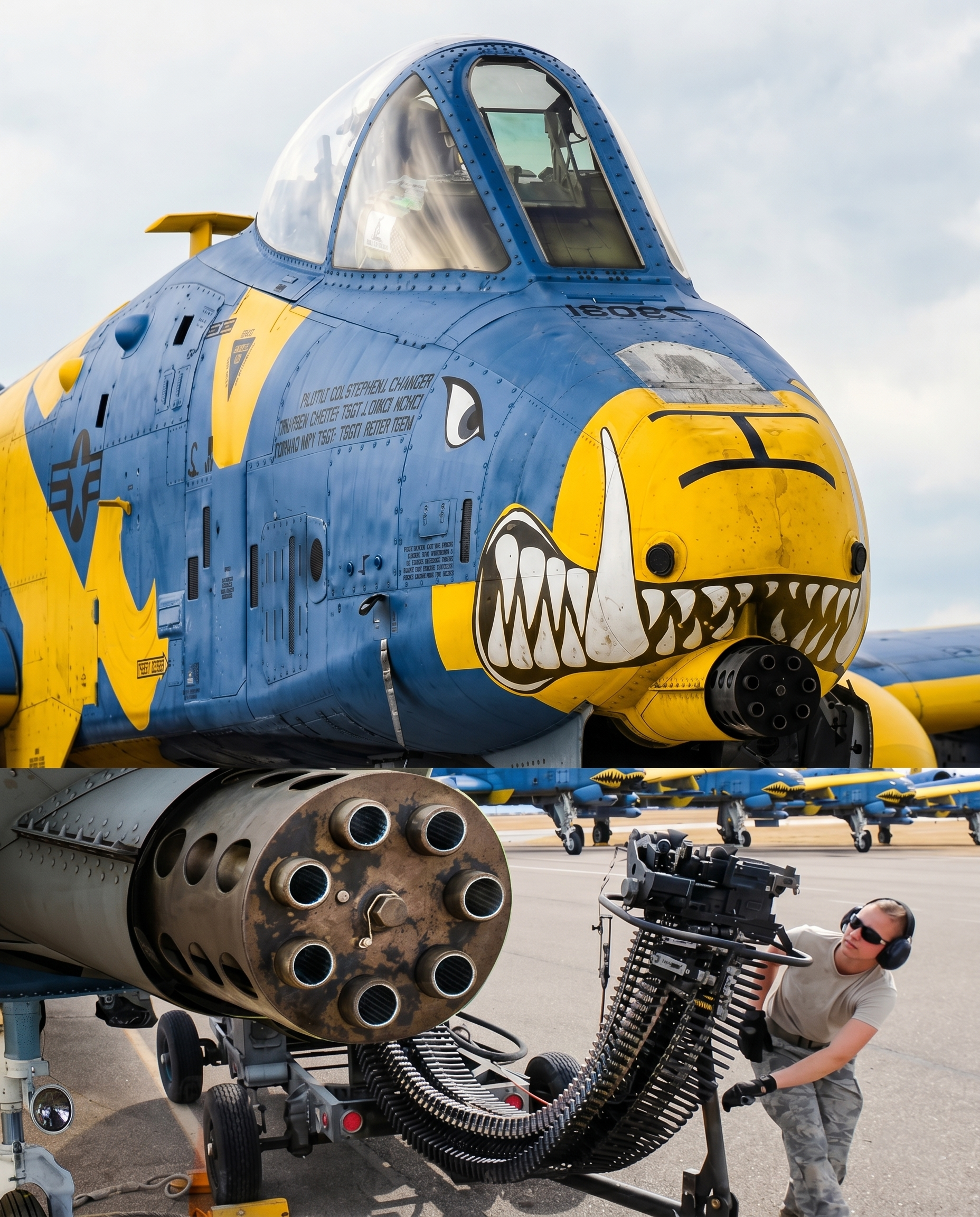
Engineers essentially built the entire aircraft around the monstrous GAU-8/A Avenger, a seven-barrel 30mm Gatling gun capable of firing nearly 3,900 rounds per minute.
The weapon was specifically engineered to rip apart Soviet tanks during the Cold War. Each shell is capable of tearing through armor with devastating force.
Pilots often describe firing the cannon as an experience unlike anything else in aviation.
“It’s like driving over speed bumps,” said U.S. Air Force Capt. Alex Boules. “Like Chewbacca with chainsaws.”
When the trigger is pulled, the entire aircraft shakes violently as streams of depleted uranium rounds erupt from the nose in a terrifying storm of firepower.
This cannon became the soul of the Warthog — and the reason enemies learned to fear its approach.


Why the Warthog Is Called a “Flying Tank”
The nickname is not symbolic.
The A-10 is genuinely built to survive punishment that would destroy most aircraft.
Its cockpit sits inside a 1,200-pound titanium armored shell, often called the “bathtub,” designed to protect the pilot from anti-aircraft fire and battlefield shrapnel.
The aircraft can withstand direct hits from armor-piercing rounds up to 23mm.
Its fuel tanks are self-sealing.
Its flight systems are heavily redundant.
Even if hydraulic controls are destroyed in combat, the pilot can still fly the aircraft manually.
There are documented cases of A-10s returning to base with:
- Massive holes in their wings
- Missing hydraulic systems
- Damaged engines
- Destroyed stabilizers
- Severe structural damage
And yet they still brought their pilots home.
That toughness transformed the A-10 from a machine into a symbol of battlefield survival.
The Aircraft Soldiers Trust Most
The A-10’s greatest strength is not speed.
It is presence.
Unlike fast-moving fighters that streak across the sky for seconds, the Warthog can remain above troops for long periods, circling patiently while scanning the battlefield below.
This ability is called loiter time, and in close air support missions, it can mean the difference between life and death.
“Our job is to support the guys on the ground,” explained Colonel Dressel, an A-10 pilot who served in multiple combat operations including Operation Desert Storm and War in Afghanistan.
“Unlike other aircraft, that’s our main focus — providing close air support day after day, 24/7.”
For ground troops, hearing an A-10 overhead often brings immediate psychological relief.
One pilot described responding to a desperate radio call from troops pinned down under heavy fire.
“They tell you where the fire is coming from, and within seconds you are in there with your weapons systems.”
Then comes the unforgettable response over the radio:
“Hog good effect.”
Those three words became legendary among A-10 crews because they meant friendly forces had survived.


How the Vietnam War Changed American Air Power
The roots of the A-10 trace back to the painful lessons of the Vietnam War.
During Vietnam, the United States relied heavily on fast jet fighters for ground attack missions. But high-speed aircraft struggled to provide accurate support for troops fighting at low altitude in difficult terrain.
Older propeller-driven aircraft like the Douglas A-1 Skyraider proved surprisingly effective because they could fly slowly, remain over battlefields longer, and attack targets with precision.
The problem was survivability.
These older aircraft suffered heavily from enemy ground fire.
The U.S. Air Force realized it needed a completely new type of aircraft:
- Slow enough to identify targets
- Tough enough to survive direct hits
- Powerful enough to destroy armored vehicles
- Cheap enough to operate continuously
This led to the creation of the A-X Program in the late 1960s — the project that eventually produced the A-10 Thunderbolt II.


Creating the Warthog
In 1972, the experimental YA-10 prototype took its first flight.
The aircraft looked unusual from the beginning:
- Straight wings for low-speed maneuverability
- Engines mounted high to reduce heat signatures
- Wide landing gear for rough airfields
- Massive cannon dominating the nose
It was not elegant.
It was lethal.
The U.S. Air Force officially selected the design in 1973, and full production began soon afterward.
By March 1976, the A-10 officially entered operational service.
Its mission was clear:
Protect ground troops at all costs.


Desert Storm: The Warthog Proves Itself
If there were ever doubts about the A-10’s value, the Gulf War erased them.
During Operation Desert Storm, A-10s became some of the most effective aircraft in the entire coalition campaign.
The numbers were staggering:
- Over 8,100 combat sorties
- Nearly 90% of AGM-65 Maverick missile launches
- Mission-capable rate above 95%
The aircraft devastated Iraqi armor columns, artillery positions, radar systems, and troop concentrations.
Its ability to fly low and absorb damage made it uniquely suited for the battlefield environment.
Many historians consider the A-10 one of the defining aircraft of Desert Storm.


The Brotherhood Behind the Aircraft
Ask A-10 pilots what makes the Warthog special, and many will give the same answer:
The people.
Lt. Col. Timothy “Scream” Mitchell, who flew the aircraft for nearly two decades, explained:
“People always get enamored about the aircraft. But the number one thing is the community dedicated to it.”
That bond extends beyond pilots.
Maintainers, weapons crews, rescue personnel, and mechanics all contribute to the aircraft’s success.
Airman 1st Class Brenna Velasco, responsible for loading munitions onto A-10s, once described the pride of seeing her work directly protect troops in combat.
“A lot of people don’t see what gets done over here,” she said. “But I get to see it every day.”
The A-10 community became more than a military unit.
It became a family united by one mission:
Protect those fighting on the ground.


By the Numbers: The Warthog’s Raw Power
The A-10 remains one of the most specialized combat aircraft ever built.
Key Specifications
- Primary Role: Close Air Support
- Manufacturer: Fairchild Republic
- Engines: Two General Electric TF34 turbofans
- Top Speed: 420 mph
- Combat Range: 800 miles
- Maximum Takeoff Weight: 51,000 pounds
- Crew: One pilot
- Main Weapon: GAU-8/A 30mm Avenger cannon
- Payload: Up to 16,000 pounds of ordnance
The aircraft can carry:
- AGM-65 Maverick missiles
- Laser-guided bombs
- Rockets
- Cluster munitions
- AIM-9 Sidewinder air-to-air missiles
- Electronic warfare countermeasures
Even decades after entering service, the Warthog remains one of the most feared close-support aircraft ever created.


Why the A-10 Still Matters
Modern warfare increasingly focuses on stealth, drones, and long-range precision strikes.
Yet the A-10 continues to survive retirement debates year after year.
Why?
Because few aircraft can do what it does.
The Warthog was designed around a simple military truth:
When soldiers are under fire, they need immediate, accurate, relentless support.
The A-10 delivers exactly that.
It is not glamorous.
It is not futuristic.
But for generations of troops who heard the roar of its engines overhead in their darkest moments, the A-10 Thunderbolt II has been something far more important: