PART 1: THE MOMENT JAMIE STOPPED CALLING HIM DAD
The preschool bus was climbing through Pennsylvania’s Laurel Highlands when my five-year-old son, Jamie, pressed his face against the window and began counting barns.
He wore a navy blazer that was slightly too large for him.
“Dad picked this one,” he told me proudly. “He’ll notice me as soon as he gets to the farm.”
I smiled because I could not bring myself to tell him the truth.
You May Also Like

His father, Bradley, had never seen the blazer. An assistant at his architecture firm had ordered it after I reminded her that Jamie needed something formal for his kindergarten celebration.
Bradley had forgotten that event, just as he had forgotten the parent conference, the winter concert and almost every ordinary moment that mattered to our son.
From the outside, our life looked perfect.
Bradley was a successful architect, and we lived in a beautiful house outside Pittsburgh. After Jamie was born, he persuaded me to leave my museum job.
“You don’t need to work,” he said. “I’ll take care of everything.”
For years, I confused financial comfort with safety. I did not yet understand that control could look remarkably similar to care.
Three months before the school trip, Bradley’s former girlfriend, Caroline, returned to Pennsylvania with her four-year-old daughter, Ava.
He said Caroline needed help after a painful separation. He found her an apartment, introduced her to business contacts and arranged for Ava to attend Jamie’s private school.
Soon, he began missing family dinners because Caroline needed help assembling furniture. He left Jamie’s school performance early when Ava developed a fever.
On the morning of the trip, Bradley sent me one message.
“Keep an eye on Ava. Caroline is worried.”
He did not mention Jamie.
The road was wet from an early rain when a vehicle stopped suddenly in front of our bus.
The driver swerved.
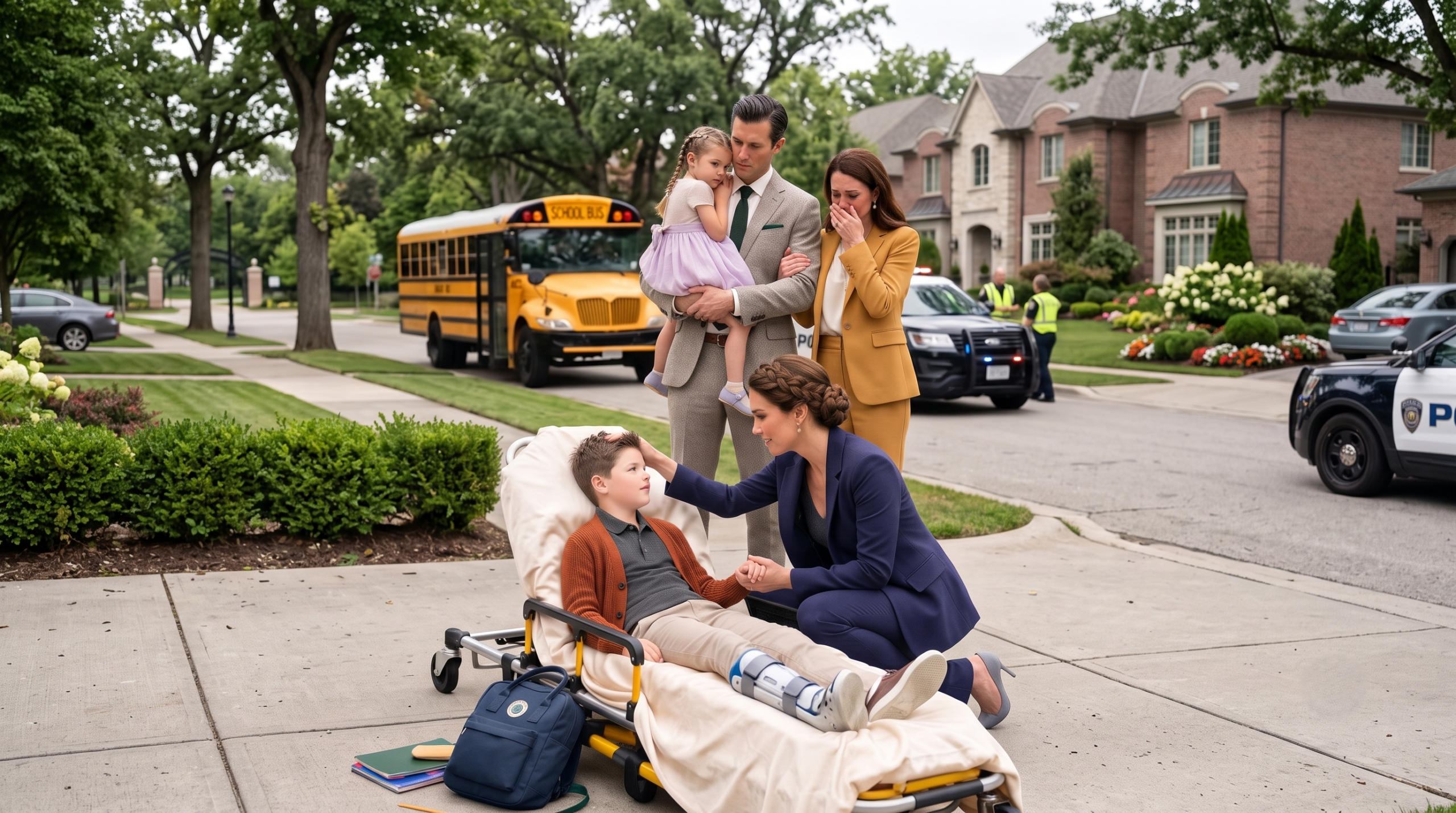
The bus struck a roadside barrier, and the world tilted.
Lunch boxes flew beneath the seats. Windows cracked. Children began crying for their parents.
I wrapped my arms around Jamie.
Above us, part of the storage rack had broken loose and was hanging dangerously from the ceiling.
Then Bradley appeared at the emergency exit.
He had been driving to the farm after a presentation and saw the damaged bus from the road.
For one hopeful second, I believed he had come for his son.
Jamie reached for him and grabbed his jacket.
“Dad, please stay. That thing is falling.”
Bradley looked at him.
Then he heard Ava calling from several rows away.
She was frightened, but she was already safe in a teacher’s arms.
Bradley gently removed Jamie’s fingers from his sleeve and hurried towards her.
“Dad?” Jamie called again.
The storage rack shifted.
I pushed Jamie towards the aisle, but a heavy supply crate dropped and pinned his lower leg against the seat.
As teachers moved the other children outside, Jamie stared towards the exit where Bradley had carried Ava away.
He did not scream.
His eyes simply filled with tears.
“Mom,” he whispered, “I don’t think we need Dad anymore.”
At the hospital, doctors prepared Jamie for surgery.
Bradley arrived with Caroline and Ava just before an orderly came to take Jamie upstairs.
Caroline rushed towards him.
“Is Ava all right?”
Bradley wrapped his arms around her.
“She’s fine. I made sure I got her out first.”
Jamie heard every word.
As his bed disappeared through the double doors, Bradley remained behind comforting another woman.
I did not confront him.
I took out my phone and called a divorce lawyer.
PART 2: THE QUIET ESCAPE
Jamie’s surgery lasted nearly four hours.
The doctors said his leg would require months of rehabilitation, but they were hopeful he would recover.
Bradley appeared only after the operation.
“I’ve contacted a famous orthopaedic specialist,” he announced. “Whatever this costs, I’ll pay for it.”
“Thank you, Mr Mercer,” I replied.
He stared at me.
“What did you call me?”
“Mr Mercer.”
Our arguments had always followed the same pattern. Bradley disappointed us, I became upset, and he accused me of being emotional. By the next evening, I would be cooking his favourite dinner, desperate to restore peace.
This time, I stopped trying to convince him to care.
My calm frightened him more than anger ever had.
The following morning, he leaned over Jamie’s hospital bed.
“Hey, buddy. Dad came to see you.”
Jamie looked at him briefly.
“Thank you, Mr Mercer.”
Bradley tried to explain that everything had happened quickly and that Ava was younger.
“You thought she mattered more,” Jamie said. “My leg hurts. I want to sleep.”
That afternoon, Caroline called because Ava was having trouble resting.
Bradley left the hospital and did not return for three days.
When Jamie was discharged, I brought him home in a wheelchair.
Two unfamiliar coats hung in the entrance hall.
Caroline and Ava had moved into our guest rooms.
Jamie’s books had been packed into boxes, and his playroom was filled with Ava’s dolls. Bradley had even replaced the blue curtains with pink ones.
“It’s temporary,” he said. “They need somewhere stable.”
Then he gave Jamie’s piano lesson to Ava.
“You can’t sit comfortably at the piano right now,” he explained. “Try to be generous. Ava doesn’t have a father.”
Jamie looked at him with a stillness no five-year-old should possess.
“She can have my lesson,” he said. “She can have my toys too.”
Later, I asked why he had given away things he loved.
“If she has everything,” Jamie whispered, “maybe they won’t come into my room.”
That night, while he packed his favourite books, I opened a folder hidden inside my desk.
It contained divorce papers, a temporary custody request, medical records, documents for an accessible school and a lease for a furnished apartment in Charleston.
Bradley believed I had no money of my own.
He was wrong.
My grandmother had left me two small commercial properties. I had sold them early in our marriage and invested the money under my maiden name. The investments had grown enough to support Jamie and me without Bradley.
My lawyer had also collected statements from teachers, doctors and relatives showing that Bradley rarely attended appointments or school events.
Several parents had recorded the bus evacuation, and the transportation company had its own camera footage.
I was not disappearing illegally with our child.
I was leaving through a lawful exit I had quietly prepared.
The night before our departure was Jamie’s sixth birthday.
Bradley had forgotten.
While he ate downstairs with Caroline and Ava, Jamie and I shared a small chocolate cake beside his bed.
“Do you think Dad will come upstairs?” he asked.
I refused to lie.
“I don’t know.”
We waited until nine.
Then Jamie blew out the candle without making a wish.
“I already made one in the hospital,” he explained. “I wished for a quiet home with you.”
He handed me a drawing of two figures holding hands outside a small house beside the ocean.
There was no father in the picture.
Before sunrise, I packed our clothes and left my jewellery behind.
I placed my wedding ring beside the house keys.
As I carried Jamie to the car, he asked, “Are we going to be happy now?”
“We’re going to learn how,” I promised.
He did not look back.
PART 3: WHAT JUSTICE COULD NOT REPAIR
Bradley returned home that afternoon.
He found my keys, my ring and Jamie’s empty bedroom.
In the dining room, the forgotten birthday cake had begun to soften. The icing still read:
**Happy Sixth Birthday, Jamie.**
Beside it was Jamie’s drawing.
When Bradley contacted his lawyer, he learned that I had filed for divorce and primary custody.
I wanted no share of his company, property or personal accounts.
“She has no income,” Bradley insisted. “She can’t afford to leave.”
His lawyer informed him that I had substantial investments and had already paid a year’s rent in Charleston, along with Jamie’s school fees.
For years, Bradley had treated money like a locked gate.
Only then did he understand that his wealth had never trapped me.
I had stayed because I kept hoping he would eventually choose his own family.
The custody battle lasted seven months.
Bradley’s mother accused me of turning Jamie against him for money. My lawyer responded with my financial records and written refusal of Bradley’s assets.
Then she played the bus footage.
The courtroom watched Jamie clutch his father’s sleeve and beg him to stay. They saw Bradley pull away and run towards Ava, who was already secure in a teacher’s arms.
The judge paused the recording.
“After confirming that the other child was safe, why didn’t you return to your son?”
Bradley lowered his eyes.
He had no answer.
The school administrator confirmed that I had attended every meeting, recital and emergency alone. She admitted that many parents had assumed Bradley was Ava’s father because he appeared so often beside Caroline.
The court ruled that Jamie would remain with me.
Bradley received supervised visits that could increase only when Jamie and his counsellor believed he was ready.
I did not celebrate.
A court could establish boundaries, but it could not rebuild trust.
At his first visit, Bradley arrived without an assistant, an expensive present or a rehearsed speech.
Jamie was using two small crutches.
“Hello, Jamie,” Bradley said.
Jamie held my hand tightly.
“Hello, Mr Mercer.”
Bradley nodded.
“I understand why you don’t want to call me Dad. I failed you that day, and I failed you many times before it. I’m sorry.”
“Why did you choose her when I asked you to stay?” Jamie asked.
Bradley remained silent for a long time.
“Because I cared too much about impressing Caroline,” he finally admitted. “I wanted her to see me as a hero, and I stopped seeing what my own son needed. There is no excuse.”
“I don’t want to go anywhere with you yet,” Jamie said.
“All right,” Bradley replied. “I’ll wait. You don’t owe me forgiveness.”
It was the first truly fatherly decision he had made in years.
He respected his son’s refusal.
Over the following months, Bradley attended counselling and rehabilitation appointments. Some days, Jamie agreed to speak with him. Other days, he refused, and Bradley slowly learned not to argue.
A year after the accident, Jamie sat at a piano again.
That evening, we carried his astronomy book onto our balcony. The Atlantic breeze moved the blue curtains he had chosen for our new apartment.
“Do people ever stop feeling lonely?” he asked.
“Yes,” I told him. “Sometimes they find people who stay. Sometimes they create a safe home for themselves.”
He rested his head against my shoulder.
“I have you.”
“And I have you.”
I never taught Jamie to hate his father.
I taught him something more important:
Sharing blood, a surname or a history does not give anyone the right to make us feel replaceable.
A true family is not defined by promises, appearances or money.
It is created by the people who remain present, respect our boundaries and choose us when we need them most.