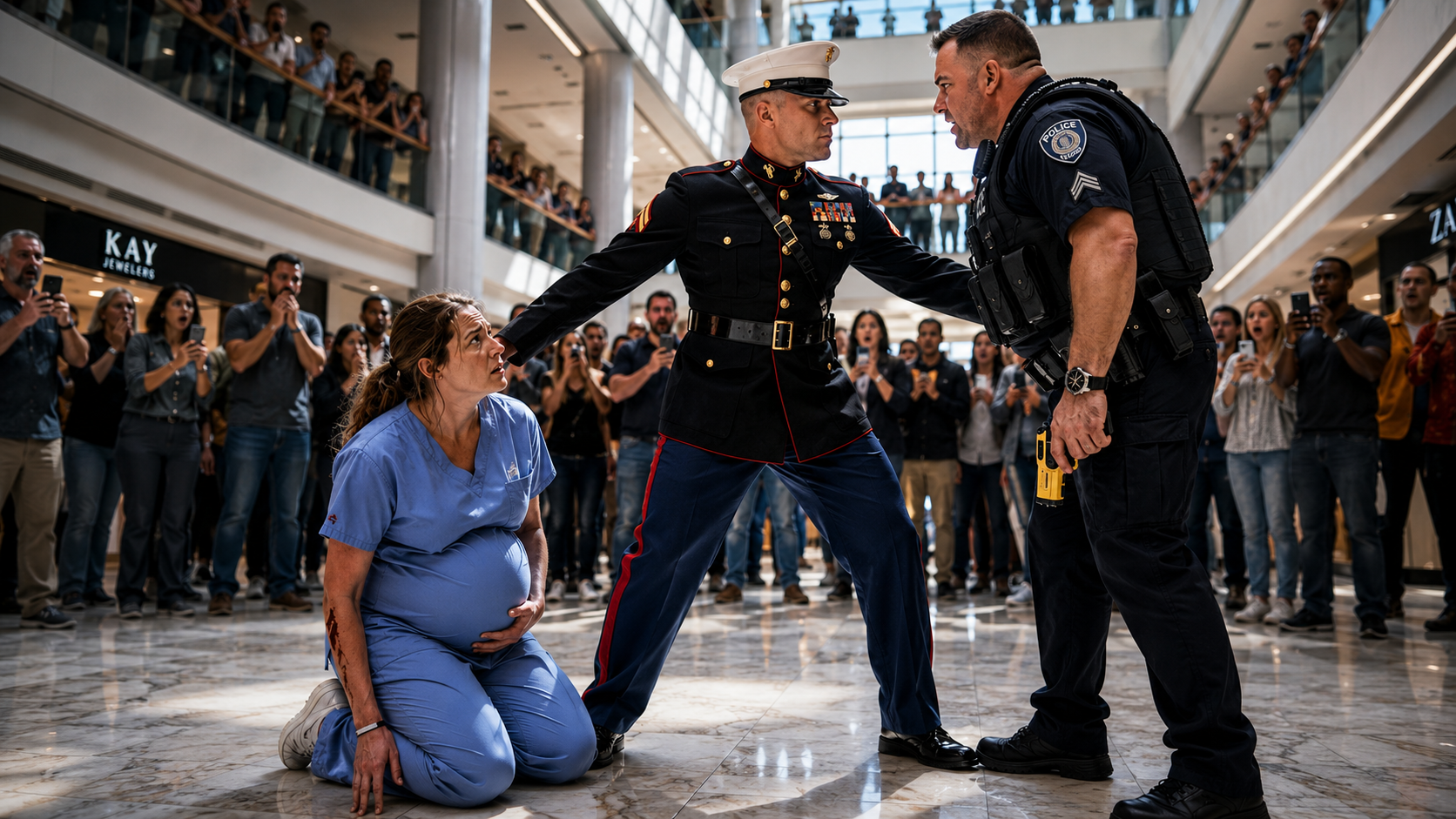
A Cop Thought She Was a Helpless Pregnant Nurse — Then a Marine Captain Saluted Her in the Middle of the Mall
An Officer Pointed a Taser at an 8-Month Pregnant Nurse Using Her Inhaler — But He Didn’t Know She Had Already Set a Trap for His Corrupt Unit
“Drop the device or I’ll put you on the ground!”
The officer’s shout echoed through the crowded mall.
You May Also Like
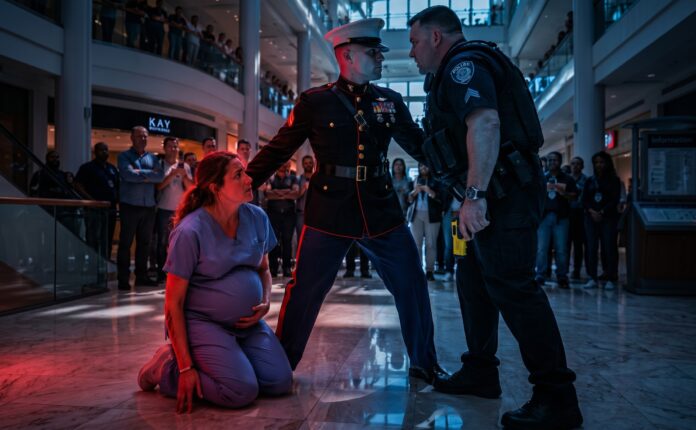


I was eight months pregnant, wearing nurse scrubs, and struggling to breathe through a sudden asthma attack.
The “device” in my hand was not a weapon.
It was my inhaler.
I gasped, “Please… I can’t breathe.”
But Officer Trent Holloway stepped closer with his taser raised and called me a junkie in front of everyone.
Then he forced me to my knees.
My belly hit my arm as I tried to protect my unborn baby.
People started filming.
No one stepped in.
Until one voice cut through the chaos.
“Officer, stand down immediately!”
A Marine captain in full dress uniform pushed through the crowd, stopped in front of me, and delivered a sharp salute while I was still on the floor.
His voice shook with fury.
“Ma’am, permission to neutralize this threat?”
The officer froze.
Because the man saluting me was not a stranger.
He was one of my former recruits.
And he knew exactly who I was.
But what the officer didn’t know was worse.
I wasn’t just a pregnant nurse having an asthma attack.
I was the whistleblower carrying evidence that could destroy his entire corrupt department.
The Story
“Drop the device or I will put you on the ground!”
The command shattered the morning quiet of Cedar Falls Shopping Center.
But it barely registered over the roaring panic in my lungs.
My name is Maya Collins.
For six years, I was a Marine Corps drill instructor.
I trained young men and women who arrived soft, arrogant, scared, and unfinished. I broke civilian habits out of them and rebuilt them into Marines.
I had stared down recruits twice my size.
I had carried wounded men through training drills.
I had shouted over storms, gunfire, panic, and pain.
But that morning, I could barely whisper.
Because I was eight months pregnant, wearing blue trauma nurse scrubs, and my lungs were closing.
The sudden temperature shift from the freezing parking lot to the heated mall had triggered a massive asthma flare-up.
My chest felt like someone had wrapped steel bands around it and kept tightening.
I could hear my own breathing.
Thin.
Ragged.
Wrong.
I reached into my bag for my Albuterol inhaler.
One puff.
That was all I needed.
One puff and I could breathe again.
But before I could lift it to my mouth, Officer Trent Holloway stepped directly in front of me.
His hand went to his taser.
His eyes locked on the little blue inhaler like he had just discovered contraband.
“I said drop it!”
People turned.
A woman holding a shopping bag stopped near the fountain.
A teenage boy lowered his pretzel.
A mother pulled her child closer.
I tried to speak.
“It’s… an inhaler…”
The words scraped my throat.
Holloway stepped closer.
His face held that dangerous mixture I had seen before in bad officers, bad soldiers, and bad men.
Power without discipline.
Authority without judgment.
Fear disguised as command.
“Drop the device!”
I looked at his taser.
Then at my belly.
Every survival instinct I had screamed at me to stay upright, stay calm, stay in control.
But another part of me knew the truth.
If he lunged at me…
If I fell hard…
If he fired that taser and I hit the tile…
My baby could pay the price for his stupidity.
So I made a decision that went against every military reflex in my body.
I lowered myself carefully to the freezing mall floor.
One knee.
Then the other.
My left arm wrapped protectively around my heavy stomach.
My right hand still gripped the inhaler.
“I can’t…” I gasped. “Breathe.”
Holloway stepped over me.
His boot landed inches from my face.
“Tell it to the judge, junkie. Hands behind your back.”
The word hit me harder than the floor.
Junkie.
I was a trauma nurse.
A veteran.
A pregnant woman in medical distress.
And he reduced me to something dirty because it made his cruelty easier.
Phones came out.
A crowd gathered.
I heard whispers.
“She’s pregnant.”
“That’s an inhaler.”
“Why is he doing that?”
“Is anyone calling security?”
But no one moved.
That is the terrible truth about public humiliation.
A crowd can surround you and still leave you completely alone.
Holloway bent down and grabbed for my arm.
Then a sharp voice cut through the atrium.
“Officer, stand down immediately!”
The voice was not loud because it needed attention.
It was loud because it was used to being obeyed.
The crowd split.
A man in a pristine Marine Corps dress uniform pushed through.
Tall.
Broad-shouldered.
Jaw tight.
Boots polished.
Ribbons perfectly aligned.
For a second, my oxygen-starved brain struggled to place him.
Then he came into focus.
Captain Evan Mercer.
Years earlier, he had been Recruit Mercer.
A reckless, angry nineteen-year-old who thought discipline was punishment and authority was something to challenge.
I had turned him into a Marine.
Now he stood between me and Holloway.
Then, in front of the entire mall, Captain Mercer brought his boots together and saluted me.
A rigid, trembling salute.
Not to the pregnant nurse on the floor.
To the Staff Sergeant he remembered.
To the woman who once stood over him in the rain and told him, “Pain is temporary. Character is what you do while it hurts.”
Holloway froze.
“Captain?”
Mercer’s eyes locked onto mine.
They were burning.
Not with panic.
With controlled fury.
“Ma’am,” he said, voice tight, “permission to neutralize this threat?”
My lungs screamed.
I lifted the inhaler.
“Not… unless… he makes you.”
Holloway’s face twisted.
“You two know each other?”
Mercer did not turn.
“That woman is a decorated Marine veteran, a trauma nurse, and an eight-month pregnant citizen in respiratory distress. Lower your weapon.”
Holloway’s hand tightened on the taser.
“Back off, military.”
Mercer stepped wider, placing his body fully between us.
“Lower. Your. Weapon.”
The atrium went silent.
Even the music from the nearby clothing store seemed to fade.
Holloway raised the taser toward Mercer’s chest.
The crowd gasped.
Someone whispered, “Oh my God.”
I pressed the inhaler to my lips with shaking hands and took one desperate puff.
Then another.
The medication hit my lungs like water on fire.
Slowly, painfully, the airways began to open.
My vision cleared around the edges.
And that was when I noticed it.
Holloway’s body camera was dark.
No green light.
No recording indicator.
Nothing.
A chill colder than the asthma attack moved through me.
This was not random.
Two weeks earlier, at St. Anne’s Medical Center, I had filed a whistleblower report.
High-grade narcotics were disappearing from the trauma unit.
Not low-level mistakes.
Not missing pills.
Systematic diversion.
Fentanyl.
Morphine.
Ketamine.
The digital signatures on the stolen pharmacy logs pointed toward a regular transport officer who frequently brought suspects into our emergency department.
Officer Trent Holloway.
The department promised an internal investigation.
But I knew better than to trust a system when the suspect wore its badge.
That was why I had copied the unredacted logs onto a flash drive.
That was why I carried it everywhere.
That was why I was at the mall that morning.
I was not shopping.
I was meeting Captain Mercer, who now worked with a military criminal investigative unit attached to a federal task force.
He was supposed to escort me to federal prosecutors.
But Holloway had found me first.
And he was not after my inhaler.
He was after my bag.
“I said drop the bag!” Holloway shouted suddenly.
There it was.
Not the device.
The bag.
He lunged forward, pushing past Mercer’s shoulder, reaching for the reusable grocery bag beside my knee.
“Get your hands off her!” Mercer roared.
He stepped into Holloway’s path and used a defensive blocking maneuver to redirect the officer’s arm.
Holloway stumbled.
For one second, panic took over his face.
Then he pulled the trigger.
The taser popped.
The wires shot out.
But they did not hit Mercer.
The electrified probes struck the tile inches from my knee.
Blue sparks snapped across the floor.
The crowd erupted.
People screamed.
A child cried.
Someone yelled, “He fired at her!”
Mercer turned his head toward me.
“Staff Sergeant!”
“I’m okay,” I gasped.
But I was not okay.
My lungs were opening, yes.
But my baby rolled hard beneath my ribs, as if startled by the electricity, the noise, the fear.
I placed both hands over my stomach.
“Stay with me, little one,” I whispered. “Stay with me.”
Then heavy footsteps thundered across the atrium.
Backup.
For one hopeful second, I thought help had arrived.
I was wrong.
Three Cedar Falls police officers rushed in with weapons drawn.
Leading them was Sergeant Nolan Vance.
Holloway’s direct supervisor.
A man I had seen whispering with him in the hospital corridors twice.
My stomach dropped.
Vance’s eyes moved from me to Mercer to the bag.
Not to my face.
Not to my belly.
To the bag.
“Hands in the air!” Vance shouted. “All of you!”
Mercer lifted his hands slowly.
“I am Captain Evan Mercer, United States Marine Corps. This woman is in medical distress.”
Vance pointed his weapon directly at Mercer.
“Shut your mouth.”
Another officer grabbed Mercer’s arms and cuffed him.
Mercer did not resist.
A physical fight against armed officers would only endanger me and my baby.
Vance stepped toward me.
His boots stopped beside my bag.
Then he kicked it away from my reach.
“Nurse Collins,” he said, his voice low and ugly, “you’re being detained for assaulting an officer and possession of suspected illegal substances.”
I looked up at him.
“You know what’s in that bag.”
His eyes flickered.
Only for a second.
But I saw it.
“I know enough,” he said.
Holloway was breathing hard behind him.
“She reached for a device. She resisted.”
The crowd shouted.
“No, she didn’t!”
“She couldn’t breathe!”
“She’s pregnant!”
“That was an inhaler!”
Vance turned toward them.
“Anyone interfering will be arrested.”
Several people stepped back.
But their phones stayed up.
That mattered.
It mattered more than Vance realized.
He reached down and grabbed my arm.
His fingers dug into my skin.
“Stand up, nurse. You’re coming with us.”
I looked at Mercer.
He was cuffed, but his face had gone strangely calm.
That battlefield calm.
The kind that appears when a Marine knows the trap has finally closed.
“Sergeant Vance!” Mercer’s voice boomed across the atrium. “Look up at the balcony.”
Vance froze.
Mercer’s voice carried like command thunder.
“You are completely surrounded.”
Slowly, Vance looked up.
So did Holloway.
So did the crowd.
Standing along the second-floor railing were four plainclothes federal agents.
Badges visible.
Weapons drawn.
Behind them stood the Cedar Falls Police Chief.
Beside him were State Police troopers.
The crowd gasped.
Holloway’s face drained of color.
Vance whispered, “No.”
Captain Mercer smiled without warmth.
“Yes.”
The police chief’s voice thundered from the balcony.
“Drop your weapons! Now!”
The two officers who had arrived with Vance immediately lowered their weapons and stepped back, realizing they had been used as pawns.
Vance and Holloway looked around wildly.
For the first time, their badges could not protect them.
State troopers flooded the atrium.
Holloway dropped his taser.
Vance raised his hands, hatred burning in his eyes.
A trooper uncuffed Mercer.
Then another officer cuffed Vance.
The crowd erupted into cheers.
Phones kept recording.
The truth had gone live before corruption could drag it into a blind spot.
The police chief rushed to my side.
His face was filled with shame.
“Nurse Collins, I am deeply sorry.”
I looked at him while still sitting on the tile.
“You should be.”
He swallowed.
“Yes. I should.”
Mercer knelt beside me.
His fierce expression softened into the deep respect of a soldier looking at the person who once trained him not to break.
He picked up my grocery bag carefully.
Then held it out.
“The drive is safe, Staff Sergeant.”
I took it.
My hand shook.
He offered his other hand.
“Are you alright?”
I took one deep breath.
Then another.
My lungs finally opened fully.
I placed my palm on my belly.
“We’re going to be fine, Captain.”
He smiled slightly.
“This little one is tough.”
I nodded.
“Runs in the family.”
The ambulance took me to St. Anne’s.
Not the local holding cell Vance had wanted.
Not the back room where evidence disappeared.
The hospital.
The place where the whole nightmare had started.
Mercer rode with me.
He sat across from the stretcher, still in dress blues, jaw clenched, one hand resting on my bag like he would break anyone who tried to touch it.
The paramedic checked my oxygen.
“Breathing is improving.”
“And the baby?” I asked.
“We’ll monitor at the hospital.”
I closed my eyes.
Mercer leaned forward.
“Ma’am.”
I opened them.
“You did exactly what you taught us,” he said.
I let out a tired laugh.
“I taught you to get forced to your knees in a mall?”
“No,” he said. “You taught us that surviving the first attack matters more than looking strong during it.”
I swallowed hard.
That hit deeper than I expected.
For years, I had trained Marines to endure.
But nothing had felt as humiliating as kneeling on cold mall tile while an incompetent man called me a junkie.
“I wanted to break his wrist,” I admitted.
Mercer’s mouth twitched.
“I know.”
“I couldn’t.”
“You protected your child.”
I looked down at my belly.
“Yes.”
“That was not weakness.”
I looked at him.
“Say that again.”
He did.
Slowly.
Firmly.
“That was not weakness.”
At the hospital, everything moved fast.
Doctors checked the baby’s heartbeat.
Strong.
Steady.
Angry, apparently.
The OB smiled after a long scan.
“Your daughter looks extremely offended, but healthy.”
I laughed and cried at the same time.
“Daughter?”
The room went quiet.
Mercer stood near the door.
The doctor froze.
“You didn’t know?”
I shook my head.
My husband had died two years earlier in a training accident.
I had gone through pregnancy alone, choosing not to know the baby’s sex because I wanted one surprise untouched by grief.
The doctor’s eyes softened.
“I’m sorry. I thought—”
“No,” I whispered, touching the screen. “It’s okay.”
A daughter.
My daughter.
Strong heartbeat.
Tiny fists.
Kicking like she had a complaint to file.
Mercer looked away, giving me privacy.
But I saw him wipe one eye.
I smiled through tears.
“Captain.”
He straightened immediately.
“Yes, ma’am.”
“Don’t tell your Marines you cried in an ultrasound room.”
“No, ma’am.”
The OB smiled.
“He absolutely will.”
Mercer cleared his throat.
“Only as a leadership lesson.”
For the first time that day, laughter replaced fear.
But it did not last long.
Because outside that room, the investigation was exploding.
By evening, Cedar Falls had become national news.
The video from the mall was everywhere.
Officer threatens pregnant nurse over inhaler.
Marine captain salutes former drill instructor.
Police supervisor arrested in corruption sting.
Pregnant whistleblower exposes narcotics pipeline.
But headlines only showed the surface.
The truth was uglier.
The narcotics theft at St. Anne’s had been running for nearly two years.
Not by one officer.
By a ring.
Hospital staff.
Transport officers.
A pharmacy technician.
Two local police supervisors.
A private security contractor.
Emergency narcotics were being diverted before audits, replaced with diluted medication, and sold through a network connected to Vance and Holloway.
Patients in pain had been underdosed.
Families had been lied to.
Doctors had been blamed.
Nurses had been pressured into silence.
When I first noticed the discrepancies, people told me to be careful.
Then they told me I was hormonal.
Then dramatic.
Then paranoid.
One hospital administrator, Martin Keller, had pulled me into his office after my report.
“Maya,” he said, “you’re pregnant. This is not the season to pick fights.”
I sat across from him in my scrubs.
“Patients are being hurt.”
“We don’t know that.”
“I know that.”
He leaned back.
“You are seeing patterns because you are under stress.”
I stared at him.
“I spent six years training recruits. I know the difference between stress and evidence.”
His smile hardened.
“Evidence can be misunderstood.”
“So can silence.”
That was the day I copied the logs.
That was the day I called Mercer.
Now Keller was sweating in an interview room while federal agents asked why my whistleblower report had been forwarded to Sergeant Vance within forty-eight hours.
The answer came from email records.
Keller had leaked it.
In exchange for monthly payments routed through a consulting company tied to Vance.
When Mercer told me, I was sitting in a hospital bed drinking warm broth and trying not to fall asleep.
I looked at him.
“Keller?”
“Yes.”
“He told me I was hormonal.”
Mercer’s jaw tightened.
“Men with weak arguments often blame women’s bodies.”
I smiled faintly.
“Careful, Captain. That sounded wise.”
“You trained me well.”
“Don’t flatter me. I’m armed with hospital pudding.”
He looked at the pudding cup.
“That is not regulation.”
“No, but it’s lethal.”
He almost smiled.
Then his phone buzzed.
His face changed.
“What?”
He looked at me carefully.
“They found a storage unit.”
My hand tightened around the blanket.
“And?”
“Medication. Cash. Fake transfer logs. Patient wristbands. And a list.”
“What list?”
His voice lowered.
“Names of staff who filed complaints.”
I already knew before he said it.
“My name is on it.”
“Yes.”
“What does that mean?”
Mercer looked toward the hallway.
“It means Holloway was not improvising. They had planned to take you today.”
My daughter kicked hard beneath my ribs.
I whispered, “They picked the wrong day.”
Mercer’s eyes met mine.
“No, ma’am. They picked the wrong woman.”
The next morning, Police Chief Aaron Bell came to my hospital room.
He looked like a man who had not slept.
His uniform was crisp, but his face carried the weight of a department cracking open.
He removed his hat before entering.
“Staff Sergeant Collins.”
“It’s Maya now.”
He nodded.
“Nurse Collins.”
“That works.”
He stood at the foot of the bed.
“I owe you more than an apology.”
“Yes.”
He seemed surprised by the bluntness.
Then nodded again.
“Yes. You do.”
I appreciated that.
Excuses would have been easier.
He did not offer them.
“I should have found this inside my department earlier,” he said.
“You should have.”
“I trusted Vance.”
“That was your mistake.”
He inhaled slowly.
“Yes.”
I looked at him.
“Trust is not supervision, Chief.”
His eyes held mine.
“You’re right.”
Mercer stood near the window, arms crossed.
The chief glanced at him, then back to me.
“We have placed Vance and Holloway on administrative termination pending criminal proceedings. The state is taking over internal review. Federal prosecutors are leading the narcotics case.”
“And the officers who came with Vance?”
“They claim they believed they were responding to an assault on an officer.”
“Did they check my inhaler?”
“No.”
“Did they check my medical distress?”
“No.”
“Did they check Holloway’s body camera?”
The chief’s jaw tightened.
“No.”
I nodded.
“Then they need training before they need forgiveness.”
Chief Bell bowed his head slightly.
“I would like you to help build that training.”
Mercer’s eyes moved to me.
I almost laughed.
“I’m eight months pregnant.”
“Yes.”
“I was nearly arrested for using an inhaler.”
“Yes.”
“And now you want me to train your officers?”
The chief did not flinch.
“When you are ready. Only if you choose. Paid. Public. With full authority to say no.”
I studied him.
That was the difference between apology and performance.
An apology tries to be forgiven.
Accountability asks what repair costs.
“I’ll think about it,” I said.
“Thank you.”
As he turned to leave, I said, “Chief.”
He stopped.
“If you ever call me brave in a press conference, make sure you also say your department failed.”
His face tightened with shame.
Then he nodded.
“I will.”
And to his credit, he did.
The trial came in two parts.
First, the assault and misconduct case against Holloway and Vance.
Then the federal narcotics conspiracy.
Holloway tried to save himself by claiming he mistook my inhaler for drug paraphernalia.
The prosecutor played the mall footage.
Me gasping.
Me saying, “It’s an inhaler.”
The crowd yelling, “She can’t breathe.”
Holloway shouting, “Drop the bag.”
Not the inhaler.
The bag.
Then the body camera report.
His camera had been turned off seven minutes before he approached me.
Not malfunctioning.
Turned off manually.
The prosecutor asked him why.
Holloway said, “Battery issue.”
The technician testified the battery was at eighty-two percent.
Holloway stopped looking confident.
Then came the recovered texts.
From Vance to Holloway:
She carries the drive. Don’t let her reach Mercer. Make it look like possession.
From Holloway:
What if crowd films?
Vance:
Take the bag first. We handle phones after.
The jury saw everything.
Holloway’s face as the taser fired.
Vance kicking my bag.
Mercer saluting me on the floor.
The chief and federal agents watching from the balcony.
During testimony, Holloway’s attorney tried to question my military background.
“Mrs. Collins—”
“Ms. Collins,” I corrected.
He frowned.
“Ms. Collins, as a former Marine Corps drill instructor, you are trained in intimidation, correct?”
I looked at him.
“I am trained in discipline.”
“Isn’t it true you could have used force against Officer Holloway?”
“Yes.”
The courtroom shifted.
He smiled like he had found something.
“And yet you claim you were afraid?”
I leaned toward the microphone.
“I was eight months pregnant and unable to breathe. I lowered myself to the floor because I knew if I defended myself physically, my daughter could be hurt. That is not fear. That is calculation.”
His smile faded.
The prosecutor asked one final question.
“Ms. Collins, why did you keep holding the inhaler?”
“Because breathing is not a crime.”
No one spoke after that.
Holloway was convicted of assault, official misconduct, obstruction, evidence tampering, and conspiracy.
Vance was convicted on additional charges tied to the narcotics operation.
The federal case took longer.
Keller pleaded guilty.
So did the pharmacy technician.
Two more officers went down.
By the end, the pipeline was fully exposed.
Licenses were revoked.
Pensions were lost.
Prison sentences followed.
But the biggest twist came during sentencing.
Vance asked to speak.
He stood in his orange jumpsuit and looked toward me.
“None of this would have happened if Nurse Collins had gone through proper channels instead of trying to play hero.”
I almost laughed.
The judge did not.
She leaned forward.
“Sergeant Vance, according to the evidence, Nurse Collins did go through proper channels. You corrupted them.”
Vance’s mouth closed.
The judge continued.
“She did not create your crimes by exposing them.”
That sentence became the headline the next morning.
Good.
It deserved to be.
My daughter was born six weeks later.
Not in chaos.
Not under mall lights.
Not with tasers or shouting or strangers filming.
In a quiet delivery room at St. Anne’s with my OB, two nurses I trusted, and Captain Mercer standing awkwardly near the door because he insisted he was “only there for security” but cried before the baby even arrived.
I named her Hope Elaine Collins.
Hope, because I needed the word to become real again.
Elaine, after my grandmother, who taught me to breathe through pain long before I knew asthma had a name.
When the nurse placed Hope on my chest, she screamed with the rage of a tiny commander who did not approve of being born into bright lights.
I laughed.
“Yeah,” I whispered. “I know. The world is a lot.”
Mercer stood frozen.
I looked at him.
“Captain.”
He snapped to attention.
“Yes, ma’am.”
“Come meet your little honorary recruit.”
His face softened.
He stepped closer.
Hope stopped crying for one second and opened one eye.
Mercer whispered, “She’s judging me.”
“She gets that from me.”
“She’s terrifying.”
“She gets that from me too.”
He smiled.
Then, very carefully, he saluted her.
The nurse burst out laughing.
“Is that normal?”
“No,” I said. “But neither are Marines.”
Recovery was not simple.
People wanted the story to end at victory.
The corrupt officers arrested.
The whistleblower safe.
The baby born healthy.
The Marine saluting.
A neat ending.
But real life does not close like a headline.
For months, I startled at loud voices.
My chest tightened every time I saw a police uniform.
I carried two inhalers, one in my bag and one in my pocket, because the idea of not being able to reach one made my hands shake.
At night, I replayed the mall floor.
The cold tile.
Holloway’s boot.
The taser sparks.
Vance’s fingers digging into my arm.
Then I would hear Hope stirring in her bassinet, and I would get up.
Feed her.
Hold her.
Breathe her in.
She became my reminder that survival is not always loud.
Sometimes it is a mother rocking a baby at 3 a.m., whispering, “We made it.”
Mercer visited often.
He brought groceries.
Fixed a broken cabinet.
Installed a better security system.
Once, he arrived with a stuffed bulldog wearing a tiny Marine cover.
I stared at it.
“No.”
He held it up.
“Ma’am, it’s morale equipment.”
“It is ridiculous.”
“Most morale equipment is.”
Hope loved it immediately.
I hated that he was right.
One evening, while Hope slept on my chest, Mercer stood in my kitchen washing bottles.
I watched him.
“You know you don’t owe me anything.”
He did not turn around.
“Yes, I do.”
“No, Captain. You don’t.”
He placed a bottle on the drying rack.
Then faced me.
“You saved my life before I knew what discipline was. I was reckless. Angry. Headed for a dishonorable discharge before I even earned the uniform. You saw something worth saving.”
I looked down at Hope.
“I yelled at you for six months.”
“Yes.”
“I made you do pushups in mud.”
“Yes.”
“I called you a walking safety violation.”
“You were correct.”
I smiled.
He did too.
Then his voice softened.
“That day in the mall, I saw you on the floor and realized something.”
“What?”
“Even the strongest people need someone to step in front of them sometimes.”
My throat tightened.
“I hated being on that floor.”
“I know.”
“I still hate it.”
“You should.”
“I keep thinking people saw me weak.”
Mercer shook his head.
“No. They saw exactly what you taught us.”
“What?”
“Control under threat.”
I closed my eyes.
Hope breathed softly against my chest.
For the first time, I began to believe him.
Three months after Hope was born, Chief Bell called.
“I need to ask you something,” he said.
“If it involves a press conference, no.”
“It involves training.”
I was quiet.
He continued.
“You said our officers needed training before forgiveness.”
“I remember.”
“I want you to design it.”
I looked at Hope, sleeping in her swing.
“Medical distress recognition. De-escalation. Disability response. Pregnancy risk. Body-camera accountability. Evidence handling. Whistleblower protection.”
“Yes,” he said.
“And I get full control?”
“Yes.”
“And if your officers hate it?”
“They probably will.”
“I like honest answers.”
He waited.
I thought about Holloway.
Vance.
The dark body camera.
The taser.
Then I thought about the two officers who had arrived with Vance, weapons drawn, believing the wrong voice because rank came before judgment.
Training could not fix every corrupt heart.
But it could remove excuses from the careless ones.
“I’ll do it,” I said.
The first class was ugly.
Thirty officers sat in a training room pretending not to resent me.
I walked in wearing a black blazer over a shirt that said:
Breathing Is Not A Crime
No one laughed.
Good.
I placed my inhaler on the front table.
Then a taser cartridge.
Then a baby monitor.
Then the flash drive.
“This,” I said, pointing to the inhaler, “was called a device.”
I pointed to the taser.
“This was called control.”
I pointed to the baby monitor.
“This recorded my daughter’s heartbeat after your department almost helped bury evidence.”
Then I pointed to the flash drive.
“And this is why truth survived.”
The room stayed silent.
I looked at them.
“Today, no one gets to hide behind ‘I didn’t know.’”
By the end of the training, one young officer raised his hand.
“Yes?” I said.
He swallowed.
“What should Holloway have done first?”
“Asked one question.”
“What question?”
I picked up the inhaler.
“Ma’am, do you need medical help?”
He wrote it down.
So did others.
That was a beginning.
Not enough.
But a beginning.
A year later, Cedar Falls Mall invited me back for a community safety event.
At first, I refused.
Then I thought about the floor.
The tile.
The crowd.
The place where humiliation had happened.
Some places stay dangerous in your mind until you walk back into them on purpose.
So I went.
Hope was on my hip, chewing the strap of my purse.
Mercer walked beside us in civilian clothes.
The atrium looked smaller than I remembered.
The fountain still ran.
The stores still played soft music.
People still carried shopping bags.
For them, the mall had moved on.
For me, the tile remembered.
I stopped at the exact place where I had been forced to my knees.
My breath caught.
Mercer noticed.
“You okay?”
“No.”
“Want to leave?”
I looked down at Hope.
She stared at the fountain like it was the greatest intelligence operation of her young life.
“No.”
I knelt.
Not because anyone forced me.
Because I chose to.
I placed one hand on the tile.
Cold.
Smooth.
Ordinary.
I whispered, “You don’t own me.”
Mercer stood behind me, silent.
When I rose, the police chief was waiting.
So were officers who had completed the training.
So were nurses from St. Anne’s.
So were strangers who had filmed that day and refused to delete the evidence when officers shouted.
One elderly woman approached me.
“I was there,” she said.
I looked at her.
She held up her phone.
“I filmed. I was afraid to step in. I still feel ashamed.”
I touched her arm.
“You kept recording.”
“I should have done more.”
“Maybe,” I said gently. “Next time, do more. But that day, your video helped save me.”
She began to cry.
Hope reached toward her.
The woman laughed through tears.
“She’s beautiful.”
“She’s also sticky.”
Hope slapped her tiny hand against my cheek as if confirming.
The woman smiled.
“Strong like her mama.”
This time, the word strong did not feel like pressure.
It felt like witness.
Years passed.
Hope grew into a child with fierce lungs, loud opinions, and an unreasonable devotion to the stuffed Marine bulldog Mercer had given her.
She called him Uncle Evan.
He pretended to hate it.
He loved it.
Every year on the anniversary of the mall incident, he brought cupcakes.
Not because it was a celebration of what happened.
Because it was a celebration of what did not.
I did not lose my baby.
The evidence was not stolen.
The corrupt ring did not survive.
And I did not spend the rest of my life wondering what would have happened if no one had stood up.
When Hope was five, she asked about the video.
Kids always find things.
Even when you think you have hidden the internet from them.
She came into the kitchen holding a tablet.
“Mommy, why is that police man yelling at you?”
My hands froze over the cutting board.
Mercer, who was fixing the back door hinge, looked up.
I took the tablet gently.
“Where did you see this?”
“Someone at school said my mommy was famous.”
I closed my eyes.
Mercer stood.
“I can—”
“No,” I said. “I’ll answer.”
I sat on the floor so Hope could sit across from me.
“That happened before you were born,” I said.
“When I was in your belly?”
“Yes.”
“Were you scared?”
“Yes.”
“Was I scared?”
“You kicked me very hard, so maybe you were angry.”
Hope frowned.
“Why did he yell?”
“Because he saw something he did not understand and chose power instead of care.”
She thought about that.
“Did Uncle Evan help?”
“Yes.”
“Did you help?”
I paused.
Then smiled softly.
“Yes. I helped by staying calm enough to keep you safe.”
Hope nodded.
“Good job, Mommy.”
I laughed, then cried.
She climbed into my lap and hugged me.
Mercer turned away, pretending to inspect the hinge.
His shoulders shook.
“Uncle Evan crying?” Hope asked loudly.
“No,” he said.
“He is,” I whispered.
Hope grinned.
“Good job crying, Uncle Evan.”
He cleared his throat.
“Thank you, ma’am.”
Ten years after the incident, St. Anne’s opened the Collins Whistleblower Protection Unit.
Not named by me.
I fought it.
Lost.
The unit helped medical staff report dangerous patterns without going through compromised chains of command.
It offered legal guidance, encrypted reporting tools, emergency protection, and mental health support.
At the opening, Hope stood beside me wearing a yellow dress and an expression that suggested she was prepared to run the hospital by age eleven.
Chief Bell attended too.
Older now.
Humility had settled into his face in a way that made him look more human.
He spoke before me.
“Our department failed Maya Collins,” he said. “Our systems failed her. Our supervision failed her. Her courage exposed our failure, but her work afterward helped us become better.”
He looked at me.
“We are still accountable.”
That mattered.
Not perfection.
Accountability.
When I stepped to the podium, I placed my old inhaler on it.
The room quieted.
“This little piece of plastic saved my life more than once,” I said. “But that day in the mall, it became something else. It became a test.”
I looked at the nurses.
The officers.
The doctors.
The administrators.
The patients’ families.
“Would people see a person in distress, or a problem to control? Would they ask what I needed, or decide what I deserved? Would they protect evidence, or protect power?”
Hope watched me from the front row.
Mercer stood behind her.
Still straight-backed.
Still loyal.
Still the recruit who became a captain, then a friend, then family.
I continued.
“Corruption thrives when good people are afraid to be inconvenient. So be inconvenient. Ask questions. Keep records. Turn cameras on. Believe distress before you punish it.”
The room stood when I finished.
Hope ran to me afterward and hugged my waist.
“You sounded like a drill instructor.”
I smiled.
“I was trying to sound gentle.”
“You failed.”
Mercer walked up behind her.
“Accurate assessment.”
I pointed at him.
“Careful, Captain.”
He saluted.
Hope saluted too, badly.
Perfectly.
People sometimes tell this story like Captain Mercer saved me.
He did.
But not alone.
The woman filming from the food court saved me.
The teenager who shouted, “That’s an inhaler!” saved me.
The federal agents watching from the balcony saved me.
The nurse who later testified about missing narcotics saved me.
The chief who admitted failure saved others after me.
And yes, I saved myself too.
By lowering myself to the ground when pride wanted me to fight.
By protecting my baby instead of proving my strength.
By carrying the flash drive.
By reporting the theft.
By refusing to let people call evidence hormones, paranoia, or drama.
That is the part I want people to remember.
Strength is not always standing tall.
Sometimes strength is kneeling on cold tile with an inhaler in your hand, calculating how to keep your unborn child alive.
Sometimes courage is not swinging back.
It is breathing.
Recording.
Waiting.
Naming the truth at the right moment.
Officer Holloway thought I was helpless because I was pregnant and gasping.
Sergeant Vance thought he could bury me because his badge had buried other complaints.
Martin Keller thought a nurse in late pregnancy would be too tired to fight a hospital, a police department, and a narcotics ring.
They all mistook protection for weakness.
They all learned better.
The day Holloway forced me to my knees, I thought it might become the most humiliating moment of my life.
Instead, it became the moment Cedar Falls saw what had been hiding behind uniforms, titles, and polite hospital emails.
It became the day my former recruit saluted me not because I was helpless, but because he remembered who trained him.
It became the day my daughter’s life was protected before she ever took her first breath.
It became the day truth walked into the atrium wearing dress blues and refused to step aside.
And every time Hope asks me what happened that day, I tell her the same thing:
“A bad man saw an inhaler and chose fear. A good man saw his teacher and chose honor. And your mother chose to breathe long enough to finish the fight.”
Hope always asks the same question.
“Did we win?”
I smile.
“Yes, baby.”
Then I tap her nose.
“We won before they knew they were at war.”
Officer Holloway thought he was forcing a helpless pregnant nurse to her knees over an inhaler. But I was a former Marine drill instructor, a whistleblower, and a mother carrying the evidence that would destroy his corrupt unit. He wanted my bag, my silence, and my fear. Instead, he got Captain Mercer’s salute, a federal trap, and the truth broadcast across the whole mall.