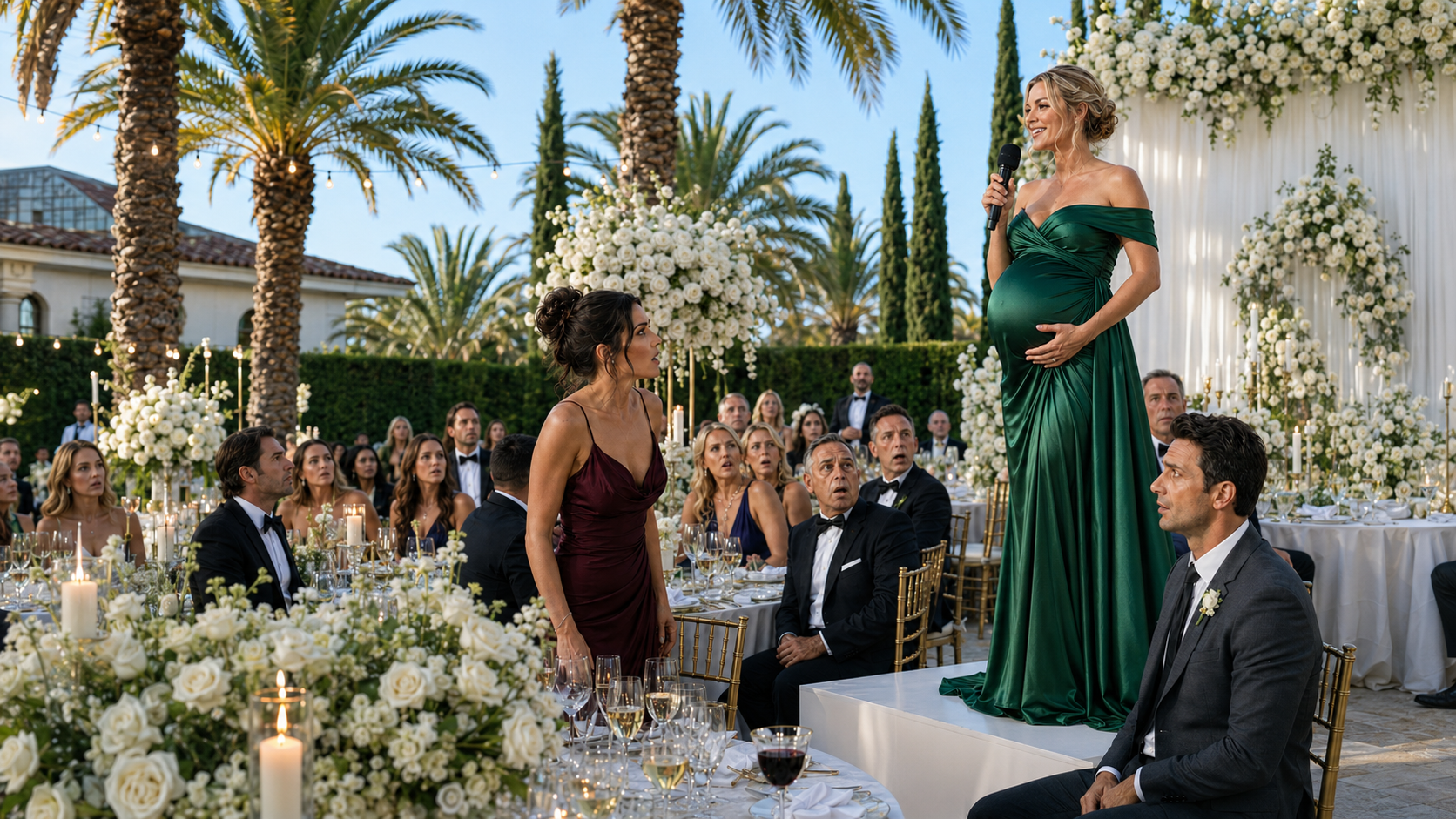
My sister destroyed my marriage with a microphone in her hand.
She did it in the middle of my tenth wedding anniversary celebration, in front of three hundred guests, under golden chandeliers, beside a three-tier cake with my name and my husband’s name written in silver icing.
She took the microphone from the DJ.
The music faded.
Everyone turned.
My sister smiled.
“I’m pregnant,” Natalie said.
A few people clapped, confused but polite.
Then she looked straight at me.
“With Eric’s baby.”
The room died.
Not quiet.
Died.
My mother’s wine glass slipped from her hand and shattered across the marble floor.
My father gripped the edge of the table like the whole building had tilted beneath him.
My husband, Eric, stood near the bar with his face drained of color.
And I sat at the head table, wearing a black satin dress, one hand resting on my lap, breathing slowly.
In.
Out.
In.
Out.
I did not scream.
I did not cry.
I did not throw my glass.
Because near the back of the ballroom sat a man in a gray suit Natalie had never met.
His name was Grant Miller.
Private investigator.
And for four months, he had been keeping a red folder for me.
I had been waiting for this moment longer than my sister knew.
Natalie tilted her head, enjoying the silence.
“Oh, Lauren,” she said softly through the microphone. “Don’t look so shocked. You must have known a man like Eric would eventually want a real family.”
A wave of gasps moved through the room.
Eric stepped forward.
“Natalie,” he hissed. “Stop.”
She laughed.
“No, Eric. I’m tired of hiding. I’m tired of watching her stand beside you like she still matters.”
My father stood.
“Natalie, put that microphone down.”
She turned toward him, tears suddenly appearing in her eyes like she had practiced them in a mirror.
“Dad, I’m sorry. But I love him. And he loves me.”
My mother whispered, “No. No, no, no…”
I looked at my mother.
Her face was pale.
But not shocked enough.
That was the first crack.
Not in the room.
In the truth.
Natalie pointed toward me.
“Say something, Lauren. Aren’t you going to ask him if it’s true?”
I looked at Eric.
Ten years of marriage.
Ten years of dinners, holidays, mortgage payments, shared passwords, family photos, hospital visits, and Sunday mornings.
He opened his mouth.
Nothing came out.
That told me everything.
Natalie smiled harder.
“You see? He can’t deny it.”
Then she stepped closer to me, still holding the microphone.
“I didn’t want to embarrass you, sis. But you always act so perfect. So strong. So untouchable. I thought everyone deserved to know you lost.”
That word.
Lost.
It landed in my chest like an old bullet.
I stood slowly.
The room held its breath.
I smoothed the front of my dress.
Natalie’s smile faltered for the first time.
“Put the microphone down,” I said.
She lifted her chin.
“No. Everyone deserves the truth.”
I walked toward her.
Three hundred eyes followed me.
Eric whispered, “Lauren, please.”
I ignored him.
Natalie gripped the microphone tighter.
“You can’t intimidate me. I’m not a soldier under your command anymore.”
I stopped in front of her.
“No,” I said. “You’re my sister.”
Her eyes glittered.
“Not after tonight.”
I smiled sadly.
“You’re right.”
Then I turned toward the back of the room and nodded.
Grant Miller stood.
He was calm, broad-shouldered, and silent, with a thick red folder tucked under one arm.
Natalie’s smile disappeared.
“Who is that?”
I took the microphone from her hand.
This time, she let go.
“He is the man who knows something even you don’t know.”
Eric’s eyes widened.
“Lauren…”
I looked at him.
“Don’t worry, Eric. Your turn is coming.”
Grant walked to the front, placed the red folder on the cake table, and opened it.
He removed a single sheet stamped with a laboratory seal.
Natalie stared at it.
The room seemed to lean closer.
I took the paper and held it up.
“Natalie,” I said, “the baby you’re carrying is not Eric’s.”
Her face went white.
A woman near the front whispered, “Oh my God.”
Eric staggered back like someone had hit him.
Natalie shook her head.
“That’s fake.”
Grant spoke for the first time.
“It is a certified prenatal paternity test, confirmed through chain-of-custody records.”
Natalie’s lips trembled.
“No.”
I turned slightly.
“The real father is in this room.”
The ballroom erupted.
People twisted in their chairs, searching faces.
I pointed three tables away.
“Jason. Your coworker. The man you invited tonight.”
A dark-haired man shot to his feet so fast his chair nearly tipped over.
He looked at Natalie.
Natalie looked at him.
Everything was written in that one look.
The silence.
The guilt.
The fear.
Eric covered his face with both hands and sank into a chair.
Ten years of marriage.
Four months of betrayal.
And in the end, even the baby they used to humiliate me was not his.
Natalie began crying.
Not because she was sorry.
Because she had lost control of the scene.
“You followed me?” she screamed.
I looked at her.
“No, Natalie. I investigated a lie.”
She turned to Eric.
“Say something!”
Eric lowered his hands.
His voice cracked.
“You told me it was mine.”
“You told me you were leaving her!”
“You told me she knew!”
My breath stopped.
The room quieted again.
I turned to Eric.
“What did you say?”
He looked at me, then away.
Natalie shouted, “Don’t blame me! You said Lauren was cold. You said she never gave you children. You said you deserved a family!”
My mother made a sound like a wounded animal.
My father closed his eyes.
I felt the old ache rise inside me.
Children.
That word had always been a locked door in my heart.
Because twelve years before that night, before I married Eric, before Natalie betrayed me, before my life became a room full of people staring at my pain, I had given birth to a son.
A son everyone told me had died.
No one in that ballroom knew I had carried that grief for twelve years.
No one knew that in the bottom drawer of my dresser, inside an old bread bag, I still kept a tiny blue knitted cap I made with my own hands when I was seven months pregnant.
No one knew that every Mother’s Day, I locked myself in the bathroom and cried quietly so nobody would feel uncomfortable.
No one knew.
Except Natalie.
She had been there that night.
She had held my hand after the birth.
She had looked me in the eyes and said, “He’s gone, Lauren. He never took a breath.”
I had believed her.
Because she was my sister.
That night, in the ballroom, I thought the worst betrayal had finally been exposed.
I was wrong.
That was only the beginning.
Security moved toward the front, but my father raised his hand.
“No one touches my daughter.”
His voice was low, but the whole room obeyed it.
Natalie wiped her tears and tried to recover.
“Fine,” she snapped. “Fine. Maybe the baby isn’t Eric’s. But that doesn’t change what he and I had.”
I turned toward Eric.
“What did you have?”
He looked destroyed.
“Lauren, I made a mistake.”
“A mistake is forgetting an anniversary card,” I said. “Sleeping with my sister is not a mistake. It is a decision you made again and again.”
He whispered, “I was lonely.”
I almost laughed.
“Lonely? In our marriage?”
“You were always so controlled. So disciplined. You never needed me.”
“I needed loyalty.”
He flinched.
Natalie sneered.
“She was always like that. Perfect Lauren. Strong Lauren. Captain Lauren. Everyone’s hero.”
I stepped closer.
“You slept with my husband because you were jealous?”
She laughed through tears.
“I slept with him because he wanted me.”
Eric said quietly, “Natalie, stop.”
“No,” she snapped. “You don’t get to hide now.”
She turned back to me.
“You always got everything. Dad’s respect. Mom’s approval. The career. The medals. The house. The husband.”
I looked at her, stunned.
“You think you lived in my shadow?”
“I lived under it.”
“Natalie, I paid your debts. I covered for you. I protected you.”
“You controlled me!”
“I loved you.”
She froze.
For a second, something human passed across her face.
Then it was gone.
“No,” she said. “You pitied me.”
My father walked toward us.
“That is enough.”
Natalie pointed at him.
“You always chose her.”
My mother whispered, “Natalie…”
She spun toward our mother.
“And you let him.”
There it was again.
That strange look on my mother’s face.
Fear.
Not anger.
Fear.
I noticed it then.
But I did not understand it yet.
The party ended in pieces.
Guests slipped out whispering.
The cake remained untouched.
The band packed their instruments in silence.
Jason disappeared before anyone could stop him.
Eric tried to approach me near the exit.
“Lauren, please. Can we talk privately?”
I turned.
“Did you love her?”
He swallowed.
“I thought I did.”
“Did you tell her I knew about the affair?”
His silence answered.
I nodded.
“You made me the villain so you could sleep with my sister and still feel like a decent man.”
His face crumpled.
“I never wanted to hurt you.”
“Then why did you keep choosing things that would?”
He had no answer.
I left alone.
That night, I went home to a house filled with anniversary flowers.
White roses.
Eric had sent them that morning with a card.
To ten beautiful years. Forever, E.
I picked up the card and stared at it for a long time.
Then I threw the flowers in the trash.
But I could not sleep.
Not because of Eric.
Not because of Natalie’s pregnancy.
Something else had awakened inside me.
A question I had buried for twelve years.
Why did I never see my baby?
When I gave birth, I was twenty-six, serving in the military, recently widowed by a training accident that killed the baby’s father three months before our son was born.
I was young.
Alone.
Broken.
I went into labor early at a small clinic during a storm.
I remembered pain.
Blood.
Bright lights.
Natalie’s voice.
Then darkness.
When I woke up, Natalie was beside my bed, holding my hand.
Her eyes were red.
“He’s gone, Lauren,” she whispered. “He never took a breath.”
“Let me see him,” I begged.
She cried harder.
“No. Please don’t do that to yourself. Remember him before pain. Remember him as love.”
I was weak.
I had lost too much blood.
I had just lost the last piece of the man I loved.
So I believed her.
Natalie handled everything.
There was no funeral.
No grave.
Only her word.
For twelve years, I mourned a child I never held.
At dawn after the anniversary disaster, I opened the bottom drawer of my dresser.
Inside the old bread bag was the tiny blue cap.
I lifted it out.
It fit in my palm.
My hands shook.
I whispered to the empty room, “Why didn’t they let me see you?”
Then I remembered Oliver.
Natalie’s son.
Twelve years old.
Born the same week my baby supposedly died.
The child I had carried around at family gatherings.
The boy I bought birthday gifts for.
The boy who had my father’s eyes.
And the tiny mark on his chin that matched mine.
My stomach turned.
“No,” I whispered.
But once a soldier sees the shape of a threat, she cannot unsee it.
Two days later, I went to my parents’ house.
Oliver spent weekends there.
He opened the door in a Yankees jersey, hair messy, phone in one hand.
“Aunt Lauren?”
My heart twisted.
Aunt Lauren.
“Hey, kiddo,” I said, forcing a smile. “Your grandma home?”
“She’s upstairs. You want coffee?”
I almost cried.
He always asked that because he had heard adults ask it.
“No, honey. I’m okay.”
While he went back to his video game, I walked into the bathroom.
His blue hairbrush sat beside the sink.
My hand hovered over it.
I felt like a thief.
Then I thought of the baby I had never seen.
I took several strands of hair, placed them in a plastic bag, and slipped them into my purse.
At the lab, the receptionist asked, “Relationship to the child?”
I opened my mouth.
No answer came.
Finally, I said, “I just need to know.”
Three weeks passed.
Three weeks of barely sleeping.
Three weeks of ignoring Eric’s calls.
Three weeks of Natalie sending messages that changed from begging to threatening.
You embarrassed me.
You think you’re better than everyone.
Stay away from Oliver.
That last one made my blood run cold.
When the envelope finally arrived, I opened it in my kitchen.
One line changed the shape of my life.
Probability of maternity: 99.99%.
I sank to the floor.
The paper shook in my hands.
My son had not died.
He had eaten Christmas dinner three chairs away from me.
He had called me Aunt Lauren.
He had hugged me after school plays.
He had asked me for birthday money.
He had slept under the roof of the woman who stole him.
And I had loved him without knowing why it hurt so much.
The next morning, I went to my parents’ house early.
Oliver opened the door again.
“Aunt Lauren? Why are you here so early?”
I stared at him.
His eyes.
His chin.
His sleepy little frown.
My son.
“I…” My voice broke. “Have you eaten breakfast?”
He blinked.
“No.”
I walked into the kitchen like I belonged there.
Because I did.
Because my son was there.
I made scrambled eggs and beans, exactly the way he liked them.
He climbed onto the stool, talking about a video game, completely unaware that the woman cracking eggs at the stove was trying not to fall apart.
He took a bite.
“You okay?” he asked.
I turned too quickly.
“Yes.”
“You’re crying.”
I wiped my face.
“Onions.”
“There are no onions.”
I laughed and sobbed at the same time.
He looked confused.
“Auntie, you’re being weird.”
I set the plate in front of him and sat down.
“Oliver…”
He looked up.
“Did you know I used to hold you a lot when you were little?”
“Grandma said that.” He shrugged. “She said you wouldn’t let anyone else carry me.”
I gripped the edge of the table.
“Did she?”
“Yeah. She said you sang to me.”
I turned away.
My body remembered what my mind had forgotten.
The weight of him.
The smell of his hair.
The way I used to reach for him at holidays without understanding why my chest ached afterward.
“Aunt Lauren?”
I forced myself to look at him.
“I love you very much.”
He smiled awkwardly.
“I know.”
“No,” I whispered. “More than you understand.”
He went back to eating.
And I sat there watching my son eat the breakfast I had made him twelve years late.
I could not tell him that morning.
How could I?
How do you tell a child the mother he knows stole him from the mother who bore him?
That week, I showed the DNA results to my parents.
My mother read them first.
She dropped the pages like they burned her.
“No.”
My father picked them up slowly.
His hands shook.
My mother backed away.
“No, Lauren. No. You are hurt. You are angry. This is because of Natalie and Eric.”
“It says ninety-nine point nine-nine percent.”
“Tests can be wrong.”
“Not like this.”
“You are going to destroy him.”
I stared at her.
“Destroy who?”
“Oliver.”
“You mean my son?”
She flinched.
My father sat down heavily.
“The chin,” he whispered.
My mother turned on him.
“Don’t.”
He looked at her.
“I always said that boy had Lauren’s chin.”
The room went cold.
I looked at my mother.
“What happened that night?”
She pressed her lips together.
“Mom.”
No answer.
I stepped closer.
“What happened to my baby?”
She began to cry.
But I had seen too many tears used as shields.
“Do not cry at me,” I said. “Tell me.”
My father stood slowly.
“Margaret,” he said, using her full name, “tell her.”
My mother covered her mouth.
“Natalie had lost a baby,” she whispered.
The world stopped.
“What?”
“She was almost full term. It happened weeks before you went into labor. She was destroyed, Lauren. She wouldn’t eat. She wouldn’t speak. She kept saying God had punished her.”
My voice was barely human.
“What does that have to do with my son?”
My mother sobbed harder.
“When I got to the clinic, Natalie was already holding him.”
My knees weakened.
“She said he was hers. She said God had given him back.”
My father whispered, “You knew?”
My mother looked at him with horror.
“I thought…” She shook her head. “Lauren was alone. Widowed. Military. Broken. Natalie had a husband then. A nursery. A home. I thought the baby would be better off.”
I stared at her.
“You thought?”
She reached for me.
“Sweetheart—”
I stepped back.
“No.”
“Please understand—”
“No!”
The shout tore out of me so violently that the room went silent.
Oliver’s voice came from the hallway.
“Grandma?”
My heart stopped.
He stood there, looking between all of us.
“What’s going on?”
Nobody spoke.
He looked at the papers in my hand.
“What is that?”
I could not breathe.
My mother rushed toward him.
“Nothing, sweetheart. Go upstairs.”
But Oliver was twelve, not stupid.
He looked at me.
“Aunt Lauren?”
I folded the papers against my chest.
“Oliver,” I whispered, “I need to talk to Natalie first.”
His face changed.
“Is this about Mom?”
My mother reached for him.
“Oliver, honey—”
He stepped away.
“What did she do?”
I wanted to tell him everything.
I wanted to fall to my knees and say, I am your mother. I never gave you away. I never stopped loving you. I didn’t know.
But truth without care can become another wound.
So I swallowed my grief.
“I promise you,” I said, “when it is time, I will not lie to you.”
He stared at me.
Then he turned and ran upstairs.
That night, I went to Natalie’s apartment.
She opened the door before I knocked twice.
She already knew.
She was six months pregnant, wearing sweatpants and no makeup. The confident woman from the anniversary party was gone.
Or maybe the mask was.
“You took his hairbrush,” she said.
I stepped inside.
“You stole my son.”
Her face hardened.
“I raised my son.”
“Mine.”
“Don’t say that.”
“My son.”
She slapped me.
Hard.
My cheek burned.
For a second, neither of us moved.
Then she whispered, “You don’t get to come in here and erase twelve years.”
I touched my cheek.
“You erased his birth.”
Her eyes filled with tears.
“He was all I had.”
“He was not yours to take.”
“You were leaving again. Always leaving. Deployments. Bases. Missions. You would have handed him to daycare and strangers.”
“I was his mother.”
“I was there!”
Her voice cracked.
“I fed him. I bathed him. I stayed up when he had fevers. I taught him to walk. I took him to school. I held him when he cried.”
“You also lied to him every day.”
She stepped closer.
“You think biology makes you a mother?”
“No,” I said. “Truth does.”
She laughed bitterly.
“Truth? Fine. Here’s the truth. He loves me. He calls me Mom. If you take me to court, he will hate you.”
The words hit exactly where she meant them to.
She saw it.
And smiled.
“If you sue me,” Natalie said, “I will tell Oliver you are trying to steal him because you’re angry about Eric. I’ll tell him you want revenge. And he will believe me.”
I looked at my sister.
The girl I carried on my hip when we were children.
The woman whose bills I paid.
The sister I trusted with my dead child.
“You are not afraid of losing him,” I said slowly. “You are afraid he’ll learn what you did.”
Her face changed.
Before I left, she said one last thing.
“You still don’t know everything.”
I turned.
“What does that mean?”
She looked at me with dead eyes.
“Ask Mom who signed the paperwork.”
The next morning, I drove to my parents’ house.
My father was in the kitchen alone.
He looked older than he had the week before.
“Where is Mom?”
“In the bedroom.”
I placed the DNA report on the table.
“Did she sign something?”
His face darkened.
“What?”
“Natalie said to ask Mom who signed the paperwork.”
My father walked toward the bedroom.
I followed.
My mother sat on the edge of the bed with a rosary twisted in her hands.
My father stood in the doorway.
“What paperwork?”
She closed her eyes.
I whispered, “Mom.”
She began shaking.
“The clinic needed documentation.”
I felt cold.
“What documentation?”
“They couldn’t release a newborn without a birth record.”
My father’s voice dropped.
“What did you do?”
She looked at me.
“I signed your name.”
The room tilted.
I gripped the doorframe.
“You signed away my child?”
“No. No, not adoption. Not exactly. I signed a release that said Natalie was authorized to take him home until you recovered.”
“And then?”
She sobbed.
“Then we never corrected it.”
My father turned away like he might be sick.
I looked at the woman who taught me how to braid my hair, how to pray, how to forgive.
And I realized she had buried me alive in grief for twelve years because it was easier than facing what she had done.
“I want every document,” I said.
“Lauren—”
“Every document.”
She nodded, crying.
“I’m sorry.”
“No,” I said. “You are caught.”
That was the first time I truly understood that apologies often arrive only when lies run out of places to hide.
I filed the lawsuit.
It was the hardest thing I have ever done.
Harder than military training.
Harder than deployment.
Harder than losing my first love.
Because suing Natalie meant dragging Oliver into a truth he had never asked for.
Natalie fought like a cornered animal.
Her lawyers said I was unstable after the anniversary scandal.
They said I wanted revenge.
They said Oliver had a loving home.
They said biology did not erase twelve years.
They said I was trying to punish my sister for sleeping with my husband.
Some relatives believed her.
Most stopped calling me.
At family gatherings, chairs went empty when I entered.
One aunt told me, “Even if it’s true, why destroy the boy now?”
I looked at her and said, “Because a lie is already destroying him.”
Oliver refused to speak to me for months.
When he had to attend court-ordered meetings with me, he sat across the room with his arms folded.
“Do you hate me?” I asked once.
He stared at the floor.
“I don’t know you.”
That hurt more than hate.
I called my father that night from my car and cried like a child.
“I can’t do this.”
“Yes, you can.”
“He doesn’t want me.”
“He doesn’t know you yet.”
“He thinks I’m stealing him.”
My father was quiet.
Then he said, “Lauren, if you stop now, he will grow up believing his real mother never wanted him. Can you live with that?”
I looked through the windshield at the courthouse lights.
“No.”
“Then keep going.”
Seven months passed.
Court hearings.
DNA tests.
Old clinic records.
My mother’s forged signature.
Natalie’s false birth claim.
A nurse who remembered the night.
An old intake worker who testified that she had been told I was unconscious and Natalie was “the mother.”
Finally, the court DNA test confirmed it.
Oliver was my son.
The judge corrected the birth certificate.
My name replaced Natalie’s.
The courtroom was full when the ruling came.
Natalie sobbed loudly.
My mother cried quietly.
My father held his cane with both hands.
Oliver sat between a court-appointed counselor and my father, staring at nothing.
The judge looked at me.
“Ms. Hale, this court recognizes that you never consented to surrender your child. You were misled, medically vulnerable, and denied your legal rights as his mother.”
For twelve years, I had carried guilt that did not belong to me.
The guilt of not holding him.
The guilt of not burying him.
The guilt of believing I had failed my baby before he even took his first breath.
That day, I let one piece of it go.
But there was no movie ending.
Oliver did not run into my arms.
He did not call me Mom.
He did not even look at me.
When the judge granted a transition plan placing him eventually in my custody, Oliver stood and said, “I hate you.”
The words were quiet.
But they cut deeper than Natalie’s betrayal.
I nodded because I deserved his honesty.
“I know,” I whispered.
He walked out holding my father’s hand.
I had gotten my son back.
And my son hated me.
People expected me to send Natalie to prison.
My lawyer had the complaint ready.
Kidnapping.
Fraud.
Forgery.
Conspiracy.
My mother could have faced charges too.
The paperwork needed only my signature.
I kept it on my kitchen table for nine days.
On the tenth day, Oliver came over for a supervised visit.
He barely spoke.
He sat at the table while I made scrambled eggs and beans.
His favorite.
I placed the plate in front of him.
He stared at it.
“My mom makes them better.”
My throat tightened.
“I know.”
He looked up, surprised I didn’t argue.
We ate in silence.
Then he said, “Are you going to send her to jail?”
I set my fork down.
“Natalie?”
“My mom.”
I closed my eyes briefly.
“She did something very wrong.”
“If you send her to jail, I’ll never forgive you.”
I looked at him.
His face was hard, but his eyes were terrified.
He had lost one mother on paper.
He was begging me not to take the other in chains.
That price was mine to pay.
Not his.
I never signed the complaint.
Maybe I was wrong.
Some people still tell me I was.
Maybe Natalie deserved prison.
Maybe my mother did too.
But I was not going to build my relationship with Oliver on another loss he did not choose.
Natalie moved to Denver before her baby was born.
Jason did not stay.
Eric disappeared from my life after the divorce.
He tried once to apologize.
We met in a quiet coffee shop because I wanted closure, not reconciliation.
He looked older.
Thinner.
Ashamed, maybe.
“I didn’t know what Natalie had done to you,” he said.
“No,” I replied. “But you knew what you were doing with her.”
He nodded.
“I was weak.”
“You were selfish.”
His eyes filled with tears.
“I loved you once.”
I stirred my coffee.
“No. You loved being married to someone people respected.”
He looked down.
“I’m sorry, Lauren.”
I waited to feel something.
Anger.
Love.
Sadness.
Anything.
But there was only a calm emptiness.
“Goodbye, Eric.”
He reached across the table.
I stood before he could touch me.
“Don’t.”
I left him there.
Some doors do not need to slam.
They only need to close.
Forgiving my mother was harder.
It still is.
Forgiveness did not arrive like sunlight.
It came in pieces.
One phone call answered.
One holiday card opened.
One afternoon when Oliver asked if Grandma could come to his school concert and I said yes because my pain was not more important than his healing.
Natalie called me once after Noah was born.
Her voice was flat.
“You got what you wanted.”
“No,” I said. “I got back what you took.”
“You always do that.”
“What?”
“Sound righteous.”
I closed my eyes.
“Natalie, you stole my child.”
“I raised him.”
“You stole him first.”
Silence.
Then she whispered, “If you had not always been so perfect, none of this would have happened.”
For the first time in my life, I refused to accept guilt that belonged to her.
“I was not perfect,” I said. “I was trusting. There is a difference.”
She hung up.
Oliver moved in with me slowly.
At first, only weekends.
Then school nights.
Then full time.
The first month was awful.
He kept his bedroom door closed.
He called me Lauren.
He flinched when I corrected his laundry because he thought every instruction was an attack.
He missed Natalie.
Sometimes I heard him crying at night.
I would stand outside his door with my hand raised, then lower it.
I had waited twelve years to be his mother.
He had twelve years of believing someone else was.
I could not demand his heart like a court order.
One Sunday morning, I made scrambled eggs and beans.
He came into the kitchen, hair messy, sweatshirt wrinkled.
He sat without speaking.
I placed the old blue knitted cap beside his plate.
He looked at it.
“What’s that?”
“I made it for you before you were born.”
He picked it up carefully.
It fit in his palm.
His thumb moved over the tiny stitches.
“You kept it?”
“Yes.”
“For twelve years?”
“Yes.”
“Why?”
My voice shook.
“Because it was the only thing I had left of you.”
He stared at the cap for a long time.
Then he slipped it into his hoodie pocket.
He did not call me Mom.
Not yet.
But after breakfast, while he rinsed his plate, he said, “Can you make these again next Sunday?”
I smiled through tears.
“Every Sunday for as long as you want.”
Months passed.
Then one year.
Healing was not dramatic.
It was quiet.
It was homework at the kitchen table.
It was learning he hated mushrooms.
It was sitting through baseball practice in the cold.
It was him texting me, “Can you pick me up?”
It was the first time he got sick and called from his room, “Lauren?”
I opened the door.
He was pale, feverish, and small in a way twelve-year-old boys hate being.
“I don’t feel good,” he whispered.
I sat beside him and pressed my hand to his forehead.
“You have a fever.”
He closed his eyes.
“Can you stay?”
My heart nearly broke.
“Yes.”
I stayed all night.
At dawn, half asleep, he whispered one word.
“Mom?”
I froze.
His eyes remained closed.
Maybe he didn’t know he said it.
Maybe he did.
I did not answer too loudly.
I did not make it a moment he had to explain.
I only brushed his hair back and said, “I’m here.”
The next morning, he called me Lauren again.
But I didn’t mind.
I had heard it once.
That was enough to keep hope alive.
Two years after the anniversary party, my father invited the family to dinner.
It was the first time all of us had been in one room since the truth came out.
Natalie did not come.
Eric was not invited.
My mother sat across from me, older, quieter.
Oliver sat beside me.
No one mentioned court.
No one mentioned the ballroom.
Then my mother looked at him and said, “Oliver, sweetheart, can you pass the salt?”
He passed it.
She smiled at him with trembling lips.
“Thank you.”
He looked at her.
“Grandma?”
“Yes?”
“Why did you do it?”
Every adult froze.
My mother’s eyes filled.
“I thought I was helping.”
Oliver stared at her.
“You lied to everyone.”
“Yes.”
“You let my mom think I was dead.”
My mother began crying.
“Yes.”
He looked down at his plate.
“That was cruel.”
She covered her mouth.
“I know.”
He nodded once.
Then he turned back to his food.
No forgiveness.
No hug.
No big emotional speech.
Just truth spoken at the table where lies had eaten with us for years.
After dinner, Oliver and I drove home in silence.
Halfway there, he said, “I’m still mad.”
“I know.”
“At everyone.”
“You’re allowed.”
“At you too sometimes.”
I swallowed.
“I know.”
He looked out the window.
“But less than before.”
I gripped the steering wheel a little tighter.
“That’s okay.”
He pulled the blue cap from his jacket pocket.
He carried it often now.
Not every day.
But often.
“I don’t remember being a baby,” he said.
“No one does.”
“So I don’t remember you.”
My chest ached.
“No.”
“But you remember me?”
I smiled sadly.
“My body did before my mind understood.”
He looked at me.
“What does that mean?”
“It means every time you were near me, something in me knew I loved you.”
He was quiet for a long time.
Then he said, “That’s weird.”
I laughed.
“Yes. It is.”
He smiled a little.
And that tiny smile felt bigger than any victory.
People ask me what happened to the sister who took my son and slept with my husband.
The simple answer?
She lost everything she tried to steal.
Eric never married her.
Jason left.
Her new life in Denver never became the perfect escape she imagined.
But punishment is not always prison.
Sometimes punishment is knowing the child you called yours now knows the truth.
Sometimes punishment is hearing your own lies come back in your son’s voice.
Sometimes punishment is living with the fact that jealousy made you destroy the only people who truly loved you.
As for me, I learned something women are rarely taught.
Do not stay silent just to keep a room comfortable.
Do not swallow questions because the answers might hurt.
Do not let people call you dramatic when your soul knows something is wrong.
For twelve years, I accepted a grief someone handed me.
I carried it like a stone.
I built my life around a grave that never existed.
And the child I mourned was growing up two blocks away, calling another woman Mom.
I cannot recover those twelve years.
No court can return first steps.
First words.
First birthdays.
First nightmares.
First school mornings.
They are gone.
But not everything was stolen.
Last Sunday, Oliver came into the kitchen while I was making breakfast.
He leaned against the counter, taller now, hair still messy, face still half-boy and half-young man.
“Need help?” he asked.
“With eggs?”
“I can crack them.”
“You always get shells in the bowl.”
“Not always.”
“Last time there were three.”
He rolled his eyes.
“You counted?”
“I’m your mother. I count everything.”
He froze.
So did I.
The word had come out naturally.
Mother.
Not Lauren.
Not aunt.
Mother.
I started to apologize.
But Oliver picked up an egg and cracked it into the bowl.
No shell.
Then he said quietly, “See, Mom? I’m improving.”
I turned toward the sink because my eyes filled instantly.
He saw anyway.
“Are you crying again?”
“No.”
“You are.”
“Onions.”
“There are still no onions.”
We both laughed.
And in that small kitchen, with eggs sizzling on the stove and the blue cap sitting on the windowsill where he had placed it months ago, I finally felt something shift.
Not a perfect ending.
Not the return of everything lost.
But a beginning.
A real one.
My sister used a microphone to humiliate me in front of three hundred people.
She thought revealing her affair with my husband would be the worst moment of my life.
She was wrong.
The worst moment had happened twelve years earlier, when she told me my baby was dead.
But the strongest moment came after.
When I asked questions.
When I found proof.
When I fought without knowing if my son would ever love me.
When I chose truth over silence.
And when, years later, he stood in my kitchen and called me Mom like the word had finally found its way home.