“If the child is that hungry, let her eat that bread roll outside. Spoiled kids grow up weak.”
Those were the first words I heard when I stepped into my own apartment.
My own apartment.
The apartment I paid for.
The apartment I bought before marriage.
The apartment where I believed my three-year-old daughter was safe.
I had just returned from a business trip to Monterrey three hours earlier than expected. For two weeks, I had worked nonstop to close one of the biggest sales campaigns of my career. I was exhausted, still wearing my travel clothes, my heels dangling from one hand, my suitcase beside me.
But I was happy.
Because I was finally home.
Because I was finally going to hold Camila.
My little girl.
My treasure.
Instead, I opened the door and heard my mother-in-law, Doña Carmen, speaking about my daughter as if she were a stray animal.
Then I saw the table.
Shrimp.
Oysters.
Octopus.
Crab.
Lobster cracked open and dripping with butter.
Expensive wine.
Fresh bread.
Imported cheese.
Desserts still in their gold boxes.
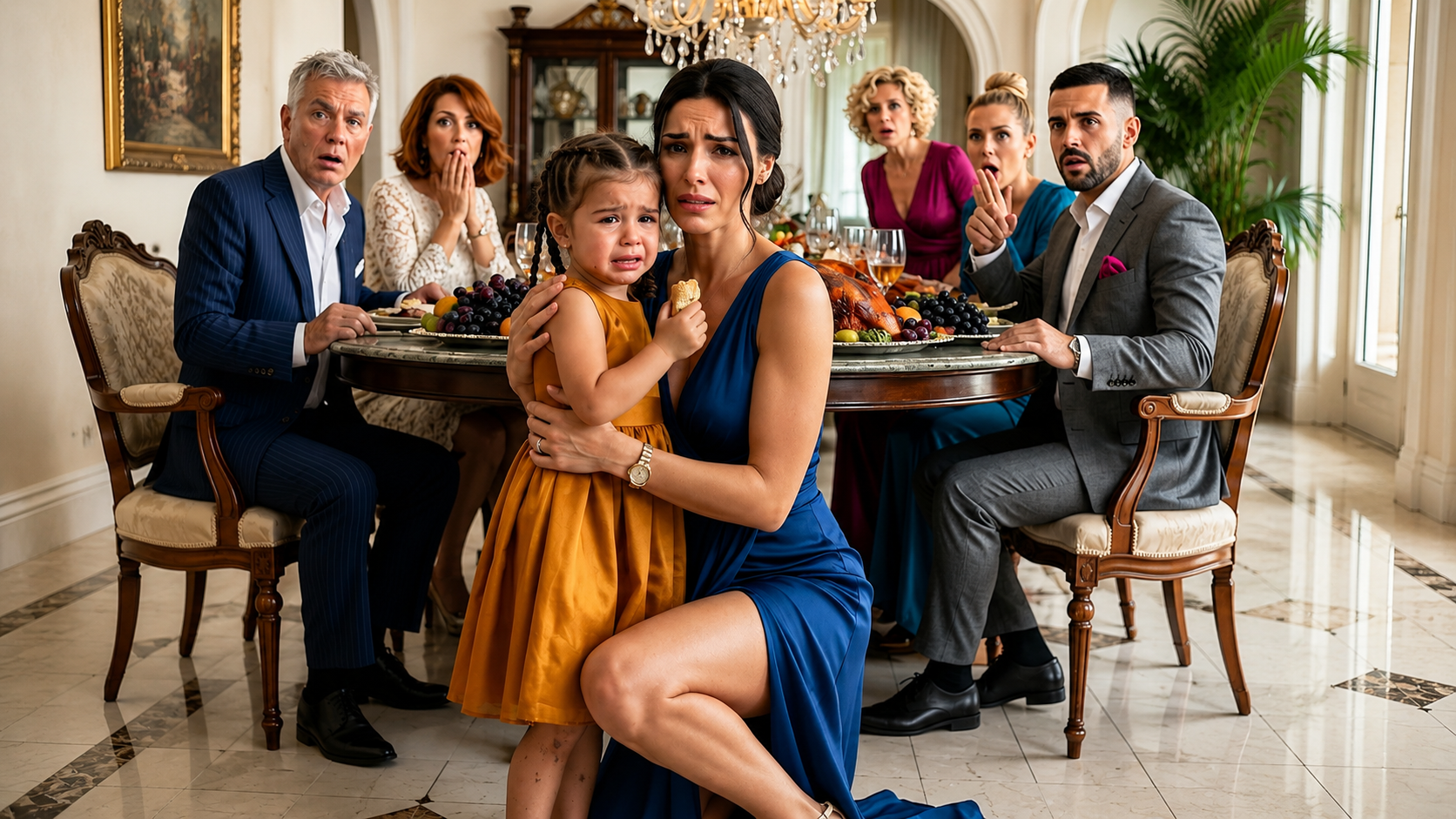
Six adults sat around my dining table eating like kings.
Doña Carmen sat at the head of the table with butter on her fingers and a smile on her face.
My husband, Daniel, poured her another glass of wine.
His sister Valeria was filming the feast on her phone while her boyfriend posed with a lobster claw like they were in a luxury restaurant.
My father-in-law sat quietly near the end, eating with his head down.
“Mom, this is better than Acapulco,” Valeria said, laughing. “Good thing Mariana makes such good money.”
Doña Carmen laughed loudly.
“Well, that is what she works for. If we don’t enjoy it, who will?”
Then they saw me.
Silence fell over the table.
Daniel stood up too quickly, nearly knocking over his glass.
“Mariana,” he said. “You’re back already?”
I looked at the food.
Then at him.
Then at the closed balcony door.
“Where is Camila?”
Daniel’s face changed.
Just slightly.
“She already ate,” he said. “I think she’s asleep.”
But Camila never slept at seven in the evening.
Not unless she was sick.
Not unless she had cried herself tired.
I dropped my heels.
“Where is my daughter?”
No one answered.
So I ran.
The Empty Room
Camila’s bedroom was empty.
Her blanket was folded on the bed.
Her stuffed rabbit was on the floor.
Bathroom.
Empty.
Living room.
Empty.
Study.
Empty.
I called her name.
“Camila?”
No answer.
My heart began to pound so hard I could hear it in my ears.
Then I noticed the balcony door.
Closed.
Locked.
The curtains were partly drawn, as if someone had tried to hide what was outside.
I walked toward it slowly.
My hands were already shaking.
I opened the door.
And there she was.
My daughter.
My three-year-old daughter.
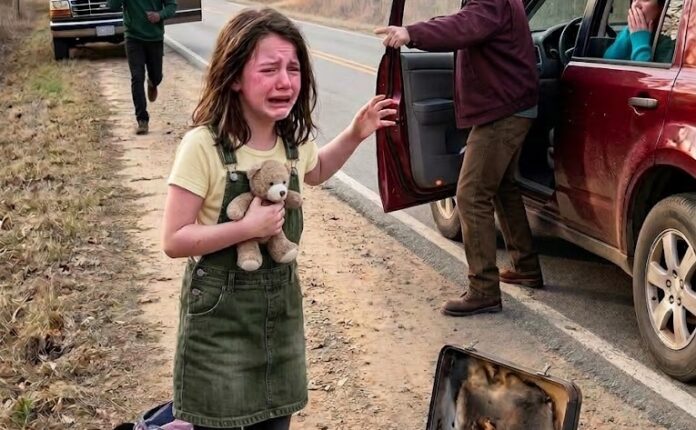
Sitting on a tiny plastic chair outside in the cold.
She wore only a thin sweater.
Her little hands were icy.
Her lips were pale.
She was holding half of a hard bread roll.
When she saw me, tears filled her eyes.
“Mommy,” she whispered, “can I come inside now?”
Something inside me shattered so cleanly I heard it.
I lifted her into my arms.
She felt lighter than I remembered.
Too light.
Her body was cold.
Her face pressed against my neck, and she clung to me like she was afraid someone might pull her away.
Behind me, the table was still full of warm food.
Lobster.
Shrimp.
Wine.
Butter.
Laughter.
My money.
And my daughter had been outside eating stale bread.
I turned slowly.
“What did you do to my daughter?”
My voice was calm.
That frightened them more than shouting would have.
“Don’t Be Dramatic”
Doña Carmen wiped her mouth with a linen napkin.
“Don’t be dramatic, Mariana. Children shouldn’t eat seafood anyway.”
I stared at her.
“She was outside in the cold.”
“A little hardship teaches character.”
“She is three.”
Valeria rolled her eyes.
“That’s why girls become spoiled. You treat her like a princess.”
I looked at Daniel.
I waited.
For shame.
For anger.
For one sign that the man I married still understood he was a father.
But Daniel only sighed.
“Mariana, don’t make this bigger than it is.”
The room went silent.
I held Camila tighter.
“Bigger than it is?”
“My mother knows how to raise children,” he said. “Camila needs to learn she can’t always have everything handed to her.”
“She asked for food.”
“She had bread.”
“She asked to come inside.”
Daniel looked embarrassed now, but not because of what happened.
Because I was saying it out loud.
“Don’t make a scene,” he said quietly.
That was when I understood.
Not gradually.
Not painfully.
All at once.
Daniel was not weak.
He was not afraid of his mother.
He was not stuck between me and his family.
He had chosen his place.
At the table.
With them.
While our daughter sat behind glass.
I looked at all of them.
Doña Carmen.
Daniel.
Valeria.
Her boyfriend.
My father-in-law.
The housekeeper I paid for, standing in the kitchen doorway with tears in her eyes because she had probably been told not to interfere.
“You’re right,” I said softly.
Daniel blinked.
“I am?”
“Yes.”
I shifted Camila higher on my hip.
“You all need to learn something.”
Valeria scoffed.
“What, Mariana? Another lecture about motherhood?”
“No,” I said. “Starting tomorrow, all of you will learn what it means to go without.”
Doña Carmen laughed.
“Threats now?”
I walked toward the door.
Daniel followed me.
“Where are you going?”
“Away from this table.”
“Mariana, stop.”
I turned back one last time.
“Enjoy the food,” I said. “It is the last feast you will ever have with my money.”
They stared at me.
None of them understood.
Not yet.
The Hotel Room
That night, I did not argue anymore.
I took Camila to a hotel on Reforma.
During the ride, she did not cry.
That frightened me more than a tantrum would have.
A child who screams still believes someone will listen.
Camila just held on to my neck in silence.
In the hotel room, I ordered everything soft and warm.
Chicken soup.
Rice.
Fruit.
Warm milk.
A small piece of cake because she asked for it with her eyes before she dared ask with words.
When the food arrived, Camila stared at the tray.
“Mommy,” she whispered, “can I eat this?”
I nearly broke.
I knelt in front of her.
“Of course, my love. It is all for you.”
She reached for the spoon, then stopped.
“Grandma says I have to wait.”
“No,” I said, my voice shaking. “You never have to wait when you are hungry.”
She ate slowly.
Too slowly.
Like every bite needed permission.
Afterward, I gave her a warm bath.
When I helped her into pajamas, I saw the marks.
Small bruises.
Finger-shaped.
On her arms.
A dark mark near her thigh.
A scratch near her shoulder.
I froze.
“Camila,” I said gently. “Who did this?”
Her eyes filled with terror.
“Don’t say anything, Mommy.”
I forced myself to breathe.
“Why?”
“Grandma will get mad.”
The room tilted.
I pulled her into my arms and held her until she fell asleep.
Then Daniel called.
I almost did not answer.
But I wanted to hear what kind of man he would be after seeing his daughter’s empty chair.
So I picked up.
“What is wrong with you?” he snapped. “You embarrassed my mother.”
I closed my eyes.
“That is what you care about?”
“You made everyone look terrible over something small.”
“Small?”
“She was fine.”
“She was outside in the cold eating stale bread.”
In the background, Doña Carmen shouted, “I took care of that brat for three years, and this is how she thanks me? Ungrateful woman!”
I looked at Camila sleeping beside me.
Then I hung up.
No more explaining.
No more begging Daniel to choose his child.
No more giving money to people who treated my daughter like a burden.
I blocked Daniel.
Then Doña Carmen.
Then Valeria.
Then every relative who had eaten at that table.
Cutting Off the Money
I opened my banking app.
My hands were steady now.
Monthly transfer to Doña Carmen: canceled.
Supplementary card for Daniel: deactivated.
Supplementary card for Valeria: deactivated.
Automatic supermarket payments: canceled.
Wine club subscription: canceled.
Housekeeper account: paused until I could speak to her directly.
Father-in-law’s medication payment: redirected through a pharmacy account under my control, because he had been silent, but I would not let an old man go without medicine.
Utilities: transferred to a protected account.
Streaming services.
Food delivery.
Designer store deposits.
Gym memberships.
Car payments.
All reviewed.
All stopped where needed.
Then I called my lawyer, Mr. Herrera.
He answered on the second ring.
“Mariana?”
“I want a divorce.”
Silence.
Then his voice became fully awake.
“Is Camila safe?”
“Yes. She is with me.”
“What happened?”
I told him.
Not everything.
Not yet.
Just enough.
By the time I finished, his voice was cold.
“Bring her to a pediatrician first thing in the morning. We need medical documentation. Then we file for custody, divorce, and removal from your property.”
“My apartment?”
“Yes. It is in your name?”
“I bought it before marriage.”
“Good.”
I looked at my sleeping daughter.
“Mr. Herrera?”
“Yes?”
“I want full custody.”
“We will fight for it.”
“No,” I said. “We will get it.”
The Doctor’s Report
The next morning, I took Camila to a pediatrician.
She sat on the examination table clutching her stuffed rabbit while the doctor examined her gently.
Low weight.
Stress.
Poor sleep.
Signs of repeated mistreatment.
The doctor looked at me seriously.
“This needs to be reported.”
I nodded.
“Report it.”
Camila looked scared.
“Mommy?”
I took her small hand.
“You are not in trouble.”
“Grandma says crying is trouble.”
“Grandma is wrong.”
The doctor’s face tightened, but she remained professional.
After the appointment, I sent the report to Mr. Herrera.
By noon, the complaint had been filed.
By 2:00 p.m., a formal notice was prepared.
Daniel and his family had seven days to leave my apartment.
Not our apartment.
Mine.
The deed was under my name.
The mortgage was mine.
The furniture was mine.
The refrigerator full of food was mine.
The lobster shells in the trash had been bought with my money.
They had lived there because I believed family meant safety.
I had been wrong.
The First Collapse
Their comfortable life began falling apart before sunset.
Doña Carmen tried to pay at the supermarket.
Card declined.
Valeria went to pick up a designer bag she had reserved.
Payment failed.
Daniel received a bank alert while sitting in the apartment he thought he controlled.
Supplementary card canceled.
He called me from another number.
I did not answer.
He called again.
Then again.
Then Mr. Herrera called him back.
“Mr. Reyes,” my lawyer said, “from now on, all communication will go through legal channels.”
“Where is my wife?”
“Filing for divorce.”
There was a silence.
“Divorce?”
“Yes.”
“What did she tell you?”
“Enough.”
That afternoon, a court officer knocked on the apartment door.
Doña Carmen opened it wearing a silk robe I had bought for myself.
She was still angry, still comfortable, still convinced the world would bend around her.
The officer handed her the documents.
“On behalf of Mrs. Mariana Robles, legal owner of this property, you are notified that you must vacate within seven days.”
Doña Carmen screamed.
“This apartment belongs to my son.”
The officer looked at the papers.
“The deed is under Mrs. Mariana Robles’ name.”
Valeria shouted from the living room.
“Daniel, do something!”
Daniel looked at the notice.
For the first time in our marriage, he had no mother, no card, no money, no lie strong enough to rescue him.
The Cameras
That night, after Camila fell asleep in the hotel bed, I remembered the apartment cameras.
I had installed them two years earlier so I could check on Camila while traveling. Doña Carmen had always complained about them.
“It feels like you don’t trust me,” she used to say.
I would apologize.
Then I would turn them off for long stretches because I did not want to create conflict.
That night, I opened the app.
I searched the footage from the evening I came home.
And what I saw changed everything.
Camila stood beside the dining table.
Her hair was messy.
Her hands were held close to her chest.
She looked at the food with the eyes of a hungry child trying not to want too much.
“Grandma,” she said softly. “I’m hungry.”
Doña Carmen did not even turn around.
“There’s bread for you. Go to the balcony.”
Camila stayed still.
Valeria laughed coldly.
“Take her away. I hate seeing her stare at the food.”
Then Daniel appeared in the frame.
My husband.
Her father.
He sat less than two meters away.
He heard everything.
He saw everything.
Instead of standing up, he kept eating.
“Listen to your grandmother, Cami,” he said. “Don’t start.”
Then Doña Carmen grabbed Camila by the arm and pushed her toward the balcony.
Camila stumbled.
Doña Carmen slid the door shut.
The camera showed my daughter standing outside behind the glass.
She did not cry.
She just looked in.
At the food.
At the family.
At her father.
I turned off the phone and ran to the bathroom.
I was sick for ten minutes.
For years, I had believed Daniel was weak.
That night, I finally understood the truth.
He was comfortable.
And a comfortable coward can be more dangerous than an open enemy.
The Evidence
The next morning, I gave the footage to Mr. Herrera.
He watched it in silence.
The only sound in his office was Camila’s small voice.
“Grandma, I’m hungry.”
When the clip ended, he removed his glasses.
“With this, custody should not be difficult.”
“I want supervised visits only,” I said. “Daniel can see Camila only when she feels safe, and only with a third party present.”
“Understood.”
“I am not using my daughter as revenge.”
“I know.”
“But I will never again hand her to people who treated her like a burden.”
Mr. Herrera nodded.
“That is not revenge, Mariana. That is protection.”
Protection.
The word settled in my chest.
For years, I had protected everyone else.
Daniel’s pride.
Doña Carmen’s comfort.
Valeria’s lifestyle.
The family image.
The apartment.
The bills.
The holidays.
The peace.
But I had failed to protect the one person who mattered most.
Never again.
Mediation
Two weeks later, Daniel and I sat across from each other at the first mediation hearing.
He looked tired.
Smaller.
Like a man whose reflection had finally stopped flattering him.
“Mariana,” he said quietly, “please don’t destroy my family.”
I looked at him.
“Your family was destroyed when you left a little girl outside while everyone else ate.”
“My mother went too far. I admit that.”
“Went too far?”
“She’s old. She grew up differently.”
“Camila is three, Daniel. She did not need character. She needed food, warmth, and a father.”
He lowered his head.
“I didn’t know about the marks.”
I opened my folder.
Photos.
Medical report.
Psychological evaluation.
Screenshots.
Video stills.
I placed them on the table one by one.
“You didn’t know because you didn’t want to know.”
Daniel’s eyes filled.
“Mariana…”
“No. Answer me.”
He looked up.
I asked, “What is Camila’s favorite bedtime story?”
He froze.
“What?”
“Her favorite bedtime story. What is it?”
He swallowed.
“I don’t know.”
“What fruit gives her an allergic reaction?”
Silence.
“What song does she ask for when she is scared?”
His lips parted, but no answer came.
“What does she do when she is about to cry but does not want adults to get angry?”
He closed his eyes.
“Mariana, please.”
“You don’t know,” I said. “Because you were never a father. You were just a man sitting at the table while your daughter watched from the balcony.”
That sentence broke him.
He did not shout.
He did not argue.
His eyes simply filled with shame.
“I’m sorry,” he whispered.
“That apology is not mine to accept.”
In the end, Daniel agreed not to fight for custody.
He agreed to supervised visits.
He agreed to child support.
But Doña Carmen?
She accepted nothing.
Doña Carmen’s Performance
One Monday morning, Doña Carmen appeared in the lobby of my office building.
She sat on the floor in front of employees, clients, and security guards.
Crying loudly.
Wailing.
Performing.
“Look at this woman!” she shouted when she saw me step out of the elevator. “She got rich and threw her poor mother-in-law into the street.”
People turned.
Phones came out.
She pointed at me.
“She stole my granddaughter. She accused me of abuse after I cared for that child for three years.”
I walked toward her calmly.
Security looked at me, waiting.
I raised one hand.
“Let her speak.”
Doña Carmen’s eyes flashed.
“You think money makes you better than us?”
“No.”
“You think you can destroy a family?”
“No.”
“Tell them the truth!”
I looked at the crowd.
Then at her.
“The truth?”
“Yes! Tell them pride changed you.”
I took out my phone.
Connected it to a small portable speaker from the conference room.
Pressed play.
Camila’s little voice filled the lobby.
“Grandma, I’m hungry.”
Then Doña Carmen’s voice:
“There’s bread for you. Go to the balcony.”
Then Valeria laughing.
“Take her away. I hate seeing her stare at the food.”
Then Daniel:
“Listen to your grandmother, Cami. Don’t start.”
Then the sliding door.
Then silence.
The lobby changed.
Not loudly.
Deeply.
People who had looked at Doña Carmen with pity now stared at her with horror.
She went pale.
“That’s edited.”
I played another clip.
Then another.
Not the worst ones.
Never the worst ones.
My daughter’s pain was not entertainment.
But enough.
Enough for the truth to stand without explanation.
When I stopped the recording, no one spoke.
I looked at security.
“Please escort her out.”
Doña Carmen stood shakily.
“You will regret this.”
I looked at her.
“No. I regret waiting this long.”
The Apartment Returned
After the legal deadline passed, I recovered my apartment.
When I walked in, the place looked different.
Not physically.
The sofa was still there.
The table was still there.
The balcony door was still there.
But the air felt stained.
I stood in the dining room for a long time.
Then I walked to the balcony.
The tiny plastic chair was still outside.
I picked it up.
For a moment, I imagined Camila sitting there, cold hands holding stale bread, watching adults eat through the glass.
I carried the chair downstairs and threw it into the trash myself.
Then I called a cleaning company.
After that, I called a painter.
Then I called a locksmith.
New locks.
New curtains.
New table.
New plates.
New beginning.
Daniel and his family moved into a small house far from the city center.
Valeria’s boyfriend left within a month when he realized the bags, dinners, and trips had never been paid for by her.
Doña Carmen lost her social circle. People stopped inviting her to events. Mothers stopped asking her to watch their children. The respected grandmother became the woman no one wanted near a child.
Daniel fell too.
At work, people discovered many of his “important contacts” had actually come through me.
His salary was cut.
He was moved to another department.
The expensive suits disappeared.
He kept sending messages asking to talk.
I answered only when it concerned Camila.
The Divorce Papers
On the day we signed the divorce papers, Daniel stared at the pen like it weighed a hundred pounds.
“Did you ever love me?” he asked.
I looked at him without hatred.
“Yes.”
His face crumpled slightly.
“I loved you so much that I mistook patience for love,” I said. “I confused sacrifice with family. I thought if I gave enough, paid enough, forgave enough, all of you would eventually see my heart.”
He lowered his eyes.
“And while I was supporting everyone,” I continued, “my daughter was learning not to ask for food.”
He cried quietly.
“Forgive me.”
“That apology is not mine to give.”
He wiped his face.
“Will Camila ever forgive me?”
“That will be her choice when she grows up.”
He nodded.
“But if one day she doesn’t want to see you,” I said, “do not call her ungrateful. Remember the balcony.”
He said nothing else.
I signed.
He signed.
The marriage ended with less noise than the sliding door that had closed between my daughter and dinner.
Camila’s Drawing
That afternoon, I picked Camila up from kindergarten.
Her teacher, Miss Ana, waved me over.
“Mariana, she made something today.”
She handed me a drawing.
A small yellow house.
Two figures holding hands.
A big red heart above them.
Camila ran over with her backpack bouncing behind her.
“This is my mommy,” she said proudly. “And this is me.”
I smiled.
“And what is the heart?”
She looked at me like the answer was obvious.
“That means safe.”
I had to breathe deeply.
Miss Ana’s eyes softened.
Camila took my hand.
“Mommy says I’m not a burden,” she told her teacher. “I’m her treasure.”
The word treasure nearly undid me.
I knelt and hugged her.
“Yes,” I whispered. “You are.”
Noodle Soup and Quesadillas
After school, I took Camila to a small restaurant because she asked for noodle soup and quesadillas.
No luxury.
No lobster.
No performance.
Just my daughter sitting across from me, sauce on her cheek, her little feet swinging under the chair.
She ate without fear.
That alone felt like victory.
Halfway through dinner, she looked up.
“Mommy?”
“Yes, my love?”
“We’re not going back to Grandma Carmen’s, right?”
“No.”
“And Dad?”
“Dad can see you when you want to, and only when it is safe. Nobody will force you.”
She thought about that.
“So where is our home?”
I reached across the table and placed my hand over her heart.
“Here. Home is where you feel safe. Where you can say you’re hungry, cold, scared, or sad, and someone listens. Where no one makes you feel like a burden.”
Camila placed her little hand over my heart.
“So we have two homes.”
I smiled through tears.
“Yes, sweetheart. And both belong to you.”
The Final Twist
Six months later, during the custody review, Mr. Herrera called me into his office.
His face was serious.
“Mariana, there is something you need to see.”
He placed a bank file in front of me.
“What is it?”
“Doña Carmen was not only using the monthly childcare money for herself.”
I frowned.
“What do you mean?”
“She opened a savings account in Camila’s name.”
My heart stopped.
For one second, I thought maybe there had been some hidden kindness.
Then Mr. Herrera continued.
“She used Camila’s identity to apply for credit.”
The room went cold.
“What?”
“Small loans at first. Store cards. Then a larger personal loan. Daniel appears to have signed as guarantor.”
I gripped the chair.
“For my daughter?”
“Yes.”
“She is three.”
“I know.”
The betrayal deepened in a way I had not thought possible.
They had not only neglected Camila.
They had used her name.
Her future.
Her identity.
To fund their comfort.
Mr. Herrera slid another document forward.
“We have already reported it as identity fraud involving a minor. The court will not look kindly on this.”
At the next hearing, Daniel looked destroyed.
Doña Carmen looked furious.
The judge looked at the file for a long time, then removed his glasses.
“You used a child’s identity to obtain credit?”
Doña Carmen snapped, “It was for the family.”
The judge’s face hardened.
“The child is the family.”
No one spoke.
That day, supervised visitation restrictions became stricter.
Doña Carmen was barred from contact with Camila.
Daniel was ordered to complete parenting classes, financial restitution, and psychological evaluation before requesting any modification.
Camila’s credit record was legally cleared.
A protected trust was opened in her name.
This time, no one else could touch it.
When I left the courthouse, Mr. Herrera said, “Now it is truly over.”
I looked at the sky.
“No,” I said. “Now it is truly protected.”
One Year Later
One year after the night I found Camila on the balcony, our life looked completely different.
We lived in the same apartment, but it no longer felt like the same place.
The dining room table was smaller now.
Round.
Warm wood.
No glass barrier.
No sharp corners.
No seat at the head for anyone to rule from.
Camila helped me choose yellow curtains for the kitchen.
She chose them because “sunshine should live inside.”
Every Friday, we made soup.
Every Sunday, we went to the park.
Every night, before bed, she picked a story.
I learned her favorite one by heart.
The rabbit who lost his way and found home by following the moon.
Some nights she still asked questions.
“Was I bad when Grandma put me outside?”
“No, my love.”
“Was I too hungry?”
“No.”
“Did Daddy know?”
I never lied.
“Yes.”
Her eyes would grow quiet.
“Why didn’t he open the door?”
I would hold her close.
“Because some adults forget what love is supposed to do.”
“What is love supposed to do?”
“Protect.”
She nodded, absorbing the word like a seed.
Months passed.
She laughed more.
Asked for seconds.
Said “I’m hungry” without whispering.
The first time she said it loudly from the kitchen, I cried in the laundry room where she could not see me.
Because a child asking for food without fear should not feel like a miracle.
But in our home, it did.
Final Reflection
My husband told me, “Don’t make a scene,” when I found our daughter outside in the cold eating stale bread.
Six adults were dining like royalty with my money while my child sat behind glass, hungry and trembling.
That night, I learned something every woman should know before she breaks completely:
A family is not proven by last names.
Not by shared meals.
Not by holiday photos.
Not by people who say “we’re family” while taking everything you provide and hurting what you love most.
Family is whoever protects your child when you are not watching.
Family is whoever feeds the hungry child before serving themselves.
Family is whoever opens the door.
And anyone who harms your child, even if they share your table, your blood, or your bed, stops being family from that moment on.
I lost a husband.
I lost a mother-in-law.
I lost the illusion of a family I had spent years financing.
But I got my daughter back.
I got her laughter back.
I got her appetite back.
I got her courage back.
And one night, as she slept hugging her stuffed rabbit, I finally understood:
I did not destroy a family.
I saved the only family that mattered.
THE END.