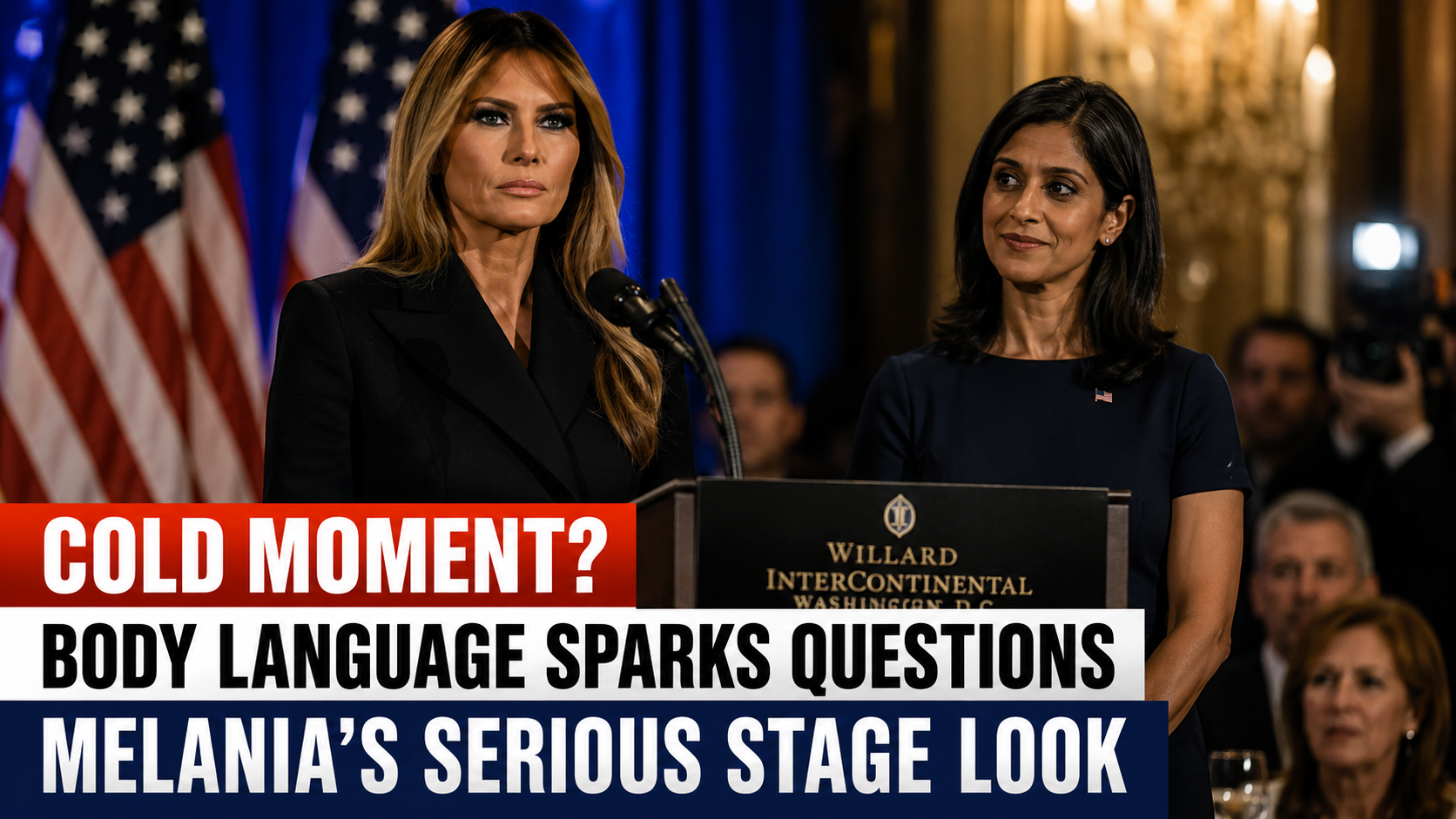
A single moment on stage was enough to set social media on fire. Melania Trump stood beside Usha Vance at one of Washington’s most traditional political luncheons, but instead of a warm hug, handshake, or friendly exchange, viewers noticed something different — a serious expression, limited eye contact, and a calm, almost unreadable presence. Was it awkward distance, quiet tension, or a deliberate display of discipline and power?
At the 113th annual First Lady’s Luncheon, held at the Washington Hilton on April 23, Melania Trump and Usha Vance appeared together before a large audience of political spouses, officials, guests, and media attention. The event itself was meant to focus on children, young people, public service, and policy initiatives. But as often happens in modern politics, one small moment on stage became bigger than the official speech.
Viewers quickly noticed the body language between the First Lady and the Second Lady. Clips from the event spread across social media, with many people describing the interaction as “cold,” “formal,” or “awkward.” Others argued that people were reading too much into a professional moment.
That is what made the scene so interesting. Nothing dramatic happened. No argument. No obvious rejection. No public mistake. But in politics, silence can speak loudly.
You May Also Like



Usha Vance introduced Melania Trump by highlighting her public achievements, including her career as a model, entrepreneur, author, and film producer. Melania then stepped forward to deliver her remarks. During the transition, Vance appeared polite and helpful, even assisting with Melania’s notes. Melania reportedly responded quietly with a simple “thank you.”
“Read more about Melania Trump’s most mysterious public moments and why they always go viral.”
On the surface, it was a small and respectful exchange. But body-language observers pointed out what was missing: no hug, no handshake, no visible warm greeting, and little direct eye contact.
For many viewers, that absence became the story.
Body-language expert Judi James later analyzed the moment, suggesting that the interaction did not necessarily prove personal tension. Instead, she described it as more formal and businesslike. In other words, what some people saw as coldness may have been a deliberate choice to project seriousness, control, and professionalism.
That interpretation fits Melania Trump’s public image. For years, Melania has often appeared reserved, composed, and difficult to read. Unlike many political figures who rely on broad smiles, constant handshakes, and emotional warmth, Melania’s style is often quieter and more controlled. She rarely appears desperate for attention. She often lets silence create its own mystery.
That is exactly why small moments involving her attract so much attention.
In public life, especially for first ladies, people often expect warmth. They expect smiles, hugs, soft gestures, and emotional connection. The role of a first lady has traditionally been tied to hospitality, family, compassion, and symbolic unity. So when Melania appears serious or distant, people immediately begin asking questions.
But this moment may reveal something deeper about the way modern political women are judged.
If a female public figure smiles too much, people may call it artificial. If she stays serious, people may call it cold. If she shows emotion, people may call it weak. If she remains controlled, people may call it strange. Melania’s stage presence with Usha Vance became powerful because it sat directly in the middle of that debate.
Was she being distant — or disciplined?
Was she uncomfortable — or simply focused?
Was it an awkward moment — or a carefully managed public image?
The First Lady’s Luncheon is not a random social gathering. It is a long-running Washington tradition dating back more than a century. The event gives the current first lady a platform to highlight her priorities while also raising support for nonprofit causes. For Melania, the event offered another opportunity to speak about issues affecting children and young people.
During her public role, Melania has often focused on child welfare. In her first term, she launched the “Be Best” campaign, which promoted children’s well-being, online safety, and healthy development. In this appearance, she continued emphasizing leadership, initiative, and the responsibility to support future generations.
She also referenced efforts connected to foster care reform, describing legislative progress as a meaningful step toward protecting vulnerable young people and helping them build better futures.
That part of the event matters because it shows the contrast between the official message and the viral moment. While Melania spoke about children, leadership, and public responsibility, the internet focused heavily on her facial expression, her posture, and her interaction with Usha Vance.
This is the reality of political media today. A serious policy message can be overshadowed by a few seconds of body language.
Still, the public reaction is understandable. People are drawn to what feels unsaid. A speech gives the official message, but body language feels like a hidden message. Whether accurate or not, viewers often believe that expressions, gestures, and pauses reveal the truth behind the performance.
That is why Melania Trump remains such a powerful visual figure. Her public presence often invites interpretation. She does not always explain herself. She does not always soften the moment. She allows people to wonder.
And in media, mystery is powerful.
Usha Vance, on the other hand, appeared polite and composed as she introduced Melania. Her smile and supportive gestures suggested respect for the occasion. But because Melania’s response appeared controlled and focused outward toward the audience, the contrast between the two women became more noticeable.
That contrast created the headline.
Two women. One stage. One formal exchange. Thousands of interpretations.
Some saw tension. Some saw discipline. Some saw awkwardness. Others saw nothing unusual at all.
The truth may be simple: this was a highly formal political event, and both women were acting within the seriousness of the occasion. Not every public appearance requires warmth. Not every stage moment needs emotional performance. Sometimes, a serious expression is just a serious expression.
But the reason this moment became so viral is because Melania Trump has always carried an image of controlled mystery. She is watched not only for what she says, but for what she does not say. Her silence often becomes louder than a speech.
That is why this interaction with Usha Vance captured attention. It was not explosive. It was not scandalous. It was subtle — and subtle moments are often the ones people debate the most.
In the end, the luncheon was about children, leadership, public service, and the future. But the viral conversation around Melania and Usha shows how modern politics has changed. Today, a gesture can become a headline. A missing handshake can become a national discussion. A serious look can become a mystery.
Maybe the moment was cold.
Maybe it was calculated.
Or maybe it was simply Melania Trump doing what she has always done best: standing in silence, holding the room’s attention, and letting everyone else argue about what it meant.