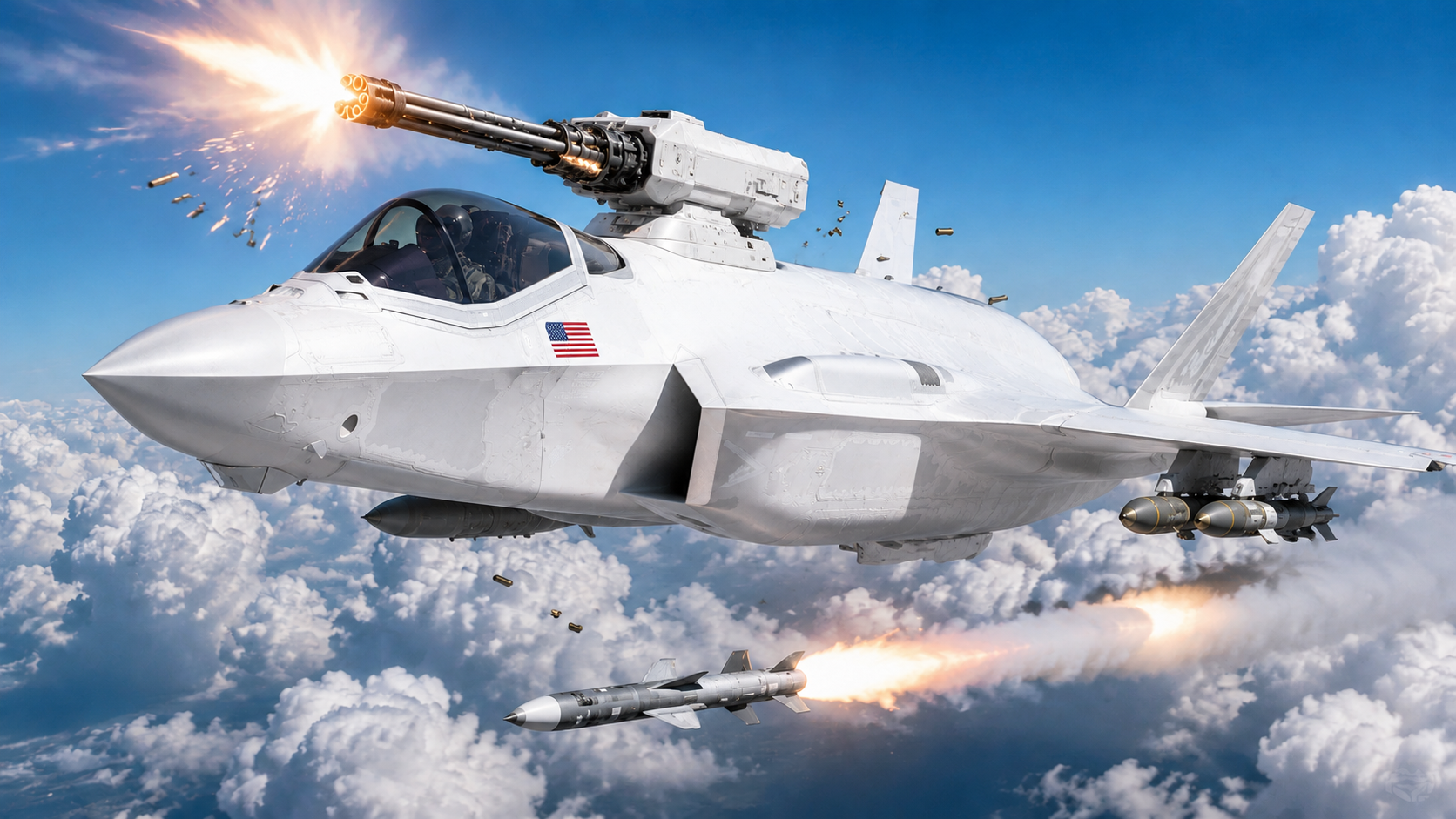
The latest viral headlines claim the United States has finally tested a “new ultra-powerful gun” for the F-35, but the public record tells a more complicated story. There is no clear official confirmation that the Pentagon has just unveiled or test-fired an entirely new cannon for the stealth fighter. The F-35A’s internal GAU-22/A 25mm cannon has been part of the aircraft’s design for years, and Lockheed Martin publicly announced successful airborne gun testing back in 2015.
What is real—and strategically important—is that the F-35 program is in the middle of a wider push to expand its combat punch through Block 4 upgrades, new weapons integration, and a growing test infrastructure to accelerate modifications. One of the most significant officially publicized developments has been the integration testing of long-range strike weapons such as LRASM and related AGM-158 family systems for external carriage on the F-35, a move Lockheed Martin tied directly to Block 4 modernization.
That means the sensational “super gun” framing may be masking the bigger story: America is not simply making the F-35’s cannon more dramatic. It is trying to turn the aircraft into a more versatile strike platform capable of reaching farther, carrying more advanced weapons, and operating as what Lockheed itself describes as a “quarterback of the skies.” At the same time, the Air Force stood up a first-of-its-kind F-35 Combined Test Force at Eglin in 2025 to focus on high-impact modifications and streamline testing, a sign that the Pentagon understands the need to move capabilities into the fleet faster
How Many B-2 Spirit Bombers Were Built?
You May Also Like




But that modernization drive comes with friction. Oversight reporting and defense coverage have repeatedly pointed to delays and integration challenges tied to the broader Block 4 effort, including schedule slips, changing requirements, and pressure on how quickly promised capabilities can actually reach operational aircraft.
So the real question is not whether the F-35 suddenly got a mysterious new cannon. The real question is whether the U.S. is quietly building a more dangerous long-range strike fighter behind the noise of misleading headlines—and whether the most controversial capability is still waiting to be revealed in testing yet to come. If this was never really about a “new gun,” then what exactly is the Pentagon trying to arm the F-35 with next—and why does it matter now?
PART 2
The answer begins with a basic distinction that viral defense headlines often blur: a gun is not the same thing as a broader weapons integration program. The F-35A already carries the internal GAU-22/A cannon, while the F-35B and F-35C rely on an external gun pod concept for cannon employment. That is old news. The newer and more consequential development is the steady effort to make the F-35 carry and employ more advanced standoff weapons under the Block 4 modernization roadmap, even as that roadmap continues to face delays and technical strain.
One of the clearest official signals came from Lockheed Martin’s announcement that LRASM had performed flight tests in the F-35 integration test series, following an earlier F-35C flight test in 2024. Lockheed said the AGM-158 strike family, including JASSM and LRASM, is being integrated for external carriage as part of Block 4. That matters because these are not cosmetic upgrades. They expand the F-35’s ability to threaten ships and land targets at longer range, potentially changing how the aircraft is used in a high-end fight, especially in the Indo-Pacific.
In other words, the aircraft’s growing lethality may come less from a more dramatic cannon and more from its ability to carry smarter, longer-reaching missiles while still acting as a sensor and command node for joint forces. Lockheed’s own description of the jet emphasizes this “quarterback” role, and the Pentagon’s testing posture reflects the same logic: the F-35 is being shaped not just into a dogfighter or bomb truck, but into a networked battle manager that can also strike from farther away.
The new Combined Test Force at Eglin points to the institutional side of that push. The Air Force said the unit was created to address critical capability gaps and streamline F-35 developmental and operational testing. That may sound bureaucratic, but in practice it means the Pentagon is trying to speed up the grind between laboratory promise and fielded capability. New weapons, new mission software, new integrations, and modified tactics do not become real combat power until testing units can validate them fast enough for the fleet to use them.
This Is How Fast The B‑2 Spirit Bomber Can Fly
Still, that is exactly where the controversy begins. The F-35’s modernization story is also a story of delays. Oversight reporting from the DoD Inspector General and outside defense coverage have highlighted serious Block 4 schedule and integration issues. By late 2025, defense reporting said the Pentagon had already pared back or slowed parts of the upgrade plan as slips mounted. The fact that some F-35As have reportedly been accepted without the next-generation APG-85 radar already installed underscores how uneven the path has been between ambitious capability claims and actual delivery.
That tension makes the “super gun” headline more revealing than it first appears. It shows how much public appetite there is for a simple, cinematic story: America builds a deadlier cannon, bolts it onto a stealth jet, and gains a new edge. The real defense story is messier. Modern airpower advantages are often built through software, test infrastructure, sensor fusion, integration of standoff weapons, and incremental changes that sound dull until war starts. By the time the public notices, the real advantage may already be in place.
There is also a strategic subtext that makes all of this more urgent. The Pentagon’s planning environment, including its 2026 National Defense Strategy, is centered on increasingly dangerous competition across multiple theaters. In that context, an F-35 that can carry more credible long-range anti-ship and land-attack weapons is not just an engineering milestone. It is part of how the U.S. signals deterrence, especially in scenarios where closing distance to a defended target could be increasingly risky.
So was America “finally” testing a new ultra-powerful F-35 gun? Not based on the best public evidence available right now. But was America continuing to make the F-35 substantially more dangerous through weapons integration and testing? Yes—and that may be the more important story. The unresolved piece is whether the next major reveal will involve another long-range missile, a sensor leap tied to Block 4, or a capability the Pentagon is not eager to describe in splashy terms until it is closer to operational reality.
The SR-71 Blackbird
That uncertainty is exactly why sensational headlines keep spreading: they oversimplify a program that is already one of the most scrutinized and politically charged in modern defense. But beneath the noise, the pattern is visible. The U.S. is still investing in making the F-35 hit farther, share more, and matter more in a future fight. Whether the program can outrun its delays long enough to fully deliver those promises remains one of the biggest open questions in American military aviation.
Is the F-35 becoming America’s most flexible strike jet—or a delayed promise still chasing its own hype? Share your take.