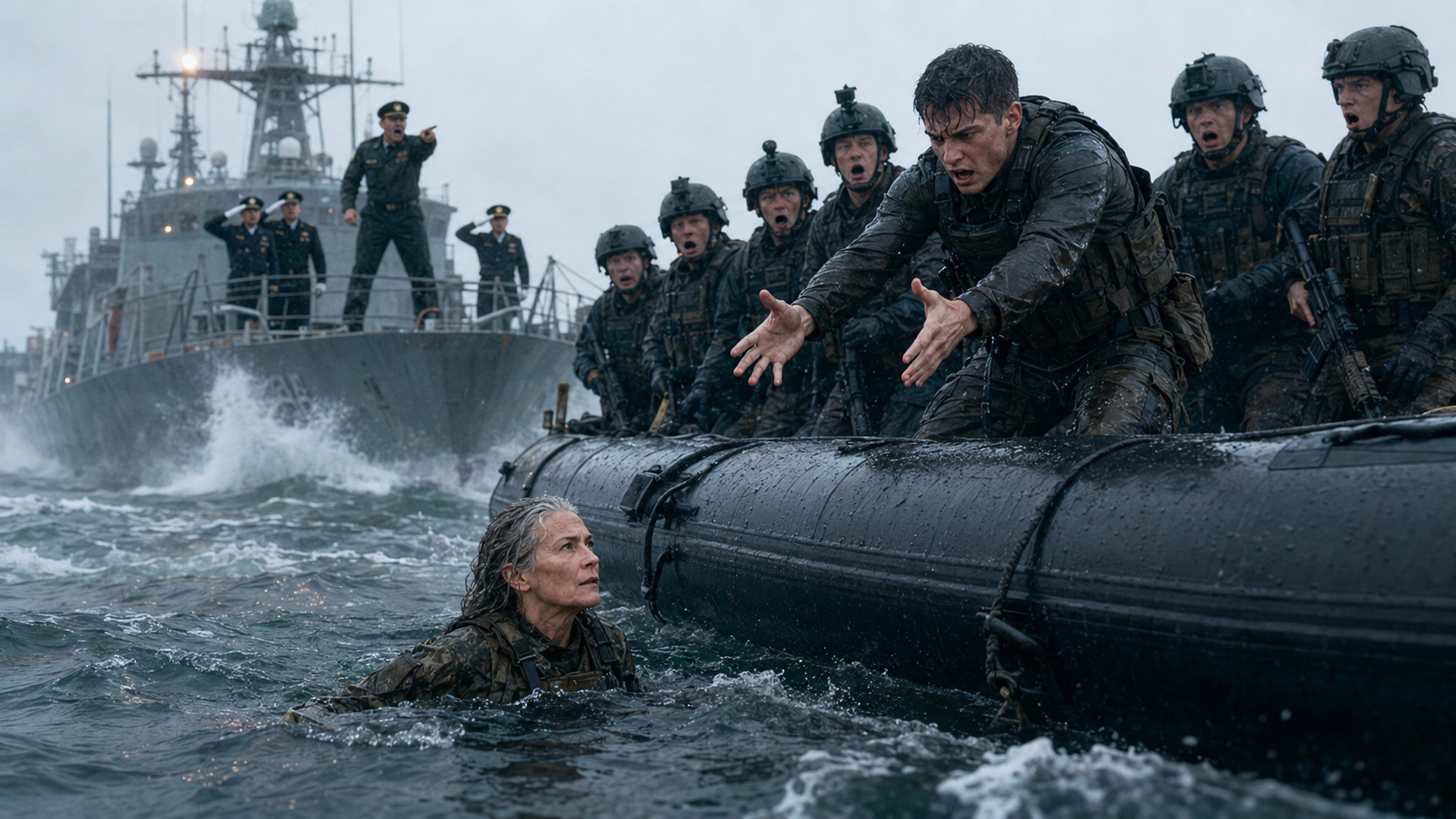
When she ignored my order to clear the port side, I snapped. I leaned in, grabbed her shoulder, and launched her over the rubber gunwale into the freezing Atlantic. It was supposed to be a lesson. A display of pure dominance. But as she went over, she didn’t panic. She didn’t flinch. She just flowed with the push, slicing into the icy water with the grace of an Olympic diver.
The deafening roar of our engines suddenly feels miles away. My buddy Miller, who was laughing two seconds ago, is completely silent. I rush to the side, gripping the safety line. She surfaces immediately, shaking the saltwater from her gray-streaked hair. She isn’t shouting for a life preserver. She’s just floating there, perfectly calm, her dark eyes locking onto mine with an analytical chill that makes my blood run cold. She looks like she’s evaluating a defective piece of equipment. Me. Suddenly, the radio on our instructor’s hip erupts in a burst of frantic static, followed by a voice screaming with raw, unfiltered terror. A massive command vessel cuts through the fog, its bow tearing the waves apart, headed directly for our starboard side. The man at the helm is the Base Commander, and he’s pointing a trembling, furious finger right at my chest.
I thought I was just clearing the deck of a clueless civilian, but the look in her eyes from the freezing water told me I had just made the biggest mistake of my life. My heart stopped as the command boat closed in. The rest of the story is below 👇
You May Also Like

Part 2
The heavy command boat slammed into our wake, nearly knocking me off my feet. The sheer size of the vessel dwarfed our Zodiac, but it was the man standing at the prow that sucked the remaining oxygen from my lungs. Captain Evans, the officer in charge of the entire Coronado training compound. I had only seen him twice, both times from a distance, standing like a god among men. Right now, his face was a terrifying shade of crimson, a thundercloud of pure, unadulterated fury.
“Jensen!” His voice blasted through an electronic bullhorn, echoing over the crushing waves. It wasn’t a question. It was a death sentence. “What in the goddamn name of the United States Navy have you done?”
I swallowed hard, my mouth tasting like battery acid. “Sir, the civilian was in the way of the tactical—”
“Civilian?” Evans roared, lowering the bullhorn, his actual voice loud enough to slice through the wind. “You colossal, arrogant, braindead fool! Stand at attention!”
My body snapped rigid out of pure reflex. My mind raced. Why was the base commander here? Why was he looking at me like I had just committed treason?
Two instructors from Evans’ boat swiftly and expertly hauled the dripping woman from the freezing water. They didn’t just help her; they handled her with a level of frantic reverence that made my stomach bottom out. One immediately wrapped her in a thick thermal blanket, while the other stepped back and snapped a crisp salute. She waved them off with a tiny, imperceptible nod, her focus completely unfazed by the icy plunge. She hadn’t even lost her notebook.
Then came the twist that shattered my entire reality.
Captain Evans didn’t look at her. He kept his murderous glare pinned on me. “You are looking at the consequences of your own pathetic ego, Jensen,” he snarled, pointing a shaking hand at the small woman dripping saltwater onto the deck. “You just shoved Vice Admiral Ana Sharma off a vessel during a live-fire drill.”
The name hit me like a physical blow to the head. The air left the lungs of every single recruit on my boat. Miller whimpered behind me. Vice Admiral Sharma. Her call sign was ‘Nereid.’ She was a living myth, the architect of cold-water extraction protocols, a ghost operative who had spent more time in classified black-ops zones than my entire lineage had spent in uniform. She was the woman who had personally rewritten the manual on survival—the very manual I had skimmed just to pass the written exam.
My knees threatened to buckle. The loud, invincible persona I had built my entire life upon instantly evaporated, leaving behind a terrified, hollow kid.
“She has more logged hours in covert maritime operations than your entire class has been alive,” Evans continued, his voice trembling with a terrifying mix of rage and awe. He finally turned his back to me, faced the small, soaked woman, and snapped a salute so perfect and rigid it looked like it hurt. Every other instructor present mirrored the motion. “Admiral, my profound apologies for this disgrace. It will be dealt with immediately.”
Admiral Sharma pulled the blanket tighter around her shoulders. She didn’t look angry. She didn’t look humiliated. She looked incredibly, profoundly bored. Her dark, ocean-deep eyes slowly drifted from Evans to me, dissecting my panic with clinical precision.
I wanted to speak. I wanted to apologize, to beg, to explain that I didn’t know. But the words turned to ash in my throat. I had mistaken her silence for weakness, her stillness for fear. I was a loud, empty drum, and I had just tried to intimidate a hurricane.
She finally opened her mouth, her voice flat, calm, and cutting through the howl of the wind.
“The unit’s response to an insider threat was chaotic,” she stated, speaking to Evans but looking directly at me. “Man-overboard recovery time was seven seconds outside acceptable parameters. Unacceptable.”
She paused, and the silence that followed was heavier than the ocean itself. “Run the drill again.”
If you’ve read this far, don’t hesitate to leave a like and comment before reading part 3. It makes us as happy as reading a complete story! Thank you. 👍❤️
Part 3“Run the drill again,” Admiral Sharma repeated, her voice perfectly level, completely devoid of the malice I knew I deserved. Then, her piercing gaze flickered over my trembling frame. “And this time… use him as the man overboard.”
Captain Evans didn’t hesitate. “Yes, ma’am!” he barked.
Before I could even process the order, two of my own instructors were on me. The very men who had been grading my ‘alpha’ performance moments ago now looked at me like I was radioactive waste. Without a word, they grabbed me by my tactical harness and heaved me over the rubber side of the Zodiac.
The shock of the freezing Atlantic hit me like a freight train. The breath vanished from my lungs, and the biting cold seized my muscles. I breached the surface, gasping for air, salt water flooding my mouth. I wasn’t graceful. I wasn’t calm. I thrashed against the swells, the heavy weight of my boots and gear dragging me down. Looking up through the stinging spray, I saw the two boats idling above me. My fellow recruits—the guys who used to follow me around like loyal puppies—were staring down at me with wide, terrified eyes. None of them moved to help. They were frozen, their entire understanding of power and authority permanently recalibrated by the small, quiet woman watching from the command deck.
“Recovery!” an instructor finally yelled, throwing a lifeline that slapped me hard in the face.
I scrambled for it, humiliated, coughing, shivering violently. By the time they dragged my soaked, heavy body back onto the Zodiac, I was a pathetic, gasping mess. The swagger was gone. The ego was dead.
Captain Evans leaned over the rail of his vessel, his eyes completely devoid of sympathy. “You are finished, Jensen. Report to the master-at-arms the second we hit the pier. You are confined to the barracks pending your formal separation from the United States Navy for assaulting a superior officer. You are a disgrace to the uniform.”
I didn’t argue. I couldn’t. I just sat heavily on the wet deck, my head hanging in shame, the freezing wind slicing right to my bones. Admiral Sharma had already turned away, her attention back on her notebook, scribbling a new set of data points. She had identified a fatal error in the system—me—and ruthlessly excised it. To her, I wasn’t an enemy. I was just a statistical anomaly that needed correcting.
That day was the end of my military career before it even began. In the span of five minutes, I went from the apex predator to an institutional ghost story. The tale of “the idiot who pushed Nereid” became a foundational myth in the Navy.
Years have passed since that cold, gray morning. I never put on a uniform again. Instead, I moved to a quiet port town and took a job at a civilian maritime safety facility. I teach people how to properly deploy emergency rafts and survive in open water. I am a completely different man now. The barrel-chested arrogance that defined my youth was crushed under the weight of my own hubris, replaced by a quiet, methodical patience.
When I stand in front of my civilian students, watching them struggle with the heavy life vests, I don’t yell. I don’t posture. I often tell them, “The ocean doesn’t care how strong you are. It doesn’t care how loud you scream. It only respects preparation and humility.”
I learned the hard way that true strength isn’t about making noise or imposing your will on others. True strength is quiet, immovable, and devastatingly competent. The loudest guy in the room is usually the most fragile, but the quiet professional? That’s the mountain. And as I found out, the mountain doesn’t celebrate when a fool trips over it. It just stands there, unbothered, while the fool breaks himself.
What do you think of this story? Please leave a like and share your thoughts in the comments. Your support means a lot to us and inspires us to keep writing more meaningful and powerful stories. Thank you! 👍❤️