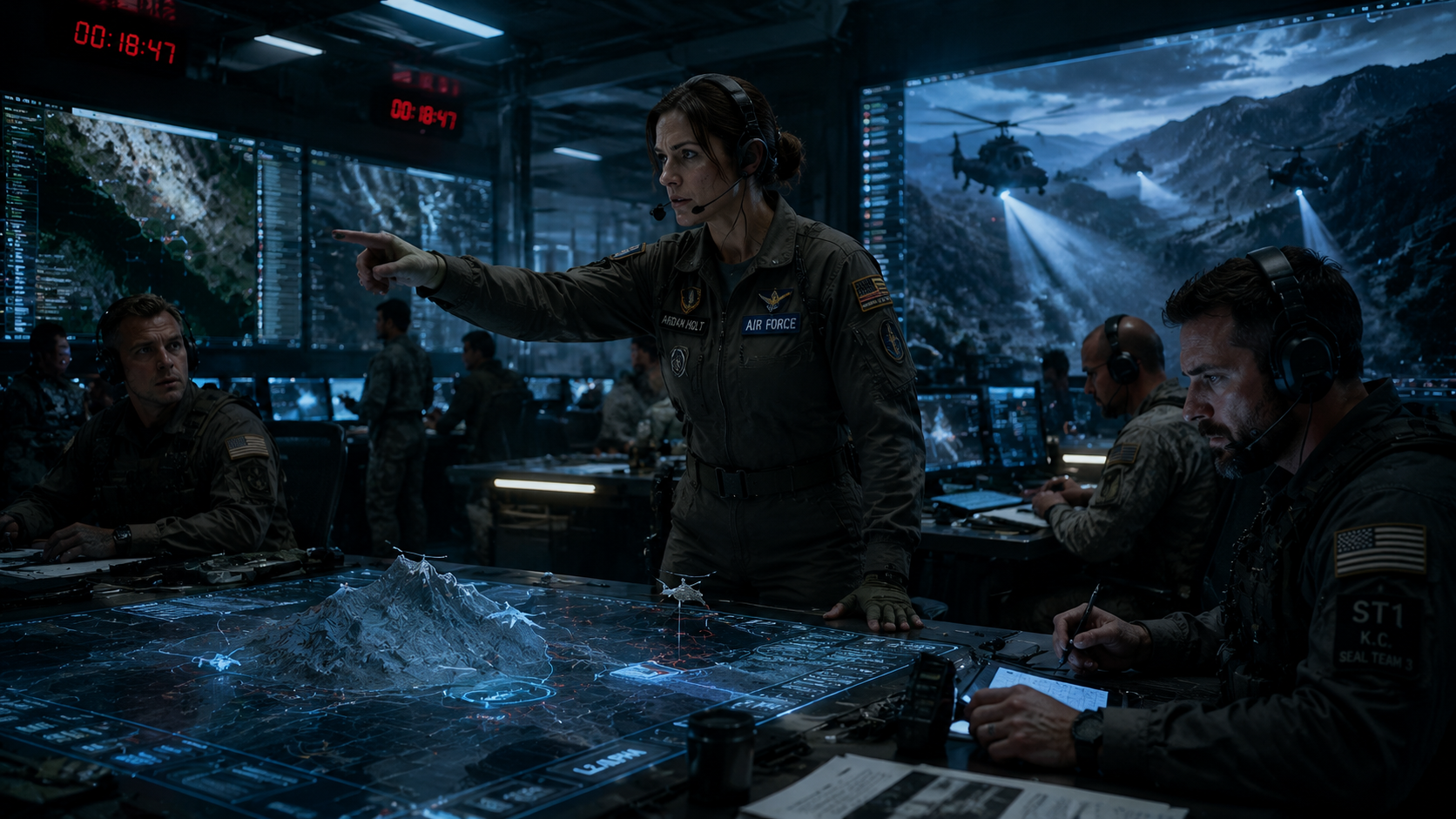
The Tactical Operations Center hummed with a tense, low-frequency panic. Red digital clocks bled seconds onto the walls, and the lives of four American hostages hung on an extraction window closing in exactly twenty-four minutes. I’m Lieutenant Colonel Ardan Holt, an Air Force combat pilot, and I had just stepped into that high-stakes pressure cooker to coordinate the urgent air support.
Before I could even unclip my tactical flight binder, a booming voice cut through the chaos like a jagged blade. “What is this, a joke?”
I turned to face Navy SEAL Captain Mason Ror. He was a towering, heavily decorated commander whose reputation for tyrannical arrogance preceded him. He looked down his nose at my flight suit, a cruel smirk plastering his face right in front of the entire joint task force unit. “Women don’t fly combat, sweetheart. This is the real world. Sit your pretty self down before you embarrass us and make a mess of my operation.”
The room went dead silent. Sergeants and tactical analysts froze mid-keystroke, their eyes darting between us. Ror leaned in closer, his voice dripping with venomous condescension. “I don’t need a desk jockey who got her rank through diversity quotas trying to tell my boys how to handle a hot zone. You haven’t smelled gunpowder in your life. Get out of my TOC.”
You May Also Like
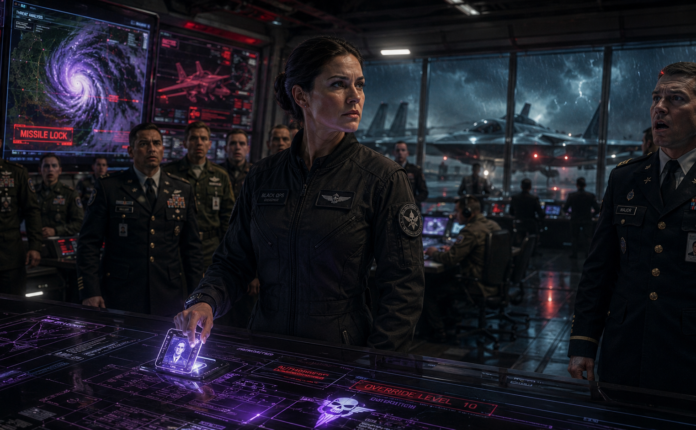
The blatant public disrespect burned, but I didn’t blink. I didn’t raise my voice. In the military, an unchecked ego can get people killed, but an undeniable record speaks louder than any scream. I stood my ground, staring straight into the eyes of the man who held the fates of those hostages—and my patience—in his hands.
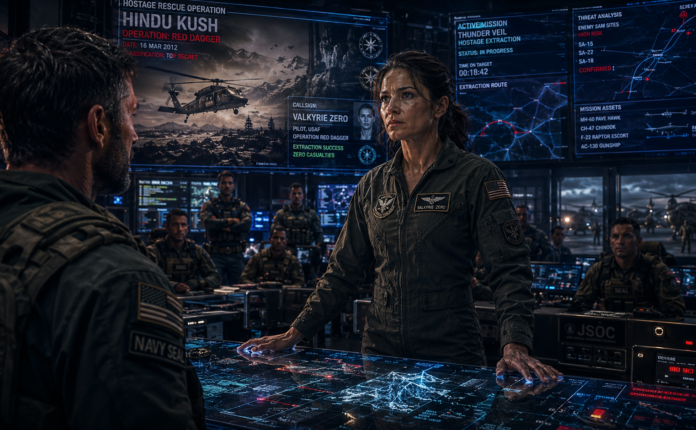
“Captain Ror,” I said, my voice steady, ice-cold, and carrying to every single corner of the room. “Before you order me out of your sight, I suggest you patch through to JSOC operations right now. Call up the encrypted archive from two years ago in the Hindu Kush mountains. Ask them who flew the extraction frame.”
Ror scoffed, crossing his massive arms. “Why the hell would I care about some old ghost story?”
“Because,” I whispered, leaning in just enough so he could see the absolute certainty in my eyes, “you need to ask them for the real identity of the pilot under the call sign Valkyrie Zero.”
The effect was instantaneous. The arrogant color completely drained from Captain Ror’s face, leaving him a ghastly, pale white. The arms he had crossed so confidently dropped heavily to his sides, his fingers twitching.
“Valkyrie Zero?” he whispered, his voice cracking, losing all its previous thunder.
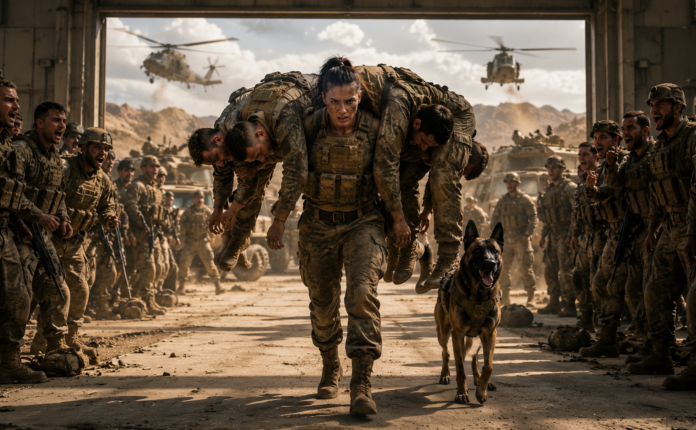
Two years ago, in a pitch-black valley in the Hindu Kush, eight Navy SEALs were surrounded, running out of ammunition, and facing certain death. A catastrophic storm had rolled in, and command had ordered all air assets to abort. But one rogue Air Force pilot defied the direct order, dipped her wings into a blind, zero-visibility canyon under heavy anti-aircraft fire, and pulled those eight men out of the jaws of hell.
Those eight men belonged to Mason Ror’s squadron. Ror had been sitting comfortably in a climate-controlled base hundreds of miles away. After the miracle rescue, he eagerly accepted the commendations, soaking up the glory and letting the Pentagon elevate his career based on the sheer survival of his team. But because the mission was highly classified, the pilot’s true identity had been scrubbed from the active files, remaining a myth known only by that classified call sign. Ror had spent two years bragging about his boys’ rescue, never imagining that the legendary “Valkyrie Zero” was the very woman he had just labeled a useless desk jockey.
“Yes, Captain,” I said, stepping forward, forcing him to take a step back. “I am the pilot who saved your men while you were watching a digital map from a safe distance. Now, are we going to sit here and talk about diversity quotas, or am I going to save your current team?”
The rest of the command center was utterly paralyzed. Sergeants and tactical analysts looked at me with newfound awe. Ror stood frozen, his eyes darting around the room, realizing his absolute authority had just evaporated in front of his subordinates.
But I didn’t have time to savor his public humiliation. The clock was ticking. I immediately took control of the main tactical console, bypassing Ror completely. For the next hour, the TOC was a blur of high-intensity coordination. I directed the strike packages, timed the suppression fire, and guided the extraction choppers through a treacherous ridge. Working flawlessly with the ground teams, we executed the rescue with surgical precision. We breached the hot zone and pulled every single hostage out alive in exactly eight minutes. It was a textbook masterpiece.
When the adrenaline finally faded and the helicopters were safely back on the tarmac, Ror tried to corner me in the hallway outside the TOC. The bravado was entirely gone, replaced by a desperate, sweating panic.
“Holt, listen to me,” he stammered, looking around nervously. “About earlier… I went too far. It was just mission stress. Let’s keep this between us. If you file a formal complaint, it’ll ruin everything. I’m up for promotion next month.”
He was begging. The great, untouchable SEAL commander was pleading with a woman he had insulted hours before. He wanted me to protect his fragile ego for the sake of the “brotherhood.”
“This isn’t about mission stress, Captain,” I replied coldly. “This is about toxic prejudice that compromises operational safety. Your bias almost made you reject the only pilot who could save those hostages today. You are a liability to the uniform.”
The real twist came the next morning when General Vance called me into his command office. He handed me Ror’s official mission log from that operation two years ago. Ror hadn’t just taken credit for his men’s survival—he had officially written that he had personally coordinated the rogue air support from the base, falsifying military records to secure his own promotion. My formal complaint wouldn’t just reprimand him for disrespect; it would trigger an audit that would expose his entire career as a fraud.
General Vance looked at me grimly. “If you press forward with this report, Holt, it will tear down a decorated Navy SEAL hero. The media will have a field day. Are you absolutely sure you want to open this box?”
I gripped the edge of the desk, knowing the immense political pressure I was about to face.
If you’ve read this far, don’t hesitate to leave a like and comment before reading part 3. It makes us as happy as reading a complete story! Thank you. 👍❤️
“I’m absolutely sure, General,” I said without a hint of hesitation. “Leadership isn’t about protecting a false hero’s ego; it’s about protecting the integrity of the mission and the lives of our service members.”
I signed the formal complaint right then and there. The political fallout within the department was swift, but justice prevailed. The subsequent military audit uncovered Ror’s falsified records and systemic misconduct. He was immediately stripped of his active operational command and reassigned to a mundane, dead-end desk position within a domestic training unit. His fast-tracked career ground to a permanent halt. He tried one last time to corner me, offering a hollow apology if I would just retract the statements. I looked him in the eye and walked away. I wanted him to carry the full weight of his actions.
Ten years flew by in a blur of supersonic flights and breaking systemic barriers. I was promoted to full Colonel (O6) and appointed to the prestigious JSOC Advisory Committee on Gender Integration and Operational Effectiveness. Our mission was to reshape Pentagon policies to ensure that capability, not gender, dictated who served on the front lines of special operations.
On my first day at the Pentagon briefing room, I walked in and stopped dead in my tracks. Sitting at the far end of the long conference table was Mason Ror. He had long since retired from active duty and was now working as a civilian defense contractor, consulting on tactical training methodologies.
The room fell quiet, the old tension briefly crackling in the air between us. I braced myself for another political battle, but what happened next caught me completely off guard.
When it was Ror’s turn to present to the board, he clicked to his opening slide. Displayed clearly on the screen was a detailed breakdown of our fateful confrontation in the TOC ten years prior, stripped of names but completely accurate in its tactical errors. Ror looked directly at me, then turned to the committee of high-ranking officers.
“Gentlemen, and ladies,” Ror began, his voice completely devoid of its old arrogance. “We are going to start today by examining a catastrophic failure of leadership. My own. Ten years ago, my personal prejudices almost cost the lives of an entire hostage rescue team because I refused to listen to a superior tactical mind simply because she was a woman. Bias isn’t just offensive; it is a tactical vulnerability that can get American soldiers killed.”
I sat back in my chair, stunned. The man who had tried to humiliate me had swallowed his pride to use his own greatest shame as a case study to educate the next generation of leadership. We never became close friends, but over the next few years, we forged a deep, professional respect. Together, our joint policy proposals were officially approved by the Joint Chiefs of Staff, fundamentally altering how the military trained, evaluated, and integrated female combat personnel.
Another ten years passed. Two decades after that explosive day in the TOC, I found myself standing in front of a mirror, straightening the collar of my dress uniform. A single, polished silver star gleamed brightly on my shoulder. At fifty-nine years old, I had been promoted to Brigadier General.
I walked out onto the grand stage of the United States Air Force Academy to deliver the commencement address to the graduating class. Looking out at the sea of eager, young faces in crisp uniforms, I saw a vibrant, balanced mix of young men and women ready to take to the skies.
After the ceremony, a sharp, young female cadet approached me, saluting flawlessly. “General Holt, ma’am. Cadet Morgan Sharp. I requested this assignment specifically to meet you.”
I smiled, shaking her hand firmly. “It’s a pleasure, Cadet. What brings you to my line?”
“My uncle is Evan Sharp, ma’am,” she said, her eyes shining with immense pride. “He was a junior officer in the TOC twenty years ago when you stood your ground against Captain Ror. He told me the story before I left for the Academy. He said watching you that day taught him the greatest lesson of his life: true leadership is about protecting the mission, never your own ego.”
As I watched Cadet Sharp walk away to join her classmates, a profound wave of emotion hit me. I realized then that my greatest legacy wasn’t the supersonic jets I had flown or the heart-pounding rescue missions I had executed. It was the invisible line I had chosen to draw in the sand two decades ago. Because I stood my ground, this new generation of women could spread their wings and fly into the storm, never needing to ask anyone for permission to prove they belonged in the sky.
What do you think of this story? Please leave a like and share your thoughts in the comments. Your support means a lot to us and inspires us to keep writing more meaningful and powerful stories. Thank you! 👍❤️