My name is Harper, and I empty trash cans for a living.
Officially, I’m a “float nurse” at Mercy General. Unofficially, I’m the punching bag for Charge Nurse Nancy and a ghost to everyone else. It’s by design. The less they look at me, the less they ask about the scar on my neck or why I never flinch when the trauma alarms blare.
Tonight was supposed to be quiet. I was mopping up a spilled saline bag while Dr. Chen hyperventilated over a collapsed vein in Trauma 2. The kid was holding the IV needle like a dart, terrified of the frail elderly patient. Before Nancy could tear Chen a new one, I bumped his shoulder, took the needle, and found the invisible vein by pure muscle memory. One second, one flash of red. Done.
“Go back to cleaning, Harper,” Nancy snapped. I nodded, slipping into the supply closet.
You May Also Like

Then the building shook.
The distinct, bone-rattling thwack-thwack-thwack of military rotors drowned out the beeping monitors. Civilian medevacs don’t sound like that. That was a Black Hawk.
LG
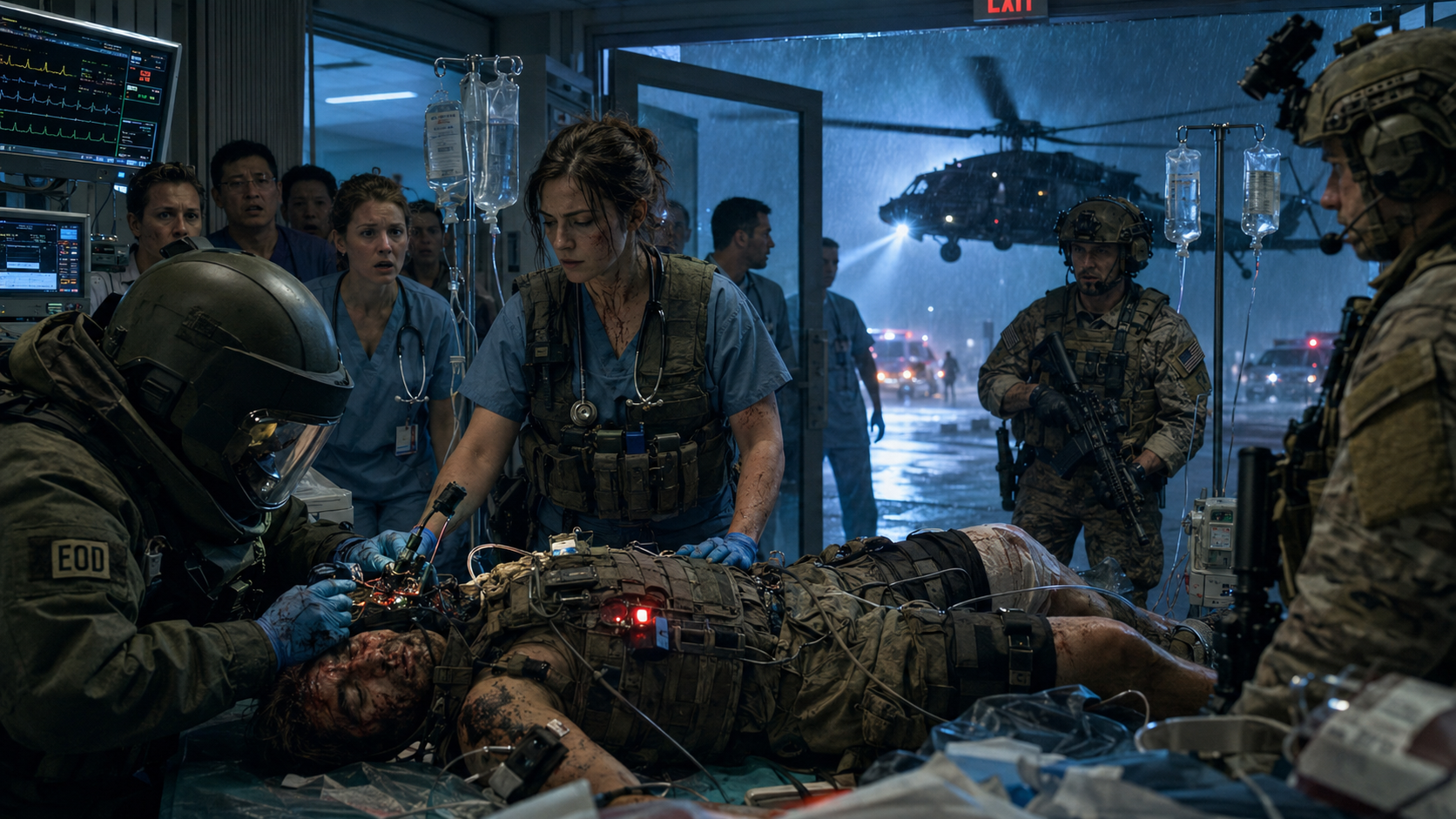
The ER doors blew violently off their tracks. A four-man Special Ops team breached the waiting room, ignoring the screaming triage nurses. They carried a soldier who was bleeding out fast. His uniform was shredded, a tactical tourniquet cranked agonizingly tight over the stump of his missing leg. Worse, his lips were blue. Tension pneumothorax. He had minutes, maybe seconds.
Dr. Aerys, the attending, stepped up, her voice trembling. “Put him on the bed! What happened?”
The squad leader-a broad-shouldered operative covered in soot-shoved Aerys aside. “Don’t touch him!”
“Sir, this is a hospital, if you don’t let us-” Nancy started, her usual arrogance faltering against the heavily armed men.
“Shut up,” the leader commanded, his hardened eyes scanning the terrified civilian staff. I knew that voice. Wyatt. He wasn’t looking for a doctor. He was hunting for the only person he trusted to put a soul back into a shattered body
I’m looking for a medic,” Wyatt roared, his gaze sweeping over the cowering nurses and resident doctors. “Callsign Dusty. I know she’s in this building. Bring her out, or my boy dies right here on your floor!”
I held my breath in the shadows of the closet, my heart hammering against my ribs. I had buried Dusty three years ago. But Wyatt was looking straight at the closet door.
I pushed the door open before he could tear it off its hinges.
“Harper?” Dr. Chen whispered, bewildered. “What is he talking about?”
I ignored him. I ignored Nancy’s furious, confused glare. I stepped out of the shadows, my eyes locked on the bleeding soldier on the tactical litter. The ambient noise of the civilian hospital faded, replaced by the rushing roar of combat adrenaline I had spent three long years trying to suppress.
“You shouldn’t be here, Wyatt,” I said, my voice dropping an octave, losing the meek, accommodating tone I used for my float nurse duties.
“We bypassed MedCenter for you, Dusty,” Wyatt rasped, his voice cracking with a desperation that didn’t belong on a Tier One operator. “It’s Hayes. He’s drowning in his own chest. The blast took his leg, but the shrapnel… his lung is collapsed. He’s got maybe two minutes before his heart stops.”
Hayes. The name hit me like a physical blow. The twist of the knife. Hayes was the rookie. The one whose life I couldn’t save during the Fallujah ambush—or so I thought. The guilt over his supposed death was the reason I walked away, the reason I hid in this dead-end job emptying bedpans. But he was here. Alive. Barely.
“He didn’t die?” I choked out, the sterile ER spinning for a fraction of a second.
“He survived,” Wyatt said grimly. “But he won’t make it to surgery tonight without you. Do it, Dusty.”
“Harper, get out of the way!” Nancy finally snapped out of her shock, marching forward with false bravado. “Security, get these men out of here! Dr. Aerys, take the patient!”
The operator guarding the door simply shifted his rifle, and Nancy stopped dead in her tracks, squeaking in terror.
I didn’t hesitate anymore. The float nurse died in that hallway; the combat medic resurrected.
“Put him on Trauma Bed One! Now!” I barked. The sheer authority in my voice made even Dr. Aerys jump back. Wyatt and his men hoisted Hayes onto the bed. I grabbed a pair of sterile gloves, snapping them onto my wrists.
“Harper, what do you think you’re doing? You’re a float nurse, you don’t have authorization—” Nancy shrieked.
I didn’t even look at her. “Nancy, get me a 14-gauge needle, a 10-blade scalpel, and a chest tube kit. Move!”
“I will not take orders from a glorified maid!” she yelled.
I rounded the bed, closing the distance between us in a heartbeat. I grabbed her by the collar of her expensive scrubs, my eyes dead and cold. “Listen to me very carefully. If you don’t hand me that scalpel in three seconds, I will break your fingers and take it myself. Get the damn kit.”
Nancy turned white as a sheet, scrambled to the cart, and threw the tray onto the mayo stand.
Hayes was cyanotic. His lips were the color of bruised plums, his trachea visibly deviated to the left. Tension pneumothorax. Air was trapped in his pleural cavity, crushing his heart. There was no time for anesthesia. No time for sterile fields or civilian protocols.
I snatched the 14-gauge needle. “Hold him down,” I ordered Wyatt. The giant operator pinned Hayes’s shoulders.
Without a flinch, I slammed the needle into the second intercostal space of Hayes’s right chest. A loud, sharp hiss of escaping air echoed in the silent room. Blood splattered across my scrubs, warm and familiar. Hayes gasped, a violent, ragged intake of breath, his eyes flying open in sheer agony.
“He needs a chest tube, now,” I commanded, tossing the needle and grabbing the scalpel. “Chen, prep a large-bore IV, push a liter of LR and get O-neg blood flowing. Aerys, manage that tourniquet!”
The civilian doctors stared at me in absolute, paralyzing horror. They had never seen battlefield medicine. They had never seen me. I pressed the cold steel of the scalpel against Hayes’s ribs, ready to slice into his chest wall raw, when Wyatt suddenly grabbed my wrist, his grip like a vise.
“Dusty, wait,” Wyatt said, his eyes darting to a flashing light on Hayes’s tactical vest that I had missed in the chaos. “There’s a problem.”
Part 3My hand froze, the edge of the 10-blade resting a millimeter from Hayes’s skin. The flashing red light on his tactical vest wasn’t a standard beacon. It was a digital timer, wired directly into a block of C4 strapped beneath his armor plates.
“An IED secondary,” Wyatt gritted out, his voice a low, dangerous rumble. “The bomb squad couldn’t defuse it in the field. If his heart rate drops below forty beats per minute, or if we try to pull the vest off… it detonates. We couldn’t take him to a major military hospital. They would have locked down the block and let him die in an isolation bunker.”
A collective gasp ripped through the ER. Nancy whimpered, backing away toward the exit, only to be stopped by the grim-faced operative guarding the door. Dr. Aerys and Chen looked like they were going to faint. We were all standing on a live mine.
“You brought a bomb into a civilian hospital?” I hissed, the betrayal stinging my chest.
“I brought my brother to the only person who can keep his heart beating fast enough to buy us time!” Wyatt fired back. “The EOD tech is two minutes out. Just keep him alive, Dusty. Please.”
I looked down at Hayes. The young soldier I had carried immense guilt for. The kid I thought I had failed in the dust of Fallujah. His pulse was thready, his eyes rolling back. The needle decompression had bought him minutes, but his lung was still collapsing, and his heart rate was plummeting. The monitor beeped sluggishly. Forty-eight… forty-five…
“Get out!” I roared at the civilian staff. “Nancy, Aerys, Chen—evacuate the ward! Go!”
“I’m staying,” Chen stammered, his face pale but his jaw set as he grabbed the blood bags. I didn’t have time to argue. I nodded once.
“Wyatt, hold the vest steady. Do not let it shift.”
I didn’t wait for the anesthesiologist. With a swift, brutal, and precise motion, I drove the scalpel through the muscle between Hayes’s ribs. He screamed—a raw, guttural sound of pure agony. Blood poured over my hands, soaking into my sterile gloves, staining my cheap float nurse scrubs. I shoved my gloved finger directly into the incision, feeling the slick, warm tissue of his lung to clear the path, before jamming a plastic chest tube into the cavity.
“Clamps! Suture!” I snapped. Chen fumbled but managed to slap the instruments into my palm. I secured the tube, hooking it to the wall suction. Dark, frothy blood immediately rushed through the plastic tubing.
The monitor’s sluggish beeping began to accelerate. Fifty… fifty-five… sixty-two.
Hayes sucked in a massive, ragged breath. His eyes locked onto mine. Recognition flashed through the pain. “Dusty…” he breathed, blood bubbling at the corner of his mouth.
“I got you, kid,” I whispered, tying off the suture. “I’m not losing you twice.”
The ER doors slid open, and a heavily armored EOD technician rushed in, carrying a tactical kit. I stepped back, my chest heaving, my hands coated in crimson. The tech moved in, meticulously snipping the wires on the vest until the dreaded red light went dark.
The collective exhale in the room was palpable. The immediate threat was gone. Dr. Aerys and the trauma surgical team rushed back in, taking over to wheel Hayes to the OR for his leg. Wyatt stopped at the door, turning back to me. He reached into his tactical pouch and pulled out a small, blood-stained Velcro patch.
He pressed it into my palm. It read: Whiskey-6. My old callsign.
“You can scrub the floors, Harper,” Wyatt said softly, looking at my blood-soaked hands. “But you can’t wash off who you really are. Thank you.”
He turned and followed the gurney.
The ER was a disaster zone. Wrappers, blood, and medical debris littered the floor. The remaining staff—doctors, nurses, security—stood in a stunned circle, staring at me. Nancy looked at me like I was a ghost, her former arrogance replaced by an awe-struck, terrified silence. Dr. Chen looked at me with pure reverence. They were waiting for me to say something. To explain. To take charge.
I walked over to the sink, turning on the faucet. I watched the water turn pink, then clear, as the blood washed down the drain. I dried my hands on a paper towel, feeling the rough texture of the Whiskey-6 patch in my pocket.
I turned back to the room, my face a mask of absolute indifference.
“Someone needs to mop up Bay One,” I said, my voice returning to its quiet, flat tone. “I’m just the float nurse. I don’t do blood.”
Leaving them paralyzed in shock, I grabbed a fresh box of gauze and walked quietly down the hall, back into the shadows.