I’m Marcus Davis, and I’ve spent my entire career learning how to read people, but nothing prepared me for the raw malice in Officer Brian Harkins’ eyes. It was a crisp afternoon in Riverside Park, and I was minding my own business, calmly reading a book on a park bench. Then, he appeared. He didn’t just walk up; he marched, his hand hovering menacingly over his holster, operating on pure racial bias and some flimsy assumption that I matched a vague robbery suspect description.
“Hands where I can see them! Now!” he barked, his voice echoing sharply across the concrete.
I slowly closed my book, keeping my movements deliberate and completely non-threatening. “Officer, is there a problem?”
“Don’t play smart with me,” Harkins snapped, stepping directly into my personal space. He was visibly unsettled by my complete lack of fear, frustrated that his presence alone hadn’t reduced me to trembling submission. His pride was a volatile substance, and I could see it exploding in real-time. “You fit the description of an armed suspect. Stand up, turn around, and give me your ID.”
You May Also Like

“I haven’t committed any crime, Officer,” I said, maintaining a composed and cooperative demeanor. I knew my rights perfectly, but I also knew how quickly a situation like this could turn fatal for a Black man in America.
Instead of de-escalating, my calm only infuriated him further. He didn’t want cooperation; he wanted a confession of guilt written in my terror. Ignoring every protocol in the manual, Harkins lunged forward and grabbed my wrist, twisting it brutally behind my back.
“You’re resisting!” he lied loudly, asserting dominant force as he shoved me hard against the cold metal of the bench.
“I am not resisting, Officer,” I replied, my voice steady even as the steel edges of the handcuffs bit viciously into my wrists.
He didn’t care about the truth. He dragged me toward his patrol car, ignoring the stares of gathering onlookers, and violently shoved me into the cramped, suffocating backseat. As the heavy door slammed shut, sealing me in darkness, Harkins locked eyes with me through the rearview mirror—a look of smug triumph masking dangerous incompetence. The engine roared to life, and as we sped toward the precinct, I realized my survival depended on a secret I wasn’t ready to reveal yet.
Harkins thought he just bagged an easy collar to feed his fragile ego, but he has absolutely no idea whose life he just upended—or the absolute storm waiting for him at the precinct. The rest of the story is below 👇
Part 2
The ride to the precinct was a suffocating blur of flashing red and blue lights reflecting off the steel mesh separator. Officer Harkins drove like a man who had just won a prize, occasionally throwing smug glances at me in the rearview mirror. I kept my mouth shut, breathing slowly, letting the anger settle into a cold, calculated focus. He thought he had broken me. He thought he had successfully neutralized another “threat” on his streets.
When we pulled into the secure garage of the precinct, Harkins hauled me out of the cruiser with unnecessary force, his fingers digging deep into my arm. He paraded me through the booking area, his chest pushed out, eager to show his colleagues his latest catch. The atmosphere in the precinct was loud—phones ringing, radios buzzing, and the low hum of stressed voices filled the room.
“Got a live one, Jenkins,” Harkins announced arrogantly, shoving me toward the high booking desk where a veteran officer sat, sorting through paperwork. “Matches the Riverside Park robbery profile. Refused to comply, acting highly suspicious.”
Officer Jenkins didn’t look up immediately. He sighed, reached for my wallet which Harkins had confiscated from my pocket, and pulled out my driver’s license. “Name?” Jenkins muttered.
“Marcus Davis,” I said, my voice deadpan.
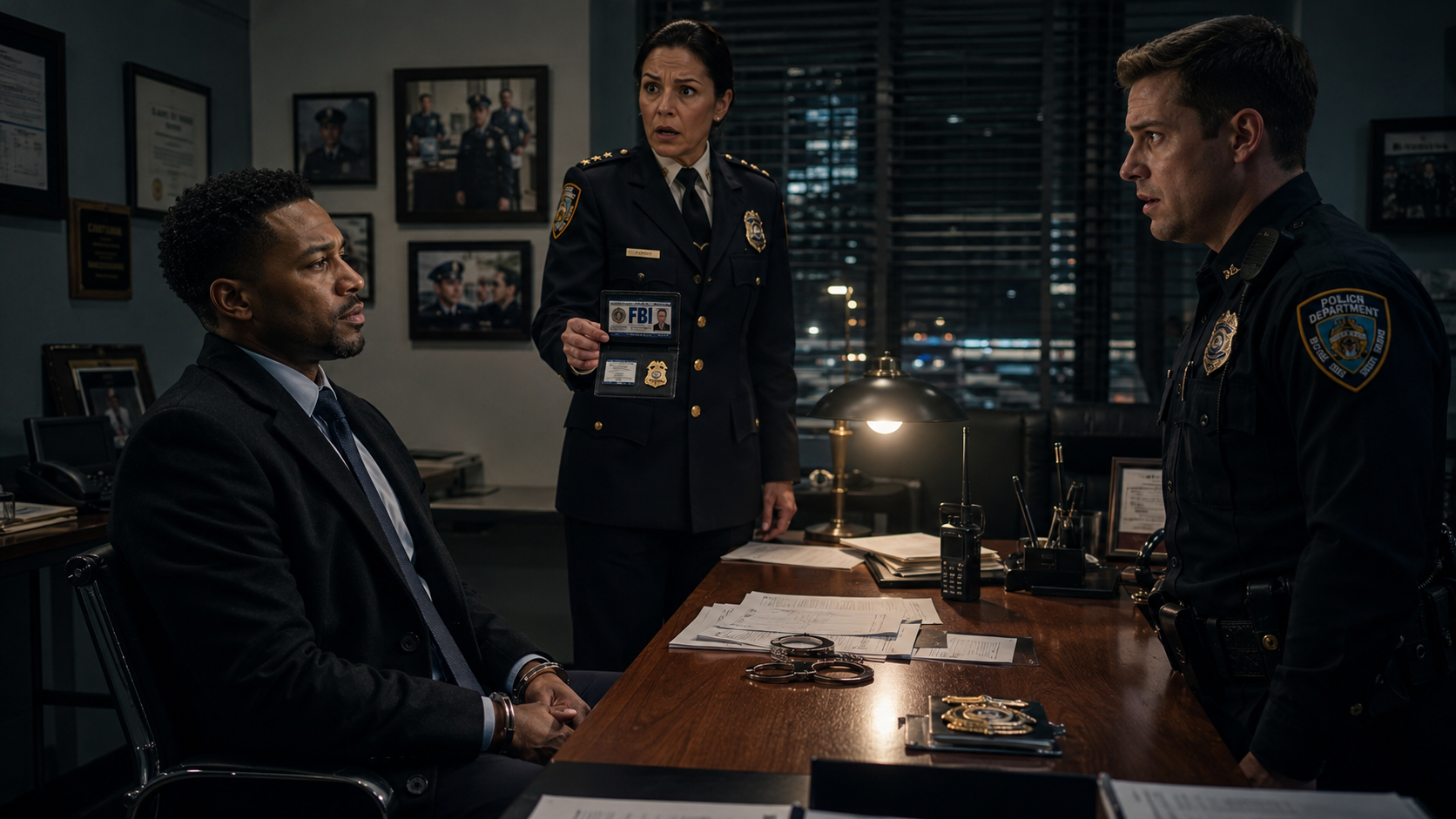
Jenkins typed the name into the system, his fingers moving mechanically. Then, he opened the leather wallet further to check for secondary identification. I watched his face closely. Suddenly, his fingers froze over the keyboard. The mechanical rhythm of his typing stopped completely. A brief, unmistakable flicker of recognition and pure shock flashed across Jenkins’ tired face. He looked at the ID, then looked up at me, his eyes widening. He blinked, looking back down at the heavy gold and enamel shield tucked into a hidden compartment behind the credit cards, alongside an official federal credential.
“Harkins,” Jenkins said, his voice dropping an octave, completely stripping away the casual demeanor. “Where exactly did you pick him up?”
“Riverside Park, like I said. Why?” Harkins smirked, completely oblivious to the sudden shift in the room’s temperature. “What’s the matter, Jenkins? Don’t tell me he’s got a clean record. He was acting dirty from the start.”
Jenkins didn’t answer him. Instead, he grabbed his desk phone, dialed a three-digit extension, and spoke in a hushed, urgent tone. “Captain? We have a massive situation in booking. You need to see this immediately. Officer Harkins just brought in Marcus Davis… Yes, ma’am. That Marcus Davis.” Jenkins hung up the phone, his face pale. He looked at Harkins with something resembling pity. “Take him straight to Captain Bennett’s office. Right now.”
Harkins frowned, his pride slightly bruised by the lack of praise, but he grabbed my shoulder anyway. “Moving. Let’s go, Davis. Looks like the Captain wants to personally see the garbage I drag off her streets.”
We walked down the narrow, fluorescent-lit hallway toward the corner office. Harkins pushed the door open without knocking, marching me inside. Captain Laura Bennett was standing behind her desk. She was a fierce, sharp-witted woman who had run this precinct with an iron fist for five years. But the moment her eyes landed on me, her stoic expression shattered into pure horror.
“Officer Harkins,” Captain Bennett said, her voice dangerously quiet. “What is the meaning of this?”
“Caught him at the park, Captain. Suspicious behavior, matched the robbery suspect, resisted my commands—”
“Shut up, Brian,” Bennett barked, cutting him off like a buzzsaw. She bypassed Harkins entirely, stepping directly in front of me. “Marcus… oh my God. I am so incredibly sorry.”
Harkins blinked, his jaw dropping. “Captain? You know this guy?”
“Know him?” Bennett spun around, her eyes flashing with absolute fury. “This ‘guy’ is FBI Special Agent Marcus Davis, Head of the Regional Organized Crime Task Force. He outranks everyone in this building, including me!”
The silence that followed was deafening. Harkins went entirely pale, the smug arrogance draining from his face so fast I thought he might faint. The danger hadn’t passed; it had just completely shifted targets.
If you’ve read this far, don’t hesitate to leave a like and comment before reading part 3. It makes us as happy as reading a complete story! Thank you. 👍❤️
Part 3
The handcuffs clattered onto Captain Bennett’s desk with a sharp, metallic ring that sounded like a gavel delivering a final verdict. Officer Harkins stood completely frozen, his eyes darting between his captain and me, his breathing shallow and panicked.
“Marcus, why didn’t you just show him your federal credentials on the scene?” Captain Bennett asked, her voice a mix of deep embarrassment and genuine confusion. “This entire nightmare could have been avoided with one look at your badge.”
I adjusted my jacket, looking directly into Harkins’ terrified eyes. “Because, Laura, a citizen shouldn’t need a federal badge to be treated with basic human dignity and respect by law enforcement,” I said, my voice cutting through the tense air of the room. “If I had pulled out my credentials right away, I would have protected myself, but I would have left the next innocent person defenseless against his bias. I needed to see exactly how far he would go when he thought nobody was watching.”
Bennett nodded slowly, understanding the gravity of the systemic failure sitting right in front of her. She turned her gaze to Harkins, her expression turning into pure stone. “Officer Harkins, hand over your service weapon and your badge. You are placed on immediate, unpaid temporary leave pending a full Internal Affairs investigation.”
Harkins stammered, his pride completely shattered. “Captain, please, it was an honest mistake, the description—”
“Get out of my office,” she ordered.
The subsequent internal investigation moved with unprecedented speed. Over the next two weeks, investigators gathered park witness statements and pulled the definitive audio and video from Harkins’ own bodycam footage. The evidence was damning. It clearly demonstrated that Harkins had engaged in blatant racial profiling, fueled entirely by groundless aggression and a toxic refusal to back down once his authority was calmly questioned.
The climax of the investigation brought us to the official review panel room. I sat at the head of the long conference table alongside the department’s top brass. Harkins stood before us, stripped of his uniform, looking incredibly small. When it was my turn to speak, I didn’t yell. I spoke directly to the room, ensuring every officer present swallowed my words.
“The high pressure of police work is undeniable,” I stated, looking around the board. “But pressure is never an excuse for biased decision-making. When you put on that uniform, you swear an oath to protect, not to profile. True strength isn’t about forcing submission; it’s about exercising restraint. We need systemic growth, not just individual retaliation.”
A few days later, Captain Bennett called me back into her office for the final resolution. “It’s official, Marcus,” she said, handing me the signed paperwork. “Following a thorough review of the evidence, Officer Harkins has been officially terminated from the police force. There is no place for his brand of policing in this city.”
As I walked out into the main bullpen to leave, I saw Harkins at his old desk, packing his personal belongings into a cardboard box. The room was completely silent around him; his former colleagues wouldn’t even look his way. As I passed, he paused, holding a framed photo. He looked up, his eyes tired, stripped of the anger that had driven him two weeks ago. He briefly acknowledged his failure to me with a slow, solemn nod—a silent admission that he had brought this ruin upon himself—before exiting the precinct permanently.
But the story didn’t end with one bad cop losing his job. Bennett and I knew that firing Harkins was just fixing a symptom, not the disease. We immediately began collaborating on sweeping structural department reforms. Together, we designed a mandatory, rigorous curriculum focused on advanced de-escalation tactics and intensive implicit bias training. Out of a moment of ugly injustice, we forged a path toward real, lasting accountability, ensuring the streets of our city would finally become safer for everyone.
What do you think of this story? Please leave a like and share your thoughts in the comments. Your support means a lot to us and inspires us to keep writing more meaningful and powerful stories. Thank you! 👍❤️