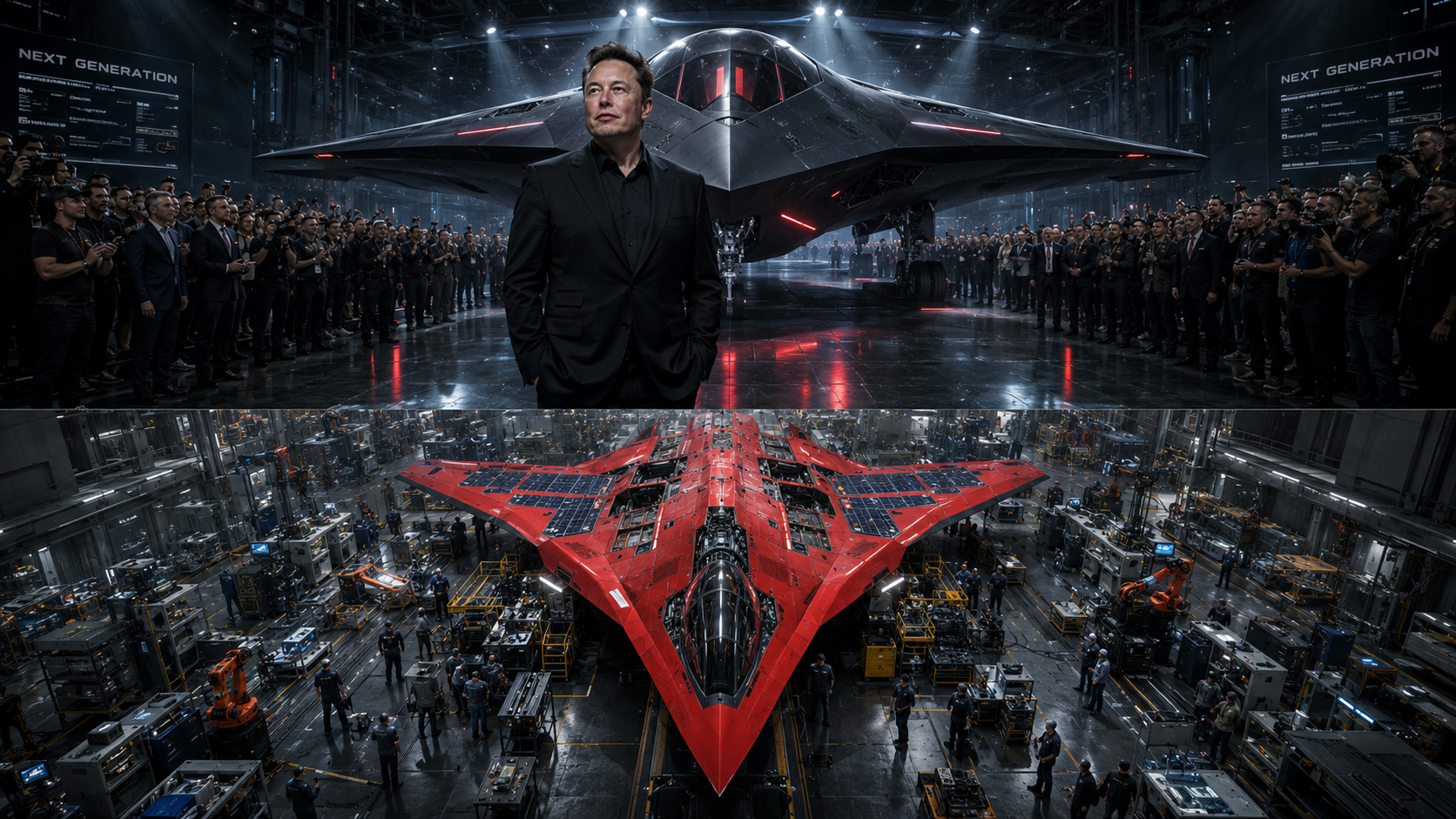
For more than a century, every aircraft ever built has obeyed the same unforgiving law:
Gravity always wins.
From the Wright brothers’ fragile flyer to modern stealth fighters capable of supersonic combat, aviation has always been a battle against weight, drag, fuel limits, and physics itself.
But what if that changed?
You May Also Like



What if an aircraft no longer needed traditional lift?
What if it could maneuver without relying entirely on aerodynamic surfaces?
What if the boundaries between fighter jet, spacecraft, and drone disappeared altogether?
That is why rumors and speculation surrounding an alleged “anti-gravity fighter jet” linked to Elon Musk have captured global imagination.
The concept sounds like science fiction.
Yet it touches something deeper than technology.
It reflects humanity’s endless desire to break limits once believed impossible.
Before separating speculation from reality, it is important to understand why the very idea of anti-gravity fascinates the world—and why even discussing it reveals how rapidly aerospace innovation is evolving.
Part I — The Dream Humans Have Chased for Generations
Humanity’s Ancient Obsession With Flight
Long before modern science, humanity dreamed of escaping Earth’s pull.
Ancient myths told stories of flying chariots and winged gods.
Leonardo da Vinci sketched machines centuries before powered flight existed.
Then, in 1903, the Wright brothers proved that controlled flight was possible.
What once seemed impossible became ordinary.
That pattern repeats throughout history.
Each generation calls something impossible—until the next generation builds it.
Why Anti-Gravity Captures the Imagination
The phrase “anti-gravity” suggests the ultimate breakthrough:
A technology capable of overcoming gravity without conventional propulsion.
If such a system existed, it could theoretically allow:
- Instant acceleration.
- Silent hovering.
- Extreme maneuverability.
- Reduced fuel consumption.
- Near-space operations.
- Revolutionary spacecraft designs.
It would fundamentally transform aviation and defense.
But there is a crucial distinction between scientific theory, experimental research, and proven engineering reality.
Part II — Separating Science From Speculation
Has Elon Musk Actually Built an Anti-Gravity Fighter Jet?
As of today, there is no verified public evidence that Elon Musk or any company has developed a true anti-gravity aircraft.
No confirmed scientific breakthrough has demonstrated the ability to negate gravity in the way often portrayed in science fiction.
That point is essential.
Many online claims are speculative, exaggerated, or fictionalized.
However, the excitement surrounding such concepts reflects real advances in aerospace technology that are pushing aircraft toward capabilities once considered impossible.
Why People Believe It Could Happen
Elon Musk has become associated with ambitious technological leaps through companies such as:
- SpaceX
- Tesla
- Neuralink
SpaceX dramatically reduced launch costs and revolutionized reusable rockets.
Tesla accelerated the global shift toward electric vehicles.
Because Musk has repeatedly challenged assumptions, many people view even extraordinary claims as potentially plausible.
Part III — What a Real “Anti-Gravity” Fighter Would Need
The Physics Problem
Gravity is one of the four fundamental forces of nature.
Modern aircraft overcome gravity through:
- Aerodynamic lift.
- Thrust from engines.
- Careful energy management.
To create a true anti-gravity system, scientists would need breakthroughs in physics far beyond current publicly known technology.
No known material or engine can simply “switch off” gravity.
Could Advanced Propulsion Mimic Anti-Gravity?

Some future technologies could create effects that appear almost anti-gravitational:
Electromagnetic Propulsion
Experimental systems using electromagnetic forces might reduce reliance on traditional moving parts.
Plasma Control
Manipulating plasma around an aircraft could alter airflow and thermal signatures.
Directed Energy Systems
Future propulsion concepts may achieve unprecedented acceleration and maneuverability.
AI-Controlled Flight
Advanced computers can stabilize aircraft in ways impossible for human pilots alone.
While none of these eliminate gravity, they could produce aircraft that feel radically different from conventional jets.
Part IV — The Future Battlefield
Why Militaries Want Revolutionary Aircraft
Modern warfare increasingly values:
- Speed.
- Stealth.
- Information dominance.
- Automation.
- Long-range precision.
The next generation of combat aircraft may blur the line between aircraft and spacecraft.
Concepts under exploration worldwide include:
- Hypersonic vehicles.
- Spaceplanes.
- AI-assisted fighters.
- Drone swarms.
- Directed-energy weapons.
In that context, the idea of a radically advanced fighter no longer feels entirely impossible.
The End of Traditional Dogfights?
Future air combat may depend less on turning ability and more on:
- Sensor fusion.
- Electronic warfare.
- AI-assisted targeting.
- Networked systems.
An aircraft with extreme maneuverability and unconventional propulsion would dramatically reshape air combat doctrine.
Part V — Elon Musk and the Culture of Technological Disruption
Why Musk Symbolizes the Future
Love him or criticize him, Elon Musk has become a symbol of technological disruption.
He represents a mindset that asks:
“What if the impossible is merely difficult?”
That philosophy resonates strongly in aerospace, where many breakthroughs once seemed absurd.
Reusable rockets were dismissed for years.
Private companies reaching orbit sounded unrealistic.
Mass-market electric vehicles were considered impractical.
Then reality changed.
The Psychological Power of Futuristic Technology
Even rumors of advanced aerospace systems influence geopolitics.
Nations compete not only through weapons, but through perception.
A revolutionary aircraft concept can:
- Inspire allies.
- Intimidate rivals.
- Attract talent and investment.
- Shape strategic thinking.
Technology has always carried psychological power alongside military power.
Part VI — The Hidden Reality: Innovation Is Built Slowly
Real Revolutions Take Time
History shows that transformational technologies emerge gradually.
Stealth aircraft required decades of research.
Jet engines evolved over generations.
Spaceflight advanced through countless failures.
The future rarely arrives overnight.
It arrives step by step.
The Engineers Behind the Vision
Every aerospace breakthrough depends on:
- Physicists.
- Software engineers.
- Materials scientists.
- Test pilots.
- Manufacturing experts.
True innovation is not magic.
It is persistence, experimentation, and relentless problem-solving.
Part VII — Could Humanity One Day Defeat Gravity?
The Possibility of Future Discoveries
Science continues to evolve.
Researchers explore:
- Quantum physics.
- Exotic materials.
- Advanced propulsion.
- Gravitational theory.
While anti-gravity remains speculative today, history teaches caution when declaring something permanently impossible.
Human knowledge expands constantly.
From the Moon Landing to Mars
Only a century separated the Wright brothers from astronauts walking on the Moon.
Today, companies like SpaceX are openly planning missions to Mars.
That perspective matters.
Technologies that appear fantastical today may become achievable in future generations.
Part VIII — The Deeper Meaning of the “Anti-Gravity Fighter”
More Than a Machine
The fascination with anti-gravity aircraft reveals something profound about humanity.
We are a species that constantly seeks to transcend limitations.
We build faster aircraft.
Taller rockets.
Smarter machines.
Not because the path is easy—
but because exploration defines us.
Final Thoughts: The Future Begins With Impossible Ideas
The idea of Elon Musk unveiling an anti-gravity fighter jet may currently belong more to speculation and futuristic imagination than verified engineering reality.
But history has repeatedly shown that impossible ideas are often the starting point of extraordinary breakthroughs.
The B-2 Spirit once looked impossible.
Reusable rockets once seemed impossible.
Landing humans on the Moon once seemed impossible.
Progress begins when someone dares to imagine beyond accepted limits.
Whether or not true anti-gravity technology ever emerges, the conversation itself reflects a world entering a new era of aerospace innovation—an era where artificial intelligence, advanced propulsion, space travel, and autonomous systems are reshaping the future faster than ever before.
And perhaps that is the most powerful lesson of all:
The future does not belong to those who fear impossible ideas.
It belongs to those bold enough to pursue them.