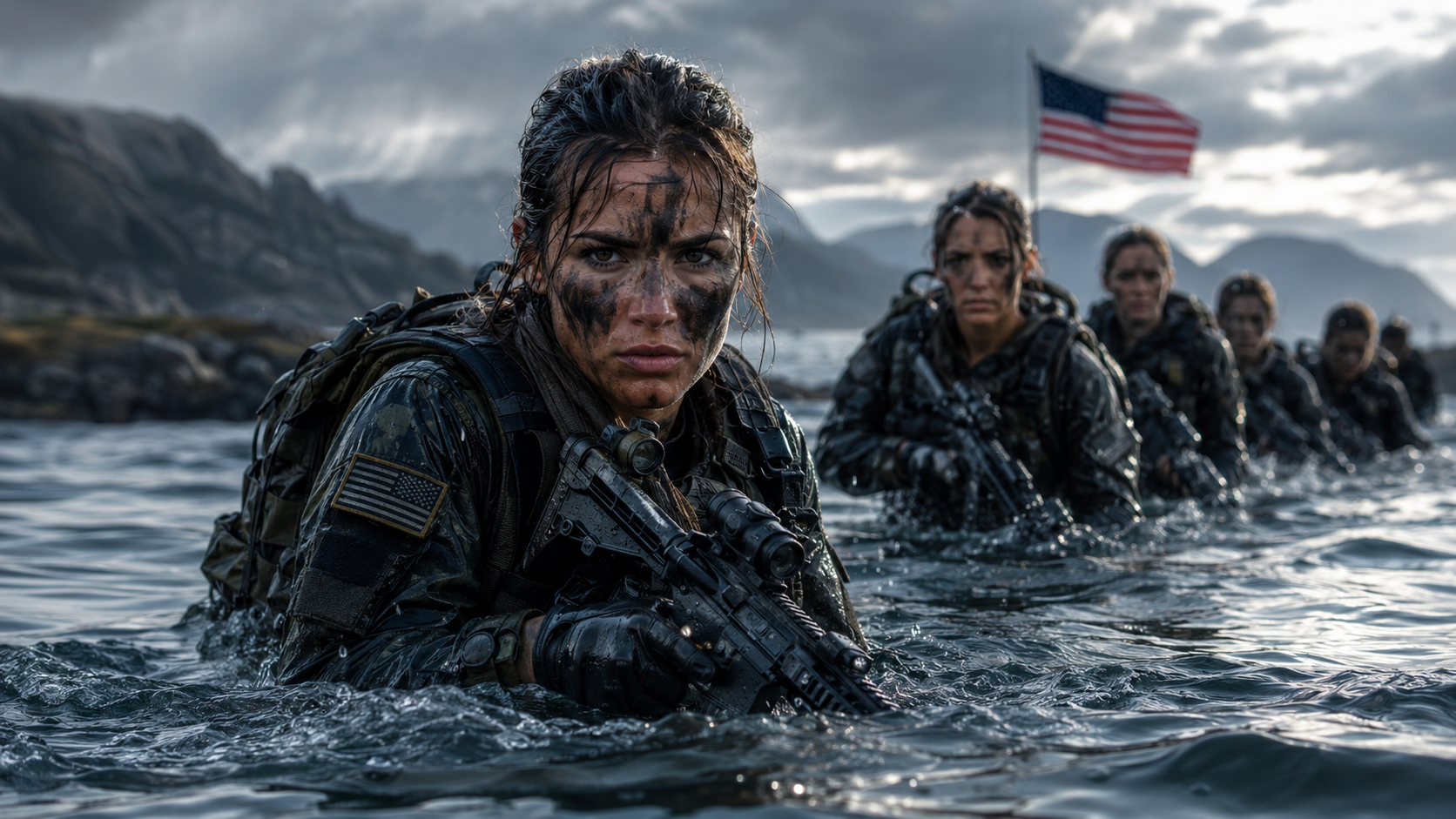
Colonel James Walker
- Former special operations planner
- Served in Iraq and Afghanistan
- Supports opening elite combat roles to women under identical standards
Major Robert Hayes
- Former infantry officer and SOF advisor
- Believes combat effectiveness must override political pressure
- Skeptical but willing to debate honestly
PART I — “THE QUESTION NO ONE CAN AVOID”
The auditorium lights dim.
A giant screen behind them displays one sentence:
“Should Women Be Allowed to Serve in Elite U.S. Special Operations Forces?”
Silence fills the room.
You May Also Like
The moderator steps back.
The debate begins.
Opening Exchange
Colonel Walker:
Let me begin with something simple.
War does not care about ideology.
Bullets do not care about politics.
The battlefield does not reward social media opinions.
It rewards capability.
So the real question is not:
“Should women be allowed into elite special operations?”
The real question is:
“If a woman can survive the same selection, complete the same missions, endure the same suffering, and fight at the same operational level… why should America reject that capability?”
Major Hayes:
And I’ll begin with something equally simple.
Special operations is not regular military service.
We are not talking about office positions.
We are not talking about support units.
We are talking about the absolute sharpest edge of military violence.
Navy SEALs.
Delta Force.
Army Special Forces.
MARSOC.
Units that operate in darkness, isolation, exhaustion, and chaos.
These are organizations built around one brutal truth:
Weakness gets people killed.
So my concern is not equality.
My concern is survivability.
Walker:
Good.
Because survivability is exactly why this conversation matters.
America cannot afford to ignore talent.
Historically, every major military innovation faced resistance.
People once argued Black soldiers should not fight beside white soldiers.
People argued women should never fly combat aircraft.
People argued women could not command warships.
Then reality proved otherwise.
The military evolved because warfare evolved.
Hayes:
That comparison has limits.
Because biology is real.
And special operations selection is overwhelmingly physical.
There are differences in upper-body strength, bone density, endurance under load, recovery rates, injury vulnerability—
Walker interrupts calmly.
Walker:
Then test those exact things.
That’s my entire argument.
No lowered standards.
No special categories.
No political quotas.
No symbolic graduation ceremonies designed for headlines.
One standard.
One mission requirement.
One selection process.
Pass or fail.
Hayes leans back slightly.
Hayes:
You say that now.
But political systems rarely stop there.
The fear inside the special operations community is not women.
The fear is institutional pressure.
Because once politicians become emotionally invested in outcomes, standards become vulnerable.
And once standards become negotiable, operators die.
The Room Gets Tense
Several veterans in the audience nod quietly.
Walker notices.
Walker:
Then let’s talk facts.
In 2015, the Pentagon officially opened all combat jobs to women provided they met qualification standards.
Since then, women have graduated from Army Ranger School.
Women have served in combat aviation.
Women have deployed into dangerous operational environments.
And despite all the panic years ago, the U.S. military did not collapse.
Hayes:
Ranger School is not a SEAL platoon.
And you know that.
Ranger School proves leadership under stress.
It is not identical to Tier One direct-action operations.
Walker smiles slightly.
Walker:
True.
But it disproved a myth.
The myth was:
“No woman could ever survive elite combat training.”
That myth died.
Now the debate has shifted to scale and practicality.
Hayes:
Because practicality matters.
Let me explain something civilians often misunderstand.
Special operations is not built around individual greatness.
It’s built around team reliability.
If one operator cannot keep pace during a mountain insertion at altitude…
If one operator cannot drag a wounded teammate…
If one operator breaks physically under sustained load…
the entire team pays for it.
Walker:
And that standard should remain absolute.
But let me challenge another assumption.
Modern warfare is changing.
Today’s elite operator is not only a door-kicker.
Special operations now integrates:
- cyber warfare
- drone operations
- intelligence fusion
- language capability
- psychological operations
- surveillance coordination
- high-level strategic planning
The modern battlefield rewards adaptability, not just brute force.
Hayes:
But brute force still matters when things go wrong.
And things ALWAYS go wrong.
You know what combat looks like after 72 hours without sleep?
You know what happens when helicopters fail extraction?
When ammunition runs low?
When a six-man team must carry a wounded operator across hostile terrain?
That is not theoretical.
That is real.
Walker’s expression hardens.
Walker:
I know exactly what that looks like.
And I also know this:
Mental resilience matters just as much as muscle.
The best operators I ever worked with were not always the biggest men.
Sometimes they were the calmest.
The smartest.
The most emotionally controlled under pressure.
Special operations selection already filters weakness.
So why fear letting individuals attempt it?
PART II — “THE REAL FEAR INSIDE SPECIAL OPERATIONS”
The moderator says nothing.
The audience is completely silent.
Hayes Goes Deeper
Hayes:
Fine.
Then let’s speak honestly.
The fear is not women entering special operations.
The fear is what happens afterward.
Because elite military culture is fragile.
Trust inside special operations teams is almost tribal.
Those men train together, suffer together, deploy together, bury friends together.
That environment was built over decades.
Introducing gender dynamics changes team chemistry whether people admit it or not.
Walker:
You’re talking about unit cohesion.
Hayes:
Exactly.
Jealousy.
Romantic complications.
Protective instincts.
Social tension.
False accusations.
Distractions.
These things matter in high-risk units.
People pretend they don’t, but they do.
Walker:
And yet militaries around the world have integrated women into high-level operational roles successfully.
Israel has mixed combat units.
Women serve in intelligence-heavy operations worldwide.
The issue is leadership quality and discipline.
Not gender alone.
Hayes:
Special operations is different.
It is intentionally hyper-aggressive.
Sometimes violent.
Sometimes psychologically brutal.
You cannot socially engineer that environment like a corporate office.
Walker:
Nobody is asking to.
We are asking whether extraordinary women should have the opportunity to prove themselves.
That is a very different argument.
A Veteran in the Audience Speaks
The moderator unexpectedly allows a retired operator to ask a question.
A gray-haired former special operator stands.
Veteran:
I fought in Afghanistan.
Lost friends there.
My question is simple:
If your daughter could pass every single standard honestly… would you let her join?
The room goes completely silent.
Hayes pauses for several seconds.
Hayes quietly:
If she passed everything honestly…
without favoritism…
without lowered standards…
without political interference…
then yes.
Because at that point, she earned it.
The audience murmurs softly.
Walker nods respectfully.
PART III — “THE FUTURE OF WAR”
Walker Pushes Forward
Walker:
That answer right there changes everything.
Because this debate is not actually about capability anymore.
It’s about trust in the institution.
If standards remain sacred, then excellence should remain open.
And strategically, America needs every possible advantage.
The future battlefield is becoming more complex every year.
Artificial intelligence.
Autonomous drones.
Urban warfare.
Counterterrorism.
Hybrid warfare.
Psychological warfare.
Special operations forces are evolving rapidly.
Hayes:
True.
But human performance still decides missions.
Technology cannot replace courage.
Walker:
Agreed.
But courage belongs to neither gender exclusively.
History already proved that.
Women have fought as resistance fighters, snipers, pilots, intelligence operatives, medics, and guerrilla warriors throughout history.
The question now is whether modern institutions are willing to evaluate individuals honestly.
Hayes:
Then let’s establish principles.
Walker:
Good.
The Two Analysts Build Common Ground
Principle One
Hayes:
No lowered standards.
Ever.
Walker:
Agreed.
Principle Two
Hayes:
Mission effectiveness comes before politics.
Walker:
Absolutely.
Principle Three
Hayes:
Selection must remain brutally honest.
No public-relations pressure.
No media interference.
No protected status.
Walker:
Completely agree.
Principle Four
Walker:
If someone meets the exact operational standard, they deserve respect regardless of gender.
Hayes pauses… then nods slowly.
Hayes:
Yes.
That I can accept.
PART IV — “THE EMOTIONAL CORE”
The debate becomes quieter.
Less aggressive.
More human.
Walker:
You know what I think the real issue is?
For generations, military masculinity became tied to identity.
So when people hear “women in special operations,” some hear:
“Men are being replaced.”
But that’s not what this is.
This is about expanding capability.
Not erasing men.
Hayes:
That’s fair.
And I’ll admit something difficult.
Some resistance IS cultural.
Some operators simply cannot imagine women beside them in combat because they grew up in an entirely different military era.
Walker:
Exactly.
And some concerns are legitimate.
But fear should not decide policy.
Performance should.
Hayes:
You know something ironic?
The military has always claimed it wants the toughest people possible.
Then occasionally it becomes uncomfortable when toughness appears in unexpected forms.
The audience laughs softly.
Walker smiles:
Exactly.
PART V — THE FINAL EXCHANGE
The moderator announces final statements.
The atmosphere feels heavy and meaningful.
Final Statement — Major Hayes
Hayes stands slowly.
Hayes:
I entered this debate skeptical.
And I remain cautious.
Because special operations cannot afford failure.
Not symbolic failure.
Not political failure.
Real failure costs lives.
But after years of watching warfare evolve, I also understand something important:
America’s enemies are adapting constantly.
And the United States cannot afford to reject exceptional people automatically.
So my final position is this:
If a woman can meet the exact same combat requirements honestly—
carry the same weight,
survive the same selection,
fight through the same suffering,
and protect the team under fire—
then she has earned the right to stand beside any operator in the world.
But the standards must remain untouchable.
Forever.
Final Statement — Colonel Walker
Walker stands beside him.
Walker:
The greatest militaries in history were not strong because they feared change.
They were strong because they adapted faster than their enemies.
This debate was never about lowering standards.
It was about removing artificial barriers while protecting excellence.
Special operations should remain brutally difficult.
It should reject most candidates.
It should demand extraordinary resilience.
But the gate should measure capability—
not assumptions.
Because somewhere in America right now…
there may be a future operator,
a future combat rescuer,
a future intelligence leader,
a future battlefield hero—
who happens to be female.
And if she can truly meet the standard,
America becomes stronger by letting her try.
The audience rises slowly into applause.
Not because the debate ended with complete agreement—
but because both men defended the same ultimate principle: