He spent the entire dinner bragging about his wealth and humiliating me in front of my family. But when I revealed who I really was, his face turned white. And when my sister discovered what he had been hiding from her, Thanksgiving became a night none of us would ever forget.
My name is Dr. Emily Carter.
I’m thirty-six years old.
And for the past nine years, I’ve worked as a pediatric cardiothoracic surgeon, specializing in complex heart operations involving children and young adults.
You May Also Like



I have spent thousands of hours inside operating rooms.
I’ve held hearts no larger than a walnut in my hands.
I’ve spent sleepless nights waiting to see whether a child would survive a procedure that gave them only a small chance of living.
And I’ve had to tell parents news that no mother or father should ever have to hear.
My job has never been glamorous.
Most days, it is exhausting.
Some days, it is heartbreaking.
But I have never once been ashamed of what I do.
Unfortunately, my family had spent years treating my career as though it were something embarrassing.
And that Thanksgiving evening, they finally learned how wrong they had been.
THE MOMENT BRAD STOPPED SMILING
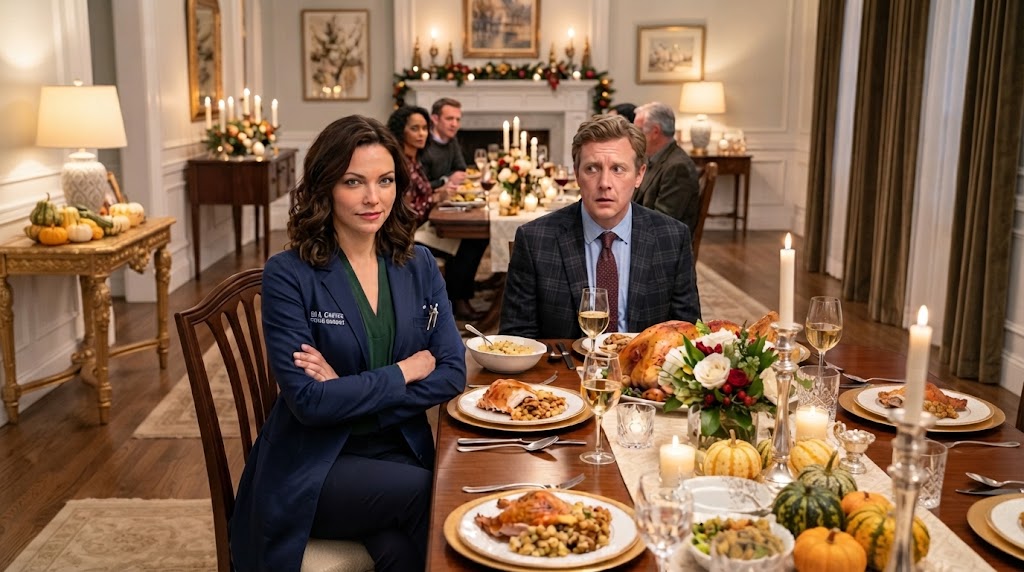
Brad’s wineglass froze halfway to his mouth.
For the first time since arriving, he had nothing to say.
His eyes narrowed as he examined my face.
“What did you just say?”
I folded my hands neatly in my lap.
“You saw me every morning last month, Brad.”
My sister Chloe let out a sarcastic laugh.
“Oh, please, Emily. Are you seriously going to pretend you know him?”
I ignored her.
Brad stared at me.
Then something shifted in his expression.
Recognition.
Confusion.
And finally, fear.
He leaned forward.
“Wait…”
I smiled politely.
“Good morning, Mr. Harrison.”
His wineglass struck the table with a sharp clink.
My mother frowned.
“Emily, what are you doing?”
I kept my eyes on Brad.
“Do you remember the morning of October seventeenth?”
He swallowed.
I continued.
“The cardiac intensive care unit. Room 412. You asked your attending surgeon whether you would ever be able to run again.”
Brad stopped breathing for a moment.
Chloe turned toward him.
“Brad?”
He didn’t answer.
I continued quietly.
“You asked if the operation had damaged your heart permanently.”
His face drained of color.
“And I told you that recovery would take time, but your prognosis was encouraging.”
The entire table fell silent.
Then Brad whispered:
“Dr. Carter?”
I nodded.
“Hello, Brad.”
THE SURGERY HE NEVER TOLD MY SISTER ABOUT
Three weeks earlier, Brad Harrison had been admitted to our medical center after developing a serious cardiac complication.
He was thirty-nine years old.
Successful.
Athletic.
And convinced that money could protect him from almost anything.
It couldn’t.
His condition required urgent evaluation and a complex heart operation.
I had been the lead surgeon.
The procedure lasted nearly seven hours.
Afterward, Brad spent several days in cardiac intensive care.
During his recovery, I checked on him every morning with my medical team.
I wore surgical scrubs, a mask when required, and the plain hospital identification badge that he apparently never bothered to read carefully.
I was exhausted most mornings.
Sometimes I had been operating until two or three in the morning.
But I visited my patients because they deserved to understand what had happened and what recovery would involve.
Brad was no exception.
I remembered him clearly.
Not because he was wealthy.
Not because he was a corporate executive.
But because he had asked me the same question almost every morning.
“Am I going to be okay?”
And every time, I answered as honestly and compassionately as I could.
Now that same man sat across from me at Thanksgiving dinner.
Mocking the people who worked in hospitals.
Mocking the profession that had helped save his life.
And he had no idea I was the person who had performed his operation.
THE FAMILY SECRET
Chloe looked between us.
“Can someone please explain what’s happening?”
Brad lowered his head.
I remained quiet.
His medical history was private, and I had no intention of revealing more than he chose to share.
But Brad had already recognized me.
Finally, he spoke.
“I was in the hospital last month.”
Chloe blinked.
“What?”
He rubbed his forehead.
“I had surgery.”
My sister’s mouth fell open.
“Surgery? What kind of surgery?”
He hesitated.
Then whispered:
“Heart surgery.”
My mother gasped.
Dad put down his fork.
Chloe stared at her boyfriend as though she had never seen him before.
“You told me you were in Switzerland for business!”
Brad closed his eyes.
“I know.”
“You sent me pictures from a hotel!”
“I didn’t want you to worry.”
Chloe shook her head.
“For three weeks, you told me you were traveling for work.”
Brad looked toward me.
I said nothing.
This was his confession to make.
He finally whispered:
“Emily was my surgeon.”
The silence that followed was so complete I could hear the grandfather clock ticking in the hallway.
My father slowly turned toward me.
“Emily?”
I looked at him.
“Yes, Dad?”
“You’re a heart surgeon?”
I blinked.
“Yes.”
He stared at me.
“Since when?”
I almost laughed.
“Since I completed my fellowship.”
My mother’s face flushed.
“But you told us you worked with children.”
“I do.”
Chloe looked confused.
“Wait. You operate on children?”
“Yes.”
“On their hearts?”
“Yes, Chloe.”
She stared at me.
Then asked the question that revealed just how little attention my family had paid to my life.
“Why didn’t you ever tell us?”
NINE YEARS OF BEING IGNORED
I looked at my sister.
“I did.”
She frowned.
“When?”
I took a slow breath.
“When I graduated from medical school.”
No response.
“When I matched into surgical residency.”
My mother’s expression changed.
“When I completed my cardiothoracic surgery fellowship.”
Dad looked down.
“When I was appointed attending surgeon.”
Chloe stared at me.
I continued.
“I invited all of you to my hospital’s recognition ceremony three years ago.”
My father shifted in his chair.
“I remember something about that.”
I nodded.
“You couldn’t come because Chloe had just bought a new car and everyone wanted to celebrate.”
Chloe opened her mouth.
Then closed it.
I turned toward my mother.
“And Mom, when I told you I had been promoted to lead a surgical program, you said you were too busy planning Chloe’s birthday party to talk.”
Her face went pale.
“I didn’t realize it was that important.”
I smiled sadly.
“That’s exactly the problem.”
For years, my family had heard the words children’s hospital and assumed I was doing something simple.
They had never asked for details.
Never attended an event.
Never asked what my work actually involved.
They had simply decided that Chloe’s marketing career was impressive because it came with fashionable clothes, expensive dinners, and corporate parties.
Meanwhile, I spent most of my life inside hospitals.
And apparently that made me the disappointing daughter.
BRAD’S FIRST APOLOGY
Brad pushed his chair back.
Then he stood.
Everyone turned toward him.
He looked directly at me.
“Dr. Carter, I owe you an apology.”
I didn’t answer.
His voice was quieter now.
“An enormous apology.”
Chloe folded her arms.
“Brad, sit down.”
He ignored her.
“I was disrespectful. I made assumptions about your work, and I said things I had absolutely no right to say.”
I nodded once.
“You’re right.”
He swallowed.
Then continued.
“I remember waking up after surgery.”
My mother began crying softly.
Brad looked down at his hands.
“I remember asking whether I was going to die.”
His voice cracked.
“And I remember you telling me that the operation had gone well, but I still needed careful monitoring and recovery.”
He looked at me again.
“I was terrified.”
I said nothing.
“I thought my life was over.”
He paused.
“And the doctor who helped me through it was sitting across from me tonight while I mocked her.”
His eyes filled with tears.
“I’m ashamed of myself.”
For the first time that evening, I believed him.
But the apology didn’t erase everything.
Because Brad wasn’t the only person who needed to understand what had happened.
WHAT MY MOTHER SAID NEXT
My mother reached across the table.
“Emily, sweetheart, why didn’t you tell us you were so successful?”
I looked at her.
Then I asked quietly:
“Would it have changed how you treated me?”
She blinked.
“Of course!”
The answer came too quickly.
I felt a familiar ache in my chest.
“That’s what makes it worse, Mom.”
She frowned.
“What do you mean?”
“If you had known I was a surgeon, you would have respected me?”
“Well, naturally—”
“But when you thought I was a receptionist or someone handing out stickers to sick children, you were embarrassed?”
My mother stared at me.
I continued.
“What’s wrong with being a receptionist?”
She opened her mouth.
Nothing came out.
“What’s wrong with being a nursing assistant?”
Silence.
“What’s wrong with being someone who comforts frightened children in a hospital?”
My father lowered his eyes.
I looked around the table.
“The nurses who monitor my patients are essential. The assistants who help keep our units running are essential. The receptionists who guide frightened families through the hospital are essential.”
My voice grew firmer.
“And the people handing stickers to children who are scared of needles are doing something important, too.”
Nobody interrupted.
“You didn’t just insult me tonight.”
I looked at Chloe.
“You insulted people whose work matters, simply because you thought their jobs weren’t prestigious enough.”
My sister looked away.
For once, she had no clever response.
THE REASON I NEVER CORRECTED THEM
Dad finally spoke.
“Emily, you could have told us more.”
I looked at him.
“I tried.”
He sighed.
“But surely you could have explained.”
I shook my head.
“Dad, when someone you love tells you what they do for a living, you’re supposed to care enough to listen.”
His expression softened.
I continued.
“I shouldn’t have to prepare a presentation to convince my own family that my life matters.”
A tear slipped down my mother’s cheek.
I wasn’t trying to hurt her.
But for years, I had swallowed the disappointment.
Every missed celebration.
Every unanswered message.
Every conversation that shifted back to Chloe’s latest achievement.
I had convinced myself it didn’t matter.
I had patients who needed me.
Friends who respected me.
Colleagues who understood my work.
But sitting at that Thanksgiving table, I realized something.
It had mattered.
More than I wanted to admit.
THEN CHLOE ASKED ONE QUESTION
Chloe had been unusually quiet.
Finally, she turned toward Brad.
“Why didn’t you tell me you had heart surgery?”
He looked exhausted.
“I was scared.”
“Of what?”
“Of losing everything.”
She frowned.
“What does that mean?”
Brad rubbed his face.
“My company has been restructuring. The promotion I talked about isn’t guaranteed. I’ve been under enormous stress.”
Chloe blinked.
“But you said you were getting promoted in January.”
“I hoped I would.”
“You said the board had already approved it.”
He looked down.
“They haven’t.”
My sister stared at him.
The expensive watch.
The luxury car.
The designer suit.
All the symbols of success he had spent the evening bragging about.
Suddenly, none of them seemed quite as impressive.
Chloe’s voice trembled.
“What else haven’t you told me?”
Brad didn’t answer immediately.
Then he said:
“I took medical leave. I haven’t been working full-time since the surgery.”
My mother looked stunned.
My father cleared his throat.
The man who had spent Thanksgiving lecturing everyone about ambition and wealth was now admitting that his own life was far less perfect than he had pretended.
But I didn’t feel satisfaction.
I felt sadness.
Because I recognized the pattern.
Brad had convinced himself that if he admitted weakness, people would stop respecting him.
And tonight, he had tried to make himself feel important by belittling someone else.
THE MOMENT EVERYTHING CHANGED
Brad sat down.
For several minutes, nobody spoke.
Then he looked at me.
“Dr. Carter, can I ask you something?”
“Of course.”
“When I was in the hospital, why didn’t you ever treat me differently?”
I frowned.
“What do you mean?”
He swallowed.
“I was difficult.”
I remembered.
He had been frightened, impatient, and occasionally rude to staff.
But frightened patients often struggled to manage their emotions.
“You were scared, Brad.”
He nodded.
“I was rude to a nurse.”
“Yes.”
“I complained about almost everything.”
“I remember.”
He looked ashamed.
“But you still came every morning.”
I leaned forward.
“Brad, my responsibility as your surgeon was to give you competent medical care, regardless of how much money you had or whether you were pleasant to be around.”
He stared at me.
I continued.
“A person’s life doesn’t become more valuable because they’re wealthy. And it doesn’t become less valuable because they aren’t.”
My mother covered her mouth.
Brad lowered his head.
Then he said quietly:
“I wish I’d understood that before tonight.”
THE NEXT MORNING
I left Thanksgiving dinner earlier than usual.
Not angrily.
Not dramatically.
I simply thanked my father for the meal, collected my coat, and drove home.
The following morning, my phone rang.
It was Dad.
I almost let it go to voicemail.
Then I answered.
“Hi, Dad.”
“Emily.”
His voice sounded different.
“I’ve been thinking about last night.”
I sat down with my coffee.
“Okay.”
He hesitated.
“Your mother and I owe you an apology.”
I said nothing.
“We should have taken more interest in your career. In your life.”
My throat tightened.
He continued.
“I looked up the hospital’s website this morning.”
I closed my eyes.
“Your name is there.”
I smiled faintly.
“Yes, Dad.”
“There’s an article about a surgical program you helped develop.”
“Yes.”
“And there’s a picture of you with your team.”
I swallowed.
“Yes.”
His voice broke.
“Emily, I had no idea.”
I looked toward the window.
“Dad, I know.”
For several seconds, neither of us spoke.
Then he whispered:
“I’m proud of you.”
Those four words should have made me happy.
Instead, they made me cry.
Because I had waited so many years to hear them.
THE PACKAGE FROM BRAD
Three days later, a package arrived at my office.
Inside was a handwritten card.
And a small box of stickers.
Brightly colored stars.
Dinosaurs.
Butterflies.
Smiling cartoon animals.
I stared at them in confusion.
Then I opened the card.
“Dear Dr. Carter,
I owe you more than an apology.
When I mocked the idea of handing stickers to sick children, I revealed how little I understood about the work of caring for others.
During my recovery, I remembered something.
One morning, a nurse noticed I was struggling emotionally. She sat beside me for several minutes and told me I was allowed to be frightened.
That conversation meant more to me than any business award I’ve ever received.
I have spent much of my life measuring people by titles, salaries, and possessions.
Thanksgiving taught me how wrong that was.
Thank you for the care you and your team provided.
And thank you for reminding me that kindness is not a weakness.
Sincerely,
Brad Harrison.”
I read the note twice.
Then I opened the box.
At the bottom was a second envelope.
Inside was a donation acknowledgment.
Brad had made a substantial contribution to the hospital’s pediatric family support program.
The donation would help provide meals, temporary accommodations, and transportation assistance to families whose children required extended hospital care.
I stared at the paper.
For the first time since Thanksgiving, I smiled.
Not because he had donated money.
But because he had finally understood something important.
The greatest use of privilege isn’t showing people how much you have.
It’s helping people who need it.
SIX MONTHS LATER
Life changed gradually.
My father began calling once a week.
Not to ask about Chloe.
Not to talk about Brad.
But to ask how I was doing.
Sometimes he asked about my patients.
I couldn’t share private medical details, of course.
But I told him about the challenges of surgery, the importance of teamwork, and the joy of seeing children recover.
My mother apologized too.
Not perfectly.
Sometimes she still made careless comments.
But she was trying.
And for the first time, I saw her ask a nurse a genuine question about her work rather than assuming she understood it.
Chloe took longer.
At first, she seemed embarrassed.
Then defensive.
Then quiet.
Eventually, she asked whether we could have lunch.
Just the two of us.
I agreed.
THE CONVERSATION WITH MY SISTER
We met at a small café near the hospital.
Chloe arrived ten minutes early.
That alone surprised me.
She looked nervous.
After ordering coffee, she stared at her hands.
“Emily, I’ve been awful to you.”
I didn’t interrupt.
She took a breath.
“I think I’ve always been jealous.”
I blinked.
“Jealous?”
She nodded.
“You always knew what you wanted.”
I almost laughed.
“Chloe, I spent most of medical school terrified I wasn’t good enough.”
She looked surprised.
“Really?”
“Of course.”
She shook her head.
“You never seemed afraid.”
I smiled sadly.
“That’s because you never asked.”
Her eyes filled with tears.
She looked down.
“You’re right.”
We sat in silence for a moment.
Then she whispered:
“I made jokes about your career because I thought everyone was more impressed by yours than mine.”
I stared at her.
“Chloe, I’ve never thought your work was less important.”
She began crying.
“I know that now.”
I reached across the table.
“Then maybe we can stop competing.”
She squeezed my hand.
“I’d like that.”
It wasn’t an instant repair of everything that had happened.
But it was a beginning.
THE DAY MY FATHER VISITED THE HOSPITAL
Several months later, our hospital hosted a community education event.
Families were invited to learn about pediatric cardiac care.
There were demonstrations.
Educational exhibits.
Information about early diagnosis and rehabilitation.
And an opportunity to meet some of the medical teams.
My father asked if he could attend.
I was surprised.
But I said yes.
He arrived wearing his best jacket.
He stood quietly near the back while I gave a presentation with two colleagues about multidisciplinary cardiac care.
Afterward, I introduced him to the nurses, perfusionists, physician assistants, and respiratory therapists who worked with our team.
He shook every hand.
He asked questions.
He listened.
Then he noticed a little girl sitting in a wheelchair beside her mother.
She was holding a sheet of star stickers.
My father smiled.
“Those are pretty.”
The girl grinned.
“Dr. Emily gave them to me!”
Dad looked toward me.
I smiled.
The little girl held up the stickers proudly.
“She said I was brave.”
My father crouched beside her.
“Well, I think she’s right.”
The girl giggled.
Then she offered him a golden star.
“For you.”
He accepted it.
“Thank you.”
When he stood, his eyes were wet.
He pressed the sticker onto his jacket.
And for the rest of the afternoon, he wore it proudly.
WHAT MY FATHER SAID IN THE PARKING LOT
As we walked toward our cars, Dad stopped.
“Emily?”
I turned.
“Yes?”
He looked down at the little golden star on his jacket.
“I understand something now.”
I waited.
“For years, I thought success meant having an important title. Making good money. Being the person everyone wanted to know.”
He shook his head.
“But that little girl doesn’t care about your title.”
I smiled.
“No.”
“She doesn’t care what car you drive.”
“No.”
“She doesn’t care how much money you make.”
I felt tears gathering.
Dad looked at me.
“She cares because you made her feel safe.”
I nodded.
He stepped forward and hugged me.
A real hug.
Not the awkward kind we’d exchanged at holidays.
He held me tightly.
“I’m sorry I didn’t see you before.”
I closed my eyes.
For years, I had waited for my father to notice the work I did.
But standing in that parking lot, I realized I had wanted something even simpler.
I wanted him to notice me.
Not the surgeon.
Not the title.
Not the white coat.
Just his daughter.
And finally, he did.
ONE YEAR AFTER THANKSGIVING
The following Thanksgiving was very different.
We gathered at my parents’ house again.
Same dining room.
Same wooden table.
Same familiar smell of roasted turkey.
But the atmosphere had changed.
Chloe brought dessert.
Dad asked me about a medical education conference I’d attended.
Mom told me about volunteering at a local children’s charity.
And Brad?
He was there too.
He and Chloe had worked through a difficult year together.
His recovery had continued under medical supervision.
He had made changes to his lifestyle and learned to take his health more seriously.
But the biggest change was in how he treated people.
He no longer dominated conversations with stories about money.
He asked questions.
He listened.
And when my mother mentioned that I’d been working long hours, Brad smiled.
“Well, I happen to know firsthand that Dr. Carter takes her job seriously.”
I laughed.
“Please don’t start.”
He raised his hands.
“Fair enough.”
Then my father lifted his glass.
“I’d like to make a toast.”
Everyone turned toward him.
He looked at Chloe.
Then Brad.
Then my mother.
Finally, his eyes settled on me.
“Last Thanksgiving, we learned something important about respect.”
My throat tightened.
Dad continued.
“We spent too much time measuring people by their jobs, their salaries, and what they could provide.”
He paused.
“But every person deserves dignity, whether they’re a surgeon, a nurse, a receptionist, a teacher, or someone who spends their day comforting frightened children.”
He looked directly at me.
“And I want to thank my daughter Emily for teaching us that.”
I felt tears slip down my cheeks.
Everyone raised their glasses.
Even Brad.
Then Dad added with a smile:
“And for the record, I think handing out stickers is a pretty wonderful job.”
The room filled with laughter.
This time, I laughed too.
THE LITTLE BOX I KEEP IN MY OFFICE
Today, there’s a small wooden box on the bookshelf in my office.
Inside are letters from families.
Thank-you cards.
Photographs shared with permission.
And a handful of colorful stickers.
Every time I have a difficult day, I open that box.
It reminds me why I became a doctor.
Not for status.
Not for money.
Not for applause.
But because when I was sixteen, I watched a surgeon save my younger cousin’s life.
I remember standing in a hospital hallway while my aunt cried.
I remember the doctor approaching us after hours in the operating room.
And I remember the words:
“The surgery went well.”
That moment changed my life.
I wanted to become the person who could bring that kind of hope to someone else.
Years later, I did.
But the strangest lesson came from an arrogant executive at Thanksgiving dinner.
A man who had looked down on my profession without realizing that he had depended on it.
A man whose expensive watch, luxury car, and impressive title couldn’t protect him when his health was in danger.
And a family that had spent years overlooking me because they never bothered to ask who I really was.
I learned that evening that you cannot force people to see your worth.
You can explain.
You can succeed.
You can achieve everything they once told you was impossible.
But if someone is determined to judge you by appearances, even your greatest accomplishments may not change their mind.
And that’s okay.
Because your value was never theirs to decide.
THE FINAL LESSON
A few weeks ago, I was leaving the hospital after a long shift when a little boy stopped me near the elevators.
He was holding his mother’s hand.
He couldn’t have been more than five.
“Are you Dr. Emily?” he asked.
I smiled.
“Yes, I am.”
His eyes widened.
“My mommy said you helped fix my heart.”
I knelt beside him.
“You had a whole team of people helping you.”
He nodded seriously.
Then he reached into his pocket.
He pulled out a small sticker.
A bright yellow star.
He pressed it into my hand.
“For you.”
I stared at it.
“What’s this for?”
He smiled.
“Because you’re brave too.”
For a moment, I couldn’t speak.
Then I hugged him gently, with his mother’s permission.
“Thank you, sweetheart.”
Later, I returned to my office and placed the sticker in my wooden box.
I thought about Thanksgiving.
About Brad’s cruel joke.
About my sister’s laughter.
About my mother’s embarrassed expression.
And I smiled.
Because after all those years, I’d finally understood something.
The world may applaud people for their wealth, power, and titles. But the people whose lives we touch remember us for how we made them feel.
Brad had called me a glorified babysitter.
He thought handing stickers to sick children was beneath him.
But that little boy had just handed me a sticker that meant more than any professional award I’d ever received.
And I wouldn’t have traded it for all the money in Brad’s bank account.
THE END.
❤️ THE LESSON OF THIS STORY
Never judge someone’s worth by their job title, income, clothing, or social status.
The person you dismiss as unimportant today may be the person whose kindness, knowledge, or courage changes your life tomorrow.
A surgeon may save a life in the operating room.
A nurse may save a life through careful observation.
A receptionist may help a frightened family find their way.
And someone handing a sticker to a sick child may give that child a moment of courage when they need it most.
No honest work that serves others should ever be considered beneath anyone’s dignity.
True greatness isn’t measured by how important you appear.
It’s measured by how you treat people, especially those who can do nothing for you in return.
Because the most valuable people in this world aren’t always the ones with the biggest salaries or the most impressive titles. Sometimes, they’re the ones quietly making someone else’s hardest day a little easier.
If this story touched your heart, share it with someone who needs a reminder that kindness, humility, and respect will always be worth more than money.