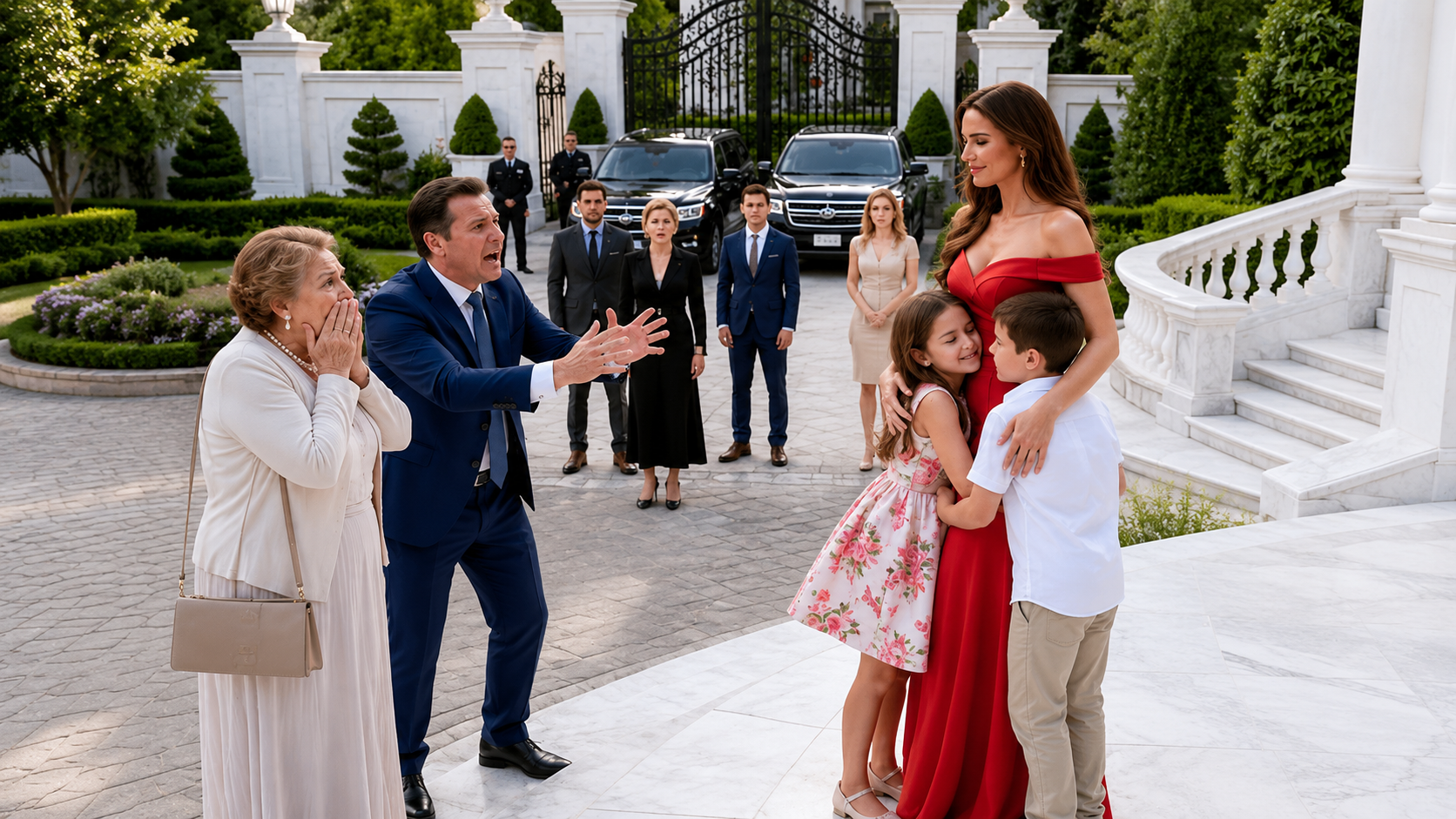
“Without my son, you won’t even be able to pay your electricity bill, Elena.”
Doña Victoria Mendoza said it outside the family court in Guadalajara with the satisfied smile of a woman who believed she had just watched me lose everything.
The divorce had been finalized less than twenty minutes earlier.
The ink was barely dry.
The courthouse steps were hot beneath the afternoon sun, and I stood there holding a small suitcase in one hand, wearing a simple cream dress that I had chosen carefully because I knew they would mistake simplicity for poverty.
Alejandro stood beside his mother, adjusting the cuff of his designer jacket. He smiled like a man who had finally removed an inconvenience from his life.
“Mother is right,” he said. “Let’s see how long you survive without the Mendoza name.”
His sister Paola stood behind him, arms folded, watching me with amused pity. Two cousins whispered near the entrance. Even the family lawyer looked away, embarrassed but not enough to object.
For five years, I had listened to that family speak to me as if I were a charity case.
Poor Elena.
Quiet Elena.
Lucky Elena.
The girl Alejandro “rescued” from an ordinary life.
At every Sunday lunch, every Christmas dinner, every family gathering, they reminded me that I had married above my level. Doña Victoria called me “humble” when guests were around and “provincial” when they were not. Alejandro allowed it. Sometimes he even smiled.
I carried five years of silence in my chest.
But that day, on the courthouse steps, something in me finally felt light.
Not broken.
Released.
As the elevator doors opened behind us, I turned back.
“You’re right about one thing,” I said calmly. “A month is enough time to discover who really depends on whom.”
Alejandro laughed loudly.
“What now? Motivational speeches?”
“No,” I replied. “An invitation.”
Doña Victoria lifted one eyebrow.
I continued, “Easter Sunday. A simple dinner. So you can all see how I live without your money.”
For a second, they just stared.
Then Doña Victoria laughed.
“Oh, sweetheart. Where will it be? Some tiny restaurant? Are you renting a terrace just to pretend you’re not ruined?”
“I’ll send the address,” I said.
Alejandro smirked.
“You really want us there?”
“Yes.”
“Everyone?”
“Everyone.”
His smile widened.
“You may regret that.”
I looked at him one last time.
“No, Alejandro. I think you will.”
Then I walked away.
The Woman They Thought They Knew
Outside the courthouse, a sleek black sedan waited near the curb.
Julián stepped out immediately.
He had been my family’s trusted driver for more than twenty years. He wore a dark suit, polished shoes, and the kind expression of a man who had known me before I ever became Elena Mendoza.
He opened the door.
“Welcome back, Miss Elena,” he said softly.
For the first time in years, hearing my real name almost made me cry.
“Shall we go straight to Valle?” he asked.
“Yes, Julián,” I said. “It’s finished.”
As the car pulled away from the courthouse, I looked through the tinted window at Alejandro and his mother still standing on the steps. They were laughing. Doña Victoria was saying something to Paola, probably another insult about my dress, my suitcase, my supposed future.
Let them laugh, I thought.
They had no idea that the woman they had mocked for five years had never needed the Mendoza fortune.
Because I was not Elena Mendoza anymore.
I was Elena Varela.
Heiress to one of Mexico’s most powerful shipping, logistics, and real estate families.
Majority shareholder in Varela Enterprises.
Owner of properties, ports, warehouses, private investments, land trusts, and holding companies the Mendozas had unknowingly depended on for years.
But Alejandro had never asked who I was before him.
He only asked what I could do for him.
That was the difference between love and possession.
Love wants to know you.
Possession only wants to use you.
Why I Hid My Name
People often ask why a woman like me would hide her identity.
The answer is simple.
I wanted to be loved without the Varela fortune standing between us.
I met Alejandro at a charity event in Mexico City. He was charming, handsome, and ambitious in a way that felt exciting at first. He spoke about building something of his own. He said he was tired of families who only valued names and money.
That was what caught my attention.
He said, “I want someone who sees me, not the Mendoza name.”
I believed him because I wanted the same thing.
So I let him know me as Elena.
Not Elena Varela.
Just Elena.
I told him I worked in investment strategy. That was true. I told him my family was private. That was also true. I told him I valued a quiet life. That was the truest thing of all.
When we married, I signed everything my attorneys required. Prenuptial protections. Separate assets. Confidentiality structures. Ownership walls. Trust barriers. Not because I planned to leave him, but because my father taught me that love should never require financial blindness.
Alejandro laughed when he saw the documents.
“You really are cautious,” he said.
“I am responsible.”
He kissed my forehead.
“Don’t worry. I don’t care about your money.”
I almost told him then.
Almost.
But some quiet instinct stopped me.
Over time, I became grateful that I had listened to it.
The Mendoza House
Living with the Mendoza family was like being trapped inside a museum where every object had a price and every person had a rank.
Doña Victoria ruled the family from a marble dining room where portraits of dead Mendozas stared down from gold frames. She measured worth through bloodline, property, and obedience.
To her, I was useful only because I made Alejandro look stable.
She never wanted a daughter-in-law.
She wanted a quiet accessory.
At Sunday lunches, she would say things like:
“Elena, you don’t mind serving coffee, do you? You’re so natural with domestic things.”
Or:
“In this family, we have standards. I know that must have been an adjustment for you.”
Or my personal favorite:
“You are lucky Alejandro is patient. Many men in his position would have chosen someone more suitable.”
I never answered.
Paola once found me washing dishes after a family party and smiled.
“You know, you’re actually very good at this kind of life.”
“What kind of life?” I asked.
She shrugged.
“Serving important people.”
I looked at her for a long moment.
Then I handed her a plate.
“Then you should practice.”
She never forgave me for that.
Alejandro never defended me. Not once.
In private, he would sigh and say, “You know how my mother is.”
“Yes,” I would answer. “I do.”
But he never understood that every time he asked me to accept disrespect for peace, he was teaching me what kind of husband he was.
The Marriage Ended Before the Divorce
The divorce was not caused by one argument.
It was caused by years of small betrayals.
Alejandro stopped coming home for dinner.
He started taking calls outside.
He told business associates I was “not involved in serious matters.”
He allowed his family to joke that I was expensive to maintain, even though he had never paid for anything that truly mattered in my life.
Then came the final insult.
At a party, I overheard him speaking to a banker.
“My wife is simple,” he said with a laugh. “She doesn’t understand finance. That’s probably why the marriage works.”
The banker laughed politely.
I stood behind the open balcony door, holding a glass of water, listening.
That banker worked with a subsidiary of Varela Enterprises.
The next morning, I called my legal team.
“Begin separation review,” I said.
My attorney, Mariana Solís, paused.
“Are you certain?”
“Yes.”
“And the Mendoza-linked loans?”
“Quietly. I want a full exposure report.”
“You understand what that may reveal.”
“I’m counting on it.”
Three weeks later, I had the answer.
The Mendoza family’s real estate business was far weaker than they pretended. Their expansion projects were overleveraged. Several properties in Guadalajara were backed by credit lines connected indirectly to Varela capital. Their status, their developments, their confidence—all of it rested on financing they did not even realize I could influence.
For five years, they had mocked the woman standing between them and collapse.
That almost impressed me.
The Easter Invitation
Three weeks after the divorce, thick ivory envelopes stamped with gold wax arrived at the Mendoza estate.
Doña Victoria found hers on the breakfast table.
According to Paola, she picked it up with two fingers as if it were contaminated.
“What is this?” she asked.
Alejandro opened his and laughed.
“She’s hosting Easter dinner.”
Doña Victoria’s eyes lit with cruel delight.
“Where?”
Alejandro checked the card.
His smile faltered for a fraction of a second.
“It’s an address in Valle.”
Paola leaned over.
“Valle? She rented something?”
“Probably,” Alejandro said quickly. “She must have spent her entire divorce settlement to pretend she’s fine.”
Doña Victoria smiled.
“Oh, we are going.”
Alejandro looked amused again.
“All of us?”
“Everyone,” she said. “If she wants to embarrass herself publicly, the Mendoza family should be present to witness it.”
That was how thirty-two members of the Mendoza family decided to attend my Easter dinner.
They thought they were coming to watch me fail.
They did not know they were walking into a room where their own future had already been decided.
The Caravan to Valle
On Easter Sunday, the Mendoza family arrived in a caravan of luxury SUVs.
Black vehicles.
Tinted windows.
Designer suits.
Silk dresses.
Gold jewelry.
Enough perfume to choke the spring air.
Alejandro sat in the lead SUV with Doña Victoria beside him. She wore deep purple silk and a pearl necklace large enough to look like a challenge.
Paola texted in the family group chat:
This is going to be hilarious. Imagine if she rented a ranch.
A cousin replied:
Maybe we should bring candles in case her electricity is off.
Alejandro sent a laughing emoji.
They were still laughing when the GPS led them away from the city center and into the heavily guarded hills of Valle.
The roads became quieter.
The houses disappeared behind taller walls.
Security cameras appeared at intersections.
The SUVs slowed as they reached a massive black iron gate flanked by stone walls and two uniformed guards.
Inside the lead vehicle, Alejandro’s smile faded.
Doña Victoria leaned forward.
“This cannot be right.”
The guard stepped toward the driver’s window and checked a tablet.
“Good evening,” he said calmly. “Welcome to the private residence of Mrs. Elena Varela.”
The silence inside the SUV was immediate.
Alejandro lowered the window.
“Excuse me?”
The guard looked at him.
“Your family is expected, Mr. Mendoza.”
Doña Victoria’s voice sharpened.
“This is Elena’s address?”
“Yes, señora.”
Paola whispered from the back seat.
“Varela?”
The guard pressed a button.
The heavy iron gates opened slowly.
And for the first time, the Mendozas entered my world.
The Estate
The driveway curved through ancient oak trees and flowering jacarandas. Stone lanterns lined the path. Beyond them stood a modern mansion of glass, limestone, and steel, built into the hillside with views stretching across the valley.
A fountain reflected the evening sun.
Staff moved quietly near the entrance.
Security watched from discreet positions.
The Mendoza family stepped out one by one, suddenly quiet.
The laughter was gone.
Doña Victoria looked up at the mansion as if it had personally insulted her.
Paola whispered, “Alejandro, what is this?”
He did not answer.
Because he did not know.
That was the beautiful part.
He had lived beside me for five years and never known anything real about me.
The front doors opened.
Julián stood there.
“Welcome,” he said. “Mrs. Varela is waiting in the courtyard.”
Doña Victoria stiffened.
“She means Elena?”
Julián smiled politely.
“Of course.”
They walked inside.
The entry hall rose three stories high, with glass walls framing the valley beyond. Original art lined the walls. A sculpture by a famous Mexican artist stood beneath the skylight. The floors were polished stone. The air smelled faintly of orange blossoms and cedar.
Alejandro looked around like a man realizing he had spent years mocking a palace from outside the gate.
Then they reached the courtyard.
I stood in the center beneath a canopy of flowering vines.
No cream dress.
No suitcase.
No lowered eyes.
I wore an emerald gown tailored in Mexico City, my hair pinned back with gold combs that had belonged to my grandmother. Beside me stood Mariana Solís, my chief attorney, another senior corporate lawyer, and a bank representative from Banco Regional de Occidente.
The Easter table was visible through open glass doors behind us.
It was set beautifully.
But not for them.
“Whose House Did You Rent?”
Alejandro was the first to speak.
“Elena?”
His voice sounded small.
“What is this?”
I smiled.
“Easter dinner.”
He looked around the courtyard.
“Whose house did you rent?”
The question was so perfectly Alejandro that I almost laughed.
“I don’t rent, Alejandro.”
Doña Victoria stepped forward, trying to recover her authority.
“Enough of this performance. What is going on?”
I looked at her.
“Welcome to my home.”
Paola whispered, “Your home?”
“Yes.”
Alejandro shook his head.
“No. That’s impossible.”
“Why?”
“Because you—”
He stopped.
I tilted my head.
“Because I what?”
Because I was poor?
Because I was simple?
Because I was lucky to marry him?
Because I served coffee quietly while they insulted me?
He had too much pride to say it now.
So I said it for him.
“Because you believed I was nothing without your family.”
His face tightened.
I continued.
“I let you believe that because I wanted a husband who loved me for who I was, not what my family owned.”
Doña Victoria scoffed.
“You were just a penniless girl from nowhere.”
“No,” I said. “I was a Varela.”
The name moved through the courtyard like thunder.
Several cousins exchanged panicked glances.
Richard Mendoza, Alejandro’s uncle, whispered, “Varela Enterprises?”
I looked at him.
“Yes.”
The bank representative stepped forward.
“And Mrs. Elena Varela is the controlling family shareholder for several holding structures connected to Varela Enterprises.”
Alejandro looked at the man.
“What does the bank have to do with this?”
Mariana answered.
“Everything.”
The Folder
The bank representative handed Alejandro a thick folder.
“Mr. Mendoza,” he said formally, “as of Friday afternoon, Varela Enterprises completed a restructuring of its investment exposure. Primary capital support linked to Mendoza Group credit facilities has been withdrawn.”
Alejandro stared at him.
“What?”
“Your family’s credit lines have been frozen pending review.”
Doña Victoria gasped.
“That is illegal.”
“It is contractual,” Mariana said.
The representative continued.
“Several corporate properties in Guadalajara are now under financial review. Unless replacement capital is secured, foreclosure proceedings may begin on certain pledged assets.”
Alejandro dropped the folder.
Papers scattered across the courtyard floor.
A cousin bent to pick one up, read it, then went pale.
Paola whispered, “Alejandro…”
Doña Victoria turned to me.
“You did this?”
“No,” I said. “You did.”
Her eyes widened.
“I did not sign anything.”
“No. But you spent five years teaching your son that disrespect has no consequences. He believed you. Then he built a business on arrogance and borrowed money.”
Alejandro stepped toward me.
“Elena, please. We can talk.”
I looked at him calmly.
“We talked for five years. You just never listened.”
His voice lowered.
“We were married.”
“Yes.”
“We were family.”
“We were.”
He swallowed.
“Don’t do this.”
I took one step closer.
“Alejandro, I did not destroy your family’s business. I removed my family’s protection from it.”
The difference landed hard.
Doña Victoria’s face changed.
For the first time, she understood.
She had not been insulting a powerless ex-daughter-in-law.
She had been insulting the quiet investor whose absence could expose every crack in the Mendoza empire.
The Dinner They Could Not Attend
Behind me, through the open glass doors, the Easter dinner table glowed with candlelight.
Roasted lamb.
Fresh bread.
Fruit.
Flowers.
Wine from my family’s vineyard.
A feast prepared with care.
Doña Victoria looked past me.
“So this was a trap.”
I smiled gently.
“No. It was an invitation.”
“Then why humiliate us?”
I let the question hang.
Then I said, “You arrived with thirty-two people to mock me.”
No one answered.
“You came dressed for my downfall.”
Still silence.
“You laughed in your cars about whether I could pay electricity.”
Paola looked down.
Alejandro stared at the ground.
I continued.
“So let’s not pretend this is humiliation. This is revelation.”
Doña Victoria’s face hardened again.
“You are cruel.”
I looked at her for a long moment.
“No, Doña Victoria. Cruelty is calling a woman poor for five years while eating at her table and living on her capital. Cruelty is watching your son disrespect his wife and calling it family loyalty. Cruelty is teaching your children that kindness means weakness.”
My voice stayed calm.
“That ends today.”
Alejandro whispered, “Elena…”
I raised my hand.
“No.”
“Trash Gets Taken Out Today”
Julián stepped closer, waiting for my instruction.
The Mendoza family stood frozen in the courtyard, unsure whether to argue, beg, or pretend dignity remained.
I looked at Alejandro.
The man I had once loved.
The man who had told people he rescued me.
The man who had mistaken my silence for dependence.
Then I looked at Doña Victoria.
The woman who had spent years measuring me with eyes full of contempt.
Finally, I looked at the thirty-two family members who had arrived expecting entertainment and found consequences.
“Trash gets taken out today,” I said.
My voice echoed across the courtyard.
“You can leave.”
Doña Victoria inhaled sharply.
“How dare you?”
I turned toward Julián.
“Show them to the gates.”
Alejandro stepped forward.
“Elena, wait.”
I did not.
I turned my back and walked toward the dining hall.
Behind me, I heard the soft chaos of a family realizing power had changed hands.
Whispers.
Footsteps.
Doña Victoria’s angry voice.
Paola crying quietly.
Alejandro saying my name again and again.
But I did not look back.
For five years, I had stayed in rooms where I was not respected.
That night, I finally remembered I owned the door.
The Calls Began Before Dessert
The first call came before dessert.
Alejandro.
I let it ring.
Then a message.
Alejandro: Elena, please. My mother was wrong. I was wrong. We need to talk.
Then another.
Alejandro: You can’t punish the whole family because of our divorce.
Then Doña Victoria.
Doña Victoria: I demand a meeting.
Then Paola.
Paola: I’m sorry. I didn’t know.
I looked at that one for a long time.
Then I typed:
Me: You knew enough to laugh.
I did not send anything else.
Mariana sat across from me at the dining table, cutting into her lamb.
“You’re calmer than I expected.”
“I was angry for five years,” I said. “I’m tired now.”
She nodded.
“Anger burns energy. Peace preserves it.”
I looked toward the windows.
Outside, the last Mendoza SUV disappeared through the gate.
For the first time in years, Easter felt holy again.
Not because revenge had been served.
Because truth had finally entered the room.
The Collapse of the Mendoza Illusion
In the weeks that followed, the Mendoza family discovered how fragile their empire truly was.
Their business had looked impressive from the outside.
Luxury offices.
Press releases.
Groundbreaking ceremonies.
Charity galas.
Architectural renderings.
But beneath the polished surface were unpaid obligations, overextended loans, delayed permits, and a dangerous dependence on favorable financing.
When Varela Enterprises withdrew support, lenders became nervous.
When lenders became nervous, partners began asking questions.
When partners asked questions, old weaknesses became visible.
A project in Guadalajara was paused.
A luxury tower lost its bridge financing.
Two investors pulled out.
A newspaper ran a business column asking whether Mendoza Group had expanded too aggressively.
Doña Victoria stopped hosting Sunday lunches.
Alejandro requested a private meeting through attorneys.
I declined.
Not because I wanted him to suffer.
Because he had spent years using private rooms to rewrite public cruelty.
This time, everything would happen properly.
Documented.
Legal.
Clean.
Alejandro Came to the Gate
One month after Easter, Alejandro came to the Valle estate alone.
Security notified me immediately.
“He is at the outer gate,” Garrett, my security director, said. “He says he only wants five minutes.”
I looked at the monitor.
Alejandro stood outside in a white shirt, no jacket, no mother beside him, no cousins, no lawyer.
He looked tired.
For a moment, I remembered him younger, standing in the rain outside a café, telling me he wanted a life that was honest.
Maybe that man had existed once.
Maybe he had always been a performance.
“Let him into the lower garden,” I said.
Garrett frowned.
“Are you sure?”
“Yes. Stay nearby.”
Alejandro walked into the garden ten minutes later.
He looked around, still overwhelmed by the estate.
“Elena,” he said.
“Alejandro.”
“I didn’t know.”
“I know.”
He swallowed.
“If I had known—”
“That I was wealthy?”
His face flushed.
“No. That’s not what I meant.”
“It is exactly what you meant.”
He lowered his eyes.
“I treated you badly.”
“Yes.”
“My mother treated you worse.”
“Yes.”
“I should have defended you.”
“You should have respected me even when you thought I had nothing.”
That sentence broke through him.
He sat on the stone bench as if his legs had weakened.
“You’re right.”
I waited.
He looked at me.
“Is there any way to fix this?”
“The marriage?”
He shook his head.
“No. I know that’s gone.”
“Good.”
“The business.”
There it was.
At least he had finally learned honesty.
I sat across from him.
“The bank will follow the contracts. Varela Enterprises will follow its risk policies. Your family will need restructuring, new capital, asset sales, and serious leadership changes.”
He laughed bitterly.
“Leadership changes means me?”
“It means your mother, you, and anyone who confused inheritance with competence.”
He stared at the grass.
“She’ll never accept that.”
“Then she’ll lose more.”
He looked up.
“Could you help us?”
“I already did.”
His face tightened.
“For five years, Alejandro. My family’s capital helped support deals your family celebrated as proof of its greatness. You called me ordinary while my company quietly carried yours.”
His eyes filled with shame.
“I’m sorry.”
I studied him.
He seemed sincere.
But sincerity after consequence is not the same as character before it.
“I hope you mean that,” I said.
“I do.”
“Then become better without needing me to rescue you.”
He nodded slowly.
Then he stood.
Before he left, he said, “Were you ever happy with me?”
The question hurt more than I expected.
I looked toward the valley.
“Yes,” I said. “Before I understood what your silence cost me.”
He left without another word.
Doña Victoria’s Fall
Doña Victoria resisted until the end.
She claimed I was vindictive.
She claimed I had deceived them.
She claimed the Varela family had acted in bad faith.
She even tried to convince mutual acquaintances that I had “trapped” Alejandro by hiding my identity.
But society is cruel in the direction of power.
The same people who once accepted her insults began repeating my version in quieter rooms.
“Did you know Elena was a Varela?”
“They called her poor.”
“Can you imagine?”
“They depended on her family’s capital.”
“Victoria must be furious.”
She was.
But fury does not refinance debt.
Eventually, the Mendoza board forced changes.
Doña Victoria lost her formal advisory role.
Alejandro stepped down from two major projects.
Paola distanced herself from the family business and sent me one handwritten letter.
It said:
I laughed because I thought it was safer than defending you. That was cowardice. I am sorry.
I read it twice.
Then I placed it in a drawer.
Forgiveness, I had learned, does not always require reunion.
One Year Later
One year after the Easter dinner, I hosted another gathering at the Valle estate.
This time, the guests were different.
My parents.
My cousins.
Old friends.
Employees who had become family.
Julián’s grandchildren ran through the garden chasing lantern lights.
Mariana sat beside the fountain with a glass of wine.
There was music.
Real laughter.
No one mocked anyone’s clothes, background, accent, or bank balance.
At sunset, my father raised a glass.
“To Elena,” he said. “Who remembered who she was.”
I smiled.
“No,” I said. “To never forgetting again.”
Later that night, after everyone had gone, I walked alone through the courtyard where the Mendoza family had stood in stunned silence a year earlier.
The stone was warm beneath my feet.
The valley lights glittered below.
For five years, I had tried to become small enough to be loved by people who only respected power.
Now I understood the truth.
Love that requires you to shrink is not love.
It is ownership.
And I was never meant to be owned.
Final Reflection
After the divorce, my former mother-in-law came to Easter with the entire family, ready to mock what they thought was my downfall.
They expected a rented hall.
A cheap dinner.
A desperate woman trying to prove she was fine.
Instead, they reached my private gate and heard the guard say:
“Welcome to the private residence of Mrs. Elena Varela.”
That was the moment the laughter died.
They had spent five years calling me poor while living on business lines supported by my family’s capital.
They called me ordinary because I did not wear my wealth like armor.
They called me weak because I did not answer every insult.
They called me lucky because they never understood that I was the one quietly protecting them.
But that protection ended.
Not from rage.
From clarity.
Because sometimes the most powerful revenge is not shouting.
It is letting people step into the truth they worked so hard not to see.
The Mendozas arrived at my home expecting to watch me fall.
Instead, they learned the ground beneath them had always belonged to someone else.
And when I told them, “Trash gets taken out today,” I did not say it because I hated them.
I said it because peace has gates.
And not everyone deserves to enter.
THE END.