That was the exact moment my family understood they had never truly known who I was.
The backyard was filled with the smell of charcoal smoke, barbecue sauce, and freshly cut grass. Children darted between folding chairs while country music played quietly from an old speaker by the porch. My uncle hovered over the grill, turning ribs, while my grandmother argued with someone about the potato salad.
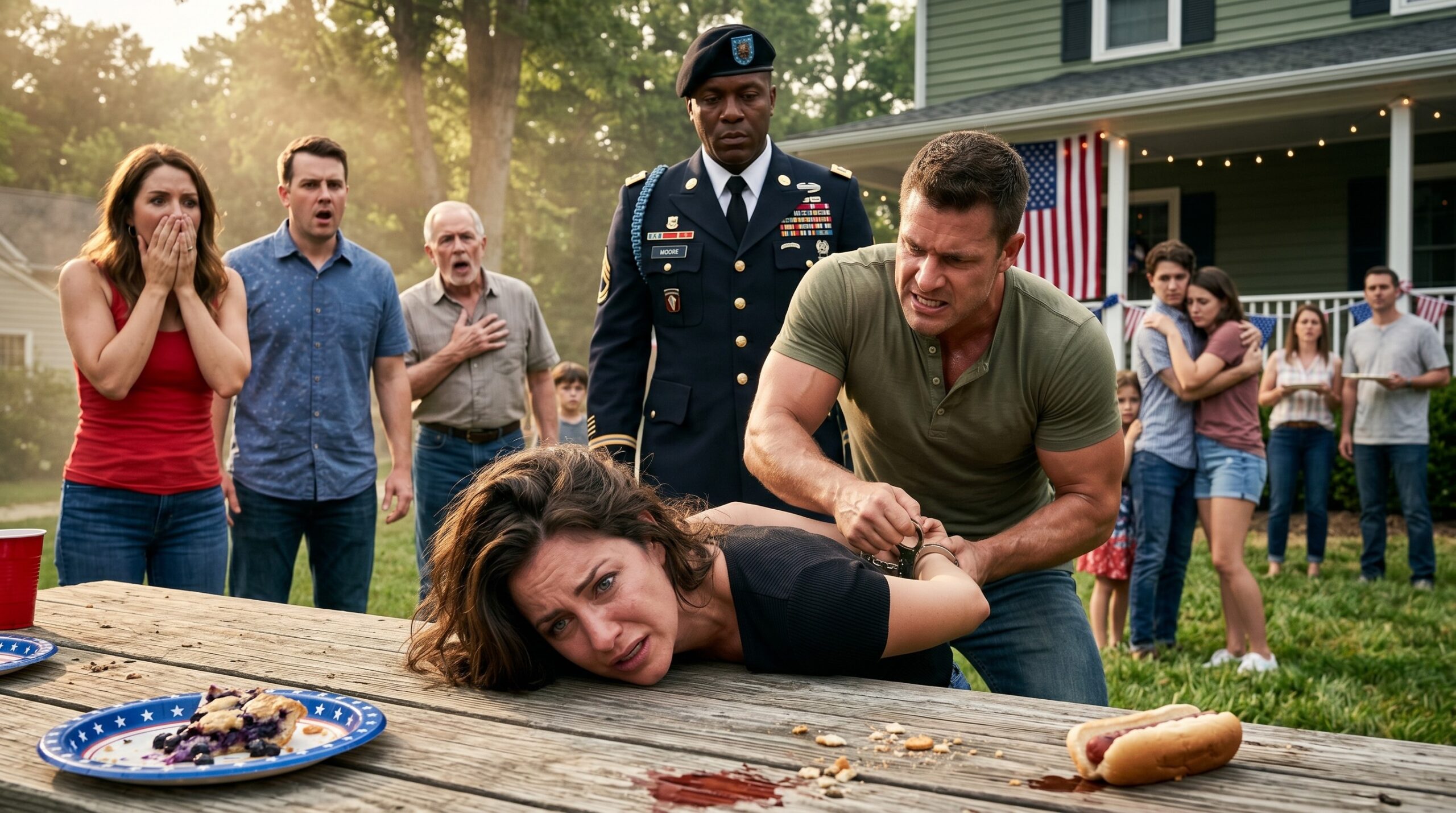
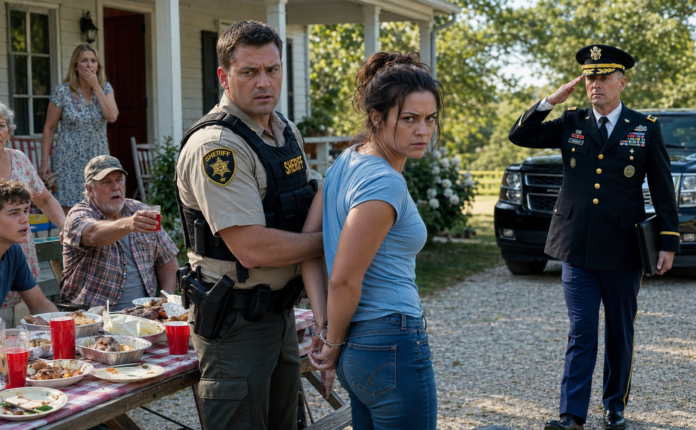
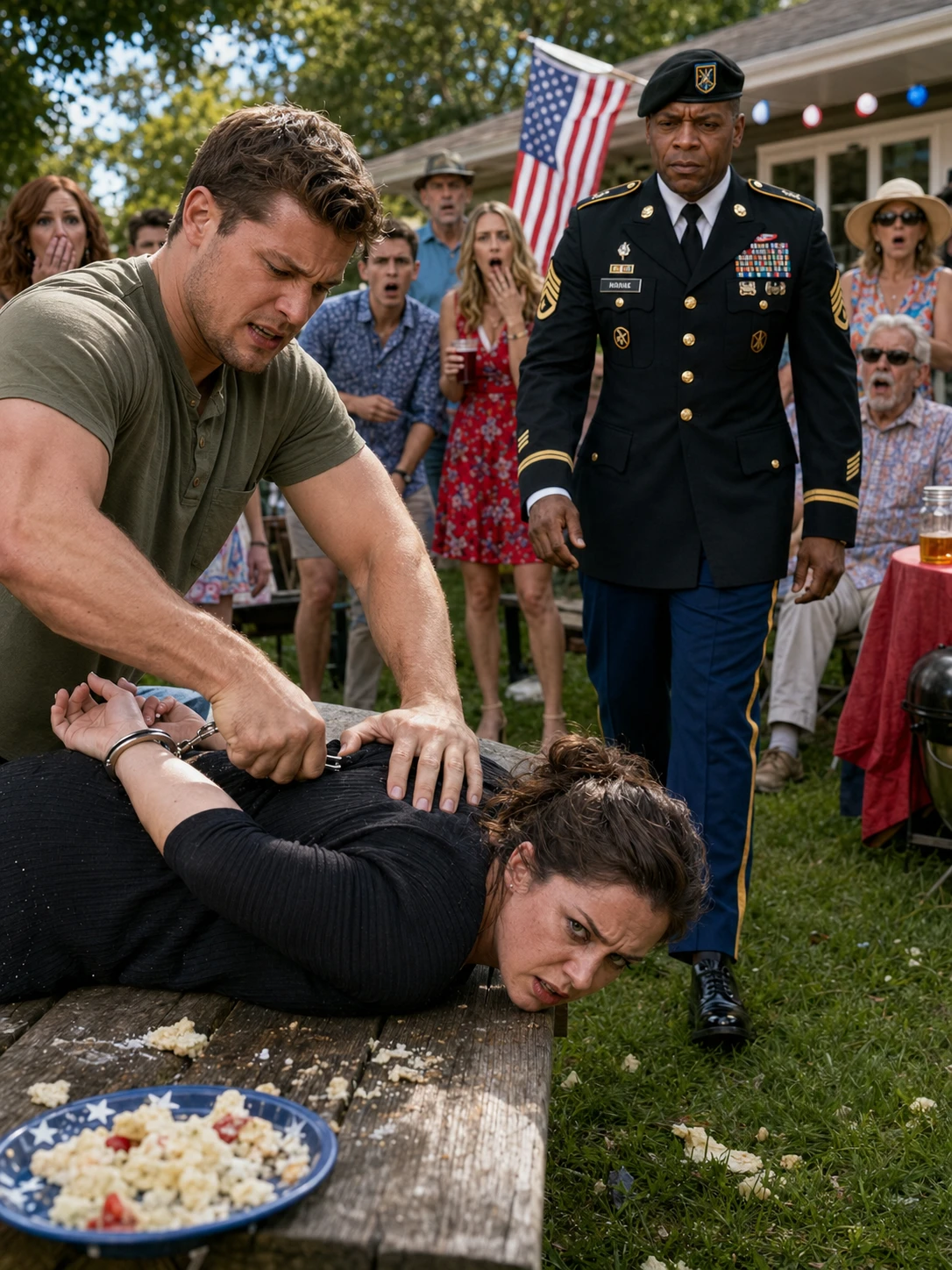
And right in the center of all of it, my cousin Derek forced my hands behind my back and pressed me against the picnic table like he was performing for the entire family.
My paper plate dropped to the ground beside me.
You May Also Like
Potato salad spilled across the grass.
Cold metal cuffs clicked around my wrists.
“Let’s see who respects you now, Harper,” Derek whispered near my ear.
The backyard fell silent.
Even the children stopped moving.
I could feel every set of eyes fixed on me as Derek tightened his hold, like he had finally claimed something he had wanted his whole life.
Three seconds later, black tires ground over the gravel driveway.
A government SUV eased to a stop beside the mailbox.
The driver’s door opened slowly.
Then a soldier stepped out.
Tall.
Broad-shouldered.
His dress uniform perfect under the Georgia heat.
Every ribbon lined up precisely across his chest.
Sergeant First Class Daniel Brooks.
A man I had once seen carry two injured soldiers through smoke and wreckage outside Mosul while blood ran down one side of his face.
He was not the kind of man people overlooked.
Daniel crossed the backyard without slowing, his polished boots pressing into the gravel with every controlled step.
He did not look at my cousins.
He did not look at my mother.
He did not even acknowledge the sheriff’s deputy standing beside Derek.
His eyes stayed locked directly on me.
Then he stopped and lifted his hand in a crisp military salute.
“General Carter,” he said in a steady voice. “We’re ready for you.”
The whole backyard went still.
The only sound left was the shrill cry of cicadas in the thick afternoon heat.
Derek’s grip on the handcuffs loosened.
Only a little.
I felt the fear move through him before it reached his face.
He was trying to decide whether this was some kind of prank… or the exact second his power vanished for good.
I slowly turned my head toward him.
“You’re going to want to remove those,” I said evenly, “before he has to ask again.”
Derek laughed, but it came out wrong.
Too sharp.
Too fake.
“Seriously?” he sneered. “Which one of your army buddies did you pay to play dress-up?”
Daniel’s jaw clenched once.
Just once.
That was enough for two more soldiers to step out of the SUV behind him.
Near the porch, my mother stood motionless with one hand pressed to her chest. She had the same look on her face that she wore the day I enlisted at seventeen.
Disappointment pretending to be concern.
To her, I had always been the daughter who embarrassed her.
I embarrassed her when I joined the Army instead of accepting a receptionist job in her office.
I embarrassed her when I came home with a limp and refused to tell her what had happened overseas.
I embarrassed her when I bought my own house after my divorce instead of crawling back into her basement.
And apparently, I embarrassed her most by staying alive in silence.
For fifteen years, my family had called me dramatic.
Cold.
Difficult.
Broken.
They treated my silence like evidence that I was weak.
But silence is not weakness.
Sometimes silence is discipline.
Sometimes silence is survival.
And sometimes silence is a weapon waiting for exactly the right moment.
Derek squared his shoulders, trying to cover the sweat gathering under his collar.
“This is an active arrest,” he snapped at Daniel. “Stay back.”
Daniel ignored him completely.
Instead, he looked at me.
There was one silent question in his eyes.
Do you want me to step in?
I gave the smallest shake of my head.
Not yet.
Because for the first time in my life, my entire family was finally watching.
The barbecue had begun hours earlier under the pecan trees behind my grandmother’s house. By then, crushed soda cans littered the tables, smoke hung low across the yard, and half the family stood frozen near the grill, watching everything fall apart.
Then Daniel reached inside his jacket and took out a sealed military folder.
Derek’s confidence disappeared instantly.
My mother took one step back.
And my grandmother slowly lowered her fork as Daniel opened the file and spoke the words that changed the entire afternoon forever.
“Deputy Derek Lawson,” he said coldly, “you are interfering with a federal officer under direct presidential appointment.”
(I know you’re curious about the next part, so please be patient and read on in the comments below. Thank you for your understanding of the inconvenience. please leave a ‘YES’ comment below and give us a “Like ” to get full story )
Derek’s face lost every trace of color.
The handcuffs suddenly seemed far heavier in his hands.
For one long second, no one moved.
The cicadas shrieked from the trees. Smoke drifted slowly across the backyard. And every person in my family stared at Daniel Brooks as if he had stepped straight out of a battlefield film and into our Memorial Day barbecue.
“Federal officer?” Derek repeated, his voice weak.
(I know you’re curious about the next part, so please be patient and read on in the comments below. Thank you for your understanding of the inconvenience. please leave a ‘YES’ comment below and give us a “Like ” to get full story )
Derek’s face lost every trace of color.
The handcuffs suddenly seemed far heavier in his hands.
For one long second, no one moved.
The cicadas shrieked from the trees. Smoke drifted slowly across the backyard. And every person in my family stared at Daniel Brooks as if he had stepped straight out of a battlefield film and into our Memorial Day barbecue.
“Federal officer?” Derek repeated, his voice weak.
Daniel did not answer him right away.
That silence was worse than shouting.
He simply stood there in his dress uniform, shoulders squared, eyes steady, the sealed folder open in his hands. The sunlight hit the ribbons across his chest, and for the first time that afternoon, no one was laughing at me. No one was whispering about how I had always been strange. No one was calling me dramatic under their breath.
They were all staring.
At Daniel.
At the folder.
At Derek’s hands.
At the cuffs around my wrists.
And finally, at me.
My cousin swallowed hard.
“You can’t just walk into a private family gathering and say things like that,” Derek said, trying to sound official again. “I’m a sworn deputy.”
Daniel’s eyes moved to him slowly.
“Yes,” he said. “That is exactly why you should have known better.”
A quiet sound went through the yard. Not a gasp. Not a word. Just the soft shifting of people realizing the ground beneath them had changed.
Derek’s father, my Uncle Ray, stepped away from the grill with the metal tongs still in his hand.
“Now hold on,” he said, trying to smile like this could still be turned into a misunderstanding. “Everybody just calm down. Derek was only trying to handle a family issue.”
“A family issue?” Daniel repeated.
His voice did not rise.
That made it worse.
My uncle’s smile weakened.
Daniel looked down at the folder, then back at Derek.
“Deputy Lawson placed restraints on a federally appointed officer without confirming identity, without stating lawful cause, and without following standard procedure. He did so in front of civilians, at a private gathering, during what appears to have been a personal dispute.”
Derek’s mouth opened.
Nothing came out.
My mother finally moved. She stepped off the porch slowly, her face pale beneath her careful makeup.
“Harper,” she said, her voice trembling in that familiar way that always made her sound injured even when she was the one holding the knife. “What is this?”
I looked at her.
“Nurse Stabbed 5 Times Protecting a Veteran’s K9 — 24 Hours Later, 200 Navy SEALs Arrived”
For a moment, all I saw was the woman who had once refused to come to my basic training graduation because she said she did not want to encourage my poor choices. The woman who told relatives I was “going through a phase” when I reenlisted. The woman who made my limp the first thing people noticed about me when I came home, because she kept asking in front of everyone whether I had finally learned my lesson.
I had spent years thinking that if I just stayed quiet, the wound would close.
But some wounds do not close.
They wait.
“This,” I said softly, “is my life.”
My mother blinked.
Daniel turned one page in the folder.
“General Harper Carter,” he said, his words clean and formal, “currently serving under a classified federal appointment connected to the Office of Strategic Defense Coordination. Authorization confirmed by presidential directive. Identity status restricted under federal protection until disclosure was deemed operationally necessary.”
My grandmother’s fork slipped from her hand and hit the plate with a tiny sound.
No one moved to pick it up.
Derek stared at me as if I had become a stranger in front of him.
“You’re not a general,” he said.
The words came out almost childlike.
“You can’t be.”
I almost laughed.
Not because anything was funny.
Because that was the same sentence my family had been saying to me my whole life in different forms.
You can’t do that.
You can’t survive that.
You can’t live alone.
You can’t make it without us.
You can’t be more than what we decided you were.
I lifted my wrists slightly, the cuffs catching the sunlight.
“Apparently,” I said, “I can.”
A low murmur spread through the yard.
My younger cousin Katie covered her mouth. My Aunt Linda looked at my mother, then at me, then away. My Uncle Ray set the tongs down on the grill so carefully it was like he was afraid the sound might offend someone.
“K-9 Titan Took a Bullet to Save the Man Who Saved Him First.”
Derek’s deputy friend, who had been standing near the cooler with his arms crossed, finally stepped forward.
“Derek,” he said quietly. “Take them off.”
Derek turned on him.
“Stay out of it.”
The deputy’s face tightened.
“No. Take them off.”
That was when Derek understood he was alone.
Not abandoned by strangers.
Worse.
Abandoned by the same audience he had gathered to witness my humiliation.
His hand shook as he reached for the key clipped to his belt.
For years, Derek had loved reminding everyone that he was the respectable one. The man with the badge. The man with the uniform. The man who stayed in town, attended church, shook hands with the right people, and knew exactly how to make a joke sound harmless while cutting someone open with it.
He called me “combat Barbie” when I first came home.
He asked if my medals came with coupons.
He once told my grandmother I only wore long sleeves because I wanted attention.
Every insult had been wrapped in a laugh. Every cruelty followed by “Don’t be so sensitive.” Every family dinner became a courtroom where I was expected to sit silently while they decided the value of my life.
And I had let them.
Not because I was afraid.
Because I had been tired.
Tired in a way none of them could understand.
Tired from missions they would never hear about. Tired from hospital rooms and briefings and names engraved on folded flags. Tired from carrying the kind of silence that is not emptiness, but weight.
The cuffs opened.
Metal released from my wrists.
I straightened slowly.
No one touched me.
No one offered a hand.
They did not know if they were allowed to anymore.
I rubbed one wrist, not because it hurt badly, but because I needed a second to feel the present moment settle into my body.
Daniel took one measured step closer.
“Ma’am,” he said.
He did not ask if I was okay.
He knew better.
Soldiers do not ask that in public unless they are prepared for the truth.
I nodded once.
“I’m fine.”
Derek laughed under his breath. It was small, desperate, and almost unrecognizable.
“This is insane,” he said. “You’re all acting like she’s important. She’s Harper. She’s the one who left. She’s the one who never tells anybody anything. She shows up late, barely talks, sits in corners like she’s better than us.”
My mother flinched at that, but she did not defend me.
She never had.
Daniel closed the folder.
“No,” he said. “She sits quietly because she understands discipline. That is different.”
The words landed harder than any accusation.
Derek’s face tightened.
“You don’t know this family.”
Daniel looked at him for a long moment.
“No,” he said. “But I know her.”
And that was when my grandmother began to cry.
Not loudly.
Just one hand pressed to her mouth, eyes shining with the kind of fear that comes when the past turns around and looks directly at you.
“Harper,” she whispered. “Why didn’t you tell us?”
I looked at her, and I wanted to say something gentle.
I wanted to be the kind of woman who could soften the truth because the person asking was old and shaken and suddenly aware that she had missed something important.
But I had spent too many years protecting people from the consequences of how they treated me.
So I told her the truth.
A cocky military cadet pressed a training pistol to an old man’s head, mocking his worn Marine pin and demanding respect in front of the whole park. But he didn’t know the quiet man he threatened was Gordon “Ghost” Whitaker — the Navy Cross legend who held Hill 742 alone for three days.
“Because nobody asked to know me,” I said.
The yard went silent again.
Somewhere behind the house, a child whispered a question and was hushed by an adult.
My mother stepped closer.
“That is not fair,” she said.
I turned toward her.
The whole backyard seemed to hold its breath.
“Fair?” I repeated. “You told people I was unstable because I did not want to talk about classified work. You told Aunt Linda I probably exaggerated my service because I came home without stories. You told Derek I needed to be brought down a little because I had become cold.”
Her lips parted.
“I never meant it like that.”
“Yes,” I said. “You did.”
Her eyes filled, but this time I did not look away.
“You meant every word when you said I was difficult. You meant every word when you said I had wasted my life. You meant every word when you said I would come crawling back eventually.”
She shook her head slowly.
“Harper, I was worried about you.”
“No,” I said. “You were embarrassed by me.”
That sentence did what Daniel’s folder had not done.
It broke something open.
My mother’s face crumpled, but I could not tell if it was grief or shame. Maybe both. Maybe neither. With her, pain had always been a tool she knew how to use.
Derek took a step back from the picnic table.
“I’m calling this in,” he said, reaching for his radio.
One of the soldiers behind Daniel moved half a step.
Daniel raised one hand, stopping him.
“No need,” Daniel said. “It has already been reported.”
Derek froze.
A new sound entered the yard.
Another engine.
Then another.
Two vehicles turned onto the gravel drive behind the government SUV. Not with sirens. Not with drama. Just quiet, official purpose.
The kind that made every adult in the yard understand this was no longer a family scene they could gossip away.
A woman in a navy blazer stepped out of the first vehicle carrying a slim case. Behind her came a man in a dark suit with an identification badge clipped to his jacket.
My uncle whispered something I could not hear.
Derek’s deputy friend took one full step away from him.
Daniel turned toward the woman.
“Agent Morris,” he said.
She nodded to him, then looked at me.
“General Carter.”
Again, the title moved through the backyard like thunder without sound.
Agent Morris opened her case and removed a tablet.
“Deputy Lawson,” she said, “we need to speak with you regarding an unauthorized restraint of a protected federal official, misuse of position during a personal dispute, and failure to verify restricted identity after notification.”
Derek’s voice broke.
“I didn’t know.”
Agent Morris looked at the cuffs still hanging from his hand.
“That will be included in the review.”
Review.
Such a small word.
But Derek heard what it meant.
His badge did not vanish in that moment, but the certainty behind it did. The confidence. The swagger. The lifelong belief that a title made him untouchable.
All of it drained out of him as quickly as the color from his face.
My mother turned to me again.
“Harper, please,” she whispered. “Tell them this was a misunderstanding.”
I stared at her.
There it was.
Not “Are you all right?”
Not “I’m sorry.”
Not “I should have protected you.”
Tell them this was a misunderstanding.
Protect us from what we did to you.
I almost smiled.
Not because I was cruel.
Because the pattern was so clear now that it finally stopped hurting.
“No,” I said.
The word was quiet.
It was also final.
My mother’s face hardened for half a second before she remembered everyone was watching. Then she softened it into pain.
“After everything we’ve been through as a family?”
I stepped away from the picnic table.
The grass was warm under my shoes. The smell of smoke still clung to the air. A red plastic cup rolled slowly near the cooler, pushed by a light breeze. Everything looked ordinary, and yet nothing would ever be ordinary again.
“After everything?” I said. “You mean after fifteen years of jokes? Fifteen years of being treated like a failure because I would not explain things I was not allowed to explain? Fifteen years of being invited to family gatherings only so everyone could measure how quiet I was and decide that meant I was broken?”
Nobody answered.
Because they all knew.
Maybe not all of them had started it.
But enough of them had joined in.
Enough had laughed.
Enough had watched.
Enough had looked away.
My grandmother wiped her eyes.
“I thought you were ashamed of us,” she said.
That one surprised me.
I looked at her.
“Why would you think that?”
She glanced toward my mother, then away.
“Because you never brought anyone home. You never talked about your work. You came and went like you were visiting strangers.”
The honesty in her voice was small, but real.
I breathed slowly.
“I came and went like that because every time I stayed too long, someone reminded me I did not belong.”
My grandmother lowered her head.
For the first time all afternoon, I saw the truth arrive in pieces. Not as one great revelation. Not as a dramatic speech. But as tiny expressions crossing faces around the yard.
Aunt Linda remembering the jokes she did not stop.
Uncle Ray remembering the time he asked if I knew how to smile anymore.
Katie remembering that she once called me scary because Derek told her I was.
My mother remembering everything and deciding which parts she could deny.
Daniel remained beside me, silent and immovable.
He had always understood when to speak and when to let the moment do the work.
Agent Morris asked Derek to step aside near the driveway. His deputy friend went with them, not as support, but as a witness. Derek tried once to look back at me with anger, but it collapsed into uncertainty before it reached his eyes.
Without him at the center, the backyard looked smaller.
The picnic tables. The folding chairs. The flag. The grill. The relatives in summer clothes pretending they had not spent years making cruelty sound like concern.
I had imagined this moment many times.
Not this exact one.
Not Daniel arriving at a barbecue.
Not my cousin standing pale beside a cooler while a federal agent read from a tablet.
But the moment my family finally saw me.
In my imagination, I always thought I would feel satisfaction.
I did not.
I felt tired.
And strangely light.
My mother approached one more time.
This time she stopped several feet away, as if some invisible line had appeared between us.
“General Carter,” she said, and my title sounded unnatural in her mouth.
I almost told her not to call me that.
But I let her feel it.
Let her understand the distance between the daughter she had dismissed and the woman standing in front of her.
“Harper,” she corrected herself. “Can we talk inside?”
I looked past her toward the porch.
That house had shaped half my childhood. Birthday cakes on the dining table. Christmas stockings near the fireplace. Arguments in the kitchen. My mother’s voice floating through rooms, telling relatives I was hard to understand, hard to love, hard to help.
For years, I believed if I could just become accomplished enough, brave enough, useful enough, they would finally stop seeing me as a problem.
But some people do not change their opinion because you prove them wrong.
They change it only when someone more powerful tells them they were wrong.
That was not love.
That was hierarchy.
“No,” I said. “Not inside.”
Her mouth tightened.
“Then where?”
“Here,” I said. “In front of everyone.”
The words startled her.
Good.
She had never minded correcting me in public. She had never minded letting people laugh. She had never minded using an audience when the audience was on her side.
Now the audience belonged to the truth.
My mother folded her hands together.
“I may have said things I should not have said.”
Aunt Linda looked down.
My grandmother closed her eyes.
I waited.
My mother swallowed.
“But you have to understand how hard it was for us. You disappeared into the Army. You came back different. You would not explain anything. You shut me out.”
There it was again.
The careful turning of the blade.
I heard Daniel inhale beside me, but he did not speak.
I could handle this.
“I did not disappear,” I said. “I served. I did not come back different to punish you. I came back different because life changed me. I did not shut you out because I hated you. I stayed quiet because my work required it, and because every time I tried to simply exist here, you turned my silence into evidence against me.”
My mother’s eyes filled again.
“I’m your mother.”
“I know,” I said. “That is why it hurt longer than it should have.”
The words softened something in the yard.
Not forgiveness.
Not yet.
But recognition.
My grandmother covered her face.
My uncle removed his baseball cap.
Even Derek, standing by the driveway with Agent Morris, had stopped pretending not to listen.
I turned slightly, letting my voice carry.
“I did not come here today to expose anyone. I came because Grandma asked me to. I brought a pie. I sat at the end of the table. I tried to be quiet. Derek made a choice. And now every person here has to decide what they are going to do with what they have seen.”
No one answered.
That was fine.
I had not asked a question.
Daniel stepped closer and lowered his voice so only I could hear.
“Ma’am, we do need to leave soon. The briefing window is narrow.”
I nodded.
Of course it was.
Duty had always arrived with a clock in its hand.
I looked toward the SUV, then back at my family.
My grandmother stood slowly from her chair.
“Harper,” she said. “Wait.”
Her voice was fragile, but not manipulative. That was the difference. I could hear it.
She took two careful steps toward me.
“I don’t know what to say,” she whispered.
I believed that.
So I answered gently.
“Then don’t say anything you don’t mean.”
Her chin trembled.
“I’m sorry I let them talk about you that way.”
The backyard changed again.
Not dramatically.
Not loudly.
But something shifted.
Because apology, when it is real, does not ask for immediate reward. It simply stands there and accepts its own weight.
I nodded once.
“Thank you.”
My grandmother cried harder, but she did not reach for me. Maybe she understood that touching me without permission was not comfort. Maybe she understood too late, but understood anyway.
My mother watched the exchange with an expression I could not read.
Jealousy.
Regret.
Fear.
All three, perhaps.
Then Derek spoke from the driveway.
“This is ridiculous,” he said, but the power was gone from his voice. “She’s still Harper.”
I turned toward him.
“Yes,” I said. “I am.”
The simplicity of it stopped him.
I was still Harper.
The girl who left at seventeen.
The soldier who came home limping.
The woman who bought her own house.
The officer who never explained what she was not allowed to explain.
The daughter they failed to understand.
The general they never imagined.
All of those truths lived in one body.
Mine.
Agent Morris asked Derek to place the cuffs on the hood of the vehicle. He obeyed. Watching him follow instructions from someone else was almost surreal. The man who had always filled every room with certainty now looked smaller than the shadow of his own badge.
His father finally spoke.
“Harper, I’m sorry,” Uncle Ray said.
I looked at him.
He shifted uneasily.
“I should’ve stopped him.”
“Yes,” I said. “You should have.”
He nodded, accepting it.
That mattered more than excuses.
Aunt Linda began crying quietly. Katie whispered that she was sorry too, though she did not seem to know whether she had the right to say it. Several relatives looked ashamed. Others looked frightened. A few looked like they were already planning how to retell this story in a way that made them less guilty.
I knew my family.
Truth did not transform everyone.
Sometimes it only exposed them.
Daniel opened the rear door of the SUV.
“General.”
The title no longer shocked the yard.
It settled over them.
Heavy.
Undeniable.
I walked toward the driveway.
My mother followed one step.
“Harper,” she said.
I stopped, but did not turn fully.
“What happens now?”
The question was small.
For once, she was not asking about Derek.
Not directly.
She was asking about us.
I looked at her for a long moment.
“I don’t know,” I said honestly. “But what happens next will not be built on pretending this did not happen.”
Her face crumpled again.
This time, I thought it might be real.
Maybe.
But real regret still had to become real change.
And I had lived too long to confuse the first with the second.
I stepped into the SUV.
Daniel closed the door gently, then walked around to the front passenger seat.
Through the window, I saw my family standing in the yard among the picnic tables and paper plates, surrounded by the remains of a barbecue that had become something else entirely.
A reckoning.
Derek stood by the driveway with Agent Morris.
My grandmother held a napkin to her face.
My mother stood alone near the porch, one hand pressed to her chest, staring at me as if she was seeing both her daughter and a stranger.
Maybe that was fair.
She had never really known me.
Not because I had hidden everything.
But because she had stopped looking.
The SUV rolled backward slowly.
Gravel crunched under the tires.
As we turned toward the road, Daniel looked at me through the rearview mirror.
“You handled that with restraint,” he said.
I leaned my head back against the seat.
“Restraint is what they mistook for weakness.”
Daniel’s eyes softened.
“People often do.”
The house disappeared behind the trees.
For a few minutes, no one spoke.
The road stretched ahead under a bright Georgia sky. Flags hung from porches. Families gathered on lawns. Smoke rose from grills. Memorial Day continued everywhere else as if the world had not shifted in one backyard.
I looked down at my wrists.
Faint red marks circled them.
They would fade quickly.
Some marks do.
Others take longer.
My phone buzzed in my pocket.
A message from my grandmother.
I hesitated before opening it.
I am sorry. I should have asked who you became instead of believing what others said you were.
I stared at the words until they blurred slightly.
Then another message arrived.
From Katie.
I didn’t understand before. I’m sorry. I want to know you if you’ll let me.
I closed my eyes.
Not forgiveness.
Not yet.
But maybe a door.
Across from me, the folder rested on Daniel’s lap. The presidential seal caught a thin line of sunlight.
“Briefing begins in forty minutes,” he said.
I nodded.
“Then we should not be late.”
He almost smiled.
“No, ma’am.”
I looked out the window as the SUV accelerated onto the main road.
Behind me was a family that had finally seen the truth.
Ahead of me was a room full of people who had known it all along.
And somewhere between those two worlds sat the woman I had spent fifteen years becoming.
Not broken.
Not cold.
Not difficult.
Not a nobody.
Just silent long enough for the truth to arrive with witnesses.
By the time we reached the federal building, the afternoon sun had shifted, turning the glass front of the entrance gold. Two security officers opened the doors before the SUV stopped moving completely. Daniel stepped out first, then stood aside as I exited.
Inside, the hallway smelled of polished floors, paper, and quiet urgency.
A young aide rushed toward us with a tablet pressed to her chest.
“General Carter, the deputy secretary is already in the secure room. They moved the schedule up.”
“Of course they did,” I said.
The aide looked nervous.
Daniel looked amused.
I walked beside them through the corridor, my steps steady, my shoulders straight. People turned as I passed. Some saluted. Some nodded. No one questioned whether I belonged there.
That alone felt almost strange after the backyard.
We entered a secure conference room where six officials waited around a long table. Maps glowed on screens along the wall. Red folders sat in neat stacks. A speakerphone blinked at the center of the table.
The deputy secretary rose when I entered.
“General Carter,” he said. “Thank you for coming on short notice.”
I almost thought of the potato salad on my shoe.
The fallen paper plate.
Derek’s voice near my ear.
My mother’s face.
Then I set all of it aside.
Compartmentalization is not denial.
It is duty.
“What do we have?” I asked.
The room shifted immediately into motion.
For the next two hours, nobody mentioned my family. Nobody asked about the marks on my wrists. Nobody looked at me like I was fragile. They handed me reports, asked for decisions, challenged assumptions, and waited for answers.
That was respect.
Not softness.
Not sympathy.
Respect.
And I realized, sitting at that table beneath sealed monitors and national briefings, that my family had never taken my silence from me.
They had only misunderstood it.
My silence had held.
My work had held.
I had held.
When the briefing ended, Daniel walked me back to the hallway. The building had gone quieter by then. Evening pressed blue against the windows.
“Agent Morris sent an update,” he said.
I looked at him.
“Derek?”
“Administrative review pending. No immediate public action beyond formal reporting. Your name remains protected in the official record. Only those present today know what they heard.”
I nodded.
That was better.
I did not need headlines.
I did not need revenge.
I had never wanted Derek destroyed in front of everyone.
I had wanted the truth to stand without lowering itself.
My phone buzzed again.
This time, it was my mother.
I stared at her name for a long moment.
Daniel noticed but said nothing.
I opened the message.
I don’t know how to talk to you anymore. I don’t know who you are.
For once, there was no accusation in it.
Only fear.
I typed slowly.
Start with asking.
I did not add more.
I did not comfort her.
I did not carry the whole bridge alone.
A minute later, three dots appeared.
Then vanished.
Then appeared again.
Finally, her reply came.
Who are you, Harper?
I looked at the screen for a long time.
There were a hundred ways to answer.
A soldier.
A daughter.
A general.
A survivor.
A woman who had spent half her life being underestimated by people who mistook quiet for emptiness.
But in the end, I typed only one sentence.
Someone you never took the time to know.
I sent it.
Then I turned the phone face down in my palm.
Outside, the last light of Memorial Day faded beyond the federal building. Somewhere, families were still gathered around grills, laughing beneath flags, telling old stories that made everyone feel safe.
My family would be telling a different story now.
Maybe some would twist it.
Maybe some would deny what they saw.
Maybe some would finally remember my face at that picnic table and understand that the quiet woman they had mocked had been carrying more than they ever imagined.
I could not control that.
I no longer wanted to.
Daniel stood beside the exit, waiting.
“Ready, ma’am?”
I looked through the glass doors at the darkening sky.
For the first time in years, the thought of going home did not feel like retreat.
It felt like choosing my own ground.
“Yes,” I said. “I’m ready.”
And when I stepped outside, I did not look back.