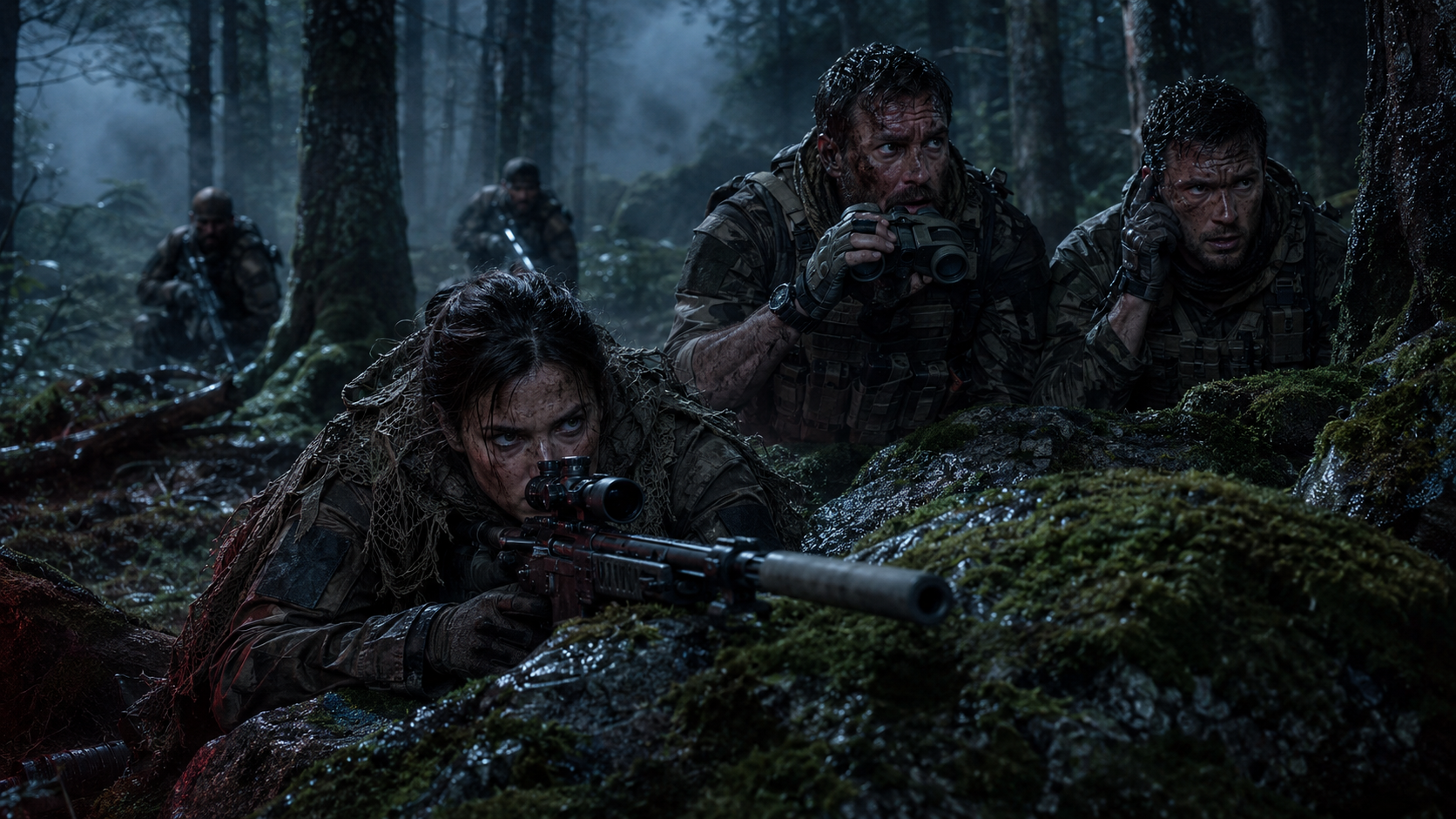
Commander Marcus Blake lifted the binoculars to his eyes and watched the woman crawl into the forest alone.
For a few seconds, he said nothing.
The ridge below him was washed in the pale gray light before dawn, that thin hour when the world seemed undecided about whether it wanted to belong to night or morning. Mist clung to the trees in long, low ribbons. The Afghan forest stretched in every direction, dense and black beneath the canopy, swallowing sound and movement the way deep water swallowed stones.
Somewhere inside that green darkness, twelve armed militants were closing around Blake’s pinned-down team.
You May Also Like

And somewhere between them moved Staff Sergeant Luna Cross.
One woman.
One rifle.
One impossible chance.
Blake lowered the binoculars just enough to glance at Senior Chief Daniel Mercer crouched beside him behind the rocks. Mercer had dirt across one cheek, blood drying under his left ear, and the expression of a man who had seen enough combat to recognize when luck was starting to run out.
“She’ll be dead in minutes,” Blake muttered.
Mercer did not answer.
The words were not meant for him anyway. They were meant for the fear Blake refused to call fear.
A burst of automatic fire cracked from the tree line below them. Rounds chopped leaves from branches and slapped into the rocks near Blake’s position. One of his operators cursed. Another dragged the wounded communications specialist behind a fallen trunk while their medic tried to stop the bleeding in his upper arm.
Blake’s SEAL team had been in ambushes before. They had been surrounded before. They had fought their way out of uglier places than this. But this one was different, and he knew it. He hated that he knew it.
The enemy had chosen the terrain too well.
The compound sat in a shallow bowl beneath a broken hillside. Blake’s team had expected a small guard force, maybe fifteen fighters spread thin around a meeting between a high-value target and regional commanders. Instead, they had walked into a layered kill zone. Concealed firing positions. Elevated angles. Interlocking fields of fire. Routes blocked before the SEALs even realized they were trapped.
The mission had been called Operation Silent Thunder.
There was nothing silent about it now.
Blake pressed his radio. “Phantom, this is Steel. Hold your position and report enemy movement.”
Static snapped in his ear.
Then Luna’s voice came back, low and even. “Steel, this is Phantom. I have twelve hostile positions confirmed. I am moving to engage.”
Blake’s jaw tightened. “Negative, Phantom. Maintain overwatch. Do not break position.”
A pause.
Not hesitation. Something colder than hesitation.
“Steel, your assigned overwatch angle is obstructed. I cannot support you effectively from there. Relocating.”
“Damn it, Cross, that is a direct—”
The radio clicked off.
Blake stared at the forest.
He had spent months convinced Luna Cross was a problem sent to him by headquarters. Not because she lacked skill. He was not blind. Her range scores were absurd. Her field reports were clean. Her instructors spoke about her with the reverence usually reserved for dead legends. But range scores were not war. Reports were not blood. In Blake’s mind, special operations combat was not a classroom for social experiments, and every time some officer with polished boots and a diversity briefing assigned him “the female sniper,” he felt the same hard knot of resentment.
Luna had never argued with him.
That almost irritated him more.
She accepted his clipped orders. Took the worst watch shifts. Stayed quiet during planning sessions unless asked a direct question. When his men made jokes about Alaskan hunting stories and “snow princess marksmanship,” she neither laughed nor glared. She simply looked at them with those steady hazel eyes, as if recording wind direction, distance, and character at the same time.
Blake had mistaken that silence for submission.
Now she had disobeyed him in the middle of a firefight.
“Where is she?” Mercer asked.
Blake lifted the binoculars again.
He found her for half a breath between two black spruce trunks, then lost her.
That bothered him.
No one moved through hostile terrain carrying a long rifle and a pack without disturbing something. Leaves. Branches. Soil. The human eye was built to catch irregular motion. Blake had spent eighteen years hunting men in bad places. He knew what to look for.
Luna Cross moved as if the forest had agreed not to reveal her.
Then the first shot cracked.
It did not sound like the rest of the battle.
Automatic fire was anger. Grenades were thunder. Suppressed rifles were whispers with teeth.
Luna’s shot was a punctuation mark.
Sharp. Final. Certain.
Through his binoculars, Blake saw a man standing near a camouflaged fighting position fold backward and disappear into the brush. The radio handset in his grip fell beside him. Two fighters near him jerked toward the sound, confused, searching the wrong direction.
Mercer whispered, “That was their coordinator.”
Blake said nothing.
The second shot came six seconds later.
A machine gun position on the north edge of the bowl went silent.
For the first time since the ambush began, Blake’s team was no longer taking fire from that side.
A third shot.
A fighter attempting to flank the SEAL medic dropped behind a tree before he could raise his weapon.
A fourth.
Then a fifth.
The forest changed.
It had belonged to the enemy. Every shadow had threatened Blake’s men. Every hidden muzzle had been part of a net tightening around them. Now the net was ripping strand by strand, and nobody could see the hand doing it.
Blake heard panic begin in the enemy lines.
Shouted commands. Confusion. Men firing at empty trees. Men moving when they should have stayed covered. Men who had believed they were predators realizing something unseen had started hunting them instead.
Five minutes earlier, Blake would have called that kind of shooting impossible.
Now he was watching it happen.
“Phantom,” he said into the radio, his voice lower than before. “Status.”
Luna answered with the same terrible calm. “Engaging targets. Stay down.”
Stay down.
Not “sir.” Not “awaiting orders.” Not “request permission.”
Stay down.
And Blake, commander of one of the most elite teams in the United States military, stayed down.
The sixth shot came from a different angle.
The seventh from another.
Mercer’s face changed slowly as understanding settled over him. “She’s moving between shots.”
“That’s not possible,” Blake said.
But even as he said it, he knew possible had lost relevance.
Luna Cross had spent her childhood in a place where possible was negotiated daily.
Long before the Army knew her name, long before commanders argued over whether she belonged in combat, Luna had learned to survive in the Alaskan wilderness under a sky so wide it made people feel honest. Her father, Sergeant Major Robert “Tracker” Cross, had taken her into the snow before she was old enough to understand that other children spent weekends at malls and birthday parties instead of following wolf tracks across frozen valleys.
Their cabin stood fifty miles from the nearest neighbor, tucked between black spruce, glacial streams, and mountains that turned purple at sunset. In winter, snow buried the world so completely that silence became its own weather. In summer, mosquitoes came in black clouds and the sun refused to leave. Supply runs were rare. Mistakes were expensive. Carelessness could kill faster than cruelty.
Robert Cross had not raised Luna gently, but he had raised her with love.
He taught her to read tracks before she could write cursive. Deer. Moose. Bear. Human. Old trail. Fresh trail. Limping animal. Spooked animal. Animal that knew it was being followed. He taught her to sit still until cold seeped through her bones and boredom stopped mattering. He taught her that patience was not waiting. Patience was working without motion.
At twelve, she could follow a wounded caribou across broken snow for miles, identifying blood so faint most adults would miss it. At fourteen, she could strike small targets at distances her father refused to brag about because he said bragging made shooters stupid. At sixteen, she could disappear into the backcountry for ten days with a knife, a rifle, a tarp, and a notebook, then come home smelling like smoke and pine, thinner but calm.
Her father’s lessons were never only about shooting.
“Anyone can pull a trigger, baby girl,” he would tell her while they cleaned rifles by lantern light. “The bullet is the last part. Not the first. You decide long before that whether you’re worth trusting with one.”
Robert had been one of the most respected Army snipers of his generation. He had survived three deployments, carried invisible damage home with him, and buried Luna’s mother after a winter road accident took her in a storm. He could have gone anywhere after retirement. He chose Alaska because grief needed space, and because raising his daughter far from noise felt like the only thing he still knew how to do right.
Luna never confused her father’s silence for emptiness. She knew he loved her in practical ways. Sharpened knives. Dry socks. Extra gloves packed without comment. A hand on her shoulder after her first clean shot on an animal they needed for meat. A story told at night about when not shooting had saved more lives than shooting.
When she enlisted, nobody knew what to do with her.
Basic training tried to break recruits down and rebuild them in standard shapes. Luna had never fit standard shapes. She was too quiet for drill sergeants who wanted visible fear. Too comfortable in mud. Too accurate on the range. Too unbothered by weather, hunger, discomfort, or men yelling inches from her face.
At sniper school, irritation turned into curiosity, then into respect.
She did not merely hit targets. She understood terrain like language. She could read wind by the movement of grass, heat shimmer, leaf flutter, smoke drift, and the feel of air against her cheek. She learned military formulas quickly, but often arrived at answers before instructors finished explaining how to calculate them.
One instructor had asked her how she had known a shot would drift left when the instruments showed crosswind holding steady.
“Birds changed direction in the tree line,” she said.
He stared at her.
She stared back.
The Army gave her certificates, tabs, qualifications, deployments, and a nickname whispered first by a Ranger who watched her vanish during a field exercise and appear two hours later behind the instructors.
Phantom.
Luna did not choose it.
But it fit.
Still, skill did not erase suspicion.
Commanders praised her at briefings, then placed her far from the center of operations. Men who trusted her to hit impossible shots did not always trust her to share danger. They called it caution. Experience. Unit cohesion. Mission optics. Luna recognized prejudice even when it wore professional language.
Marcus Blake had been the worst because he was not stupid.
Stupid men were easier to dismiss. Blake was talented, decorated, and brave. He was the kind of commander other men followed into fire because he had led them out of it before. His flaw was more dangerous than incompetence.
He believed his success proved his assumptions were correct.
When headquarters attached Luna to his team for Operation Silent Thunder, he reviewed her file and frowned.
“She’s technically impressive,” he told Mercer. “But range performance is not frontline combat.”
Mercer, wiser in the way senior enlisted men often were, said, “Maybe we should let combat decide that.”
Blake ignored him.
In the mission briefing, Luna noticed the problem before anyone else.
Satellite imagery showed the compound. Drone footage confirmed routine guard patrols. Intercepts suggested the target would be present for a narrow window. Everything pointed toward a direct assault supported by overwatch.
Everything except the forest.
Luna studied the photographs longer than anyone. Not the buildings. Not the obvious entrances. The spaces between trees. The game trails too clean to be natural. The odd gaps in vegetation. The shadows that repeated at intervals no forest made on its own. She saw concealed lanes. Fallback positions. Possible weapon caches. A defensive web hidden under leaves.
“Sir,” she said during the final planning session, “the approach route is being shaped.”
Blake looked up slowly. “Explain.”
“The vegetation here and here has been disturbed. The ground route funnels toward open terrain. These tree lines give defenders overlapping fire angles. If they have more than the estimated guard force, your assault element could be drawn into a prepared kill zone.”
One of Blake’s operators shifted. Another smirked.
Blake’s expression hardened with the faint embarrassment of a man challenged in front of subordinates.
“Satellite analysis didn’t flag that.”
“No, sir. The canopy hides most of it.”
“But you can see it.”
“Yes, sir.”
The room went quiet.
Blake leaned over the map. “Staff Sergeant Cross, I appreciate your attention to detail. You will establish overwatch at Ridge Point Delta and monitor the western escape route.”
“That position has limited support angle if your team takes contact near the creek bed.”
“It is the position assigned.”
“If I move to this outcrop instead—”
“You will take the position assigned,” Blake said, voice flat. “Your role is overwatch. Not mission command.”
Luna held his gaze for one beat.
Then she nodded. “Yes, sir.”
She did not argue again.
But she prepared for the mission Blake thought he was running and the one the terrain told her was coming.
Now, in the forest beneath him, Blake watched her preparation become survival.
Shot eight silenced a fighter moving toward the creek bed.
Shot nine stopped another who had been crawling into position above Mercer’s flank.
Shot ten came after a pause long enough that Blake thought she might have been hit. Then a muzzle flash sparked from a concealed hollow, and before the hostile shooter could fire again, Luna’s bullet found him.
The enemy fire weakened from a coordinated storm into scattered bursts.
Blake keyed his radio. “All elements, prepare to move on Phantom’s signal.”
It felt strange saying it.
Necessary, but strange.
The eleventh shot cracked from farther east than Blake expected. One of the remaining militants dropped his weapon and tried to run toward thicker forest. He never reached it.
A final hostile remained near a fallen log, tucked into a position so tight Blake could barely see movement even through magnification. The angle looked impossible. Two tree trunks crossed the lane. Branches broke the view. Wind shifted mist between shooter and target.
Luna did not fire for nearly twenty seconds.
The battlefield seemed to hold its breath.
Later, Blake would learn that this was the moment she thought of her father.
Not dramatically. Not as a memory flooding her mind. More like a voice rising from years of practice.
Bad weather. Bad position. Bad odds. That’s when you find out what you’re made of.
Luna settled into the earth. She let the forest speak. A leaf turned. Mist thinned. The hostile shifted half an inch, impatient, believing cover was protection.
The final shot landed.
The forest went still.
No triumphant music. No heroic shout. Only the echo moving through trees and the sudden absence of incoming fire.
“Steel,” Luna said over the radio, calm as morning frost. “Threats neutralized. You are clear to move.”
Blake did not answer immediately.
He counted what he had seen.
Twelve enemy positions. Five minutes. No wasted rounds. No panic. No hesitation. No team casualties beyond the wound sustained before she moved.
Mercer looked at him, and there was no mockery in his expression. Only the quiet satisfaction of a man watching truth arrive.
Blake pressed the radio. “Phantom, confirm your status.”
“Green.”
“Location?”
“Mobile.”
Of course she was.
Blake almost laughed, but the sound died in his throat. His team was alive because the woman he had kept at the edge of the operation had read the battlefield better than he had and acted when he would not listen.
There would be time to feel ashamed later.
For now, there was still a mission.
With the ambush broken, Blake’s team moved.
They crossed the killing ground fast, clearing to the compound through lanes Luna called from somewhere unseen. Her voice guided them around secondary positions, past a tripwire Blake had not noticed, through a drainage cut that shortened their exposure by half. The high-value target and his council were confirmed inside the main structure. The strike that followed was clean, fast, and controlled.
Operation Silent Thunder succeeded.
But nobody on that team would remember the compound first.
They would remember the forest.
They would remember the five minutes when the woman they had underestimated controlled the entire battlefield without being seen.
Extraction came at sunrise.
The helicopter dropped into a clearing beyond the ridge, rotors hammering mist into silver sheets. Blake’s men loaded quickly, faces drawn with exhaustion and the strange quiet that follows close survival. Luna arrived last.
She emerged from the tree line without drama, rifle slung, face streaked with dirt, braid dark against her shoulder. There was a shallow scrape along one cheek and mud on her sleeves. She looked smaller than the thing she had just done.
Blake watched her climb aboard.
For a few moments, the helicopter’s noise made conversation impossible. The team sat along the cargo bay benches, knees braced, weapons secure. Mercer leaned back with closed eyes. The wounded comms specialist had been stabilized. Across from Blake, Luna checked her rifle with the same calm she might have used cleaning it at a range.
Blake had never struggled to speak to subordinates.
Now he did.
When the helicopter banked away from the valley and the noise settled into a steady roar, he leaned forward.
“Cross.”
She looked up. “Sir.”
The word carried no accusation. That somehow made it worse.
“I owe you an apology.”
The men nearest them turned slightly, pretending not to listen.
Blake did not care.
“I ignored your assessment. I assigned you to a bad position. I treated your input like an inconvenience. If you had followed my order exactly, we might be carrying body bags right now.”
Luna’s expression remained controlled, but something shifted in her eyes. Not satisfaction. Not victory. Maybe relief that reality had finally been spoken aloud.
“I made the call I believed the situation required,” she said.
“You disobeyed.”
“Yes, sir.”
“You saved my team.”
“Yes, sir.”
A few men exchanged glances. One almost smiled.
Blake looked at her hands. They were steady. He wondered how much discipline it took to remain that calm after being doubted for so long.
“What you did in that forest,” he said, “I have never seen anything like it.”
Luna looked toward the open side door where the valley was falling away beneath them. “My father used to say a sniper’s job isn’t to shoot. It’s to decide.”
Blake absorbed that.
He had spent his career believing aggression was the heart of combat. Hit first. Hit hard. Own the initiative. It had served him well, until the day it almost killed his men. Luna had brought something different into the fight. Patience sharper than speed. Precision stronger than force. A way of seeing that did not need to dominate the battlefield in order to control it.
“I was wrong about you,” Blake said.
Luna turned back to him.
“Not just today,” he continued. “From the beginning.”
That cost him.
Good, he thought. It should.
Luna nodded once. “Thank you, sir.”
No speech. No demand. No visible anger.
But Blake understood that forgiveness, if it came at all, would come through future conduct, not one apology in a helicopter.
The after-action report became classified within hours.
The official version was clean, stripped of emotion, and buried under operational language. Ambush initiated by enemy force. Friendly team pinned. Assigned sniper element repositioned. Twelve hostile combatants neutralized. Primary objective completed. No friendly fatalities.
But inside special operations circles, the story spread the way stories always do where official silence leaves space.
At first, it came as rumor.
Did you hear about the sniper attached to Blake’s team?
Twelve in five minutes.
No misses.
Moved through forest like smoke.
Saved the whole damn assault element.
Then came the review. Ballistics, drone footage, helmet camera fragments, radio logs. Skeptics looked for exaggeration and found none. If anything, the report understated it. Luna Cross had not merely shot well. She had read the ambush before it fully formed, identified command hierarchy under fire, broken the enemy’s coordination, and guided the assault element through terrain the original plan had misunderstood.
What could not fit neatly in the report was how it changed Marcus Blake.
Change did not come all at once.
He was not magically transformed into a humble man because one mission humbled him. Men like Blake did not shed old assumptions overnight. But after Silent Thunder, he began catching himself before dismissing input that arrived in a voice he did not expect. He began asking Luna what the terrain said before he finalized plans. At first, his questions were stiff, almost formal.
“Cross, review this route.”
“Cross, what do you see in the canopy?”
“Cross, does this approach feel wrong to you?”
She answered precisely.
Sometimes she agreed with his plan.
Often she improved it.
Twice, she told him the mission profile was flawed enough to require restructuring. The first time, Blake almost snapped back out of reflex. Mercer saw it happen and waited.
Blake breathed once and said, “Explain.”
Luna did.
She was right.
The second time, he asked before she had to interrupt.
Trust grew like that. Not through speeches. Through repeated evidence. Through one professional listening and the other proving that listening had value.
Six months after Operation Silent Thunder, Luna was promoted.
At the ceremony, she stood straight in dress uniform while the commendation was read in language careful enough not to reveal classified details and vague enough to frustrate everyone who knew what she had done. Her father attended in an old suit that fit badly across his shoulders. Robert Cross stood in the back, hands folded, eyes bright beneath the brim of a weathered hat he refused to remove until Luna gave him a look.
Afterward, he hugged her for a long time.
“You did all right, baby girl,” he said gruffly.
Luna smiled into his shoulder. “That’s high praise from you.”
“Don’t get used to it.”
But his voice shook.
Blake approached them later. Robert looked him over with the cool appraisal of a man deciding whether another man deserved respect.
“Commander,” Robert said.
“Sergeant Major Cross.”
“Heard you doubted my daughter.”
Blake did not flinch. “I did.”
“Heard she fixed that.”
“She did.”
Robert nodded. “Good.”
That was all.
Somehow, Blake felt he had passed a test by not defending himself.
Years moved forward.
Luna’s name became one instructors used in closed rooms. Not as a slogan, not as a diversity talking point, though plenty of people tried to make her one. She disliked that most of all. She had not trained her entire life to become proof in someone else’s argument.
She wanted better doctrine.
She wanted snipers taught to think beyond marksmanship. To read terrain. To identify command flow. To understand when patience mattered more than rate of fire. To know when not shooting was the correct choice. To respect weather, silence, fear, and the strange moral weight of deciding who lived because you intervened and who lived because you waited.
Blake, promoted first to captain and later to admiral, became one of her strongest advocates. The transformation surprised people who had known his older views. It did not surprise Luna. She had learned in the wilderness that even hard ground changed under enough weather.
At conferences, when officers questioned whether her methods were too unconventional, Blake would let them talk. Then he would ask one question.
“Have you ever watched one sniper save an assault team from a prepared ambush?”
The room usually went quiet.
“I have,” he would say. “Teach what she teaches.”
Luna eventually became Master Sergeant Cross, senior instructor at the military’s most advanced sniper training program.
The facility sat in high desert country, surrounded by ridges, scrubland, and wind that never seemed to stop moving. Students arrived with confidence. Some had combat experience. Some had perfect range scores. Some believed being good with a rifle made them snipers.
Luna corrected that quickly.
On the first day of each course, she never began at the firing range.
She took them into the field before sunrise, made them sit on cold ground, and told them to write down everything they noticed.
Most wrote obvious things. Wind. Temperature. Distance. Visibility.
Then Luna would ask about the bird calls that stopped fifteen minutes earlier. The dust pattern on the eastern road. The broken grass near the dry creek. The way sound carried differently after the sun touched the ridge. The students learned fast that she saw more sitting still than most people saw moving.
“Your rifle is not your weapon,” she told them. “Your mind is. Your patience. Your judgment. Your willingness to notice what pride ignores.”
She did not tell the story of Silent Thunder often.
Others told it for her.
When they did, they usually focused on the twelve shots. The numbers were easy. Twelve hostiles. Five minutes. Impossible angles. No friendly fatalities.
Luna always thought they missed the point.
The real story had begun earlier, in the briefing room, when her warning was dismissed. It continued in the forest, when she chose to move despite the order. It ended not when the last hostile fell, but when Blake learned to listen before men had to bleed.
That was the lesson she wanted her students to understand.
Capability meant nothing if ignored.
Authority meant nothing if it could not absorb truth from below.
And assumptions, left unchallenged, could kill faster than bullets.
Years after the operation, Luna returned to Alaska for a winter leave. Her father was older then, his beard fully gray, his knees stiff in the mornings. The cabin looked smaller than she remembered, though the mountains behind it remained enormous and indifferent.
They went out before dawn, not to hunt, but to walk.
Snow lay deep between the trees. The air was cold enough to make breath sparkle. Luna carried no military rifle, only an old hunting rifle her father had used for decades. They moved slowly through the timber, father and daughter, reading tracks out of habit.
At a ridge overlooking a frozen valley, Robert stopped.
“You ever get tired of proving people wrong?” he asked.
Luna watched the wind lift snow from the valley floor in pale drifting sheets.
“Yes,” she said.
He nodded. “Thought so.”
She glanced at him. “That’s it?”
“What else you want me to say?”
“I don’t know. Something wise.”
Robert leaned on his walking stick. “Fine. Stop proving people wrong.”
Luna almost laughed. “That’s your advice?”
“Proving people wrong still makes them the center of the work. Do the work because it’s yours. Let them catch up or don’t.”
She stood with that for a while.
Below them, the valley was empty except for fox tracks and the soft blue shadow of morning. She thought of Blake. Of Mercer. Of the men who had doubted her and lived because she had not let bitterness slow her hand. She thought of younger women now entering programs that had once treated them like exceptions, some carrying anger, some carrying hope, all of them tired before they began because the world still demanded proof unevenly.
“Do you think it changes?” she asked.
Robert looked at her. “Slowly. Then all at once. Like weather.”
Luna smiled.
Back at the training program months later, she added a new line to the wall of the classroom.
It hung above the maps, above the ballistics charts, above the photographs of terrain from conflicts most civilians would never hear about.
Skill does not need permission to exist. Wisdom knows when to reveal it.
The students asked who said it.
Luna told them her father did, more or less.
One afternoon, Admiral Marcus Blake visited the training facility.
He was older now, broader in the face, silver beginning at his temples. The aggression in him had not disappeared, but it had been tempered by experience, loss, and the humility of surviving mistakes. He watched from behind the firing line as Luna corrected a student’s position with two quiet words and a tap to the shoulder. The student adjusted, breathed, waited, and made the shot.
Blake approached after the class ended.
“Master Sergeant.”
“Admiral.”
“You ever get tired of making this look easy?”
“It’s not easy.”
“I know.” He looked across the range. “That’s why I asked you to teach it.”
A comfortable silence settled between them.
In the early days, silence between them had been full of tension. Now it was professional, almost friendly. Not because the past had vanished, but because both of them had done enough work to stand on the other side of it.
Blake nodded toward the students. “Half of them came here because of your legend.”
Luna sighed. “That’s unfortunate.”
“They leave because of your standards.”
“That’s better.”
He smiled. Then his expression grew serious. “I never thanked you properly.”
“You apologized.”
“That’s not the same thing.”
Luna waited.
Blake looked toward the ridgeline beyond the range, where heat shimmer bent the horizon. “Silent Thunder changed the way I command. Not immediately. I wish I could say I became wiser in one helicopter ride, but I didn’t. I had to keep catching myself being the man who almost got his team killed.”
Luna said nothing.
“You taught me that confidence without listening is just arrogance with a better uniform.”
“That sounds like something worth teaching.”
“I do,” Blake said. “Every chance I get.”
She looked at him then, really looked, and saw that he meant it.
For a moment, she was back in the forest, hearing his voice in her ear telling her to stay put. Then she remembered the later voice. The one in the helicopter, stripped of pride. I was wrong about you.
Some apologies mattered because the words were perfect.
Others mattered because the life after them proved they were true.
“Thank you,” Luna said.
Blake nodded.
At sunset, after the admiral left and the students had gone to chow, Luna remained on the range alone. The desert wind moved across the sand. Targets stood in rows, still and waiting. In the distance, mountains cut black shapes against a red sky.
She thought about the path that had brought her here.
A cabin in Alaska. A father’s hard lessons. A mother she barely remembered except through photographs and the softness in her father’s voice when he spoke of her. Snow trails. Long rifles. Bad weather. Basic training. Doubt. Laughter behind her back. Briefing rooms where her warnings were treated as inconveniences. A forest where twelve men thought they owned the battlefield until they learned otherwise.
People liked the clean version.
They liked saying Luna Cross proved women belonged in combat.
That was true, but too small.
She had proved something older and wider than that. She had proved that competence did not always look the way people expected. That quiet was not weakness. That patience was not passivity. That the person dismissed as symbolic might be the one person reading the terrain correctly.
She had proved that when everything went wrong, the real measure of a warrior was not noise, size, swagger, or certainty.
It was judgment.
The next morning, Luna stood before a new group of students. Twenty-four faces looked back at her. Men and women. Young, confident, nervous, guarded. Some knew her story. Some thought they knew it. All of them were waiting for the legend to speak.
She picked up a piece of chalk and wrote one sentence on the board.
Anyone can shoot when everything is perfect.
Then she turned.
“A real sniper,” she said, “learns what to do when everything is wrong.”
No one moved.
No one whispered.
For once, they were all listening.
Luna Cross looked at them with eyes that had tracked movement through forests, storms, deserts, and doubt. Then she smiled slightly, not kindly, not cruelly, but with the patient confidence of someone who had learned long ago that the world reveals the truth eventually.
“Let’s begin,” she said.
THE END.