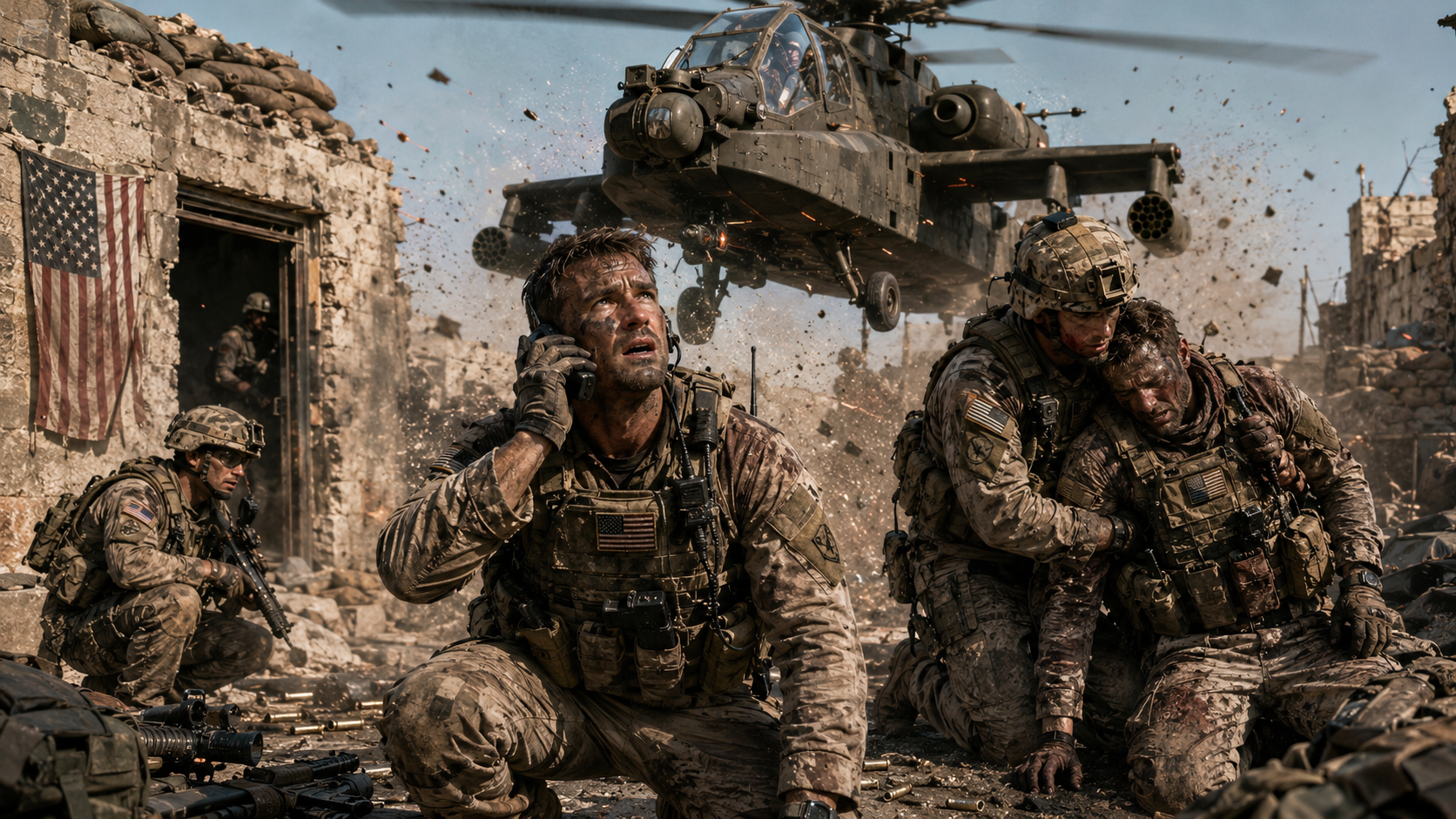
It was Senior Chief Remy Fontino screaming into the radio like a man already standing at the edge of his own grave.
“Command, this is Night Viper Six! We are pinned! Multiple wounded! We need air support now!”
Then came static.
Then gunfire.
You May Also Like

Then silence.
For three seconds, every man in that Afghan compound believed help was not coming. They believed their wives would get folded flags, their kids would get medals in shadow boxes, and their names would be read in some church back home.
Then my voice cut through their secure frequency.
“Night Viper, I’m on you. Stay low.”
And that was the moment Commander Dax Harwell’s perfect little murder plan began to fall apart.
PART 1 — THE GHOST ON THE RIDGE
“The Navy sent you here to die, Senior Chief. They just didn’t expect me to be watching.”
I did not say that part over the radio.
Not yet.
At that moment, all Senior Chief Remy Fontino knew was that his SEAL team was trapped inside a kill box, surrounded on three sides, with one man bleeding out and no extraction for at least thirty minutes.
Thirty minutes might as well have been thirty years.
The first RPG had punched through the east wall and turned concrete into dust. Automatic fire swept the courtyard so hard the air looked alive. Every muzzle flash lit up the Afghan night in violent white bursts.
Fontino pressed himself behind a cracked concrete pillar, blood running down the side of his face.
“Tango Two is hit!” someone shouted.
“I can’t reach Morrison!”
“Reloading!”
“We’re boxed in!”
I watched it all from eight hundred meters east, belly pressed into cold rock, my eye locked behind the scope of my rifle.
My name is Chief Petty Officer Tamson Admy.
Officially, I was not there.
Officially, I was conducting solo reconnaissance in a completely different province.
Officially, if I died that night, my body would be found in a place no American command could explain.
That was the idea.
Commander Dax Harwell had sent me into the mountains with bad coordinates, bad intel, and no backup. He thought I was walking into a grave.
He was wrong.
I smelled the trap three kilometers out.
The compound was supposed to be empty. It was not. Forty insurgent fighters had moved in before sunset. They were too disciplined, too ready, too perfectly positioned.
Then Night Viper walked straight into it.
I could have left.
That was the mission survival move.
Get out. Stay invisible. Let the SEALs die. Keep breathing long enough to expose Harwell later.
But I saw Morrison crawling across the courtyard with a shoulder wound, leaving a dark trail behind him.
I saw an insurgent raise his rifle and line up the shot.
I thought of my little brother Kofi, smiling in dress whites before SEAL training.
And I squeezed the trigger.
The insurgent dropped before Morrison ever knew he had been one second from death.
Then I shifted.
Second target. Machine gun nest on the western wall.
One breath.
One shot.
The gunner folded backward and vanished from view.
Fontino’s head snapped up behind the pillar.
He had no idea where the shot came from.
That was the point.
I keyed into their secure frequency.
“Night Viper, I’m on you. Stay low.”
Fontino froze.
Even from eight hundred meters away, through smoke and fire, I could feel his confusion.
“Who is this?” he barked. “Identify yourself.”
I did not answer.
A man who wants a name wastes time.
A man who wants to live moves when told.
Three more insurgents rushed the courtyard.
Three rounds left my rifle.
Three bodies hit the dirt.
“Senior Chief,” a voice said over their comms, breathless and panicked, “who the hell is shooting for us?”
Fontino did not answer.
He could not.
Because no one was supposed to be there.
No female sniper. No ghost. No classified asset on an unauthorized ridge with access to his team’s frequency.
“Night Viper,” I said again. “You have a window. North exit. Thirty seconds. Move.”
To his credit, Fontino did not argue.
“Bravo Team!” he shouted. “North exit! Move, move, move!”
They ran.
Seven men, one wounded, sprinting through smoke, fire, and broken concrete.
Every fighter who tried to chase them died before he made it three steps.
I was not angry when I shot.
Anger shakes the hands.
I was calm.
Sickeningly calm.
Twenty-three rounds.
Twenty-three kills.
By the time the SEALs cleared the north wall and disappeared into the rocks, the compound behind them had become a burning funeral pyre.
Fontino stopped just long enough to count his men.
All seven alive.
That mattered.
He keyed the radio again.
“Unknown station, this is Night Viper Six. Who are you?”
I stayed silent.
“Respond. That is an order.”
I almost smiled.
Men like Fontino were used to orders meaning something.
Out there, in that valley, the only things that mattered were distance, wind, discipline, and who was willing to kill first.
His comms specialist, Petty Officer Yuki Tanaka, scanned the frequency.
“She’s gone, Senior Chief,” he said. “No signal. It’s like she was never there.”
Fontino stared into the darkness.
He did not see me.
No one ever saw me unless I wanted them to.
I broke down my rifle with practiced hands. My shoulder ached. My knees were numb. My mouth tasted like dust and copper.
In my vest pocket, close to my heart, was a worn photograph of Kofi.
My little brother.
The boy who followed me into soccer, track, the Navy, and finally into a dream that killed him.
The official report called it a training accident.
Equipment failure during a dive exercise.
No one at fault.
Just one of those tragedies military families are expected to swallow with dignity while some officer in a clean uniform hands them a flag and says, “Your son served with honor.”
But I had found the maintenance logs.
Kofi’s rebreather had been flagged for replacement six months before his death.
Commander Dax Harwell signed the waiver that kept it in service.
Budget constraints.
Acceptable risk.
Operational readiness.
That was how he described my brother’s life.
Five thousand dollars saved.
One young man drowned.
When I started asking questions, Harwell smiled at me in his office and said, “Chief Admy, grief can distort judgment.”
Then he sent me to die.
I moved along the ridge, low and quiet.
Seventeen kilometers to extraction.
No backup. No friendly support. No one coming if I disappeared.
That was how Harwell wanted it.
Then my earpiece crackled.
Not Navy comms.
Not command.
A private channel.
A man’s voice said, “Target survived. She engaged hostile forces and extracted a SEAL team from the kill zone.”
My blood went cold.
Harwell already knew.
Another voice answered, “Orders?”
Then Harwell came on the line himself.
His voice was smooth. Annoyed. Almost bored.
“Send a cleanup team. No survivors.”
I stopped walking.
For one heartbeat, the whole mountain seemed to hold its breath.
No survivors.
Not just me anymore.
Night Viper too.
Seven men who had done nothing wrong except survive a trap they were never meant to understand.
I touched Kofi’s photograph.
“Stay alive, sister,” I heard him say in my memory.
I looked toward the direction Fontino’s team had gone.
“I will,” I whispered.
Then I turned back into the dark.
Because the SEALs I had just saved were about to learn that the most dangerous enemy in Afghanistan was wearing an American uniform.
And he was already hunting them.

PART 2 — AMERICANS HUNTING AMERICANS
“The men behind you are American,” I told Night Viper over the radio. “And they are not friendly.”
Fontino did not answer right away.
I could imagine his face.
Hard. Angry. Refusing to believe what every instinct was already telling him.
His team had been moving for two hours through broken ravines and rock shelves. Morrison was still bleeding. Tanaka had a gash across his forehead. The others were exhausted but disciplined, the way real operators are when fear has no room to be loud.
Then they spotted movement on the ridge.
Not insurgents.
Wrong posture.
Wrong spacing.
Wrong discipline.
Those men were using American tactics.
“Explain,” Fontino said.
“No time,” I replied. “Alternate route. Two hundred meters west. Canyon system. Move now.”
One of his men snapped, “How do we know this isn’t a trap?”
I let two seconds pass.
Then I said, “Because if I wanted you dead, you would already be dead.”
Fontino made the call.
“Bravo Team, west. Canyon route. Stay low.”
That was when I knew he was smart enough to live.
The canyon swallowed them in darkness. Its walls rose high and narrow, cutting off the sky. A bad place to fight. A worse place to die.
Halfway through, they found the body.
One of Harwell’s cleanup men.
No dog tags. No name tape. No unit patch.
But his rifle told the truth.
Standard SEAL issue.
Serial number filed down.
Tanaka picked it up and stared like someone had handed him a rattlesnake.
“Senior Chief,” he said quietly, “this came from our own armory.”
Fontino looked down at the dead American, then into the canyon darkness.
“You killed him,” he said into the radio.
“He was going to kill your point man,” I replied. “I made a choice.”
“Who are these people?”
“Men paid to make problems disappear.”
“What problem?”
I did not want to say it yet.
Not over an open frequency.
Not before I knew who else might be listening.
So I said, “Keep moving. I’ll explain when you’re safe.”
He hated that answer.
I could hear it in his breathing.
Men like Fontino did not like shadows. They wanted names, chains of command, rules of engagement.
Harwell lived in the shadows.
I had been forced to learn them.
The canyon opened into the ruins of an abandoned village just before dawn. Mudbrick walls leaned like old bones. Doorways gaped empty. Dust moved through the streets like smoke.
I stepped out from behind a ruined wall.
Seven weapons came up instantly.
Seven lasers painted my chest.
I did not flinch.
“Night Viper Six,” I said. “We need to talk.”
Fontino’s rifle stayed pointed at my heart.
“Identify yourself.”
“Chief Petty Officer Tamson Admy. Naval Special Warfare. Sniper qualified. Currently listed as conducting solo reconnaissance in Kandahar Province.”
I paused.
“Obviously, that listing is inaccurate.”
A younger operator stared at me with open disbelief.
“There are no female SEALs.”
“There are no official female SEALs,” I said. “I exist in a category nobody admits exists until they need someone buried without paperwork.”
Fontino studied me.
Not my face.
My hands. My stance. My gear. My sight lines.
He was deciding if I was real.
“You’re the voice,” he said.
“Yes.”
“You killed twenty-three hostiles back there.”
“And one American in the canyon.”
Morrison stepped forward, pale from blood loss.
“Why?” he asked. “Why save us?”
That question hurt more than the others.
Because the answer was simple.
Because somebody should have saved Kofi.
“Because Commander Dax Harwell sent me here to die,” I said. “And now he’s trying to kill you too.”
The name changed everything.
Fontino’s jaw tightened.
Harwell was not some random officer. He was decorated. Connected. Photographed with generals and senators. The kind of man who smiled from walls in command buildings while younger men died under orders he wrote from air-conditioned rooms.
“That’s a serious accusation,” Fontino said.
“I have evidence. Shipping manifests. Bank transfers. Communications. Harwell has been using classified operations to move weapons to insurgent buyers for three years.”
Nobody spoke.
The silence was thick.
“He’s been arming the same people killing American troops,” I continued. “My brother died because of him. Your team nearly died because of him. Tonight was supposed to erase me. You became collateral damage.”
Tanaka looked sick.
“You’re saying our command structure is compromised.”
“I’m saying one powerful man sold his soul and wrapped it in the flag.”
Then the first shot cracked through the dawn.
I shoved Fontino sideways.
The bullet sparked against the wall where his head had been.
“Contact!” I shouted. “Four shooters! Northwest rooftops!”
The village exploded.
Harwell’s men hit hard and fast. Professional. Ruthless. No hesitation. They were not firing warning shots. They were cleaning a mess.
Bravo scattered into cover.
Fontino moved like a man born under fire. He barked orders, shifted angles, protected Morrison while still returning shots.
I put two men down from a kneeling position, shifted left, then felt something slam into my shoulder like a sledgehammer.
For a second, the world flashed white.
I hit the wall.
My rifle fell.
Somebody shouted my name.
I picked the rifle up with my left hand.
Pain screamed through my body.
I ignored it.
“Two more,” I said through clenched teeth. “Watchtower. Eleven o’clock.”
Fontino and Tanaka laid suppressing fire.
I breathed.
One shot.
One man dropped.
Another breath.
Second shot.
Second man disappeared behind the broken wall.
Then my knees gave out.
Morrison got to me first, even with his own wound.
“Through and through,” he said, cutting my sleeve. “You’re lucky.”
I almost laughed.
“I’ll put that on my Christmas card.”
Fontino crouched beside me.
“You should leave me,” I told him. “I’m slowing you down.”
His face went hard.
“Lady, you just killed six men with a hole in your shoulder. We’re not leaving you behind.”
For the first time in two years, I felt something other than rage move through me.
Trust.
Small. Dangerous. Unfamiliar.
Then Tanaka ran over with a headset.
“Senior Chief,” he said, “you need to hear this.”
Static.
Then Harwell’s voice.
“The primary target has linked up with the SEAL element. I need additional assets. I want this finished before dawn.”
Fontino removed the headset slowly.
His eyes were no longer confused.
They were furious.
“He just ordered our deaths,” he said.
“Yes,” I replied. “And that means we stop running from the truth.”
Ree called from the perimeter.
“Movement south! Multiple signatures!”
“How many?” Fontino asked.
“At least ten.”
I stood, almost blacking out.
Morrison grabbed my arm.
“You can’t move like this.”
I lifted my rifle with one hand.
“I can shoot. Moving is just walking with purpose.”
Fontino looked at me for half a second.
Then he smiled grimly.
“Good. Because impossible is what we do.”
We slipped into a dry riverbed as Harwell’s hunters closed in behind us.
Above, the sky began turning gray.
Then Tanaka intercepted one more transmission.
“All units,” Harwell said. “Target package moving east. I’m authorizing drone support. Hellfire approved.”
Fontino stopped cold.
A drone.
Against American personnel.
Harwell was done pretending.
“Move,” Fontino ordered. “Everyone move now!”
We ran through the canyon as the sound of the drone grew above us.
Wounded. Hunted. Betrayed.
Eight Americans marked for death by one of their own commanders.
And somewhere inside me, beneath the pain, Kofi’s voice whispered again.
Don’t just survive this.
End it.
PART 3 — THE FILES THAT COULD BURY A COMMANDER
“The weapons that killed forty-three Americans came from Harwell’s own manifests.”
Tanaka said it inside a cave while the drone circled overhead.
Nobody moved.
Nobody wanted to believe him.
But the tablet in his hands did not care what we wanted.
It showed dates. Routes. Serial numbers. Bank transfers. Shell companies in Dubai and Cyprus. Weapons shipments disguised as logistics support. Classified missions used as cover for treason.
Then came the casualty reports.
IED strikes.
Ambushes.
Sniper attacks.
Forty-three dead Americans.
Dozens wounded.
Folded flags. Church funerals. Children standing beside caskets too young to understand why Daddy was inside a box. Mothers on front porches in Ohio and Texas and Louisiana waiting for trucks that would never pull back into the driveway.
All of it linked back to Commander Dax Harwell.
Morrison stared at the tablet like it had punched him in the chest.
“My cousin Derek,” he said quietly. “Marine. Killed eighteen months ago. IED in Helmand.”
Tanaka scrolled.
There it was.
The explosive type matched one of Harwell’s shipments.
Morrison turned away, jaw clenched so hard I thought his teeth might crack.
“I told his mother it was bad luck,” he said. “At the funeral. I stood beside her in a little Baptist church and told her Derek died serving his country.”
His voice broke.
“Now I find out some American officer may have sold the bomb.”
I put my good hand on his shoulder.
“We’re going to make it right.”
One by one, the others spoke.
A mentor killed by a rocket that never should have reached enemy hands.
A friend shot with American ammunition.
A brother-in-law lost in an ambush that now looked too well supplied to be random.
Harwell’s betrayal was not abstract anymore.
It had fingerprints on every man in that cave.
Ree slammed his fist against the stone.
“We kill him.”
“No,” Fontino said.
The word cut through the cave like a blade.
Ree stared at him.
“He murdered our people.”
“And if we put a bullet in him without exposing the evidence, his friends bury the truth and call us unstable,” Fontino said. “He doesn’t get a quiet death. He gets a courtroom. He gets families staring at him while his crimes are read out loud.”
I looked at Fontino then.
Really looked at him.
He was not just a warrior.
He was a leader.
The kind of man Kofi would have followed anywhere.
“Harwell keeps physical records,” I said. “He’s paranoid. Digital files can be traced. He stores hard copies in his operations center at Bagram.”
Tanaka blinked.
“You want to infiltrate Bagram Airfield.”
“Yes.”
“One of the most secure American installations in Afghanistan.”
“Yes.”
“While being hunted by the man who controls part of that installation.”
“Yes.”
Morrison gave a weak laugh.
“That is the worst plan I’ve ever heard.”
Fontino checked his weapon.
“Which means it might work.”
For sixteen hours, we moved through terrain that punished every step.
No roads.
No friendly convoy.
No medevac.
No diner coffee, no base chow hall, no hot shower, no normal American morning where someone burns toast in a kitchen and complains about school traffic.
Just mountains, dust, pain, and the knowledge that a drone could find us at any second.
When we finally stopped in a rocky depression near nightfall, everyone looked ten years older.
Morrison’s bandage had soaked through.
Mine had too.
Tanaka passed around the last cold MREs.
Nobody complained.
Food was fuel.
Fontino sat beside me and handed me a packet of crackers.
“You need to eat.”
I took it.
For a while, we watched the stars.
Then he said, “Tell me something good about Kofi.”
That almost broke me.
Not because it was cruel.
Because it was kind.
“He was terrible at poker,” I said finally.
Fontino smiled.
“How terrible?”
“Every time he had a good hand, the corner of his mouth twitched. I took three hundred dollars off him the night before he shipped out for BUD/S.”
Fontino chuckled.
“He ever figure it out?”
“Never. Accused me of cheating for years.”
“Sounds like you were close.”
I looked down at the crackers in my hand.
“Our parents died when we were young. We raised each other. He used to say we were a two-person army against the world.”
Fontino’s expression softened.
“I have two daughters,” he said. “Eight and eleven. They think I’m some kind of superhero.”
“You are.”
He shook his head.
“No. I’m a man trying to make it home to a kitchen table covered in homework, cereal bowls, and those terrible glitter art projects that never come out of the carpet.”
I smiled despite myself.
“That sounds worth fighting for.”
“It is.”
For a moment, Afghanistan disappeared.
There was only a father thinking about his daughters and a sister thinking about her brother.
Then Fontino said, “This started as revenge for you.”
“Yes.”
“But it isn’t only that anymore.”
“No,” I admitted. “Now it’s justice.”
Four hours later, we moved.
Bagram Airfield sprawled across the valley like a sleeping city. Floodlights. Guard towers. Aircraft. Concrete barriers. Thousands of people with no idea a traitor was running a private empire inside their walls.
I knew Harwell’s habits.
His schedule.
His office.
His safe.
I had spent six months building a case against him before he tried to erase me.
The window came at 0200.
Twenty-three minutes between patrol rotations.
We breached the northeast perimeter with Tanaka guiding us over comms. Hawkins bypassed the sensors. Aonquo cut the fence. We crossed four hundred meters of open ground with every nerve screaming.
Building 712 waited in red emergency light.
Second floor.
Third door on the left.
Harwell’s office smelled like leather, coffee, and arrogance.
His walls were covered in photographs: Harwell with generals, Harwell with senators, Harwell shaking hands beneath American flags like a man who had not sold the country one crate at a time.
Behind one portrait was the safe.
I entered the combination.
It opened.
Inside was his real face.
Files.
Photographs.
Bank records.
Signed waivers.
Weapons manifests.
A handwritten ledger of payments.
Fontino photographed everything.
I loaded physical files into my pack.
Tanaka transmitted each image in real time to secure recipients: Inspector General, military criminal investigators, Pentagon channels, and four major news outlets.
Harwell’s secrets were leaving the building before he even knew we were inside.
Then Tanaka’s voice crackled.
“Night Viper, company. Four men approaching. Not scheduled. Moving fast.”
“How long?” Fontino whispered.
“Two minutes. Maybe less.”
We moved for the exit.
We were fifty meters away when the lights came on.
Armed men blocked the corridor ahead.
More appeared behind us.
And then Harwell walked into view, smiling like a man greeting guests at a Thanksgiving dinner he had poisoned himself.
“Chief Admy,” he said. “I was wondering when you would come home.”
My finger tightened on my trigger.
Fontino saw it.
“Stand down,” he said quietly.
Harwell laughed.
“That’s wise, Senior Chief. I expected better from you, though. Getting dragged into this woman’s little grief fantasy.”
“We have the evidence,” Fontino said. “It’s over.”
Harwell smiled wider.
“Evidence burns. Witnesses disappear. History belongs to whoever controls the report.”
He turned to me.
“Your brother understood risk when he enlisted.”
My vision narrowed.
“You killed him.”
“I made a cost-benefit analysis,” Harwell said coldly. “Your brother was acceptable collateral.”
The words hit harder than the bullet in my shoulder.
Kofi.
My little brother.
Reduced to math by a man with polished boots and dead eyes.
“You are not a patriot,” I said. “You’re a coward hiding behind rank.”
His smile vanished.
“Take them. Separate cells. No communication.”
Hands grabbed me.
My rifle was ripped away.
As they dragged us down the corridor, I caught Fontino’s eyes.
He mouthed, “This isn’t over.”
I nodded once.
Because Tanaka’s final transmission had not been a failure.
It had been the signal.
The files were already gone.
And Commander Dax Harwell had no idea that his empire was bleeding out through every server in Washington.
PART 4 — THE MAN WHO THOUGHT HE WAS UNTOUCHABLE
“Commander Harwell, you are under arrest for treason.”
Those were the most beautiful words I had ever heard.
But they did not come right away.
First came the cell.
Concrete. Steel. No window. One drain in the floor. A place designed to make strong people feel forgotten.
I sat in the corner, shoulder throbbing, wrists bruised, mind racing.
Harwell had separated us.
Standard move.
Break the team apart. Control the narrative. Make each prisoner believe the others had folded.
But he had already lost.
Three hours earlier, Tanaka had transmitted the evidence.
Every file.
Every image.
Every signed waiver.
Every payment record.
Every document connecting Harwell’s weapons to dead American service members.
By dawn, his crimes were sitting in inboxes he could not control.
So I waited.
The door opened.
Two guards came in.
“The commander wants to see you.”
I stood slowly.
Let them think I was beaten.
That was another thing men like Harwell never understood.
A quiet woman is not always scared.
Sometimes she is counting.
They marched me to a briefing room.
Harwell sat at the head of a long table in a perfect uniform. Clean shave. Calm face. American flag behind him. Coffee steaming beside his hand.
But I noticed the tremor.
Small.
Almost invisible.
His phone sat screen-down on the table.
It kept buzzing.
“You transmitted the files,” he said.
I said nothing.
His jaw tightened.
“Washington is calling. Investigators. Lawyers. People who should know better than to believe field rumors from a grieving woman.”
“You’re nervous,” I said.
He stood so fast the chair scraped the floor.
“You think this is justice? You think exposing me brings back your brother?”
“No.”
“Good. Because Kofi was weak.”
The room went still.
My heartbeat slowed.
“He washed out because he couldn’t handle pressure,” Harwell said. “The equipment failure was a convenient excuse.”
I wanted to kill him.
Not shoot him.
Kill him.
For every birthday Kofi never got.
For every Thanksgiving chair left empty.
For every time I had stood at his grave in Texas and wondered if I should have fought harder sooner.
But I heard Fontino’s voice in my head.
He gets a courtroom.
So I smiled.
Softly.
“You’re trying to make me react because you know the evidence is real.”
His face changed.
The mask slipped.
Then the door burst open.
Master Chief Silas Drummond filled the doorway with a squad of military police behind him.
“Commander Harwell,” Drummond said, “step away from the prisoner.”
Harwell went pale.
“Silas, we had an arrangement.”
Drummond’s face was stone.
“I read the files. Forty-three Americans, Dax.”
The MPs moved in.
Harwell raised his hands, but his eyes darted toward his sidearm.
“Don’t,” I said.
He moved anyway.
Two MPs slammed him into the wall before he cleared leather.
His face hit the floor.
For a moment, I felt nothing.
No joy.
No triumph.
Just a tired emptiness where rage had lived for two years.
Drummond turned to me.
“Your team is being released.”
“They’re not my team.”
He almost smiled.
“They disagree.”
In the corridor, chaos had taken over the building.
Officers shouting. MPs moving. Phones ringing. Harwell’s clean little kingdom collapsing under fluorescent lights.
Fontino waited outside the detention wing, bruised but standing.
“Tanaka?” I asked.
“Alive,” he said. “Already bragging.”
The others gathered around me. Morrison in a sling. Ree limping. Hawkins with a cut over his eye. Park and Aonquo looking exhausted but unbroken.
For one second, we all just stood there.
Alive.
Then an explosion ripped through the base.
Alarms screamed.
Radios erupted.
“Prisoner transport hit!” someone shouted. “Commander Harwell is gone!”
My blood turned ice-cold.
Of course.
Harwell had contingencies.
Cash. Safe houses. Off-book exits. People he could still buy.
Fontino looked at me.
“Where would he go?”
I ran through every file, every pattern, every habit.
“The east helicopter pad,” I said. “Civilian contract bird. He used it for off-book movement.”
We ran.
Across Bagram.
Past hangars, fuel trucks, barriers, startled soldiers.
The helicopter was already spinning up when we rounded the corner.
A modified Black Hawk with civilian markings.
And there he was.
Dax Harwell, climbing toward the open door with a bag in his hand.
I dropped to one knee and raised my rifle.
The scope found his chest.
Easy shot.
So easy.
My finger rested on the trigger.
Kofi’s face filled my mind.
His laugh.
His terrible poker face.
The way he once stood on our porch in Texas with a duffel bag over his shoulder and said, “Don’t worry, sis. I was built for this.”
Harwell had taken that from me.
From the world.
From everyone who loved Kofi.
“You have him,” Fontino said beside me.
“I have him.”
Harwell was seconds from escape.
The pilot shouted something.
The rotors beat the air.
My breathing steadied.
I could end him.
Right there.
No trial. No deals. No lawyers. No powerful friends whispering in back rooms.
Just one clean shot.
But death was too easy.
“HARWELL!” I shouted.
He froze.
Slowly, he turned.
He saw me.
Saw the rifle.
Saw Fontino and the others closing in from both sides.
“You won’t shoot,” Harwell called. “You want me alive.”
“I want you remembered,” I said, standing. “I want you in a courtroom. I want the families to hear every name. I want you to wake up every morning in a cell knowing a woman you tried to bury destroyed everything you built.”
His hand moved toward his sidearm.
“Don’t,” I warned. “I’ll put a round through your shoulder before you clear the holster. You know I can.”
He hesitated.
For the first time, I saw fear.
Real fear.
Not of death.
Of disgrace.
Of losing control.
Of becoming small.
“Get on your knees,” I said. “Hands behind your head.”
He tried one last smile.
“I have money. I can disappear. Your brother gets justice on paper. I get gone. Everyone wins.”
“Everyone except the forty-three dead Americans.”
His smile died.
Fontino stepped in with zip ties.
Harwell dropped to his knees.
And that was how the untouchable commander ended.
Not with glory.
Not with a heroic last stand.
On his knees on a tarmac, sweating through his uniform while the people he betrayed watched him break.
The court-martial came fast.
Life imprisonment without parole.
His medals stripped.
His pension gone.
His name removed from command walls.
His bank accounts frozen.
His shell companies seized.
His powerful friends arrested, exposed, or forced to testify.
The newspapers called it one of the worst military corruption scandals in modern history.
Families finally learned why their loved ones had died.
And Kofi’s case was reopened.
The report changed.
Not training failure.
Not personal weakness.
Command negligence.
Harwell’s waiver was entered into evidence.
My brother’s name was cleared.
Weeks later, I stood at Arlington National Cemetery in dress whites while forty-three names were read aloud.
Forty-three bells.
Forty-three families.
Forty-three folded flags.
When they asked me to speak, I almost refused.
Then I looked at the mothers, fathers, spouses, and children sitting in front of me.
They deserved more than silence.
“I did not know your loved ones,” I said. “I never shared a meal with them. I never heard their stories. But I know what they stood for. They served with honor. They deserved better than betrayal.”
The wind moved through the flags.
“What happened to them was not an accident. It was not bad luck. It was greed wearing a uniform. And that greed has been exposed.”
I paused.
“The man responsible will spend the rest of his life behind bars. But your loved ones will not be remembered for how they died. They will be remembered for how they lived.”
Afterward, Fontino found me near the headstones.
“Admiral Voss wants to see you,” he said.
Rear Admiral Catherine Voss offered me command of a new integrated special warfare unit.
No gender restrictions.
Selection based on capability.
A real team.
A real future.
“Why me?” I asked.
“Because you earned it,” she said.
That night, I found Fontino on the roof of the temporary barracks, watching the sun go down.
“I’m taking the position,” I said.
“Good.”
“I have one condition.”
He looked over.
“I want you. Tanaka. Morrison. Ree. Hawkins. Park. Aonquo. We work well together.”
Fontino held out his hand.
“Where you go, we go.”
I shook it.
For the first time in two years, the future did not feel like something I had to survive.
It felt like something I could build.
A month later, I visited Kofi’s grave in Texas.
I brought his old photograph.
The one in dress whites.
I sat beside the headstone until sunset painted the cemetery gold.
“They know the truth now,” I whispered. “Your name is clean.”
A breeze moved through the grass.
For a second, I could almost hear him laughing.
That same bright laugh from the porch, from our kitchen, from every hard year we survived together.
I stood.
Straightened my uniform.
And walked away without looking back.
Because justice had finally spoken.
And this time, the ghost did not disappear.
She came home.