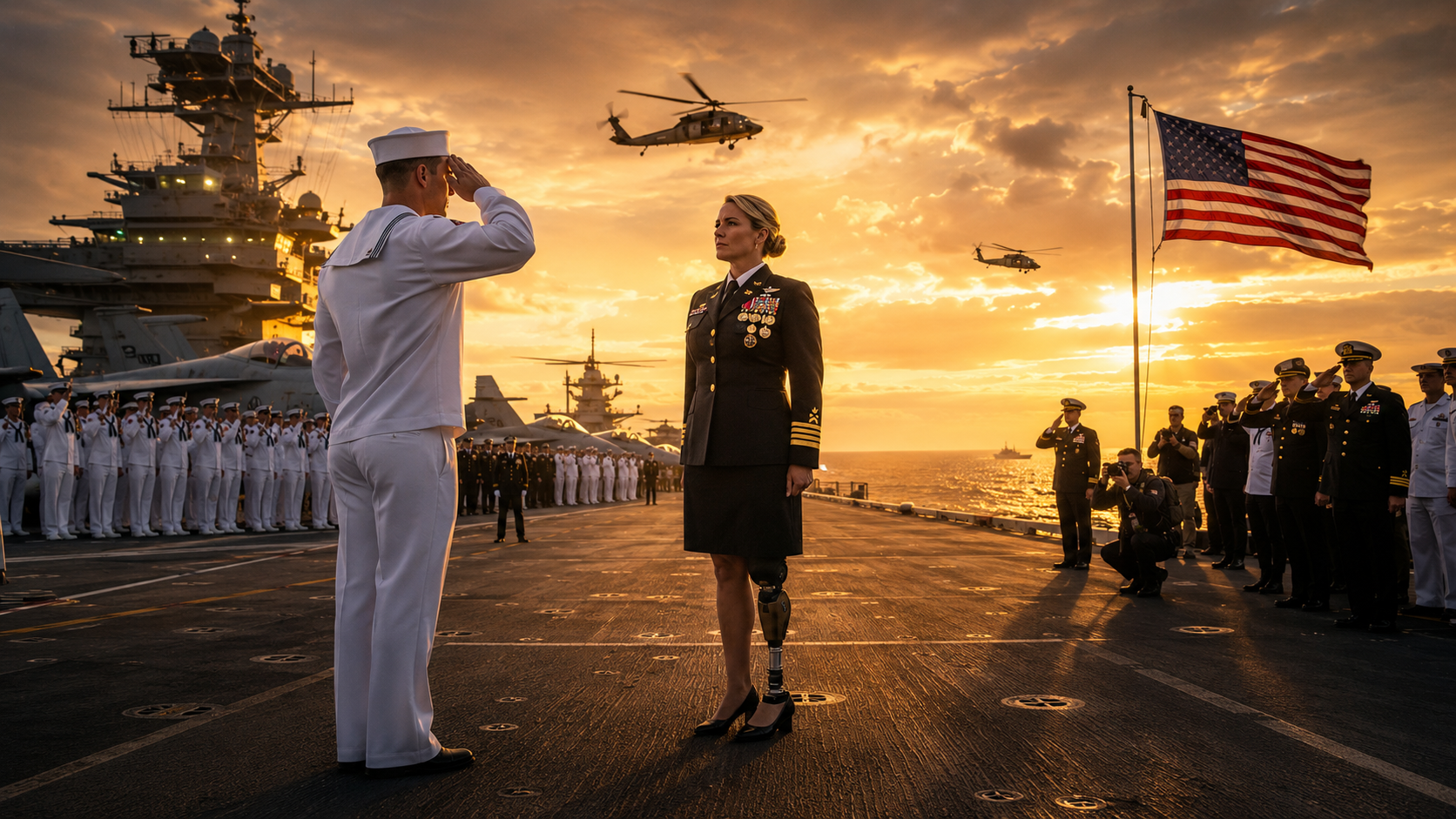
“Try not to trip on deck, sweetheart.”
The captain said it loud enough for every sailor near the gangway to hear.
Then he pointed at my prosthetic leg with his coffee cup and laughed.
Nobody moved.
You May Also Like
Not the ensign holding the clipboard.
Not the two petty officers standing by the brow.
Not the young sailor with the line in his hands, who looked like he wanted to disappear inside his own uniform.
I stood there in the cold Norfolk wind, one hand on the rail, the other holding a brown leather folder that had already cost three men their careers and one man his life.
The captain’s name was Marcus Vale.
Silver hair.
Pressed khakis.
Smile sharp enough to cut rope.
He had the easy cruelty of a man who had never been stopped in public.
He looked at my carbon-fiber blade again and said, “This isn’t a hospital tour, ma’am. This is an active U.S. Navy vessel.”
I looked past him at the gray steel hull of the USS Kearsarge.
The ship smelled like salt, diesel, paint, and old secrets.
“I’m aware,” I said.
Captain Vale’s grin widened.
“Oh, you’re aware.”
A few sailors laughed because he expected them to.
Not because it was funny.
Because men like him trained rooms to laugh before they even understood the joke.
The wind pushed my coat against my leg. My prosthetic clicked softly against the deck plate.
Click.
Click.
Click.
Vale heard it.
His eyes dropped again.
“Careful,” he said. “Wouldn’t want you suing Uncle Sam because you couldn’t handle a ladder.”
I didn’t answer.
I had learned a long time ago that silence made arrogant men reach for a shovel.
Vale kept digging.
“Let me guess,” he said. “Some advocacy office sent you? Accessibility inspection? Veteran outreach? Morale photo op?”
I watched a gull circle above the pier.
“No.”
“Then who the hell are you?”
Before I could answer, the ship’s Command Master Chief came through the hatch behind him.
Older man.
Black coffee eyes.
Jaw like a locked safe.
His name tape read: HAWKINS.
The second he saw me, his face changed.
Not softened.
Not surprised.
Changed like a man had just seen a ghost walk into daylight.
His coffee mug slipped from his hand and shattered on the deck.
Captain Vale snapped, “Master Chief, get yourself together.”
But Master Chief Hawkins didn’t look at him.
He looked at me.
Then he straightened.
His boots came together hard.
His hand rose in a salute so crisp it sounded like a slap against history.
“Commander Walker,” he said, voice rough. “Welcome back.”
The deck went dead silent.
Captain Vale’s smile vanished.
Because the name he had laughed at was supposed to be buried.
And I had come aboard to find out who dug the grave.
My name is Emma Walker.
For six years, the Navy called me dead.
For six years, my mother kept a folded flag in a wooden case above her fireplace in Ohio.
For six years, every official record said Commander Emma Walker had been lost in a classified maritime recovery operation off the coast of Alaska when a storm took the deck, the crane, the cargo, and half the crew.
That was the clean version.
The version printed in letters.
The version whispered at memorials.
The version that helped powerful men sleep.
The truth was uglier.
The storm didn’t take my leg.
A man did.
The storm didn’t erase the mission logs.
Someone inside the chain of command did.
The storm didn’t kill Lieutenant Daniel Price, my best friend, my operations officer, and the only person besides me who knew what we had really recovered from the water.
Someone made sure he never made it home.
For six years, I let the Navy think I was dead because dead women hear things living women never could.
Dead women don’t get followed.
Dead women don’t get silenced.
Dead women don’t get invited into rooms.
Dead women don’t need permission.
Dead women don’t blink when a captain laughs at their plastic leg in front of his crew.
Captain Vale stared at Master Chief Hawkins.
“Commander?” he said.
The word came out thin.
Hawkins kept saluting.
I returned it.
Slowly.
Precisely.
Then I lowered my hand.
“At ease, Master Chief.”
Hawkins dropped his arm, but his eyes stayed locked on mine.
Vale recovered just enough pride to step between us.
“There must be some misunderstanding.”
“There usually is,” I said.
His face tightened.
“Commander Walker died in 2020.”
“So I’ve heard.”
The young ensign with the clipboard swallowed so loudly I heard it over the pier bells.
Vale looked me over again, but this time he wasn’t looking at my leg.
He was looking for rank.
Uniform.
Badge.
Anything he could use.
He found nothing.
I wore dark jeans, a navy coat, and a white blouse buttoned to the throat.
No ribbons.
No brass.
No obvious authority.
Men like Vale needed symbols.
They panicked when authority arrived without costume.
He said, “I don’t allow civilians aboard my ship without clearance.”
I lifted the leather folder.
“Good thing I’m not here under your allowance.”
His jaw jumped.
“You have orders?”
I opened the folder and handed him one page.
Not the real one.
The harmless one.
He snatched it.
His eyes moved fast.
Then slower.
Then stopped.
The paper bore three signatures.
One from Naval Criminal Investigative Service.
One from the Office of Naval Intelligence.
One from a woman at the Pentagon whose name made admirals answer unknown phone numbers.
Vale’s fingers tightened around the edge.
“This is irregular.”
“So was mocking an amputee at the brow.”
A small sound came from the sailors nearby.
Not laughter this time.
Something better.
The first crack in fear.
Vale heard it too.
His ears colored.
“I was maintaining security.”
“You were performing.”
His eyes lifted.
I smiled faintly.
“Badly.”
Hawkins coughed into his fist, but I saw the corner of his mouth move.
Vale folded the paper once.
Too hard.
“Master Chief, escort Commander Walker to the wardroom.”
“No,” I said.
Both men looked at me.
“I’ll start in Combat.”
Vale stiffened.
“Combat Information Center is restricted.”
“Yes.”
“You can’t just walk into CIC.”
I leaned closer.
Not much.
Enough that only he heard the next part.
“Captain, six years ago, someone on this ship transmitted a kill order using my dead call sign.”
The blood drained from his face.
I watched it happen.
All his training.
All his polish.
All his little habits of power.
Gone for one second.
Just one.
Then he rebuilt himself.
“I don’t know what you’re talking about.”
“I know.”
His eyes flicked toward Hawkins.
Too quick.
Too guilty.
Hawkins saw it too.
The old master chief’s face went still.
A bell sounded somewhere inside the ship.
A boatswain’s call piped over the speaker.
Sailors moved again because ships do not stop for one man’s panic.
But the air around us had shifted.
Captain Vale handed the page back to me.
“You have two hours,” he said. “You touch classified systems without my authorization, I’ll have you removed.”
I slid the page into the folder.
“You’ll try.”
His mouth flattened.
Then he turned and walked away.
Nobody laughed this time.
Hawkins waited until Vale disappeared through the hatch.
Then he looked at me.
“Ma’am,” he said quietly, “I watched them bury you.”
I looked toward the gray water beyond the pier.
“No, Master Chief.”
My prosthetic clicked once against the deck.
“They buried a story.”
Inside the ship, the passageways were narrow and smelled like metal, old coffee, and sweat baked into pipes.
Every step echoed.
Click.
Boot.
Click.
Boot.
Hawkins walked half a pace behind me, the way senior enlisted do when they are guiding someone without insulting them.
He didn’t ask about my leg.
He didn’t ask where I had been.
He didn’t ask why I had come alone.
That told me he was smarter than most officers I’d met.
The sailors we passed stared, then looked away, then stared again.
Whispers followed us.
Commander Walker.
Dead Walker?
The Alaska op?
That’s her?
No way.
I kept walking.
The ship remembered me better than the people did.
Same tight corners.
Same low pipes waiting to punish tall sailors.
Same red-lensed lights.
Same hum under the soles of my feet.
But the faces were different.
Younger.
Too young to know why some names vanished from plaques.
Too young to remember when the Navy quietly renamed courage as an accident.
Hawkins stopped outside a hatch.
“CIC,” he said.
Two armed watchstanders looked at him, then at me.
One started to speak.
Hawkins said, “Open it.”
The sailor hesitated.
“Captain’s authorization—”
Hawkins leaned in.
“Son, I have worn anchors longer than you have worn shoes. Open the hatch.”
The sailor opened it.
CIC was dim, blue-lit, alive with screens.
Radar sweeps.
Track numbers.
Radio traffic.
Voices low and steady.
A ship’s nervous system.
A lieutenant at the central console turned around, annoyed.
Then saw Hawkins.
Then saw me.
Her eyes narrowed.
“Can I help you?”
“Lieutenant,” Hawkins said, “this is Commander Walker.”
The lieutenant blinked.
Then did the same thing everyone did.
She glanced at my leg.
I let her.
People always looked.
Some looked with pity.
Some with curiosity.
Some with fear, as if injury was contagious.
I preferred the ones who looked once and moved on.
This lieutenant looked once and moved on.
Good.
“Lieutenant Grace Miller,” she said. “CIC Watch Officer.”
I held out my hand.
She shook it.
Firm.
No flinch.
“I need archived comms traffic from the evening of October 12, 2020.”
Her face changed.
Not fear.
Recognition.
“That’s before my time aboard.”
“I know.”
She glanced at Hawkins.
“Those drives were transferred.”
“To where?”
“Captain’s secure locker, according to inventory.”
Hawkins swore under his breath.
I asked, “When?”
Miller tapped at a keyboard.
“Last accessed nine months ago.”
“By?”
She stared at the screen.
Then her lips pressed together.
“Captain Vale.”
Hawkins turned his head slowly toward the hatch.
I looked at the blue glow on Miller’s face.
“Print that access log.”
She didn’t move.
I waited.
She said, “Ma’am, Captain Vale can end my career.”
“Only if he still has one.”
Miller studied me.
Something passed through her eyes.
A calculation.
A risk.
A memory maybe.
Then she turned back to the console and typed.
The printer in the corner started chattering.
Mini-payoffs are small things.
A frightened sailor opening a hatch.
A lieutenant choosing the truth over comfort.
A printer spitting out a receipt for someone else’s lie.
People think justice arrives like thunder.
Usually it starts like paper sliding into a tray.
Miller handed me the log.
I read the line once.
Then again.
Nine months ago, Captain Marcus Vale accessed archived communications connected to Operation Glass Harbor.
He copied exactly one file.
File name: REAPER_TWO_FINAL.wav
My old call sign.
My last transmission.
The one the Navy said was lost.
Hawkins saw the file name and went pale under his tan.
“I heard that call,” he said.
I looked at him.
He swallowed.
“I was on the Roosevelt then. We were in the area for exercises. We picked up a fragment. Female voice. Heavy static. You said…” He stopped.
“What did I say?”
His eyes shone, but he did not let tears fall.
“You said, ‘Do not recover the crate. Repeat, do not recover the crate. We have a traitor in the net.’”
The room went quiet.
Even the radar operator stopped moving.
I remembered the cold.
I remembered the deck tilting beneath me.
I remembered Daniel Price’s hand on my shoulder.
I remembered the black crate swinging from the crane like a coffin.
I remembered seeing the coded beacon taped under the lid.
Not ours.
Not Russian.
Not Chinese.
American.
And I remembered realizing that the recovery mission was never about finding stolen tech.
It was about retrieving evidence before anyone honest saw it.
Miller said, “What crate?”
Hawkins shot her a look.
I answered anyway.
“A black composite case. Four feet by three. No markings. It was pulled from the wreckage of a civilian research vessel.”
Miller frowned.
“The Halcyon?”
That surprised me.
“You know it?”
“My brother was at Woods Hole. Everyone in marine research knows the Halcyon. It went down with seven people aboard.”
“Eight,” I said.
Her face tightened.
“They said seven.”
“They said a lot of things.”
Before she could answer, the hatch opened.
Captain Vale stepped in.
The room snapped back into motion too fast.
Forced normal.
Vale saw the paper in my hand.
Then Miller.
Then Hawkins.
He smiled.
Not a big smile.
A warning.
“Commander Walker,” he said. “You’re moving quickly.”
“I have a limp. I compensate.”
Miller looked down to hide her expression.
Vale didn’t.
“Lieutenant Miller,” he said, “step away from that console.”
She stood.
“Sir—”
“That wasn’t a conversation.”
Miller stepped back.
Vale turned to me.
“You’re disrupting operations.”
“No, Captain. I’m disrupting a cover-up.”
Every sailor in CIC heard it.
Vale’s eyes went flat.
“Careful.”
I took one step toward him.
Click.
The sound carried.
“No.”
His nostrils flared.
I lifted the access log.
“You copied my final transmission.”
“I reviewed historical files attached to my command.”
“You buried it.”
“You don’t know that.”
“I know you accessed it nine months ago. I know the official archive is missing that same file. I know Daniel Price’s widow received a classified gag letter two weeks later. And I know someone has been sending money to a shell account in Virginia Beach under your mother’s maiden name.”
That last part landed.
Hard.
His face didn’t move.
But his left hand twitched.
Hawkins saw.
Miller saw.
I saw.
Men like Vale could control their mouths.
Hands were harder.
Vale said softly, “You have no idea what you’ve walked into.”
There it was.
Not a confession.
Not enough for court.
Enough for me.
I smiled.
“Captain, I lost a leg walking out of it.”
His eyes dropped again, and for the first time, there was no mockery in them.
Only calculation.
He was wondering how much of me was still breakable.
I let him wonder.
Then the shipwide announcement cracked overhead.
“Captain to the bridge. Captain to the bridge.”
Vale stared at me one second longer.
“This isn’t over.”
“No,” I said. “It’s starting.”
He left.
The hatch closed.
Nobody spoke.
Then Lieutenant Miller turned back to the console.
Her hands trembled only once before she hid them under the desk.
“What do you need next, ma’am?”
I looked at the missing file line.
“The secure locker.”
Hawkins said, “Captain keeps it in his in-port cabin.”
Miller said, “He’ll have it watched.”
“Good.”
Hawkins frowned.
“Good?”
“If he’s guarding the wrong thing, that means the right thing is somewhere else.”
Miller glanced up.
“You already know where?”
I looked around CIC.
At the screens.
At the sailors.
At the thin blue glow lighting young faces that deserved better than old lies.
“I know where frightened men hide evidence.”
Hawkins understood before she did.
His jaw tightened.
“Medical.”
Six years ago, after the blast, they flew what was left of me to a military hospital under a name that wasn’t mine.
I woke up three days later in a room without windows.
My right leg ended above the knee.
My left arm was strapped down because I had tried to pull out every tube they put in me.
A doctor with kind eyes told me there had been an accident.
I asked for Daniel.
He looked away.
I asked for my mission recorder.
He said he didn’t know.
I asked what name was on my chart.
He left the room.
That was when I knew I had survived something I was not meant to survive.
A nurse named Carla helped me two nights later.
She was from Texas.
She chewed cinnamon gum.
She had a daughter at Annapolis.
She slipped a prepaid phone under my pillow and whispered, “Someone came for your blood samples today. Not doctors.”
That phone saved my life.
Not because I called for help.
Because I didn’t.
Help was the trap.
Instead, I called Daniel Price’s wife.
Megan answered on the fourth ring.
She was crying before she spoke.
“They told me you were dead,” she said.
“Did they tell you Daniel was too?”
Silence.
Then a sound I still hear when I sleep.
A woman trying not to break while holding a baby.
“Yes.”
“Megan,” I said, “listen to me. Do not trust the uniform. Do not sign anything. Do not give anyone Daniel’s laptop.”
She whispered, “They already came.”
“Who?”
“They said Navy legal.”
My heart slowed.
That happens in danger.
Not faster.
Slower.
The body understands before the mind does.
“What did they take?”
“His deployment bag. His notebook. Some hard drives.”
“Did they get everything?”
Another silence.
Then Megan said, “No.”
I closed my eyes.
“Good girl.”
She started crying harder.
“Emma, what is happening?”
I looked down at the space where my leg had been.
“I don’t know yet.”
But I did know one thing.
Someone had spent a lot of power making the truth disappear.
And power leaves fingerprints.
The Kearsarge’s medical bay was cleaner than the rest of the ship.
White cabinets.
Stainless drawers.
The bitter smell of antiseptic.
A young corpsman named Reed stood at the desk with the nervous posture of a man trying to decide whether to obey rank or conscience.
Hawkins did not bully him.
That impressed me.
He simply said, “HM2 Reed, Commander Walker needs access to legacy medical storage.”
Reed glanced at me.
Then my leg.
Then my face.
“I know who you are.”
That stopped me.
Most people knew the ghost.
Few knew the woman.
Reed opened a drawer and pulled out a thin envelope.
He handed it to me.
It had my name written on it.
Not typed.
Written.
EMMA WALKER.
My throat tightened.
“Who gave you this?”
“My predecessor. Senior Chief Albright. Retired last year. He said if anyone ever came asking about Glass Harbor, give them this and then forget my name.”
Hawkins looked like someone had hit him.
“Albright was on the Mercy in 2020.”
“Yes,” Reed said. “He said you’d know what that meant.”
I opened the envelope.
Inside was a small plastic key card and a Polaroid photograph.
The picture showed a hospital storage room.
A metal freezer.
A red biohazard sticker.
And taped to the freezer door was a label:
WALKER, EMMA J.
POSTMORTEM TISSUE HOLD
DO NOT DESTROY
My fingers went cold.
Hawkins whispered, “Postmortem?”
“They harvested evidence from my body while pretending I was dead,” I said.
Reed looked sick.
I flipped the photo.
On the back, someone had written:
They didn’t want the blood.
They wanted what was inside the shrapnel.
For a moment, I was back in that hospital bed.
Metal taste.
White lights.
A phantom ache where my knee should have been.
A doctor saying accident.
A nurse chewing cinnamon gum.
A man outside my door murmuring, “If she remembers the crate, we move her tonight.”
I remembered more now.
Not all.
Enough.
Hawkins said, “There’s no freezer like that aboard.”
“No,” I said. “But medical records sync with shore storage.”
Reed sat at the terminal.
“I can search by old hold code.”
“Do it.”
His fingers flew.
A warning box appeared.
He hesitated.
Hawkins said, “Keep going.”
Reed entered his credentials.
The screen flashed.
Then a record opened.
My name.
My service number.
My death status.
And a chain-of-custody log for three pieces of shrapnel removed from my leg.
Item one: transferred to Walter Reed.
Item two: transferred to Naval Research Lab.
Item three…
Reed leaned closer.
“Item three was never logged out.”
I said, “Location?”
He typed.
The screen loaded slowly.
Too slowly.
Ships had personalities.
So did networks.
This one felt like it knew we were trespassing.
Then the location appeared.
USS KEARSARGE
MEDICAL EVIDENCE LOCKER
BIN 17-C
Hawkins turned to the wall lockers behind us.
Reed whispered, “That’s impossible.”
“No,” I said. “That’s convenient.”
Reed unlocked the evidence cabinet with the key card from the envelope.
His hand shook as he pulled open Bin 17-C.
Inside was a sealed gray pouch no bigger than my palm.
The label was faded.
WALKER, E.J.
FOREIGN BODY FRAGMENT
CHAIN HOLD
I took it.
Through the plastic, I could feel the shape.
Not ordinary shrapnel.
Flat.
Ridged.
A piece of something manufactured.
Something embedded in my leg when the crane exploded.
Something someone failed to retrieve.
Hawkins stared at the pouch.
“What is it?”
“The reason I’m still alive.”
Reed looked confused.
I placed the pouch into my leather folder.
“If they had known this was still aboard, they would have burned the ship down to get it.”
The lights flickered.
Once.
Then again.
The shipwide speakers popped.
A voice came over the 1MC.
“All hands, stand by for security drill. Set modified condition Zebra. Secure all watertight doors.”
Hawkins’ eyes narrowed.
“That wasn’t on the schedule.”
From the passageway outside came the heavy clank of a hatch locking.
Then another.
Then another.
Reed looked at the door.
“Ma’am?”
I closed my folder.
Captain Vale had stopped guarding the wrong thing.
He knew.
And now he was sealing the ship around us.
Hawkins pulled out his phone.
No service.
Shipboard interference.
He moved to the wall comm.
Dead.
Reed whispered, “He can’t just lock down medical.”
“He can,” I said. “For a drill.”
“But why?”
I listened.
Footsteps in the passageway.
Multiple.
Moving fast.
“Because accidents happen during drills.”
Hawkins opened a cabinet and removed a trauma shears roll.
Then, from behind the gauze, he pulled out a pistol.
Reed’s mouth fell open.
“Master Chief?”
Hawkins checked the chamber.
“I’ve served under five captains, two fools, and one criminal. I learned to pack accordingly.”
I looked at him.
“Is that registered?”
“No, ma’am.”
“Good.”
The footsteps stopped outside the hatch.
A fist hit the metal.
“Medical, open up.”
Hawkins moved beside the door.
Reed froze.
I touched his shoulder.
“Petty Officer, look at me.”
He did.
“You’re going to breathe in for four, hold for four, out for four. Then you’re going to stand behind that exam table and not be brave unless I tell you.”
He nodded once.
Young.
Scared.
Trying.
That mattered.
The fist hit again.
“Open the hatch!”
Hawkins looked at me.
I shook my head.
Not yet.
The voice outside changed.
“Commander Walker? Captain wants to speak with you.”
I smiled.
“Tell Captain Vale I’m flattered.”
A pause.
Then the wheel on the hatch turned.
Slowly.
From the outside.
Reed whispered, “They have override.”
Hawkins raised the pistol.
I reached into my coat and pulled out the second page from the leather folder.
The real one.
Not for Vale.
For whoever came through that door.
The hatch opened six inches.
A security officer stepped in.
Lieutenant Commander Bryce Kellan.
I recognized him from Vale’s file.
Career climber.
Good evaluations.
Too much debt.
A man with a mortgage, a divorce, and a captain’s promise in his pocket.
Behind him stood two armed masters-at-arms.
Kellan looked at Hawkins’ pistol and sighed.
“Master Chief. Don’t do something stupid.”
Hawkins said, “I was about to give you the same advice.”
Kellan’s eyes moved to me.
“Commander Walker, you are in possession of classified Navy property.”
“No.”
I held up the gray pouch.
“I’m in possession of part of my own leg.”
His face tightened.
“Hand it over.”
I held up the real order.
“Read this first.”
“I don’t take orders from dead officers.”
That was his mistake.
Not because it hurt me.
Because everyone in that room heard it.
Even his own men.
Dead officers.
He had confirmed too much.
I watched the two masters-at-arms shift slightly.
Doubt is a door.
You only need it open an inch.
I said, “Petty Officer Reed, please read the header.”
Reed swallowed, stepped close enough to see the page, and read aloud.
“Federal protective authority. Witness recovery status reinstated. Commander Emma J. Walker, U.S. Navy, active duty under sealed continuity order…”
Kellan snapped, “Stop reading.”
Reed stopped.
But the damage was done.
The two armed sailors looked at me differently now.
Not as a trespasser.
Not as a ghost.
As a superior officer under federal protection.
I said, “Lieutenant Commander Kellan, I’m going to give you one opportunity to step aside.”
He laughed once.
Nervous.
“You don’t understand. Vale has the bridge. Security is locked. The pier is restricted. No one is coming aboard without his permission.”
I let him finish.
Then I said, “Who told you I came alone?”
Kellan’s eyes flickered.
There it was.
Second shovel.
Outside the hull, faint but unmistakable, came the low thud of boots on the pier.
Not sailors.
Marines.
Hawkins heard it.
So did Kellan.
Then a voice boomed over a portable loudspeaker outside the ship.
“USS Kearsarge, this is NCIS Special Agent Laura Chen. By authority of the Department of the Navy Inspector General, stand down your security posture and open the brow.”
Reed exhaled like he had been underwater.
Kellan went pale.
I looked at him.
“Accidents happen during drills,” I said. “So do audits.”
One of the masters-at-arms lowered his weapon first.
The other followed.
Kellan stared at them.
“What the hell are you doing?”
The younger one said, “Sir, I’m not shooting a commander for a captain who locked down medical.”
That was another mini-payoff.
Not dramatic.
Not cinematic.
Just a sailor choosing not to become evidence.
Kellan’s shoulders dropped.
He knew the math had changed.
But desperate men don’t become harmless when cornered.
They become useful.
I stepped closer.
“Where is Vale going?”
Kellan blinked.
“What?”
“He sealed the ship, but he didn’t come himself. That means he’s moving something. Where?”
Kellan said nothing.
Hawkins raised the pistol slightly.
I lifted a hand.
“No.”
Then I looked at Kellan’s left hand.
No wedding ring.
Still a pale band where one used to be.
“Your daughter’s name is Avery,” I said.
His face cracked.
Just a hair.
“She’s eight. She likes soccer. You missed her last two birthdays because Vale kept you close and scared. He told you loyalty would fix your promotion file. He told you one more favor would clear the debt. He told you everyone else was dirty too.”
Kellan swallowed.
I lowered my voice.
“He lied.”
His eyes reddened.
“He said it was national security.”
“It always is.”
“He said the crate could start a war.”
“It could expose one.”
Kellan looked toward the passageway.
Then back at me.
“Flight deck,” he whispered.
Hawkins moved immediately.
“Vale?”
Kellan nodded.
“He has the original drive. He kept it in the captain’s emergency abandon kit. He’s going to dump it overboard during the drill.”
I turned to Reed.
“Stay here. Lock the door after us. When NCIS boards, give them everything.”
Reed nodded.
Hawkins and I moved into the passageway.
Kellan stepped aside.
As I passed, he said, “Commander.”
I stopped.
He looked younger now.
Ashamed men often do.
“Don’t let him make me the biggest name on the indictment.”
I studied him.
“You won’t be the biggest name.”
His face changed.
He understood then.
Vale was not the top.
He was a hinge.
And hinges squeal when doors get kicked open.
We moved fast.
Hawkins knew every shortcut aboard.
Down one ladderwell.
Across a passageway.
Up another.
My prosthetic hit metal with a rhythm that echoed through the ship.
Click.
Clang.
Click.
Clang.
Pain started at my hip and spread hot through my back.
I ignored it.
Pain was information.
Not instruction.
On the flight deck, the wind hit hard.
The sky had turned the color of dirty steel.
Marines were gathering near the brow below, blocked by confused sailors and one stubborn officer who would soon regret choosing the wrong morning to impress someone.
Above us, the flight deck stretched wide and slick.
Yellow lines.
Tie-down points.
A helicopter chained near the island.
And near the starboard edge, Captain Marcus Vale stood with a black waterproof case in his hand.
He saw me.
For the first time all day, he did not smile.
Hawkins raised the pistol.
Vale held the case out over the water.
“Stop.”
The wind ripped at my coat.
I kept walking.
Click.
Click.
Click.
Vale’s arm extended farther.
“One more step.”
I stopped.
Not because of the threat.
Because distance mattered.
Wind.
Angle.
Grip.
Fear.
All of it mattered.
Hawkins muttered, “I can take the shot.”
“No.”
Vale laughed.
There was no humor left in it.
“You always were sentimental.”
I looked at him.
“You knew me?”
His face shifted.
Just enough.
Another door.
Not one I expected.
He said, “Everyone knew you after Glass Harbor.”
“Before,” I said.
His jaw tightened.
“You briefed the mission,” I said.
“No.”
“You were not captain then. You were staff operations at Fleet Forces.”
His silence answered.
The wind snapped between us.
I remembered a conference room.
Bad coffee.
A man at the end of the table, younger, darker hair, quiet.
Not important enough to remember.
Important enough to listen.
“You changed the recovery coordinates,” I said.
Vale’s eyes hardened.
“The Halcyon was carrying unauthorized surveillance material.”
“No. The Halcyon found unauthorized surveillance material.”
“You don’t know what they found.”
“I know eight civilians died after reporting it.”
His hand tightened on the case.
“Wars are not prevented by saints, Commander.”
“No,” I said. “They’re started by cowards calling themselves realists.”
That one hurt him.
Good.
His arm trembled slightly.
The case dipped.
Hawkins shifted beside me.
Below, the loudspeaker boomed again.
“Captain Vale, place the item on the deck and step away.”
Vale shouted back without looking.
“This is a restricted naval exercise!”
Agent Chen’s voice came cold.
“Not anymore.”
Vale looked at me.
“You think that drive saves you?”
“No.”
“Then why chase it?”
“Because Daniel Price died getting the first copy out.”
Vale’s face flickered.
He hadn’t known that.
There.
The first real twist.
Megan Price had kept more than Daniel’s laptop.
She had kept Daniel’s last message to me.
A message nobody knew existed.
Not Vale.
Not NCIS.
Not even Hawkins.
Daniel had hidden a duplicate under a baby monitor in his daughter’s nursery.
For six years, I didn’t touch it.
Not because I was afraid.
Because one copy was evidence.
Two copies were leverage.
And leverage had to mature.
Vale stared at me.
“You have a copy.”
I said nothing.
His face turned gray.
“You have a copy.”
I smiled.
“You should have taken Megan’s toaster too.”
Hawkins made a sound that might have been a laugh if the deck hadn’t been seconds from disaster.
Vale looked at the case in his hand.
For the first time, he understood.
The drive was not his shield.
It was bait.
His eyes lifted slowly.
“You used me.”
“You accessed the file nine months ago. You moved money. You panicked when I boarded. You locked down the ship. You brought the drive into open view.”
I took one step.
Click.
“You made yourself visible.”
His breathing changed.
He was no longer a captain in command of a ship.
He was a man standing at the edge of a deck holding the wrong piece of evidence.
The Marines reached the flight deck hatch behind us.
Weapons low but ready.
Agent Laura Chen came through first, small, sharp-eyed, black hair tied tight, windbreaker snapping over body armor.
She looked at Vale.
Then me.
“Commander Walker.”
“Agent Chen.”
She said, “Captain Vale, step away from the edge.”
Vale looked at her.
Then at me.
Then past both of us.
Toward the island.
Toward the bridge windows.
For a second, I thought he would surrender.
Then his expression emptied.
I knew that look.
I had seen it in men who had decided their future ended today and wanted company.
Vale said, “You don’t know who gave the order.”
Then he threw the case.
Not into the water.
At me.
Hawkins moved faster than a man his age should have.
He shoved me sideways.
The case hit the deck, bounced, and skidded toward a tie-down chain.
At the same time, Vale ran.
Not toward the hatch.
Toward the helicopter.
A pilot’s instinct?
No.
A coward’s final map.
Two Marines moved to cut him off.
Vale pulled something from his waistband.
A flare gun.
He fired at the deck.
The flare exploded against a puddle of hydraulic fluid near the helicopter.
Fire bloomed orange.
Sailors shouted.
Wind shoved smoke across the deck.
Hawkins cursed.
Agent Chen yelled orders.
I hit the deck hard on my left side.
Pain flashed white.
My prosthetic twisted.
For one breath, I was back in Alaska.
Cold deck.
Fire.
Metal screaming.
Daniel yelling my name.
I pushed up on one elbow.
Vale ran through the smoke.
Not away from evidence.
Toward it.
The black case had popped open near the tie-down chain.
Inside was a hard drive wrapped in foam.
And something else.
A small red envelope.
Vale lunged for it.
I moved.
Not gracefully.
Not fast.
But with six years of learning how to move when half the world thought I couldn’t.
My prosthetic scraped.
My palm hit wet deck.
I grabbed the tie-down chain and swung my body low.
Vale’s fingers closed around the envelope.
Mine closed around his wrist.
He looked down at me.
For one second, all his contempt came back.
The sweetheart.
The plastic leg.
The joke at the brow.
He tried to kick me loose.
I twisted his wrist toward his thumb.
Small joint.
Simple leverage.
Big men forget bodies have weak doors.
Vale screamed and dropped to one knee.
The envelope slid free.
Hawkins tackled him from the side.
Both men hit the deck.
Marines swarmed.
Agent Chen grabbed the hard drive.
I grabbed the red envelope.
Fire crews hit the flames with foam.
White spray blasted across the deck.
The helicopter disappeared behind chemical mist.
Captain Marcus Vale lay face-down under three Marines, still shouting about lawful orders.
No one listened.
That was the sweetest sound of the day.
Not applause.
Not apology.
Just the silence of power losing its audience.
Agent Chen crouched beside me.
“You hurt?”
“Yes.”
“Bad?”
“Not today.”
She glanced at my prosthetic.
It had rotated slightly out of alignment.
“Can you stand?”
I looked at the captain pinned on the deck.
Then at Hawkins, breathing hard, one hand on his ribs, grinning like a man who had just won a bar fight with history.
“Help me up.”
Chen and Hawkins each took an arm.
I stood.
The deck tilted.
My vision spotted.
I stayed upright.
Sailors were watching from every corner now.
Hundreds of them.
Some from the island.
Some from hatches.
Some pretending to work.
Nobody laughed.
I stepped toward Vale.
Click.
Click.
Click.
He turned his head enough to see my leg beside his face.
I bent down.
Not far.
Just enough.
“Try not to trip on deck, sweetheart.”
Hawkins laughed first.
Then one sailor.
Then another.
Not cruel laughter.
Released laughter.
The kind that breaks a spell.
Vale closed his eyes.
Agent Chen read him his rights over the wind.
When she finished, he looked at me and said one sentence that made the laughter die.
“You think I was protecting myself?”
I stared at him.
His mouth curved.
Bloody.
Small.
Terrible.
“I was protecting your father.”
The deck fell away beneath me.
Not literally.
Worse.
Inside me.
My father, Admiral James Walker, had died three months before Operation Glass Harbor.
Heart attack.
Closed casket because the Navy said the family shouldn’t see him after emergency surgery failed.
I had stood beside my mother in a black dress while admirals carried his coffin.
I had believed grief made the world blurry.
Now I wondered if grief had made it useful.
Agent Chen grabbed Vale’s shoulder.
“What did you say?”
Vale looked only at me.
“Ask her what name authorized the Halcyon intercept.”
“Shut him up,” Hawkins snapped.
But I raised a hand.
My fingers had gone numb around the red envelope.
Vale smiled wider.
“Ask her why her father’s signature is on the first kill order.”
I opened the envelope with my thumb.
Inside was a single photograph.
Old.
Water-damaged.
Taken inside a briefing room.
My father stood at the head of a table.
Alive.
Older than he should have been.
Thinner.
But alive.
Beside him stood Daniel Price.
And between them on the table sat the black crate from Alaska.
On the back of the photograph, in Daniel’s handwriting, were seven words.
Emma, if you see him, run.
Then every light on the flight deck went out.
And from the dark bridge above us, my dead father’s voice came over the shipwide speakers.
“Commander Walker,” he said calmly. “You should have stayed buried.”




One Comment on “He Mocked My Plastic Leg on a Navy Deck, Until the Chief Saluted the Woman Everyone Had Been Ordered to Erase”