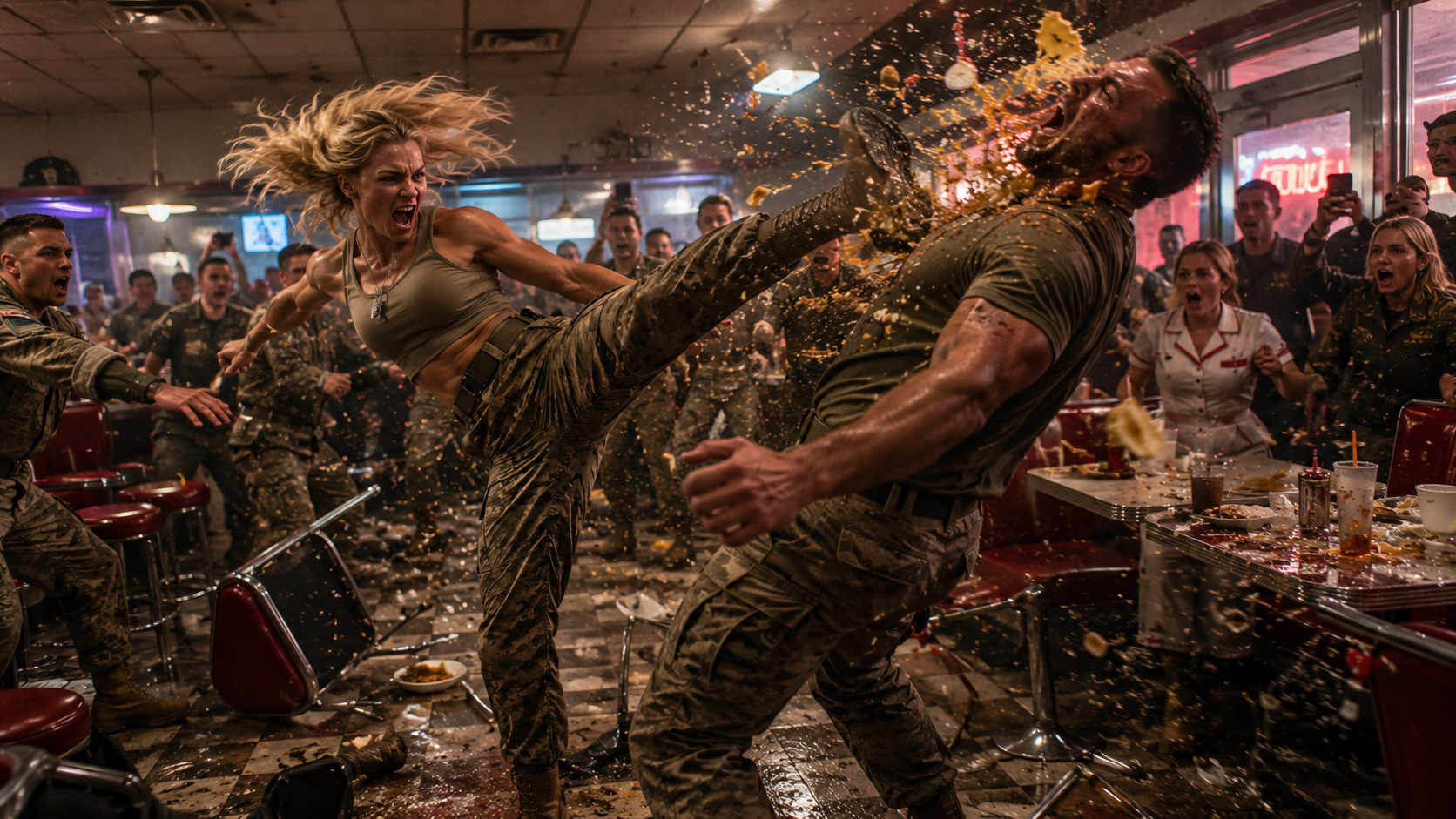
“You better learn your place, sweetheart.”
That was the very first thing this guy yelled, making sure the entire mess hall heard him. He was leaning over my table like he owned the building and every single person breathing inside of it.
I looked up from the classified folder I was reading. “My place?”
“Below men who actually earned respect,” he smirked.
You May Also Like
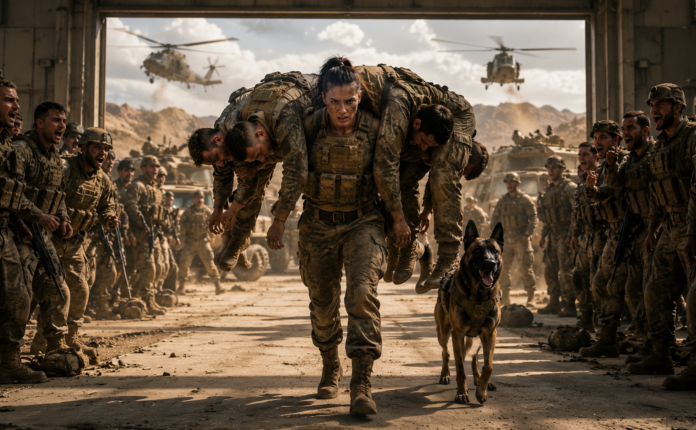
I was sitting by myself near the back wall, just going over personnel files under a plain gray folder. With my dark blazer, simple blouse, and my badge tucked away, I probably just looked like some random civilian contractor. No rank on my chest, no visible weapon. To a guy like Staff Sergeant Marcus “Tank” Rodriguez, I was an easy target.
This guy was famous on base—three deployments, Bronze Stars, a total special ops legend. He was a massive dude, six-foot-four and 240 pounds. He dragged a chair out from my table without even asking and sat down.
“You new here?” he asked.
When I didn’t answer, he tapped his fingers on my folder. “What’s that? Supply audit? Budget waste? Some little government checklist?”.
I closed the folder slowly. “Can I help you with something, Staff Sergeant?”.
“I’m Tank Rodriguez,” he puffed his chest. “Navy SEAL.”
“I didn’t ask.”.
A few soldiers at the next table literally froze with their forks halfway to their mouths. Rodriguez blinked, then let out this fake laugh because he needed everyone watching to think he was still in control. “She’s got attitude,” he announced to the room. “I like that.”.
“I’m working,” I told him.
“Well, I’m talking,” he leaned in closer.
“And I’m done listening.”
He went off on this whole bitter rant about how civilians walk onto the base with our little clearances, thinking we’re above them.
“I’m not looking down on you,” I said. “I’m observing you.”. “It means you’re loud, insecure, and escalating because a woman didn’t smile when you interrupted her.”.
He stood up so fast his chair screeched against the floor. The whole room locked in place. Nobody breathed.
“I know exactly who I’m talking to,” I told him before he could start his speech about Hell Week and his trident.
He slammed both hands onto the table. My tray jumped, and coffee spilled everywhere. He got right in my face and hissed about how he carried this country on his back.
“And yet,” I said quietly, “you still need validation from a stranger eating lunch.”.
His hand shot out and he grabbed my arm hard, his fingers digging right into my sleeve.
This was exactly the moment I had been waiting for.
“You have three seconds to let go.”.
He just smiled. “Or what? You’ll file a complaint?”.
“One.”.
“I’m a Navy SEAL.”.
I didn’t yell or panic. I just moved. I twisted my wrist, shifted my weight, broke his grip, and used his own pressure right back against him. He dropped down to one knee with a shocked grunt. The entire cafeteria inhaled at the exact same time.
I let him go and stepped back.
He staggered up, completely humiliated, his face twisted in rage. “You got lucky,” he spat.
“No,” I said. “You got warned.”.
And when he charged, the whole base saw who he really was.
PART 2 — THE CAMERA SAW EVERYTHING
“Touch me again, and your career ends before your lunch gets cold.”
I said it softly.
Rodriguez heard it.
The soldiers heard it.
The security cameras heard it.
But his ego heard something else.
Challenge.
He lunged.
The first swing came hard and wild, powered by rage more than training. I stepped aside and let his momentum carry him past me. He stumbled, caught himself, and turned back with disbelief flashing across his face.
He expected fear.
He found space.
He expected weakness.
He found timing.
He came at me again, faster this time, trying to recover the image he had lost in front of everyone.
I did not try to overpower him.
That would have been foolish.
I used distance.
Angles.
Balance.
The things men like Rodriguez forgot when they believed size was the same as strength.
His fist cut through the air near my shoulder.
I redirected it.
His boot swept low.
I stepped over it.
His hand reached for my jacket.
I turned his grab into another stumble.
He crashed into the edge of a table.
Trays clattered.
Coffee splashed.
A young private whispered, “Holy hell.”
Rodriguez heard that too.
It broke something in him.
His face became less human for a second. Not because he was evil in some cartoon way, but because pride can turn a man into a stranger to himself.
“I’m going to break you,” he said.
“No,” I answered. “You’re going to expose yourself.”
He roared and rushed me.
This time he forgot everything except humiliation.
That was his final mistake.
I stepped inside his reach, controlled his forward drive, and put him down cleanly.
Rodriguez hit the floor hard enough to silence the entire mess hall.
For one long second, nobody moved.
Then two military police officers entered through the side doors, followed by the lieutenant who had finally found his courage.
“Ma’am,” one MP said, hand near his sidearm. “Step away from him.”
I already had.
Rodriguez groaned on the floor, dazed and furious.
The lieutenant stared at me like he had just watched gravity break.
“Who are you?”
I reached into my jacket and pulled out my badge.
“Sarah Chen. Defense Intelligence Agency. Senior field operative.”
The MP’s expression changed instantly.
So did the room.
The fear did not disappear.
It moved.
Rodriguez pushed himself onto one elbow.
His eyes widened as the badge came into focus.
“No,” he whispered.
“Yes,” I said.
The lieutenant swallowed.
“Agent Chen, what exactly is happening here?”
“Staff Sergeant Rodriguez is under investigation for assault on a federal agent, conduct unbecoming, abuse of authority, and multiple potential violations under military law.”
Rodriguez’s face went pale.
“That’s not what happened.”
I looked at him.
“Then let’s watch what happened.”
I turned toward the large television mounted above the announcements board. A few taps on my phone connected the security feed.
The screen flickered.
Then the entire mess hall watched the last thirty minutes unfold in brutal clarity.
Me sitting alone.
Rodriguez approaching.
Rodriguez sitting without permission.
Rodriguez escalating.
Rodriguez mocking.
Rodriguez grabbing my arm.
Rodriguez attacking.
Me warning him.
Me defending myself.
No shouting from me.
No provocation.
No trap.
Just a man with power making the same decision he had clearly made before.
By the time the footage ended, the silence had weight.
Rodriguez stared at the blank screen.
His mouth opened.
Closed.
Opened again.
“I was angry,” he said.
“That is not a defense,” I replied.
“You disrespected me.”
“No. I failed to worship you.”
A few soldiers looked down at their trays.
They knew.
I could see it in their faces.
Some had seen Rodriguez do this before.
Some had laughed along.
Some had stayed quiet because silence felt safer.
Some had reported him and been taught that truth was less valuable than reputation.
Rodriguez pushed himself upright.
“I’m a SEAL,” he said, voice cracking. “That has to mean something.”
“It does,” I said. “It means you were held to a higher standard. You failed to meet it.”
The MP helped him stand.
His legs shook.
That humiliated him more than anything.
Not the charges.
Not the badge.
The weakness.
He looked around the room, desperate for rescue.
No one came.
Then a female lance corporal stood.
Her hands trembled, but her voice was clear.
“He did the same thing to me six months ago.”
Every head turned.
Rodriguez froze.
The young woman swallowed hard.
“My name is Jennifer Martinez. He cornered me near the supply room after evening formation. I told him no. He grabbed my wrist and said women like me needed to learn gratitude. I reported it.”
She looked at the officers.
“Nothing happened.”
A male corporal stood next.
“He threatened my sister when she worked in the kitchen two years ago. She transferred because of him.”
Another voice.
“He told me he’d ruin my promotion packet if I ever embarrassed him in training again.”
Another.
“He stole my mission planning work and told me I should be thankful he let me be near his team.”
Then another.
And another.
And another.
Stories rose from the room like smoke from a building everyone had pretended was not burning.
Seventeen names in twenty minutes.
Seventeen incidents.
Five years.
Rodriguez stood between two MPs while his legend dissolved in real time.
I opened a secure note on my phone and began taking names.
Dates.
Witnesses.
Locations.
The room that had feared him became the room that documented him.
Rodriguez shook his head.
“You’re all lying.”
Martinez’s eyes flashed.
“No. We were all silent.”
That sentence hit harder than any takedown.
The MP tightened his grip on Rodriguez’s arm.
“Staff Sergeant, we need to go.”
Rodriguez looked at me one last time.
“This isn’t over.”
Before I could answer, several phones buzzed across the mess hall at almost the same time.
Martinez looked down at hers.
Her face drained of color.
I saw the message before she even turned the screen toward me.
Unknown Number:
Stay quiet. Tank has powerful friends. Watch your back.
Three other soldiers received similar texts.
One said:
Remember where your loyalty belongs.
Another said:
Witnesses can forget.
The mess hall shifted from shock to fear.
Then a voice from the back said, “They’re not threats. They’re reminders.”
Lieutenant Brad Coulson stood slowly from a table near the rear wall.
He wore the same trident.
The same arrogance.
The same rotten confidence.
He smiled at Martinez.
“Some of you should think carefully before ruining a good man over a misunderstanding.”
I looked at him and felt the case widen under my feet.
Because Tank Rodriguez had not been protected by luck.
He had been protected by people.
And one of them had just spoken in front of everyone.
PART 3 — THE COVER-UP STARTED BEFORE THE BLOOD DRIED
“Lieutenant Coulson, did you just threaten witnesses in a federal investigation?”
The room turned toward him.
Coulson’s smile did not leave, but it hardened.
“I expressed concern about loyalty.”
“No,” I said. “You expressed obstruction.”
He laughed once.
“You people love big words.”
“You people?”
“Investigators. Bureaucrats. Civilians who think paperwork gives them the right to dismantle brotherhood.”
I stepped closer.
“Brotherhood is not a license to protect abusers.”
Coulson’s eyes cut toward Martinez.
“She couldn’t handle rough attention. That doesn’t make Rodriguez a criminal.”
Martinez flinched.
That was all I needed to see.
Not because I needed proof of her fear.
Because I needed proof of his comfort with causing it.
I lifted my phone.
“Base security is already tracing the threatening messages. Cellular data puts several of them inside this room.”
For the first time, Coulson’s face changed.
Just a flicker.
But enough.
“You’re bluffing.”
“Try me.”
He looked toward the two other SEALs at his table.
One stood.
Walked away.
Then the other.
Coulson was alone before the MPs reached him.
The room understood the meaning of that.
Even predators recognize when the pack has started running.
Sergeant Williams, the same MP who had helped escort Rodriguez out, approached Coulson with disappointment written across his face.
“Sir, I need you to come with us.”
Coulson jerked his arm away.
“For what? Telling the truth?”
“For witness intimidation.”
“This is a witch hunt.”
“No,” I said. “This is what happens when men who thought they owned the system discover the system kept receipts.”
Coulson’s face went red.
“You hate us because we’re better than you.”
“No. I’m investigating you because you keep proving you think that.”
He pointed around the mess hall.
“You all think she’s saving you? She’s using you. She came here to take down special operations.”
A young petty officer stood near the coffee station.
“I’m trying to become a SEAL,” he said. “And if becoming one means protecting guys like you, then maybe the problem is bigger than one man.”
Coulson looked like he had been punched.
The MPs took him by both arms.
He shouted as they led him out.
“How many of us are you going to destroy?”
I answered without raising my voice.
“As many as necessary.”
The doors closed behind him.
Nobody cheered.
This was not victory yet.
This was the moment everyone realized the monster had roots.
My phone rang.
Base security.
I stepped outside into the North Carolina heat, answered, listened, and felt my jaw tighten.
Someone had attempted to access the secure server where mess hall footage was stored.
Stolen credentials.
Administrative-level access.
Targeted deletion attempt.
They failed only because I had ordered redundant backups before I ever entered the cafeteria.
I walked back inside.
Every face turned toward me.
“This has expanded,” I said. “Someone just tried to delete the footage.”
The mess hall erupted.
Martinez grabbed the edge of her chair.
“They’re going to come after us.”
“Yes,” I said. “That is possible.”
The honesty made several soldiers go pale.
“But they already came after you,” I continued. “The difference is, now you are not alone.”
The female sergeant beside Martinez stood.
“Then we document everything.”
“Yes.”
“Texts. Calls. Emails. Hallway conversations.”
“Yes.”
“Retaliation.”
“Especially retaliation.”
A gunnery sergeant near the back raised his hand.
“I’ve been here fifteen years. I know where some bodies are buried.”
The room turned.
He leaned forward.
“Not literal bodies. Complaints. Transfers. Promotion packets that mysteriously died after people crossed Rodriguez’s circle.”
I nodded.
“Tomorrow morning, I open formal interviews.”
“Will it matter?” he asked. “Because I’ve seen this base protect men like him before.”
“It will matter if the evidence becomes too heavy to bury.”
He studied me.
“And can you make it that heavy?”
“I intend to.”
That was when the mess hall doors flew open.
A woman stormed in wearing jeans, a navy sweater, and the kind of grief that had sharpened itself into rage.
Tank Rodriguez’s wife.
I recognized her from his file.
Emily Rodriguez.
Married fifteen years.
Two daughters.
Church volunteer.
School board fundraiser.
The kind of woman who had spent half her adult life smiling through deployments, rumors, missed birthdays, Thanksgiving dinners with an empty chair, and late-night calls from hospitals overseas.
She pointed straight at Martinez.
“You.”
Martinez froze.
Emily’s voice cracked.
“You destroyed my family.”
The master sergeant stepped between them.
“Mrs. Rodriguez, you need to calm down.”
“Don’t tell me to calm down. My husband is being treated like a criminal because she couldn’t handle attention.”
Martinez stood slowly.
“Your husband grabbed me.”
“He’s a hero.”
“He can be a hero and still have hurt people.”
Emily shook her head like the sentence physically hurt.
“You don’t know what he’s been through. Combat changes men.”
The gunnery sergeant’s voice cut through the room.
“I’ve done three combat tours. I have nightmares too. I never used them as permission to terrorize my subordinates.”
Emily staggered like her legs had lost certainty.
“How many?” she whispered.
Martinez looked at me.
I did not answer for her.
She turned back to Emily.
“Seventeen so far.”
Emily’s lips parted.
“No.”
“Yes.”
“No. That’s not possible.”
The cafeteria stayed silent.
No one mocked her.
No one comforted her with lies.
The truth was cruel enough.
Emily sank into a chair.
Her face collapsed into her hands.
“My daughters,” she whispered. “What am I supposed to tell my daughters?”
Martinez surprised everyone.
She walked around the master sergeant and sat near her.
Not close enough to touch.
Close enough not to abandon.
“You tell them the truth,” Martinez said.
Emily looked up, stunned.
“You hate him.”
“I hate what he did. But your daughters didn’t do it.”
Emily’s eyes filled.
“I don’t know who he is anymore.”
“Maybe you’re finally seeing all of him.”
That sentence broke something open in the room.
Not loud.
Not dramatic.
Worse.
Real.
Emily stood a few minutes later, emptied of anger.
Before leaving, she looked at Martinez.
“When you give your statement, will you tell only the truth?”
Martinez held her gaze.
“That’s all I ever told.”
Emily nodded once.
Then she walked out like a woman carrying a house fire inside her chest.
I had barely turned away when my phone rang again.
This time, the call came from inside legal command.
I listened.
The room watched me.
When I hung up, the master sergeant asked, “What now?”
“Rodriguez has counsel.”
“Who?”
“Commander Patricia Hayes.”
His face went white.
Senior JAG officer.
Brilliant.
Feared.
Connected.
The kind of lawyer powerful men called before they called their wives.
“She already filed a motion,” I said.
“On what grounds?” Martinez asked.
“Entrapment.”
The room exploded.
I raised one hand.
“Listen carefully. This is how power fights back. First intimidation. Then evidence destruction. Then legal reversal. They will try to make Rodriguez the victim and me the villain.”
Martinez looked sick.
“Can they win?”
I looked around the mess hall at the soldiers who had just decided whether courage was worth the cost.
“They can only win if the truth gets scattered.”
Then my phone buzzed again.
A secure message.
I opened it.
Three words appeared from an unknown internal address.
CHECK HAYES’S FILES.
Attached below them was a document.
A sealed complaint.
Filed eighteen months earlier.
Against Commander Patricia Hayes herself.
For burying misconduct reports connected to special operations personnel.
The cover-up was not defending Rodriguez.
It had created him.
And now we finally had a name near the top.
“Commander Hayes buried the first complaint before Rodriguez ever touched Martinez.”
I said it in a closed interview room the next morning.
Across from me sat the base commander, two federal investigators, a military judge advocate from outside Camp Lejeune, and Commander Patricia Hayes herself.
Hayes did not blink.
She was polished.
Silver hair cut to her jaw.
Uniform perfect.
Voice smooth as glass.
“Agent Chen, that accusation is reckless.”
“No,” I said. “It’s documented.”
I placed the file on the table.
Eighteen months of complaint logs.
Transfer requests.
Witness statements marked “unsubstantiated” despite corroboration.
One promotion packet delayed after a soldier reported Rodriguez.
One kitchen worker reassigned within forty-eight hours of writing a statement.
One female lance corporal told to “toughen up.”
Martinez.
Hayes glanced at the folder like it was beneath her.
“You received stolen documents.”
“I received whistleblower evidence.”
“Evidence obtained improperly.”
“Then explain why your signature appears on five suppressed misconduct reviews.”
The room went cold.
Hayes’s mouth tightened.
The base commander looked at her.
“Patricia?”
She did not answer quickly enough.
That was the first crack.
I slid another page forward.
“And explain why, six minutes after Rodriguez was detained, your office contacted three potential witnesses before my team had formally identified them.”
Hayes looked at me.
Not like a lawyer now.
Like an enemy.
“You are reaching beyond your authority.”
“I’m following the obstruction.”
“You are attacking decorated service members.”
“I’m exposing people who used decoration as camouflage.”
Her eyes narrowed.
“You have no idea what kind of damage you are doing.”
“I know exactly what kind. The kind that lets clean air into a rotten room.”
The outside JAG officer opened the folder.
His expression changed as he read.
Then changed again.
By noon, Hayes’s motion to dismiss was denied.
By two o’clock, she was removed from Rodriguez’s defense.
By four o’clock, a federal review team had sealed her office.
By sunset, Camp Lejeune was no longer whispering about the woman who dropped Tank Rodriguez in the mess hall.
It was talking about the list.
The list had names.
Rodriguez.
Coulson.
Hayes.
Two senior enlisted leaders.
One cyber specialist who had used stolen credentials to try deleting footage.
Three officers who had marked complaints closed without interviewing witnesses.
One administrative clerk who had altered dates on transfer paperwork.
Powerful friends.
Just like the texts had promised.
But power has a weakness.
It leaves fingerprints.
The hearings began three weeks later.
Rodriguez entered the courtroom in dress uniform, shoulders stiff, face pale. The swagger was gone. He looked smaller without the mess hall silence protecting him.
Emily sat behind him with their daughters.
She did not smile.
She did not wave.
She held the girls’ hands and stared straight ahead.
Martinez testified first.
Her voice shook at the beginning.
Then steadied.
She told the truth.
Not more.
Not less.
That made it stronger.
Davies testified.
The cook’s brother testified.
The gunnery sergeant testified.
The petty officer testified.
One after another, they built the pattern Hayes had tried to bury.
Then the video played.
The courtroom watched Rodriguez approach me.
They watched him mock me.
Grab me.
Threaten me.
Attack me.
They watched him fall.
Rodriguez closed his eyes during that part.
Not from pain.
From shame.
When it ended, his new attorney argued stress.
Trauma.
Combat burden.
A decorated career.
Then the prosecutor stood and said something no one forgot.
“Service explains sacrifice. It does not excuse abuse.”
Rodriguez took a plea before the court-martial fully opened.
Dishonorable discharge.
Loss of rank.
Loss of pension eligibility pending final review.
Confinement.
Mandatory psychological evaluation.
Permanent removal from special operations command.
For a man who had built his identity on being untouchable, it was worse than prison.
It was erasure.
Coulson went next.
Witness intimidation.
Obstruction.
Conduct unbecoming.
His career ended in less than ten minutes because his own text logs betrayed him.
The cyber specialist tried to claim he had been “protecting sensitive material.”
The server logs disagreed.
Hayes fought the longest.
People like her always do.
She knew procedure.
She knew language.
She knew how to turn guilt into paperwork.
But she did not know what to do with a room full of witnesses who were no longer afraid.
Her resignation came two months later.
Her law license review followed.
Her reputation did not survive the week.
The base changed slowly after that.
Not magically.
Real life does not heal like movies.
But complaint channels were reviewed.
Outside oversight came in.
Commanders were transferred.
Training changed.
Anonymous reporting became real.
And the mess hall where Rodriguez had fallen became something like a landmark.
New soldiers heard the story before they learned where the good coffee was.
Not because I had won a fight.
Because someone had finally lost the protection of silence.
Three months after the hearing, I returned to Camp Lejeune for a final debrief.
I stopped at a small diner outside the gate before leaving town.
American flag by the door.
Coffee too strong.
Pie under glass.
Rain ticking against the window.
Martinez walked in wearing civilian clothes.
She had taken weekend leave to meet her mother.
She saw me and smiled.
Not brightly.
Not easily.
But honestly.
“Agent Chen.”
“Lance Corporal.”
She sat across from me.
For a minute, neither of us talked.
Then she said, “I almost didn’t testify.”
“I know.”
“I was scared every second.”
“That’s usually how courage feels.”
She looked out at the wet parking lot.
“I got promoted.”
I smiled.
“Good.”
“And Rodriguez’s wife wrote me a letter.”
That surprised me.
“What did it say?”
Martinez pulled an envelope from her jacket but did not hand it to me.
“She said she told her daughters the truth. Not all the details. Enough. She said the older one asked if being strong meant never being wrong.”
Her voice softened.
“She told her no. Being strong means admitting when you are.”
I looked down at my coffee.
For the first time in months, the anger in the case felt quiet.
Not gone.
Just quieter.
Martinez folded the letter carefully.
“Do you think he’ll change?”
“Rodriguez?”
She nodded.
“I don’t know.”
“That’s honest.”
“It’s all I have.”
She stood to leave, then paused.
“Why did you really sit alone that day?”
I looked at her.
“Because men like Rodriguez reveal themselves faster when they think nobody important is watching.”
Martinez smiled faintly.
“But you were important.”
“No,” I said. “The cameras were important. The witnesses were important. You were important.”
She swallowed.
Then nodded once.
After she left, I paid the check and walked outside into the rain.
Across the road, the base gates stood under floodlights.
Beyond them were thousands of soldiers, most of them honorable, tired, brave, imperfect people trying to serve something bigger than themselves.
And somewhere inside those gates, a story had changed.
Not the story of a woman who took down a Navy SEAL.
That was too simple.
The real story was about a man who believed fear was respect.
A system that confused silence with loyalty.
A room full of people who finally understood the difference.
I got into my car, placed the final report on the passenger seat, and drove away from Camp Lejeune without looking back.
Rodriguez had demanded I learn my place.
In the end, he learned his.
And mine was never below him.
THE END.